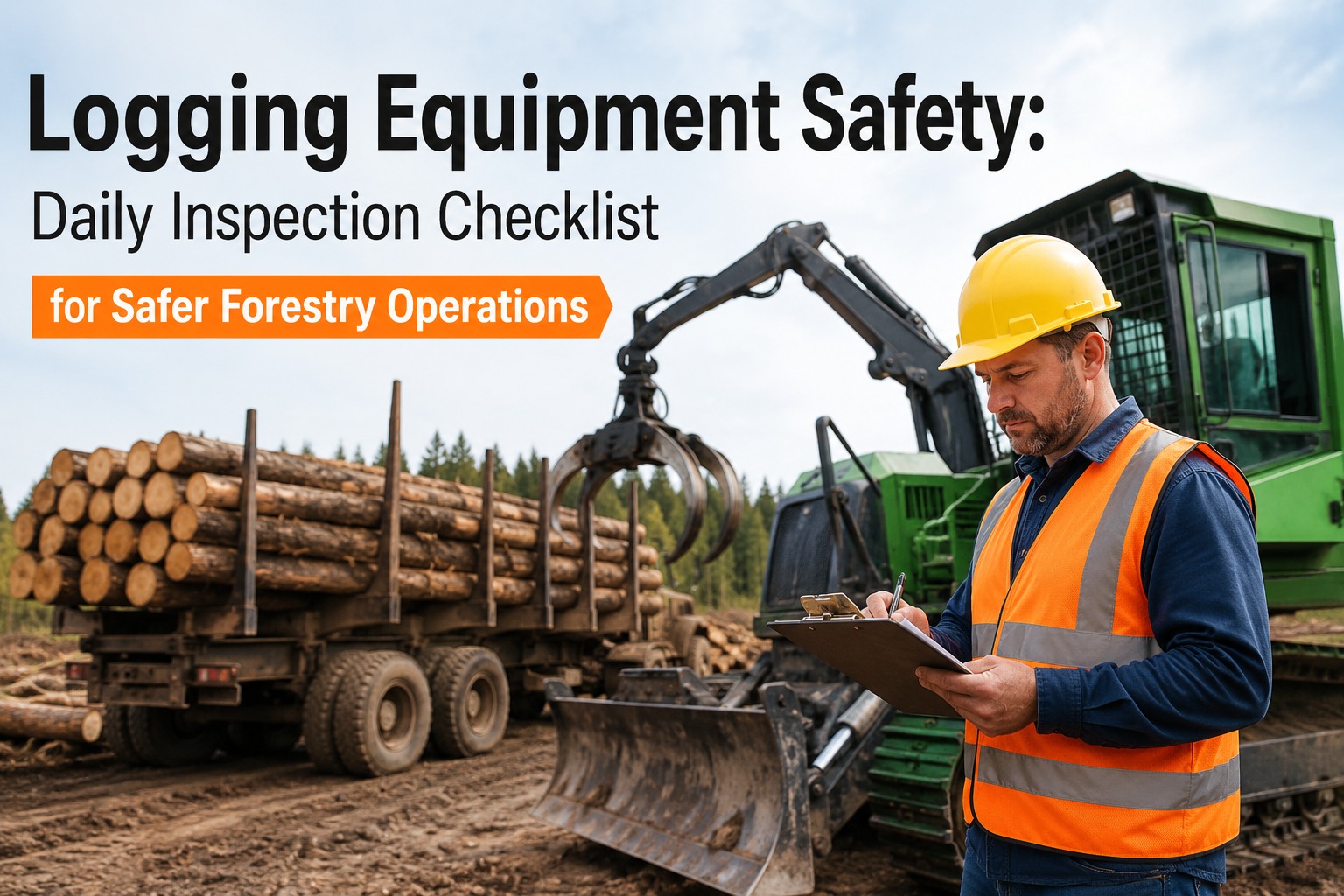
Logging has been the deadliest occupation in the United States for most of the last three decades. The U.S. Bureau of Labor Statistics puts the national occupational fatality rate at roughly 3.4 deaths per 100,000 workers; logging runs at 136 per 100,000 — roughly 30 times the national average and the highest rate of any tracked occupation. Since 2000, more than 1,700 logging employees have lost their lives on the job, and over 60% of those deaths involved timber fallers and the heavy equipment that feeds the landing: feller bunchers, skidders, processors, and log loaders. The machinery is the variable. Every one of those machines runs on high-pressure hydraulics, sharp cutting chain, hot exhaust, and components under extreme cyclic load — and every one of them is required by OSHA 29 CFR 1910.266 to be inspected before each shift before it moves a single tree. The cheapest, most reliable defense against the next fatality is a 7-minute pre-start inspection that catches the cracked hose, the worn grapple, or the frayed winch cable before the operator climbs in. HVI's logging equipment inspection & maintenance software, built specifically for remote forestry work, turns that 7-minute check into an offline-capable, photo-documented, audit-ready habit — and automatically routes every flagged defect into a maintenance workflow so it actually gets fixed. This page breaks down the 5-point inspection framework, the hazard-to-check matrix, the pre-shift decision flow, and the cadence that keeps every machine on the landing safe to operate.
- $20/min in lost production per blown hose on a remote landing
- $16,131 per OSHA serious violation (2024 penalty, adjusted)
- $161,323 per willful or repeated OSHA violation
- 30× the national average fatality rate for logging workers
- 2–3× higher repair costs when failure cascades from a missed defect
What's at Stake — Three Ways a Missed Check Hurts
A skipped daily inspection doesn't just create one risk — it creates three simultaneous exposures that compound on each other. The operator's life, the equipment's value, and the contractor's compliance posture all take a hit from the same missed hose or worn pin. Here's how each one breaks down — and why starting a free HVI trial is the fastest way to close the gap.
The Human Cost
Logging kills at 136 deaths per 100,000 workers — the highest rate of any U.S. occupation. Over 60% of fatalities since 2000 involve timber fallers and heavy equipment operators. A missed pin, frayed cable, or failing brake is the difference between an operator going home and not.
The Asset Cost
A modern feller buncher or processor carries a $300K–$700K price tag. A single blown hose on a remote site costs about $20 per minute in lost production, and reactive repairs run 2–3× what preventive care costs — because a failing part cascades into adjacent components before the machine stops.
The Legal Cost
OSHA 29 CFR 1910.266 requires inspection before every shift. After an incident, the inspector requests the last 30 days of records — immediately. Missing or pencil-whipped checklists shift liability squarely onto the contractor, and a serious violation carries a $16,131 penalty in 2024.
The 5-Point Daily Inspection Pentagon
A complete pre-shift inspection isn't a random list — it's a structured framework built around the five systems that fail most often and cause the most damage when they do. Walk each point in order, every shift, on every machine. The center of the pentagon is the operator: every check exists to protect the person in the cab. Schedule a 30-minute demo to see how HVI's software turns this 5-point framework into a 7-minute phone-guided walk-around your operators will actually complete.
SAFETY
Powertrain & Fluids
Engine oil, coolant, hydraulic fluid, fuel, belts. Catch a low-fluid reading before a $200K engine destroys itself on a remote landing.
Hydraulics & Hoses
Hoses, fittings, cylinders, pressure gauges. The #1 cause of unplanned forestry downtime — a single blown hose is $20/min in lost production.
Cutting & Holding Head
Saw chain, feed rollers, delimbing knives, grapple jaws. The business end — a worn component here is the direct link to severe injury.
Cab, ROPS & Controls
FOPS/ROPS integrity, glass, seat belt, horn, e-stop. The operator's last line of defense — and an OSHA inspector's first stop after an incident.
Undercarriage & Brakes
Tracks or tires, brake function, lights, strobe, backup alarm. Slopes and limited visibility make each one life-critical on a logging site.
The Hazard → Check Matrix
Different defects cause different hazards — and the daily inspection exists to break the chain between them. This matrix maps the most common logging-equipment hazards to the inspection points that catch them. If a hazard has shown up on your site, this is where to focus the next morning's check — and signing up for HVI lets you tag each hazard to the exact inspection point that catches it, so no shift ever misses the critical check.
Powertrain
Hydraulics
Cutting Head
Cab/ROPS
Undercarr.
The Pre-Shift Decision Flow — Can This Machine Work Today?
A daily inspection isn't complete until it produces a decision: this machine goes to work, or it doesn't. This flowchart is what every operator should run through mentally (and what HVI's inspection software enforces automatically) before the engine starts — the software won't unlock the machine for the shift until every question resolves to a green path. If any answer points right, the machine stays parked until maintenance clears it.
Inspection Cadence — What Gets Checked, and When
The daily pre-shift check is the foundation, but it sits inside a larger cadence of inspections that range from every-shift to annual. Each layer catches a different class of defect — and skipping any layer leaves a gap. Here's the full inspection rhythm for a logging fleet, and a quick demo of HVI will show you how each cadence level is automated, scheduled, and audit-ready inside one platform.
- 5-point pentagon walk-around
- Operational test (brakes, steering, horn)
- Fluid levels & visible leaks
- Cutting head / grapple condition
- Cab, ROPS, seat belt, e-stop
- Review week's defect reports
- Verify all defects were closed
- Spot-observe an operator check
- Confirm PM schedule on track
- Sign weekly compliance summary
- Engine-hour-based PM service
- Hydraulic fluid & filter sample
- Track tension / tire rotation
- Boom wear pad measurement
- Cutting chain / shear replacement
- ROPS/FOPS certification
- Full hydraulic pressure test
- Electrical & harness inspection
- Operator training recertification
- OSHA 1910.266 records audit
Paper Checklist vs. Digital Inspection — On a Remote Landing
The reason paper checklists fail in forestry isn't carelessness — it's that the work happens where paper doesn't survive and the office can't reach. Here's how a digital inspection changes the equation, point by point — and why contractors who start a free HVI trial typically retire their paper binders within the first week.
- Defects noted at 6 AM reach the mechanic at end of shift
- No signal, no photos — the office is blind all day
- 7.5% of records lost, illegible, or back-filled later
- Pencil-whipped checks become the norm under pressure
- 30 days of records = a binder hunt when OSHA arrives
- Engine hours logged inconsistently — PM drifts
- Defects photograph and route to mechanic instantly
- Works offline on remote landings, syncs when signal returns
- Required fields enforced — no blank or back-filled checks
- GPS + timestamp on every check proves where and when
- 30 days of records exportable per machine in one click
- Engine hours feed PM scheduling automatically
How HVI's Inspection & Maintenance Software Runs in the Woods
Inspection and maintenance software is only useful in forestry if it works where the work happens — remote landings, steep terrain, intermittent cell service. HVI was built for exactly that environment: a single platform that handles the daily inspection on the operator's phone, the defect workflow in the mechanic's queue, and the compliance records in the contractor's office. Here's the daily loop on a real logging operation.
Open & Inspect Offline
Operator opens the HVI inspection app on a phone at the landing. No signal required — the checklist, machine history, and last defect notes are already on the device. Walks the 5-point pentagon, taps each item, snaps a photo of anything flagged. The software logs the operator, the timestamp, and the GPS location automatically.
Photograph & Route the Defect
Any defect is photographed on the spot, severity-tagged, and tied to the specific machine in the HVI maintenance module. The software automatically creates a work order, flags the machine out-of-service, and notifies the mechanic — no operator override, no "I'll run it one more shift."
Sync, Repair & Close the Loop
When signal returns, the check syncs to the cloud with GPS and timestamp. The mechanic completes the repair in HVI's maintenance module, attaches parts and labor, and closes the work order; the office sees every machine's status in real time. The next shift opens a machine with a clean, verified history and a complete maintenance trail.
Prove Compliance in One Click
When OSHA asks for the last 30 days of inspection records after an incident, the contractor exports a complete, audit-ready report per machine — inspections, defects, repairs, and sign-offs — in a single click from HVI's software. No binder hunt, no scrambling, no reconstruction from memory.
Catch the $80 Fix Before It Becomes a $50,000 Problem
HVI is inspection & maintenance software built for the realities of logging. The operator runs the OSHA-required daily check on a phone that works offline on remote landings; every defect is photographed, auto-routed to the mechanic as a work order, and locked out until the repair is closed. Every check is GPS-stamped and stored in the cloud, so when OSHA asks for 30 days of records you export them in one click. Cut unplanned downtime, extend machine life, and give every operator the safest possible start to the shift. Trusted by 25,000+ users worldwide.



.png)