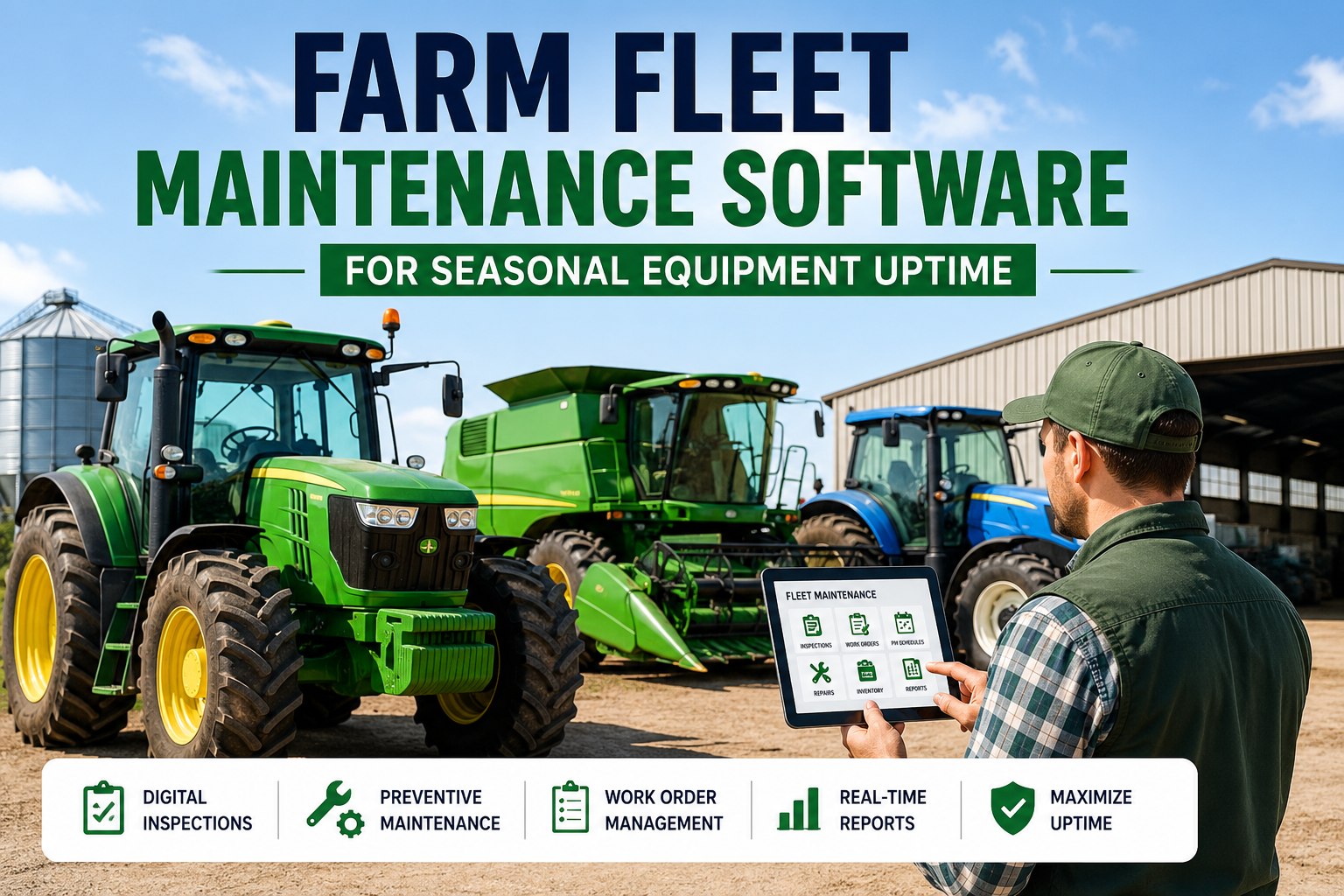
Farm Fleet Maintenance Software for Seasonal Equipment Uptime
By Ava Phillips on June 19, 2026
Farm equipment lives a feast-or-famine life unlike anything else in the fleet world. A combine might run flat-out for three intense weeks at harvest and then sit in a shed for eleven months. A planter works a tight window in spring and is idle the rest of the year. Sprayers, balers, grain carts, and tillage rigs each have their own short season of furious use bracketed by long stretches of storage. This rhythm creates a maintenance problem that calendar-based programs handle badly: the cost of downtime isn't constant — it spikes catastrophically during the season. A combine that breaks down in July, mid-harvest, isn't just a repair bill; it's grain left standing while weather closes in, a custom-harvest deadline missed, a whole year's revenue at risk on a few critical days. And the equipment most likely to fail is precisely the equipment that just woke up from months of storage — seals dried out, rodents in the wiring, fluids degraded, batteries dead. The fix is a maintenance program built around the season: thorough pre-season readiness, in-season uptime discipline, and proper post-season storage prep. Farm fleet maintenance software turns that seasonal cycle into a tracked, repeatable program so equipment is ready when the window opens. This guide covers the seasonal cycle, the three phases, and the workflow that keeps machines running when it counts.
A Combine Down at Harvest Isn't a Repair Bill — It's a Year's Revenue at Risk
HVI builds farm equipment around the season — pre-season readiness checks before the window opens, in-season daily inspections and fast defect-to-work-order routing during the crunch, and post-season storage prep — so the combine, planter, and sprayer run when the few days that matter arrive.
Why Farm Equipment Is Different: The Seasonal Curve
Most fleets run steadily year-round. Farm equipment doesn't — and that changes everything about how it should be maintained. The cost of a breakdown rises and falls with the calendar.
OFF-SEASON
Idle
Stored for months. Downtime cost near zero — but storage damage accumulates silently: dried seals, rodents, degraded fluids, dead batteries.
PRE-SEASON
Ramp-up
The window approaches. This is the time to find and fix what storage broke — before the machine is needed, while there's still slack to repair.
IN-SEASON
Critical
Running flat-out in a narrow window. Downtime cost spikes to catastrophic — every hour down is grain at risk and a deadline slipping.
The insight that drives everything: because downtime cost concentrates into a few critical weeks, the goal isn't year-round uptime — it's guaranteed uptime during the window. That means front-loading the work into pre-season readiness, when a found defect is a cheap, unhurried fix instead of a harvest-stopping emergency.
The Three-Phase Seasonal Program
A farm maintenance program isn't one schedule — it's three distinct phases timed to the crop calendar, each with a different job. Get all three right and the equipment is ready when it matters.
PHASE 1 · PRE-SEASON
Readiness
Weeks before the window, do a thorough shakedown of every machine coming out of storage — the highest-leverage work in the whole cycle.
Full inspection of stored equipment
Fluids, filters, belts, and battery service
Check for rodent damage & dried seals
Test-run and fix defects with time to spare
PHASE 2 · IN-SEASON
Uptime
During the crunch, the goal is keeping running machines running — fast daily checks and even faster defect resolution.
Quick daily operator inspections
Defects routed to repair immediately
Priority parts on hand for fast-movers
Minimize every hour of downtime
PHASE 3 · POST-SEASON
Storage Prep
When the season ends, prep each machine for months of idle storage — what you do now prevents next year's pre-season scramble.
Clean, lubricate, and treat against corrosion
Stabilize fuel, tend or remove batteries
Seal against rodents and moisture
Log deferred repairs for the off-season
The phases compound: good post-season storage prep makes pre-season readiness faster, and thorough pre-season readiness makes in-season breakdowns rare. Skip storage prep and you pay for it twice — in spring and in the field. sign up for a free HVI trial and run the full seasonal cycle.
Pre-Season Is Where Uptime Is Won
If a farm gets only one phase right, it should be pre-season readiness — because that's where a defect can be caught for the cost of a part and an afternoon instead of a lost harvest day. These are what storage breaks.
Degraded Fluids
Oil, coolant, hydraulic fluid, and fuel degrade or absorb moisture over months idle. Change and check before the first run.
Dead Batteries
Batteries discharge and sulfate in storage. Test, charge, or replace — a dead battery on day one of harvest is an avoidable delay.
Rodent & Pest Damage
Mice chew wiring and nest in headers and cabs over winter. Inspect harnesses, belts, and intakes for chew damage and nests.
Dried & Cracked Seals
Rubber seals, hoses, and belts dry and crack when idle. A hydraulic seal that fails mid-field is a tow; caught in the shed it's a part.
Flat-Spotted Tires
Tires lose pressure and flat-spot sitting in one place for months. Check pressure and condition before the machine carries a load.
Wear From Last Season
Deferred repairs logged at season's end get fixed now. The worn part you noted in October is the breakdown you prevent in July.
Every one of these is cheap and unhurried to fix in the pre-season shed and catastrophic to discover mid-harvest. The whole strategy is to move the work earlier, where time is on your side. schedule a live demo to see pre-season readiness checklists.
The Workflow Across the Season
Software ties the three phases into one continuous record so nothing resets each year. The same loop runs in every phase — only the intensity changes.
1
Inspect
A phase-appropriate check — deep pre-season shakedown, fast in-season daily, or storage prep — run on a phone with photos.
2
Route & Fix
Defects become work orders — fixed unhurried in pre-season, fixed fast in-season — with deferred items logged for the off-season.
3
Record Carries Over
Every inspection and repair logs to the machine's history, so this year's deferred note is next year's pre-season task — nothing forgotten.
Be Ready When the Window Opens
Pre-season readiness checklists for equipment coming out of storage, fast in-season daily inspections with immediate defect-to-work-order routing, post-season storage-prep tracking, usage-based PM, and a continuous per-machine record that carries from one season to the next — built for combines, planters, sprayers, balers, and the whole farm fleet. Run when the few days that matter arrive. Trusted by 25,000+ users worldwide.
Why does farm equipment need a different maintenance approach?
Because its usage is seasonal rather than steady. A combine, planter, or sprayer runs flat-out for a few intense weeks during its season and then sits idle for months, which means the cost of a breakdown isn't constant — it spikes catastrophically during the narrow operating window. A machine down mid-harvest can mean grain left standing, missed deadlines, and a year's revenue at risk on a few critical days. On top of that, the equipment most likely to fail is the equipment just coming out of long storage, with dried seals, rodent damage, degraded fluids, and dead batteries. A program built around the seasonal cycle — pre-season, in-season, post-season — handles this far better than a flat calendar schedule. Sign up for a free HVI trial for seasonal maintenance.
What should pre-season equipment readiness cover?
A thorough shakedown of every machine coming out of storage, weeks before the window opens, while there's still time to fix what you find. Cover the things storage breaks: change and check degraded fluids (oil, coolant, hydraulic fluid, fuel that may have absorbed moisture), test and charge or replace batteries that discharged over the idle months, inspect wiring harnesses and intakes for rodent damage and nests, check rubber seals, hoses, and belts for drying and cracking, verify tire pressure and look for flat-spotting, and complete any repairs that were deferred at the end of last season. Then test-run the machine so any remaining issue surfaces in the shed, not in the field. Schedule a demo to see readiness checklists.
How do you minimize downtime during harvest or planting?
The biggest lever is pre-season: most in-season breakdowns are preventable problems that a thorough readiness check would have caught when there was time to fix them unhurried. During the season itself, the focus shifts to speed — quick daily operator inspections to catch developing issues early, defects routed to repair immediately rather than waiting, and priority parts kept on hand for the fast-moving failure points so a repair isn't stalled waiting on a back-order. The goal in-season isn't deep maintenance; it's keeping running machines running and resolving any stoppage in hours, not days, because every hour down during the window is disproportionately costly. Sign up for a free HVI trial to minimize season downtime.
Why does post-season storage prep matter so much?
Because what you do at season's end determines how much storage damage you face next spring — and storage damage is the leading cause of pre-season failures. Proper post-season prep includes cleaning the machine and treating it against corrosion, lubricating components, stabilizing fuel and tending or removing batteries, and sealing the equipment against rodents and moisture before it goes into the shed. Critically, it also means logging the repairs you noticed during the season but deferred, so they're queued for the off-season rather than forgotten. Good storage prep makes the next pre-season readiness pass faster and cheaper — skip it and you pay twice, in a harder spring shakedown and more in-field failures. Schedule a demo to track storage prep.
How does software help a seasonal farm fleet?
By turning the seasonal cycle into a continuous, tracked program instead of relying on memory each year. Software runs phase-appropriate inspections — a deep pre-season shakedown, fast in-season daily checks, and post-season storage prep — routes any defect to a work order, and schedules PM by actual usage hours rather than a calendar that doesn't fit seasonal machines. Most importantly, it keeps a continuous per-machine record, so a repair you deferred in October automatically becomes a pre-season task in spring and nothing falls through between seasons. It also builds the cost and reliability history that informs when a high-value machine like a combine is worth repairing versus replacing. Sign up for a free HVI trial to run the cycle.