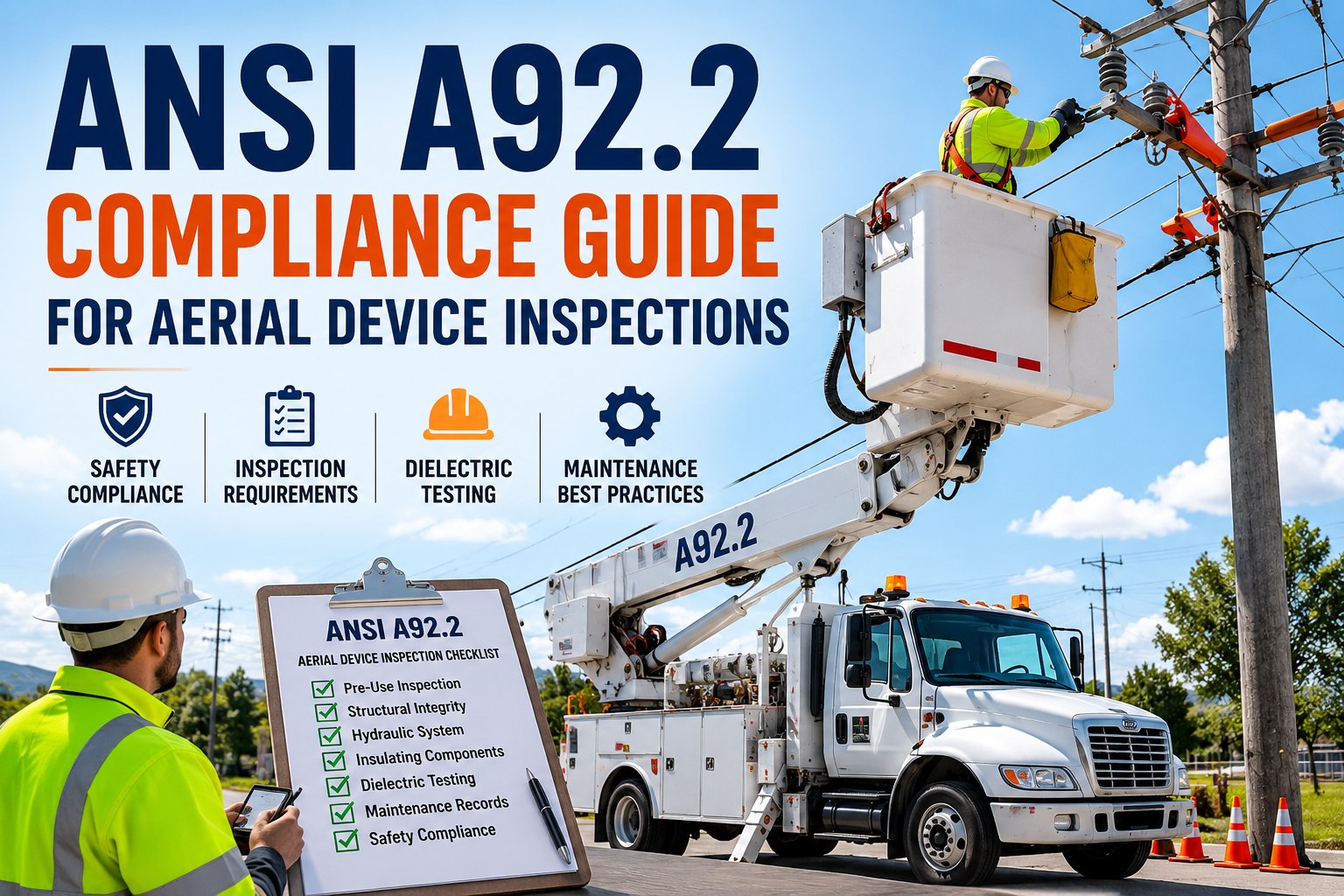
A boom lift puts a worker thirty, sixty, sometimes over a hundred feet in the air on an articulating arm — which is exactly why a missed inspection here doesn't mean downtime, it means a fall, a tip-over, or an electrocution. OSHA data attributes roughly 26 worker deaths a year to aerial lift incidents, and the causes cluster in failures a pre-use inspection is built to catch: structural damage to the boom or turntable, hydraulic failures, malfunctioning controls, and unstable setup. That's why the rules are strict and specific. OSHA 29 CFR 1926.453 and 1910.67 require a pre-start inspection before every work shift, ANSI A92 requires it before every use, and the standards layer a three-tier regime on top: a daily operator pre-use check, a frequent inspection every three months or 150 hours, and an annual machine inspection (AMI) performed by a qualified mechanic no later than 13 months after the last one. A unit that ran fine yesterday is not assumed safe today. A digital boom lift inspection program turns that compliance regime into guided, documented checks that protect the operator and prove it for the audit. This guide covers the three-tier inspection cadence, the pre-use checklist by zone, the critical systems, and the PM schedule.
Sixty Feet Up Is the Wrong Place to Find a Defect
HVI turns the boom lift pre-use inspection into a guided digital check built for ANSI A92 and OSHA 1926.453 — ground and function tests, hydraulics, controls, and fall protection — flagging a defect with a photo, locking out an unsafe unit, and documenting every inspection for the audit.
The Three-Tier Inspection Regime
Boom lift compliance isn't one inspection — it's three, each at a different interval and performed by a different person. Miss any tier and the unit is out of compliance and potentially unsafe.
EVERY SHIFT
Pre-Use Inspection
By the trained operator
A visual and functional check before each use, every shift — ground inspection plus a function test of all controls. Required by OSHA before the lift is operated. Never assume yesterday's unit is still safe.
90 DAYS / 150 HRS
Frequent Inspection
By a qualified person
A deeper inspection every three months or 150 hours of use, whichever comes first. Covers wear items, hydraulics, and structural components beyond the daily walk-around's scope.
ANNUAL / 13 MO
Annual Machine Inspection
By a qualified mechanic
A comprehensive AMI no later than 13 months after the last, performed by a mechanic qualified on that specific make and model. The full structural, hydraulic, and safety-system audit.
The Pre-Use Checklist, by Zone
The daily pre-use inspection runs in two stages — a ground inspection with the machine off, then a function test with it powered. Roughly 30 points across these zones, completed in 15–20 minutes before the first lift.
GROUND — POWER OFF
Fluids: hydraulic oil, engine oil, fuel, coolant levels
Hydraulics: hoses, cylinders, fittings for leaks or damage
Structure: boom, turntable, chassis for cracks or damage
Tires/tracks, outriggers, pins, locks, and pads
Battery charge and connections; cables and wiring
Guardrails, gate, and platform integrity
Decals, capacity placards, and manual in the storage box
FUNCTION — POWER ON
Ground controls: lift, lower, extend, rotate — all functions
Platform controls: full range, smooth, no jerk or hesitation
Emergency stop halts all functions immediately
Ground controls override platform controls correctly
Auxiliary/emergency lowering system operates
Tilt alarm, motion alarms, horn, and lights function
Fall protection: harness anchor, lanyard condition
The Four Critical Systems
Beyond the checklist, four systems carry the real safety weight on a boom lift. These are where a defect turns into an incident, and where inspection attention concentrates.
Hydraulics
Powers lift, extension, and rotation. Check oil level and condition, cylinders and hoses for leaks, and torque-hub levels. A hydraulic failure at height is a fall or drop hazard.
Controls & E-Stop
Both ground and platform controls must work smoothly, the E-stop must halt everything instantly, and ground must override platform. A control fault strands or endangers the operator aloft.
Structure & Stability
Boom, turntable, chassis, and outriggers must be crack-free and the setup level on firm ground. Structural failure or instability is the direct path to a tip-over.
Fall Protection
On a boom lift, a harness and lanyard tied to the boom or basket are required, not optional. Check anchor points, harness, and lanyard condition every shift — the last line against a fall.
The Maintenance & Inspection Schedule
The compliance tiers and preventive maintenance layer together. The daily checks catch the immediate hazards; the scheduled services keep the hydraulics, structure, and controls reliable between them.
Every Shift
Pre-use (operator)
Ground inspection & function test — fluids, hydraulics, structure, controls, E-stop, fall protection, decals
90 days / 150 hrs
Frequent (qualified)
Hydraulic filter & fluid check, full greasing, wear-item inspection, control calibration, structural review
~250–500 hrs
Preventive service
Engine service (if equipped), hydraulic fluid & filter change, battery service, boom wear-pad inspection
Annual / 13 mo
AMI (mechanic)
Comprehensive structural, hydraulic & safety-system inspection; load test; decals verified; records archived
Follow the manufacturer's published schedule — JLG and Genie differ by model. ANSI requires the frequent inspection every 3 months or 150 hours and the AMI within 13 months; the AMI must be done by a mechanic qualified on that make and model.
Keep Every Boom Lift Safe, Compliant, and Documented
Guided pre-use inspections built for ANSI A92 and OSHA 1926.453, three-tier inspection scheduling, hydraulic and control checks, fall-protection verification, instant lockout of unsafe units, and timestamped audit-ready records — built for utility and construction aerial fleets running JLG, Genie, and more. Trusted by 25,000+ users worldwide.
Frequently Asked Questions
How often must a boom lift be inspected?
Three tiers. A pre-use inspection is required before every work shift under OSHA 29 CFR 1926.453 and 1910.67, performed by the trained operator as a ground inspection plus a function test. A frequent inspection is required every three months or 150 hours of use (whichever comes first), performed by a qualified person. And an annual machine inspection (AMI) must be completed no later than 13 months after the previous one, by a mechanic qualified on that specific make and model. A unit that operated safely yesterday is never assumed safe today.
Sign up for a free HVI trial to schedule all three tiers.
What's on a boom lift pre-use inspection checklist?
It runs in two stages. A ground inspection with the machine off covers fluid levels (hydraulic, engine, fuel, coolant), hydraulic hoses and cylinders for leaks, structural condition of the boom, turntable and chassis, tires or tracks, outriggers, battery and wiring, guardrails and platform, and that the decals and operator's manual are present and legible. A function test with the machine powered verifies all ground and platform controls operate smoothly, the emergency stop halts everything, ground controls override platform controls, the auxiliary lowering system works, and alarms function. It's roughly 30 points completed in 15–20 minutes.
Schedule a demo to see the digital checklist.
What OSHA and ANSI standards apply to boom lifts?
OSHA 29 CFR 1926.453 governs aerial lifts in construction and 1910.67 covers general industry, both requiring a pre-start inspection before every shift and that any damaged or defective lift be removed from service until repaired. OSHA also incorporates ANSI A92 standards — historically A92.2 for vehicle-mounted platforms, with the current A92.20/.22/.24 family covering MEWP design, safe use, and training. ANSI requires operators to be trained and authorized in writing on each specific type and model, and sets the frequent (90-day/150-hour) and annual inspection intervals.
Sign up for a free HVI trial to stay compliant.
What happens if a boom lift fails inspection?
It must be removed from service immediately and may not be used until repairs are made — OSHA is explicit on this. Conditions that require taking a lift out of service include any safety device or control not functioning properly, structural damage to the boom, turntable or chassis, hydraulic leaks that affect operation or create a slip hazard, and guardrails that are missing, damaged, or below height requirements. A digital inspection that locks out the unit on a critical-fail and routes the defect to maintenance makes that compliance automatic rather than a judgment call.
Schedule a demo to see automatic lockout.
Is fall protection required in a boom lift?
Yes. For aerial lifts including boom lifts, OSHA requires a body harness or restraining belt with a lanyard attached to the boom or basket — workers must be tied off, and must stand firmly on the platform floor rather than sitting or climbing on the guardrails. This is a key distinction from scissor lifts, which OSHA classifies as mobile scaffolds where adequate guardrails alone can suffice. On a boom lift the harness, lanyard, and anchor point are checked every shift as part of the pre-use inspection, because they're the last line of defense against the falls that cause most aerial lift fatalities.
Sign up for a free HVI trial to verify fall protection.
.png)