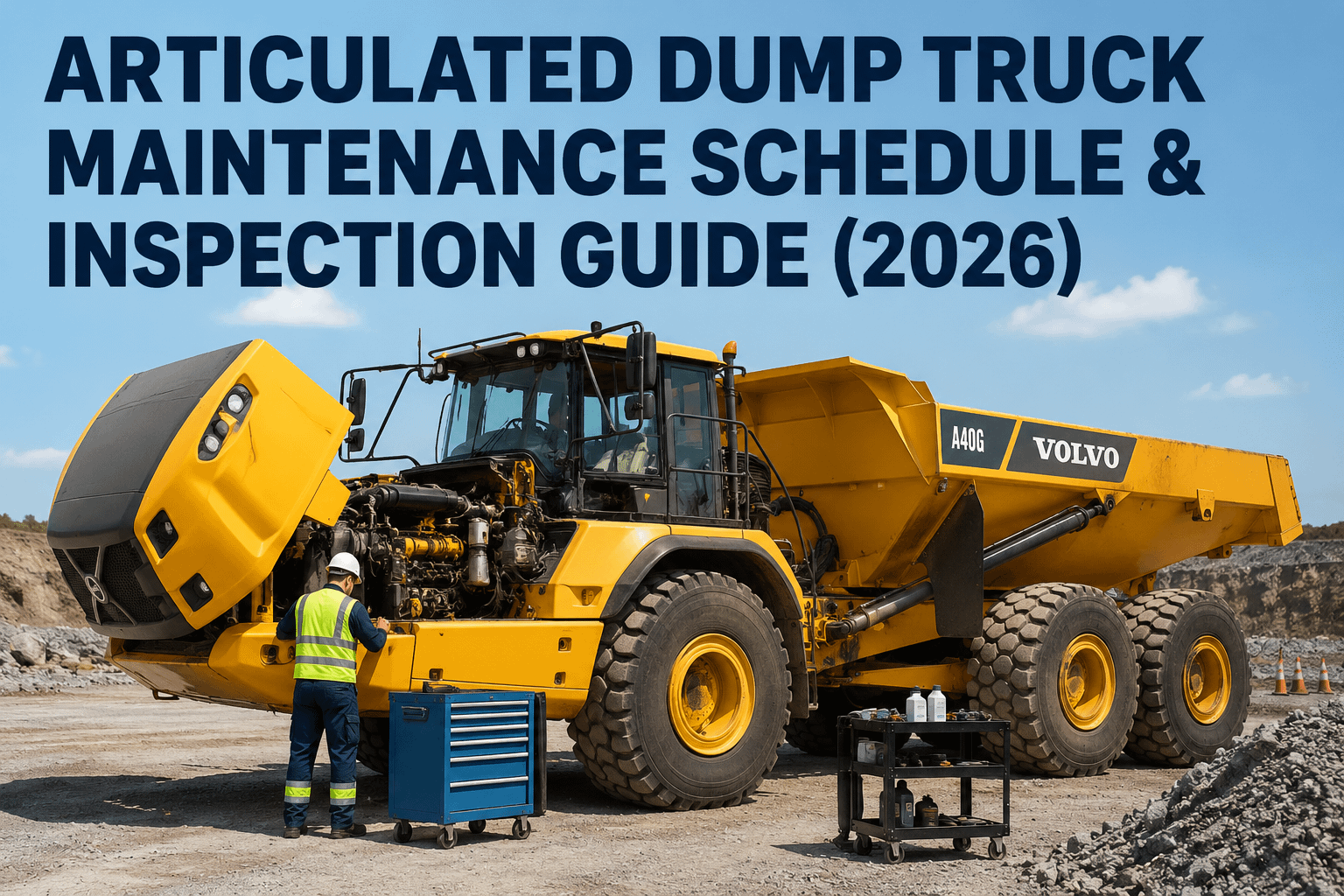
Articulated Dump Truck Maintenance Schedule & Inspection Guide

By Bruno Talley on June 11, 2026

articulated-dump-truck-maintenance-schedule-guide

An articulated dump truck is built to do what a rigid hauler can't — pivot at the waist and crawl through mud, grade, and rough haul road carrying 25 to 45 tons. That articulation is its superpower and its signature wear point: the articulation and oscillation joint connecting the front tractor to the rear dump body flexes under full load thousands of times a shift, and it's one of the most maintenance-critical components on the machine  The cost data makes the priorities clear — across an ADT's life, tire replacement drives about 40% of maintenance cost and the articulation system another 25%, so two-thirds of the budget concentrates in just two areas, both of which a disciplined inspection catches early. A single tire failure can cost $15,000 and cause a dangerous blowout; a neglected articulation joint or hydraulic dump system can sideline the whole truck mid-haul and stall the loading chain behind it. None of it is unpredictable. ADTs run on well-defined service intervals — 250-hour greasing, 1,000-hour hydraulics, 2,000-hour powertrain — and the fleets that hold the schedule run 95%+ availability. A structured ADT maintenance program turns those intervals into tracked, documented service. This guide breaks down the critical systems, the inspection priorities, and the full schedule.

Two-Thirds of ADT Cost Lives in Two Systems. Both Are Catchable Early.
HVI keeps every articulated hauler on a tracked inspection and PM schedule — articulation joint, hydraulics, powertrain, and tires — flagging a defect with a photo, routing the work order, and tracking service by engine hours so the $15,000 tire and the seized joint get caught before they strand a truck mid-haul.

Where ADT Maintenance Money Goes

Unlike a standard truck, an articulated hauler concentrates its maintenance cost in a few specific systems. Knowing the split tells you exactly where inspection discipline pays off most.

40%

Tires


The single biggest cost driver. High-value off-road tires at $15,000+ each — daily pressure and wear checks are non-negotiable.

25%

Articulation System


The joint that defines the machine. Flexes under load constantly — pins, bushings, and seals need regular grease and inspection.

35%

Everything Else


Hydraulics, powertrain, brakes, frame, and body. Important — but the first two systems are where the spend concentrates.

The Four Critical Systems

An ADT comes down to four systems that decide reliability. Each has a distinct wear pattern and a distinct consequence if it's missed — and the articulation joint and tires carry the most weight.

Articulation & Oscillation Joint

The defining component. Connects tractor to dump body and lets the truck pivot and flex on rough ground under full load.

Care: grease pins and bushings on the 250-hour interval, inspect for play, wear, and seal leaks, check hitch and steering-cylinder condition.

Tires & Wheels

The biggest cost. 40% of lifetime maintenance spend; a single failure costs $15,000+ and risks a dangerous blowout.

Care: daily pressure, tread, and sidewall checks; watch wear patterns and payload distribution; rotate and match per OEM guidance.

Hydraulics & Dump System

The work output. Powers the dump body, steering, and suspension. A weak system slows cycles and risks a stuck bed.

Care: check fluid level and condition, dump cylinder and hoses for leaks, full hydraulic service at 1,000 hours, filter changes on schedule.

Powertrain & Drivetrain

The mover. Engine, transmission, drive shafts, differentials, and all-wheel-drive axles working hard on grade.

Care: 1,000-hour engine service, 2,000-hour powertrain overhaul, inspect drive shafts, U-joints, and differentials for leaks and wear.

The articulation joint and tires together drive two-thirds of ADT maintenance cost — and both are caught by a disciplined daily and 250-hour routine, not a calendar PM. HVI tracks both on every truck. sign up for a free HVI trial and protect the two systems that matter most.

The ADT Maintenance Schedule by Interval

Articulated haulers run on well-defined hour-based intervals. The daily checks catch the immediate hazards; the deeper services keep the joint, hydraulics, and powertrain reliable for the machine's full life.

Interval
Focus
Key Tasks
Daily
Operator inspection
Tire pressure & condition, fluid levels, articulation play, leaks, brakes, lights, dump function, walk-around
250 hrs
Greasing & light service
Grease articulation joint, pins & bushings; drivetrain, hydraulic & brake inspection; fluid checks
1,000 hrs
Engine & hydraulic service
Engine oil & filters, complete hydraulic system service, dump cylinder inspection, cooling system
2,000 hrs
Powertrain service
Transmission, axles, and differential overhaul; drive shaft & U-joint service; suspension inspection
5,000+ hrs
Major overhaul
Engine rebuild, hydraulic refresh, dump body restoration, frame & articulation joint structural assessment
Intervals follow the manufacturer — Volvo (A40/A45), Caterpillar, Bell, Komatsu, and John Deere differ. Volvo's 250-hour greasing and 1,000-hour engine intervals are among the industry's longest; usage-based scheduling beats calendar dates for hard-worked haulers.

The Daily Walk-Around: 5 ADT-Specific Priorities

A generic truck check misses what matters on an articulated hauler. These five get priority every shift because they're the high-cost, high-risk items unique to ADTs.

1

Tires First

Pressure, tread, sidewall, and wear pattern on every tire — the #1 cost and the #1 blowout risk. Check before the truck moves.

2

Articulation Joint

Look for excessive play, grease condition, and seal leaks at the hitch. The defining ADT component — catch wear before it's structural.

3

Hydraulic & Dump

Cycle the dump body for smooth, controlled operation; scan cylinders, hoses, and fittings for leaks. A stuck bed stops the haul.

4

Fluids & Leaks

Engine oil, transmission, hydraulic, and coolant levels; scan the ground and components for fresh leaks — the earliest failure signal.

5

Brakes & Drivetrain

Test service and parking brakes; listen for drivetrain noise; check drive shafts and U-joints. Critical on grade and loaded.

Catching a developing articulation-joint or tire issue daily is the difference between a planned fix and a truck stranded on a haul road stalling the whole loading chain. HVI makes each priority a required, photo-backed step. schedule a live demo to see ADT inspection and PM templates.

From Walk-Around to 95% Uptime

The payoff of a tracked program is the loop: inspect daily, schedule by hours, fix early, and document — so the joint gets greased, the powertrain gets serviced on time, and the truck keeps hauling.

1

Inspect Daily

Operator runs the guided ADT walk-around on a phone — tires, joint, hydraulics, drivetrain — with photos on any defect.

2

Schedule by Hours

Greasing, engine, hydraulic, and powertrain services track by engine hours; the work order fires before each is due.

3

Fix & Document

A flagged defect becomes a routed work order; every inspection and service logs to the truck's record, audit-ready.

Keep Every Articulated Hauler at 95% Uptime

Guided daily inspections prioritizing tires and the articulation joint; 250 / 1,000 / 2,000-hour PM scheduling; hydraulic and powertrain tracking; defect-to-work-order routing; and timestamped records — built for Volvo, Caterpillar, Bell, Komatsu, and Deere ADT fleets. Catch the costly two systems before they fail. Trusted by 25,000+ users worldwide.
Frequently Asked Questions

How often should an articulated dump truck be serviced?
Layer the intervals: a daily operator walk-around (tires, fluids, articulation, leaks, brakes, dump function); greasing and light service every 250 hours focused on the articulation joint, pins, and bushings; engine and complete hydraulic service at 1,000 hours; powertrain overhaul covering transmission, axles, and differentials at 2,000 hours; and a major overhaul at 5,000+ hours. Volvo's 250-hour greasing and 1,000-hour engine intervals are among the industry's longest — follow the published schedule for your specific model and use hours, not the calendar. Sign up for a free HVI trial to track ADT intervals.
What is the most important system to maintain on an ADT?
Tires and the articulation system, which together drive about two-thirds of lifetime maintenance cost — roughly 40% tires and 25% the articulation system. Tires are the single biggest cost and the biggest safety risk, with a single failure costing $15,000+ and risking a dangerous blowout, so daily pressure and condition checks are critical. The articulation and oscillation joint is the component that defines the machine, flexing under full load constantly, and needs regular greasing and inspection of pins, bushings, and seals. Prioritizing these two is the highest-leverage maintenance an ADT fleet can do. Schedule a demo to track them.
How do I maintain the articulation joint?
Grease the articulation and oscillation joint, including pins and bushings, on the manufacturer's interval — typically every 250 hours, with Volvo offering one of the industry's longest at that mark. Daily, check the hitch for excessive play, verify grease condition, and look for seal leaks; weekly or at service, inspect the steering cylinders and the joint structure more thoroughly. Because the joint carries the full articulating load over rough ground thousands of times a shift, catching wear early keeps it from progressing into an expensive structural repair that sidelines the truck. Sign up for a free HVI trial to schedule joint greasing.
Why are ADT tires so expensive to maintain?
Articulated haulers run large, high-value off-road tires that carry heavy payloads over abrasive, rough terrain, so they wear fast and cost $15,000+ each to replace — making tires roughly 40% of total ADT maintenance cost. Beyond the cost, a tire failure can cause a dangerous blowout, so daily inspection of pressure, tread depth, sidewall condition, and wear patterns is non-negotiable. Proper inflation, correct loading and payload distribution, and rotation per OEM guidance extend tire life significantly and protect the largest single line in the maintenance budget. Schedule a demo to see tire tracking.
What uptime can a well-maintained ADT fleet expect?
Properly maintained articulated haulers reach 95%+ availability, and leading operations push toward 98% with disciplined preventive maintenance and tracking. The gap between that and a reactive fleet comes down to whether the daily inspections and hour-based services actually happen — greasing the joint at 250 hours, servicing hydraulics at 1,000, overhauling the powertrain at 2,000. Over a machine's life, the difference between proactive and reactive maintenance can be hundreds of thousands of dollars in avoided major repairs and sustained productivity. Sign up for a free HVI trial to hit 95%+ uptime.

Share This Story, Choose Your Platform!

Start Free Trial Book a Demo