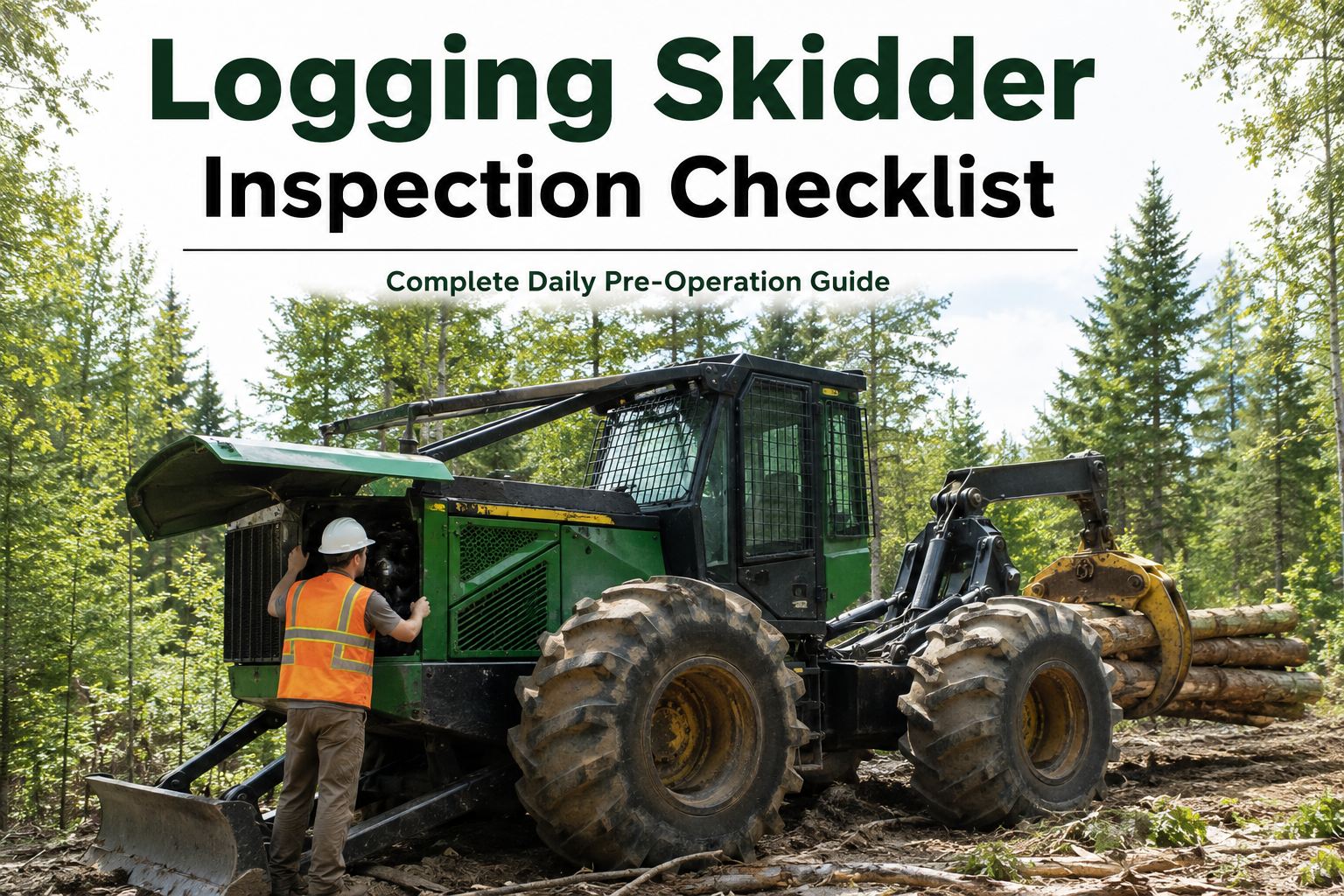
A logging skidder lives the hardest life of any machine in the woods — dragging multi-ton log hitches over stumps, mud, and grade, day after day, far from any shop. When something fails out there, help isn't a phone call away; it's a recovery operation. That's why the daily pre-operation inspection isn't optional paperwork — it's federal law. OSHA's logging operations standard, 29 CFR 1910.266, governs skidder work directly, and it's unusually specific: the operator must inspect cables and chokers before commencing work and at least twice per day thereafter, machines need certified ROPS/FOPS and maintained seat belts, and a charged fire extinguisher must be aboard at all times. Forestry operators who run disciplined digital inspections have cut equipment downtime by around 40%. This 2026 guide walks the complete daily skidder inspection — the safe shutdown that comes first, the ground-up walkaround, the safety-critical systems, and the operational test — built around what OSHA actually requires. Pair it with HVI inspection and maintenance software to run it on a phone, flag defects with photos, and keep audit-ready records per machine. Always follow your operator's manual for model-specific steps.
The Daily Inspection Sequence
A skidder inspection follows a safe, repeatable order — secure the machine first, then work it from the ground up, verify the safety systems, and finally run it under power. Four phases, every shift, before the first hitch.
Park & Secure
Level ground, blade down, brakes and locks set, pressure discharged, engine cooled.
Walk the Machine
360° ground-up: fluids, tires, hydraulics, grapple or winch, and structure.
Verify Safety Systems
ROPS/FOPS, seat belt, fire extinguisher, guards, alarms, and chokers.
Operate & Test
Start, watch gauges, cycle hydraulics, test brakes and winch from the seat.
Phase 1: Park & Secure Before You Inspect
OSHA is explicit about how a skidder must be shut down — and these same steps make it safe to inspect. Never start the walkaround until the machine is secured.
Lower the Blade
Ground the blade or arch so nothing can drop. Required by OSHA before dismounting.
Set Brakes & Locks
Apply all brakes and locks on level ground so the machine can't move during inspection.
Discharge Pressure
Work the controls to dissipate residual hydraulic and pneumatic energy before opening any system.
Clear the Danger Zone
Walk completely around the machine; confirm no personnel are within two tree-lengths before any startup.
Phase 2: The Ground-Up Walkaround
With the machine secure, work a full 360° from the ground up. These are the systems that strand a skidder in the cut when neglected.
Fluids & Engine
Check engine oil, coolant, hydraulic, and fuel levels — skidders burn fluids fast under high-stress loads. Watch for leaks and unusual consumption that signals a deeper fault.
Tires & Chains
Inspect tires for cuts, low pressure, and sidewall damage, and check tire chains where fitted. Uneven wear can flag alignment trouble. On terrain this rough, a tire is a frequent failure point.
Hydraulic Hoses & Cylinders
Trace hoses, fittings, and cylinder rods for leaks, chafing, and cracks — the most common forestry failure. Use a flashlight on undercarriage and pivot joints where damage hides.
Grapple or Winch & Arch
On a grapple skidder, check tongs, pins, rotation, and hydraulics; on a cable skidder, the winch drum, fairlead, and arch. The business end that takes the most abuse.
Blade & Frame Articulation
Inspect the dozer blade, frame, and articulation joint for cracks, stress, or misalignment. Check steps and handholds for safe three-point mounting.
Belts, Guards & Radiator
Check belts for wear, confirm all manufacturer guards over shafts and moving parts are in place, and clear the radiator and screens of debris and chaff buildup.
Phase 3: The Safety Systems OSHA Requires
These aren't optional checks — 1910.266 mandates each one, and a defect here should take the machine out of service until it's fixed. The choker rule is the one most often under-done.
Cables & Chokers — Twice Daily
OSHA requires the operator to inspect cables and chokers before commencing work and at least twice per day thereafter. Any cable with broken strands or cuts that materially increase failure risk must be replaced at the earliest opportunity — a snapped cable under load is one of logging's deadliest hazards. Wear hand protection when handling wire rope.
ROPS / FOPS
Inspect the rollover and falling-object structures for dents, cracks, or any modification. Damage or unauthorized welding compromises certification — these protect the operator in a roll or struck-by event.
Seat Belt & Restraint
Confirm the seat belt latches, retracts, and is serviceable per SAE J386. A removed or frayed belt must be replaced — it's what keeps the operator inside the ROPS in a rollover.
Fire Extinguisher
A charged, in-date, accessible extinguisher must be aboard at all times — engine bays packed with dry forest debris are a real ignition risk. Keep it clean and secure.
Guards, Mufflers & Decals
Confirm guards over moving elements, the manufacturer's muffler, and legible safety decals. The cab enclosure mesh must be intact to deflect intruding limbs.
Phase 4: Operate, Test & Decide
With the machine secured-check complete, start it and confirm it performs — then make the call on whether it runs today.
Start & Watch Gauges
Listen for rough running, watch oil pressure, coolant temp, and hydraulic temp during warm-up, and check for warning lights or smoke.
Cycle & Test
Run the grapple or winch through its range from the operator's station, cycle the blade, and test service and parking brakes for holding power.
Pass or Tag-Out
Clean check, machine works. Any safety-system defect, brake failure, hydraulic leak, or cable damage tags it out of service until repaired.
Paper Logbook vs. HVI
A twice-daily cable rule, OSHA-mandated safety systems, and rugged remote conditions where records get wet, lost, or skipped — exactly where digital inspection earns its keep.
PAPER OR MEMORY
HVI INSPECTION SOFTWARE
Keep Every Skidder Safe, Working, and Compliant
HVI gives logging operations a guided daily skidder inspection aligned with OSHA 1910.266 — secure-and-shutdown steps, ground-up walkaround, the required safety systems including twice-daily cable checks, and operational testing — with photo-flagged defects, defect-to-work-order routing, hour-based PM, and timestamped audit-ready records per machine. Catch faults in the yard, not the cut. Trusted by 25,000+ users worldwide.


.png)