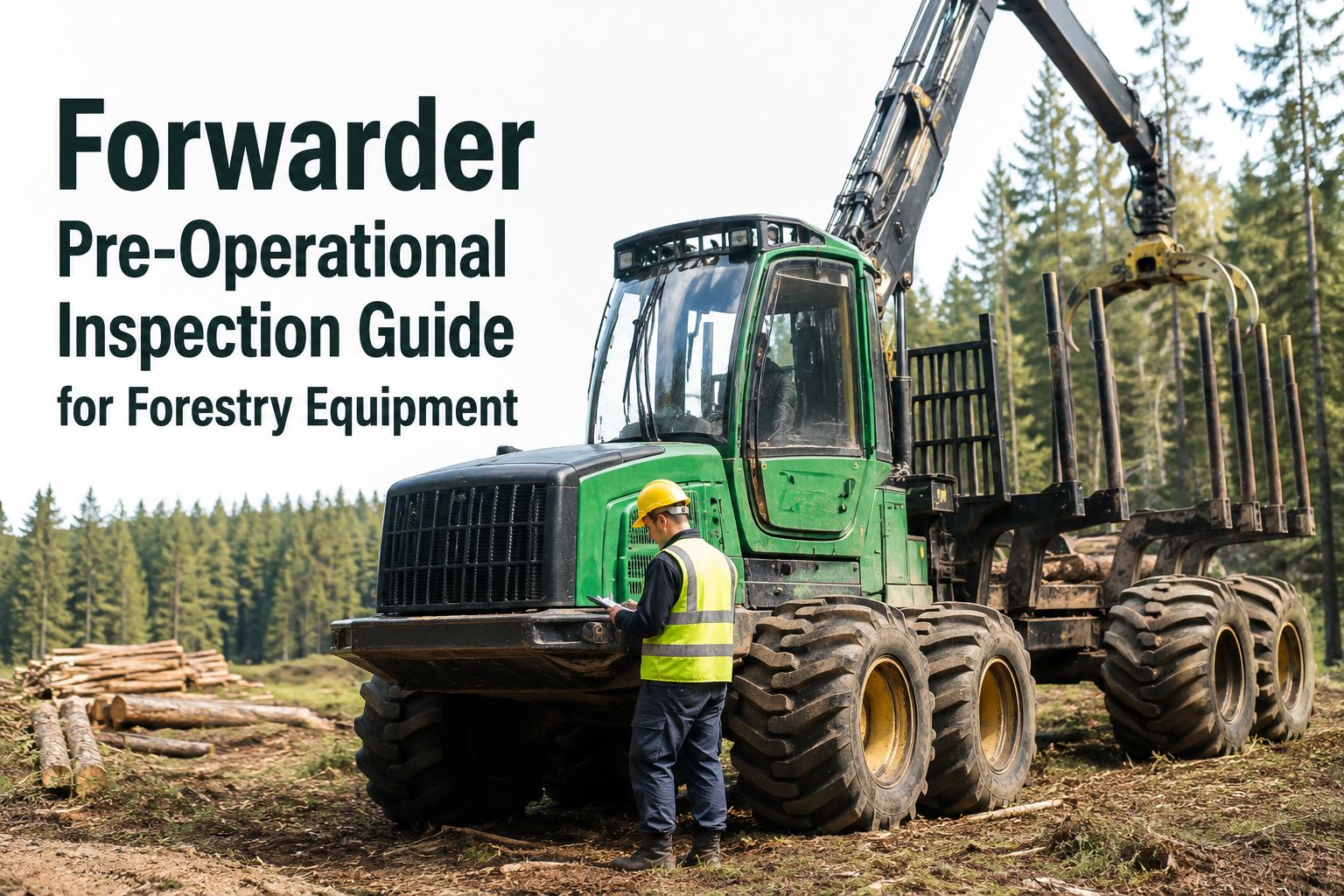
A forwarder is one of the most complex machines on a logging site — an 8-wheeled carrier with a hydraulic crane, rotating grapple, bogie axles, and a drivetrain engineered to move 20-tonne loads across terrain that would destroy a highway truck. When it breaks down mid-harvest, the entire cut-to-landing chain stops: the harvester keeps cutting but logs pile up unforwarded, truck loaders wait idle at the landing, and the $2,000–$5,000 daily revenue loss begins compounding. Forestry equipment downtime averages 15–20% of operating hours — far higher than highway fleets — and 60–70% of these failures originate as defects visible during a proper pre-operational walk-around: hydraulic hose deterioration, bogie tyre damage, crane pin wear, grapple jaw misalignment, and fluid leaks that worsen with every cycle. A structured pre-operational inspection catches these defects before they become mid-shift breakdowns in locations where repair support is 2 hours away on a logging road. HVI's forestry equipment inspection platform provides digital pre-operational checklists purpose-built for forwarders — covering crane, grapple, bogies, hydraulics, drivetrain, and cab systems with photo verification, offline capability for remote sites, and automated defect routing to your maintenance team.
Digital Inspections Built for Forestry Equipment
HVI provides forwarder-specific checklists with photo verification, offline capability for remote logging sites, and automated defect routing — reducing equipment downtime by up to 40%.
The 7-Zone Pre-Operational Inspection
A forwarder walk-around covers seven distinct zones — each with components that fail differently and require different inspection techniques. HVI's guided checklist walks operators through every zone in sequence with photo-required checkpoints.
Engine oil level and condition — check dipstick, look for metal particles or milky colour
Transmission oil — level, condition, no foaming or discolouration
Engine coolant — level at sight glass, check concentration, inspect for leaks at hoses and clamps
Air filter — restriction indicator status, visual check for debris build-up (critical in dusty forestry conditions)
Radiator — core condition, debris packed between fins (common in slash environments), coolant hose condition
All belts — tension, cracking, glazing, alignment
All hoses — check for abrasion, bulging, weeping at connections, and heat damage from proximity to exhaust
Battery — terminals clean and tight, no acid build-up, cables secured, hold-down bracket intact
Hydraulic fluid level — check at sight glass with crane lowered and grapple closed (resting position)
Hydraulic fluid condition — milky = water contamination, foamy = air ingress, dark = overheating or degradation
All hydraulic hoses — trace every line from pump to crane, boom, grapple, and steering. Check for surface cracks, abrasion from rubbing, bulging, and weeping at fittings
Cylinder rods — check for scoring, pitting, and seal leaks on crane, boom, and grapple cylinders
Hydraulic filter — restriction indicator, replacement interval tracking
Hydraulic cooler — debris build-up (slash, bark, needles), fin condition, mounting integrity
Boom sections — visual check for dents, cracks, deformation, especially at weld joints and pin connections
All pins and bushings — check for wear, excessive play, and proper retention (cotter pins, snap rings)
Slewing ring — check for play, unusual noise during rotation, lubrication status, bolt torque
Crane base mounting — bolts tight, no cracks in mounting plate or carrier frame at crane attachment points
Lift and extend cylinders — smooth operation through full stroke, no drift under load, no seal leaks
Hose routing on boom — check that all lines are properly clamped, not rubbing on boom sections during extension/retraction
Grapple jaws — alignment, closing force, no permanent deformation or cracks at jaw tips or pivot points
Rotator — smooth 360-degree rotation, no grinding noise, hydraulic supply lines intact, mounting secure
Grapple cylinder — rod condition, seal integrity, full opening and closing stroke without hesitation
Grapple tips — wear condition, sharp enough for effective log grip, no missing or broken tips
Link and chain connections — all connecting hardware between rotator and grapple inspected for wear and security
All tyres (8 wheels) — sidewall cuts, punctures, chunking, inflation, tread condition for terrain grip
Bogie axles — check for play at pivot points, mounting bolt condition, lubrication, no cracks at weld joints
Chains (if fitted) — tension, broken links, cross-chain condition, secure attachment
Drive shafts — U-joint condition, no vibration on start-up, grease fittings lubricated
Differential and axle seals — no fluid weeping at hub seals or differential cover
Frame and articulation joint — check for cracks, proper locking pin engagement, steering cylinder condition
Bunk stakes — all stakes present, straight, securely mounted, no cracks at base welds
Cross-members — structural integrity, no bends or cracks from overloading or impacts
Load space width/height adjustment — telescoping mechanisms operating smoothly (if equipped)
Tailgate — latching mechanism secure, hydraulic operation smooth (if equipped)
Floor/bolsters — no excessive wear, grease buildup, or debris that could affect load seating
ROPS/FOPS — protective structure intact, no cracks, all mounting bolts present and torqued
Seat, seatbelt, and seatbelt alarm — functional, no cuts or fraying, retractor working
All gauges and warning lights — cycle through start-up sequence, verify all indicators respond
Crane controls — all joystick functions responsive, proportional response, no sticking or dead zones
Service and parking brakes — full stop test at walking speed, parking brake holds on grade
Windshield, wipers, mirrors — visibility adequate, wipers functional (critical in rain/snow forestry operations)
Fire extinguisher — present, charged, within inspection date, accessible from cab
First aid kit, emergency equipment — present and stocked per site requirements
HVI provides digital templates for all 7 zones with photo-required checkpoints, pass/fail gates, and offline capability for remote logging sites with no cellular coverage.
Start free or
schedule a demo to see forwarder-specific inspection templates.
Why Forestry Equipment Inspections Fail on Paper
Paper inspections fail in every industry — but forestry conditions make failure worse and more expensive.
Remote Locations
Logging sites are 30–120 minutes from the nearest shop. A breakdown that would take 2 hours to fix in a yard becomes a full-day event when repair support has to navigate logging roads. Prevention is not just cheaper — it is the only viable strategy.
Paper Gets Destroyed
Rain, mud, hydraulic fluid, diesel, snow — forestry environments destroy paper forms faster than any other industry. Forms that survive conditions are often illegible. Digital inspection on a ruggedised phone or tablet survives the same conditions the operator does.
No Connectivity = No Reporting
Most logging sites have zero cellular coverage. Paper forms pile up until the operator reaches town. Digital platforms without offline mode fail entirely. HVI completes full inspections offline — photos, defects, signatures — and syncs automatically on reconnect.
Seasonal Crew Turnover
Forestry operations cycle through seasonal operators who may be unfamiliar with specific equipment. Guided digital checklists ensure every operator follows the same sequence — regardless of experience level — preventing the variability that causes missed items.
How HVI Supports Forestry Fleet Inspection
HVI is not a highway-truck-only platform — it supports heavy equipment inspection with the same guided workflow, photo verification, and compliance documentation. Start free and configure forwarder templates today.
Forwarder-Specific Templates
Pre-built 7-zone checklists covering engine, hydraulics, crane, grapple, bogies, load space, and cab. Customisable per manufacturer (John Deere, Ponsse, Komatsu, Tigercat) with model-specific inspection points.
Full Offline Capability
Complete inspections with photos, defect reports, and digital signatures without any connectivity. Data syncs automatically when the device reaches cellular or Wi-Fi range — at the landing, the truck stop, or base camp. Zero inspection gaps from dead zones.
Photo-Verified Defect Reporting
When an operator flags a hydraulic hose bulging, a bogie tyre cut, or a grapple jaw crack — the photo travels with the defect report to the maintenance team. Technicians diagnose before arriving at the site — bringing the right parts the first time.
Hours-Based PM Scheduling
Forestry equipment runs on engine hours — not miles. HVI's multi-trigger PM system tracks hours-based intervals for oil changes, hydraulic fluid replacement, filter service, and crane inspections per manufacturer specifications.
Instant Defect-to-Work-Order
Defects auto-generate prioritised work orders with photo evidence and severity classification. Critical defects (brake failure, ROPS damage, hydraulic burst) trigger immediate out-of-service status — the machine does not operate until certified repair is complete.
OSHA Compliance Documentation
OSHA 29 CFR 1910.266 (Logging Operations) and 1926 Subpart O require documented pre-shift inspections and maintenance records. HVI generates timestamped, operator-signed records stored in tamper-evident cloud storage — audit-ready at any time.
Inspect at the Landing — Not at the Breakdown
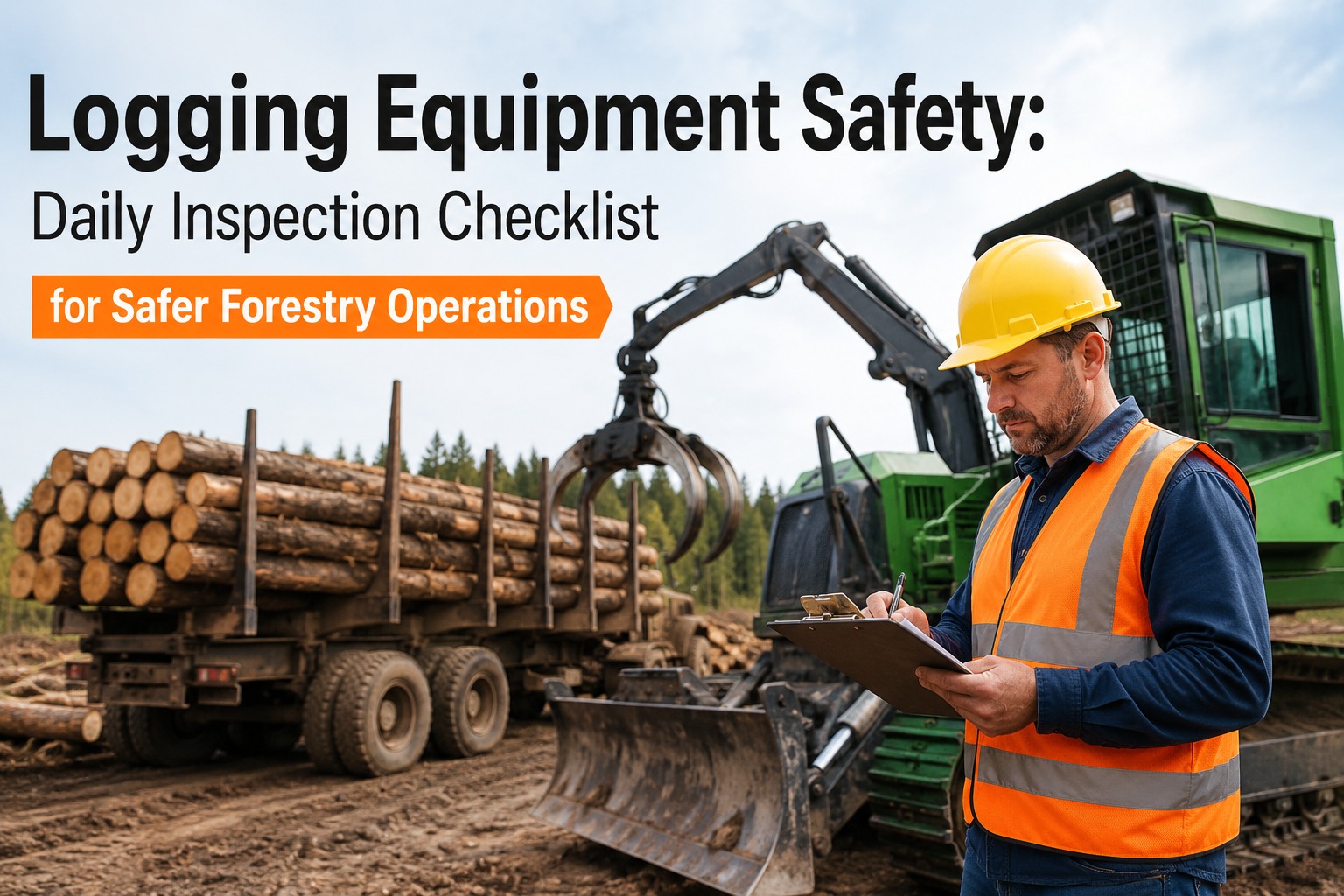
A forwarder breakdown at the cut block costs 5–10x what the same repair would cost at the shop — because of the access time, the idle crew, the stopped harvester, and the delayed trucks waiting at the landing. 60–70% of these breakdowns are detectable during a 15–20 minute pre-operational walk-around: hydraulic hoses showing fatigue, bogie pins with excessive play, grapple jaws with visible cracks, fluid levels dropping between shifts. The operators who catch these defects are not more experienced — they are using inspection tools that guide them through every zone, require photo evidence at critical points, and route defects to maintenance before the machine enters the cut. HVI provides this tool for forestry operations: forwarder-specific templates, offline-first capability, photo-verified defect reporting, hours-based PM scheduling, and OSHA compliance documentation — all on a platform built to work where logging happens, not just where the office is. Start free today — or schedule a demo to see forestry equipment templates configured for your fleet.
Digital Forestry Equipment Inspections
7-zone forwarder templates. Full offline mode. Photo-verified defects. Hours-based PM. OSHA compliance. Works where logging happens. Trusted by 25,000+ users.
Frequently Asked Questions
Q: What should a forwarder pre-operational inspection cover?
A complete forwarder inspection covers 7 zones: engine compartment (oil, coolant, filters, belts, hoses), hydraulic system (fluid, hoses, cylinders, cooler), crane and boom (pins, bushings, slewing ring, cylinders), grapple and rotator (jaws, rotation, tips, cylinders), bogies/tyres/drivetrain (all 8 wheels, axles, chains, frame), load space and bunks (stakes, cross-members, tailgate), and cab and safety systems (ROPS, controls, brakes, fire extinguisher). Takes 15–20 minutes with a guided checklist.
Start free with HVI.
Q: Does HVI work without cell service at logging sites?
Yes — full offline capability is core to HVI's design. Operators complete entire inspections including photos, defect reports, severity classification, and digital signatures without any connectivity. All data syncs automatically when the device reaches cellular or Wi-Fi range. This is essential for forestry operations where most logging sites have zero cellular coverage.
Q: What OSHA standards apply to forestry equipment inspection?
OSHA 29 CFR 1910.266 (Logging Operations) requires employers to ensure equipment is inspected before initial use each shift. OSHA 1926 Subpart O applies to mechanised equipment in construction-adjacent operations. Additionally, manufacturers specify maintenance intervals and inspection points in their operator manuals — which OSHA considers enforceable best practice. HVI generates documentation satisfying all three sources.
Schedule a demo.
Q: How does HVI handle hours-based PM for forestry equipment?
HVI supports engine-hours-based PM triggers — the standard for forestry equipment that does not accumulate road miles. Operators enter hour meter readings during daily inspections (or HVI syncs from telematics if available). PM-A through PM-D intervals trigger at the correct hour counts with 90/60/30-day lookahead alerts. Work orders auto-generate with the correct service items for each PM tier.
Q: Can HVI templates be customised for different forwarder models?
Yes. HVI supports manufacturer-specific templates (John Deere, Ponsse, Komatsu, Tigercat) with model-specific inspection points. Additional items can be added for specific site requirements, attachments, or regulatory obligations. Each template is assigned to the equipment type — operators see only the checklist relevant to their assigned machine.
Start free.



.png)