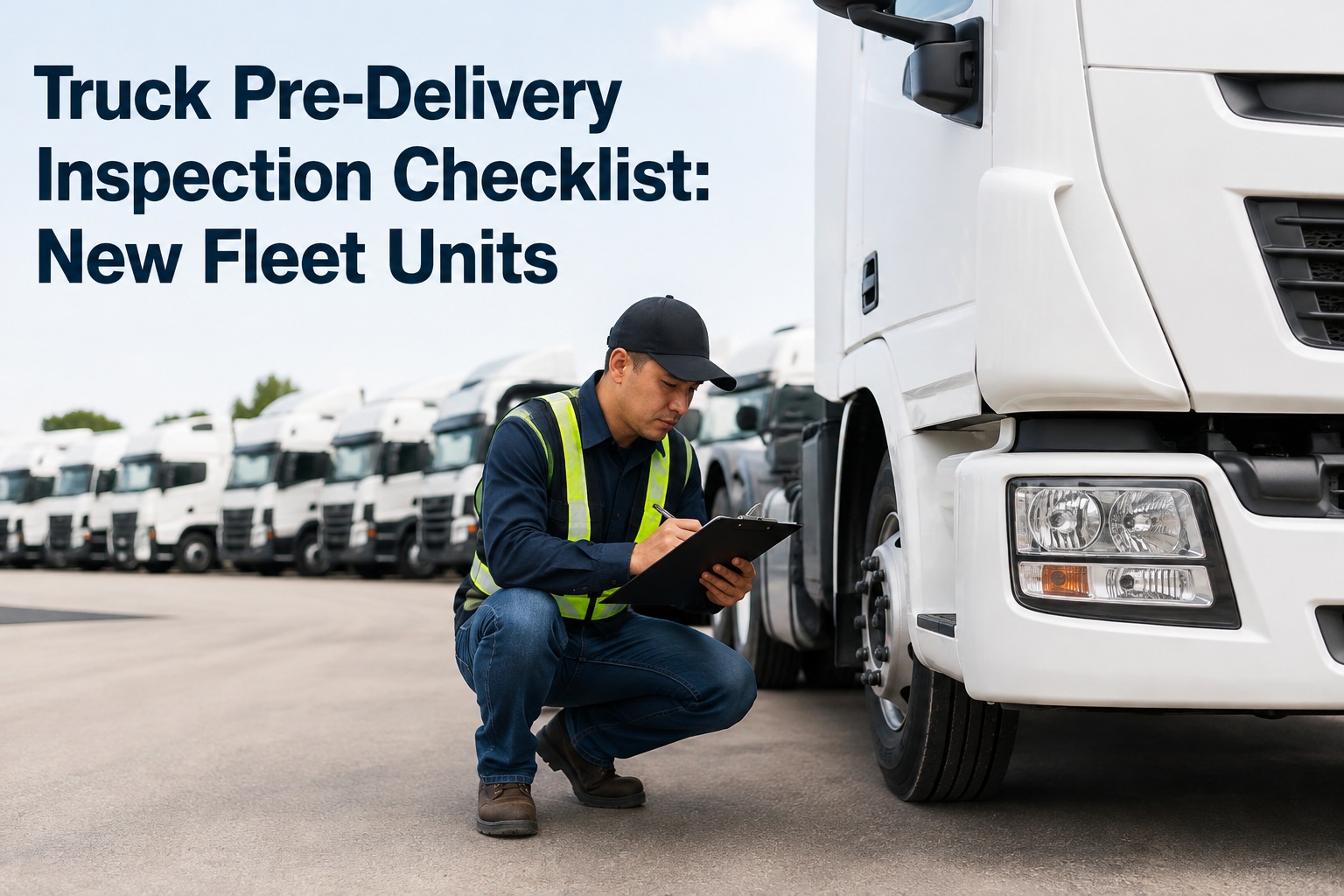
A truck pre-delivery inspection checklist that skips spec verification, transit damage photo capture, and warranty baseline documentation is the setup for the most expensive fleet mistake: accepting a defective new truck and losing the warranty claim because there's no evidence the defect pre-existed acceptance. Once you sign delivery, the truck is yours and every defect from that moment is yours to prove. This truck pre-delivery inspection checklist walks the 7 acceptance-window checks and the commissioning workflow — book a demo to digitize new truck acceptance in HVI.
The New-Truck Delivery Timeline — and the Moment Your Warranty Position Changes
Every phase produces evidence. Skip the PDI evidence at the pivot and any post-acceptance defect claim becomes an argument you're going to lose.
Ordered
- Signed spec sheet on file
- Chassis / engine / axle config
- Body, tyres, options confirmed
Delivered
- Delivery note received
- Physical asset present
- Not yet accepted — ownership pending
PDI & Accept / Reject
- Accept → ownership transfers, defects yours
- Reject / rework → defects remain OEM's
- PDI record = warranty baseline
Commissioned
- Asset record, VIN, baseline mileage
- PM cadence per OEM spec
- Telematics + driver assignment
The pivot is Phase 3. Everything before it is preparation; everything after it is either operations or dispute resolution. Which one depends on the quality of the PDI record.
The rest of this page walks each of the 7 PDI sections, the transit damage photo standard, the manufacturer-specific break-in point most fleets overlook, and the commissioning workflow that carries the acceptance record forward as the asset's baseline. Book a 30-minute demo to see acceptance templates that flow into asset creation in HVI.
The 7 PDI sections every new truck acceptance covers
A general-condition walkaround is not a PDI. A defensible pre-delivery inspection breaks the truck down into 7 sections and captures each against the build spec, the transit condition, and the operational readiness of the vehicle. Miss any section and the gap ends up being exactly where a defect surfaces two months later.
Spec verification
- Chassis serial matches purchase order
- Engine model & horsepower rating
- Transmission model & ratio
- Axle configuration & ratio
- Tyre size, brand, load rating
- Body / trailer equipment as ordered
Transit damage
- Every panel photographed under natural light
- Paintwork: scratches, ripples, colour match
- Glass, mirrors, lights, cameras intact
- Wheels, tyres, hubcaps undamaged
- Cab steps, mudguards, trim complete
- Underbody visual for damage / leaks
Fluids & leaks
- Engine oil at correct level, no visible drip
- Coolant level in operating range
- Hydraulic reservoir (if fitted)
- DEF tank filled, cap secure
- Brake fluid, PS fluid, washer fluid
- Fuel level as agreed
Start & function
- Engine starts cleanly on first attempt
- No dashboard warning lights active
- Lights, indicators, hazards all functional
- Wipers, washers, horn
- HVAC heat & cool cycles
- ADAS, cameras, telematics displays
Test drive
- Smooth acceleration through gears
- Braking straight, no pull
- Steering centred, no vibration
- No unusual noises or vibrations
- Cruise control, retarder function
- Fault codes cleared post-drive
Documents & keys
- Registration / V5C / CRW / title
- Warranty book & activation
- Owner's manual + technical docs
- 2x keys + fuel-cap keys + fobs
- Outstanding recall status: nil
- OEM inspection certificate
Signatures & PDI report
- PDI inspector sign-off with time
- OEM/dealer sign-off (if applicable)
- Any defects flagged with photo & location
- Rework list agreed before acceptance
- Final Accept / Reject decision
- PDF copy retained per asset
Recall check
- NHTSA recall search by VIN (US)
- DVSA / manufacturer recall lookup (UK/AU)
- All outstanding recalls resolved before delivery
- Recall completion certificate on file
The 7 sections take a competent inspector 45-90 minutes on a Class 8 truck. That's a small time investment against the value of the vehicle and the size of the disputes that arise later. Book a demo to see per-section PDI templates with photo evidence per checkpoint.
The transit damage photo standard — without this, warranty claims argue themselves out
Transit damage is the single most contested category in post-delivery disputes. A truck moves from OEM plant to distribution yard to dealer to your terminal, and can pick up damage at any of those legs. Once you sign acceptance, arguing that a specific scratch or dent pre-existed the acceptance moment requires a photo record dated at PDI. Without it, the OEM or dealer will attribute the damage to operation after delivery, and the warranty conversation ends there.
Four-side walkaround
Wide-angle photo from directly in front, both sides perpendicular to the truck, and directly behind, in natural daylight. Consistent framing across every acceptance. The four-side baseline is the foundation of every dispute defense.
Odometer & hours
Direct close-up of the odometer and any engine-hour display, timestamped. This sets the operational baseline for the asset and prevents any dispute over whether the truck was operated between delivery and acceptance.
Damage: wide + close
Every defect gets two photos: a wide shot showing the damage in context (which panel, where on the panel) and a close-up showing the damage detail. Coin or tape measure in-frame for scale. Marked on a body diagram.
VIN plate & spec plates
Close-up of VIN plate confirms identity. Close-up of engine model plate, transmission tag, and any GVWR/axle rating plates confirms the spec matches the purchase order. These plates are the physical evidence the truck-as-delivered matches the truck-as-ordered.
Digital PDI tools preserve GPS location and device timestamp automatically on every photo. This is what separates a warranty-defensible photo from a photo an OEM's dispute team can argue was taken later. Photos from a personal phone that get emailed and screenshotted lose that metadata and lose the evidentiary value that matters. Start a free HVI trial to capture geo-tagged, timestamped PDI photos against every new asset.
Break-in: what the manufacturer specifies vs what fleets often assume
New commercial diesel engines still have specific manufacturer break-in guidance, and skipping it is one of the fastest routes to premature engine wear that later gets classified as owner-caused rather than warranty-covered. There is no universal break-in schedule — every OEM specifies its own, and confirming against the specific engine's guidance is a required step in the commissioning phase.
| Break-in item | Typical guidance range | Why it matters |
|---|---|---|
| Initial load | Manufacturer-specific, often moderate load first 500–1,000 miles | Piston ring seating; excessive idle or overload during break-in creates blow-by that never fully resolves |
| Initial oil change | Manufacturer-specific, often earlier than standard interval | Metal fines from initial wear settle out in first oil; standard interval leaves them circulating |
| Avoid extended idle | Per OEM spec, often first 100 hours | Extended idle prevents cylinder walls reaching temperature required for ring seating |
| Variable RPM & load | Per OEM spec, first 5,000–10,000 miles | Steady-state cruising does not exercise components uniformly; varied load promotes even seating |
| Retorque wheel nuts | 50–100 miles after delivery, then again at 500 miles | Initial wheel-nut retorque is manufacturer-mandatory on almost every Class 8 truck |
| Post-drive inspection | After first 500 miles | Verify no leaks, no loose components, no fault codes; catches assembly issues before they escalate |
The single most-skipped break-in item across fleet operations is the wheel-nut retorque at 50-100 miles. It's manufacturer-mandatory on almost every Class 8 truck and light commercial vehicle, and skipping it is one of the leading causes of wheel-off events on new vehicles. Confirm the break-in schedule against the specific truck's OEM documentation during commissioning, and add the retorque as the first scheduled inspection in the asset's PM cadence. Book a demo to see wheel-nut retorque and other OEM break-in items pre-populated in HVI.
Commissioning: from acceptance signature to first live shift
Signing acceptance is not the end of the PDI — it's the start of commissioning. Commissioning is what turns a physically-received truck into an operationally-ready fleet asset, and it's where most fleet software either earns its cost or reveals its gaps. Six commissioning steps close the loop between acceptance and first revenue mile.
Asset record created
VIN, chassis serial, engine serial, spec sheet, purchase price, expected disposal date, cost centre. The PDI record attaches to this asset as its baseline for the vehicle's operational life.
Baseline readings
Delivery mileage, delivery engine hours, delivery fuel level. Every future maintenance and cost calculation traces back to these baseline numbers.
PM schedule applied
OEM-specified PM intervals loaded per asset: first oil change, wheel-nut retorque, break-in inspections, then standard intervals thereafter. Alerts fire on cadence automatically.
Telematics & ELD
Fleet telematics activated, ELD (US) or tachograph (UK/EU) commissioned, integration to fleet software confirmed. Data flow verified before first shift.
Driver familiarisation
Assigned driver walked through cab, controls, ADAS features, HVAC, retarder, cruise, cameras. Owner's manual accessible in cab. Familiarisation record signed.
Warranty registered
Manufacturer warranty registered with delivery date and mileage baseline. Extended warranties, aftermarket coverage, and body/upfitter warranties all logged against the asset with expiry dates.
A truck that clears all six commissioning steps in the first 48 hours enters service ready. A truck that skips two or three of them enters service with hidden gaps that surface as warranty disputes, missed PMs, or driver-unfamiliar-with-feature incidents in the first few months. The commissioning process is the leading indicator of how well the asset will perform for its first year in the fleet. Start a free HVI trial to run acceptance-to-commissioning as one workflow.
A fleet manager on the warranty claim that turned on PDI photos
We took delivery of 8 new Class 8 tractors in Q3 2024. Full digital PDI on each with photo evidence per section, spec verification against build sheet, signed acceptance. About 6 months in, one of the eight developed a transmission fault that turned out to trace back to an assembly issue. OEM initial position was operator-caused, warranty claim denied.
What turned it: the PDI photos of the transmission cooler lines at delivery showed the specific chafing point that later failed was already visible — not obviously defective yet, but photographed. Same asset, same location, dated 6 months earlier. Warranty claim covered in full, roughly $14,000 of parts and labour. The other 7 tractors had similar PDI records — we now specifically inspect transmission cooler routing at PDI on every new unit. Software cost per year is easily justified by that single claim.
Frequently asked questions
What should be on a truck pre-delivery inspection checklist?
A defensible truck PDI covers 7 functional sections plus a signature block. Spec verification: chassis serial matches purchase order, engine model and horsepower, transmission model and ratio, axle configuration and ratio, tyre size and load rating, body or trailer equipment, safety options as ordered. Transit damage: every panel photographed under natural light, paintwork checked for scratches and colour match, glass and mirrors intact, wheels and tyres undamaged, underbody visual for damage or leaks. Fluids and leaks: engine oil level, coolant, hydraulic reservoir if fitted, DEF, brake and PS fluid, no visible drips. Start and function: engine starts cleanly, no dashboard warnings, all lights and indicators functional, wipers, HVAC, ADAS, cameras, telematics displays. Test drive: acceleration, braking, steering, no unusual noises, cruise and retarder function, fault codes cleared post-drive. Documents and keys: registration or V5C or title, warranty book, owner's manual, 2 keys plus fuel-cap keys, outstanding recall status, OEM inspection certificate. Signatures and PDI report: inspector sign-off with time, dealer sign-off if applicable, defects flagged with photo, rework list agreed before acceptance, final Accept or Reject decision, PDF retained per asset. Plus a recall check (NHTSA in US, DVSA in UK) confirming all outstanding recalls resolved before delivery.
Why is a pre-delivery inspection important for new trucks?
Because acceptance is the single moment that changes the warranty position of the asset. Before you sign delivery, defects belong to the OEM or dealer to resolve. Once you sign delivery, the truck is yours and every defect is your problem to prove pre-existed acceptance if you want warranty coverage. Manufacturers typically cover manufacturing defects for a defined period (often 30-90 days from delivery for the strongest coverage window, longer for full warranty), but proving a specific defect is a manufacturing issue rather than an operator or transport issue requires documentation from the PDI. Without pre-delivery photographs and inspection records, the manufacturer can and usually does argue that the defect resulted from operation or transport after delivery, weakening or defeating the warranty claim. The PDI record is also the baseline condition of the asset for its operational life — every future damage assessment, insurance claim, or resale evaluation traces back to it. The 45-90 minutes invested in a proper PDI on a Class 8 truck is small against the value of the asset and the size of the disputes that arise later without it.
Who performs the truck PDI — the dealer or the fleet?
Both, and neither substitutes for the other. The dealer PDI is the manufacturer or dealer's own inspection performed before the truck is offered to the customer for delivery, typically covering factory prep, missing items, obvious transit damage, and system function. The dealer PDI is the dealer's assurance that the truck is fit to hand over. The fleet PDI (also called acceptance inspection or handover inspection) is the buyer's own inspection performed at the point of delivery, before signing acceptance. This is where the buyer verifies the truck matches the purchase order, captures transit damage evidence, confirms function, and establishes the warranty baseline. The fleet PDI is the buyer's defensible record for future warranty disputes. Some fleets also commission an independent third-party inspector for high-value orders, particularly on custom-spec vocational vehicles or where the buyer lacks in-house technical expertise. Whoever performs the fleet PDI must be technically competent on the specific vehicle type, must document findings with photos and specifics, must identify any defects for pre-acceptance rework, and must formally sign off Accept or Reject before delivery is finalised.
What is a break-in period on a new commercial truck?
A period specified by the engine and drivetrain manufacturer during which specific operational restrictions and additional maintenance apply to promote proper component seating and prevent premature wear. There is no universal break-in schedule — every OEM specifies its own, and confirming against the specific engine documentation is required. Typical break-in items include: moderate load in the first 500 to 1,000 miles to allow piston rings to seat correctly, avoiding excessive idle in the first ~100 hours because idle prevents cylinders from reaching the temperature required for ring seating, an initial oil change earlier than the standard service interval to remove metal fines from initial wear, and varied RPM and load through the first 5,000 to 10,000 miles rather than steady-state cruising. The single most-skipped break-in item is the wheel-nut retorque at 50 to 100 miles after delivery, then again at 500 miles — this is manufacturer-mandatory on almost every Class 8 truck and skipping it is one of the leading causes of wheel-off events on new vehicles. Confirm break-in against the specific truck's OEM guidance during commissioning and add the retorque as the first scheduled inspection in the asset's PM cadence.
What happens after I accept a new truck — commissioning steps?
Signing acceptance is the start of commissioning, not the end of the PDI. Six commissioning steps close the loop between acceptance signature and the first live shift. Asset record created: VIN, chassis serial, engine serial, spec sheet, purchase price, expected disposal date, cost centre entered in the fleet system. Baseline readings captured: delivery mileage, delivery engine hours, delivery fuel level — every future maintenance and cost calculation traces back to these numbers. PM schedule applied: OEM-specified PM intervals loaded per asset, starting with first oil change, wheel-nut retorque, break-in inspections, then standard intervals thereafter, with alerts firing automatically. Telematics and ELD commissioned: fleet telematics activated, ELD (US) or tachograph (UK/EU) commissioned, integration to fleet software confirmed, data flow verified before first shift. Driver familiarisation: assigned driver walked through cab, controls, ADAS features, HVAC, retarder, cruise, cameras. Owner's manual accessible in cab. Familiarisation record signed. Warranty registered: manufacturer warranty registered with delivery date and mileage baseline, extended and aftermarket warranties logged with expiry dates. A truck that clears all six commissioning steps in the first 48 hours enters service ready.
Every new truck. Acceptance to first PM. One continuous asset record.
HVI runs the PDI on the inspector's phone, captures geo-tagged photo evidence per checkpoint against the build spec, creates the asset record with VIN and baseline mileage at acceptance, applies OEM-specified PM schedules (wheel-nut retorque, first oil change, break-in inspections), commissions telematics and driver assignments, and holds the acceptance record as the asset baseline for the life of the vehicle. When a warranty claim surfaces months later, the PDI evidence is one search away. Live in under two weeks. No hardware. No credit card.
Trusted by fleet, distribution, and vocational operators across USA, Canada, UK & Australia · Ready on day one