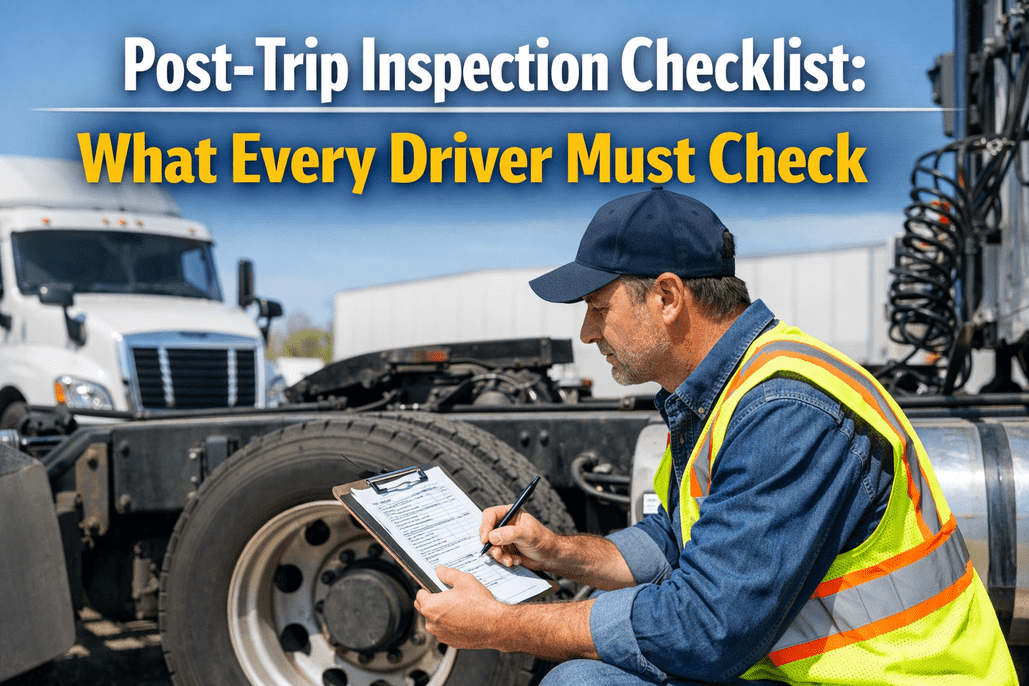
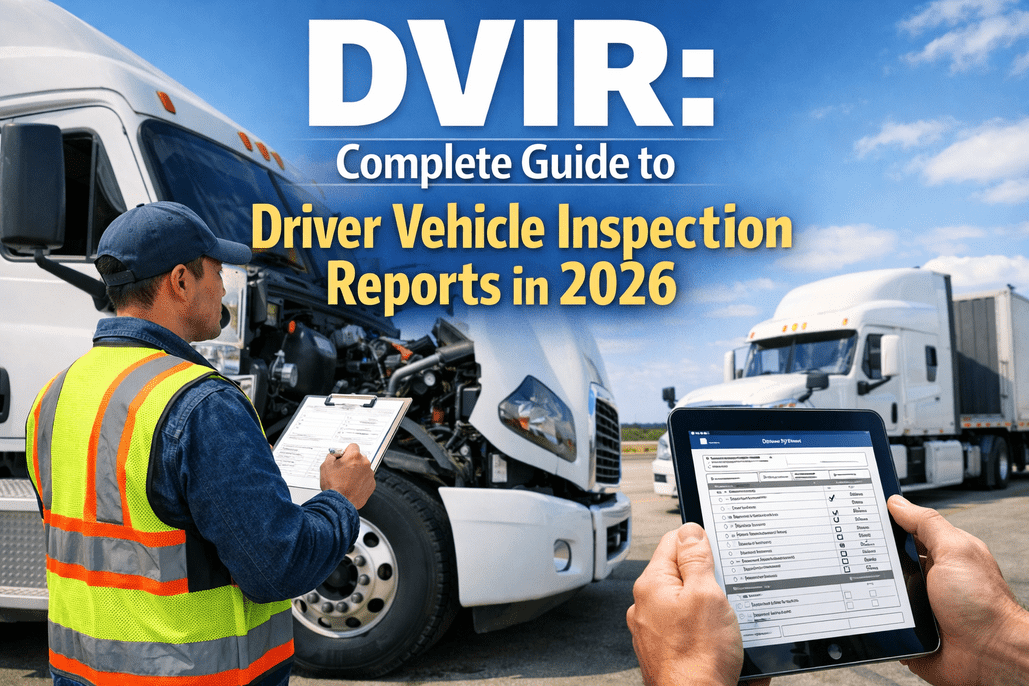
The post-trip inspection is where defects get documented — and it's the trigger for the entire DVIR compliance chain. While pre-trip inspections get most of the training attention, experienced fleet safety managers know that the post-trip is where the real maintenance value lives. Defects found at end of shift give technicians overnight to diagnose and repair, so trucks roll out clean the next morning instead of delaying departure. Under 49 CFR 396.11, the post-trip is when drivers must prepare their DVIR — the written report that documents defects discovered during the day's operation. FMCSA estimates this process prevents approximately 14,000 accidents annually, yet 95% of all driver DVIRs report no defects — a statistic that raises questions about inspection quality across the industry. This guide provides the complete post-trip inspection checklist, the FMCSA regulatory requirements, the proper defect reporting process, and the digital tools that make end-of-day inspections faster and more thorough.
Why Post-Trip Inspections Matter
Pre-trip inspections verify the vehicle is safe before driving. Post-trip inspections catch what developed during operation — the brake that started grabbing 200 miles in, the tire that picked up a nail, the clearance light that burned out, the air leak that appeared after loading. Catching these at end of shift instead of next morning's pre-trip creates a critical maintenance window that keeps trucks on schedule.
R
Overnight Repair Window
Defects reported at 5 PM get repaired overnight. Defects found at 5 AM delay departure, waste driver hours-of-service time, and disrupt load schedules. Post-trip creates the maintenance window that pre-trip cannot.
D
DVIR Compliance Trigger
The DVIR is a post-trip document (§396.11). It's completed at the end of the workday — not before driving. Every defect documented on a DVIR starts the repair-certification-review chain that auditors check.
L
Litigation Defense
A consistent post-trip program with documented inspections proves the carrier actively monitors vehicle condition. In nuclear verdict cases, juries look for evidence that the fleet took safety seriously — or didn't.
P
Predictive Maintenance Data
Post-trip reports over time reveal defect patterns by vehicle, route, and driver. This data enables predictive maintenance — fixing components before they fail on the road, where costs multiply 5-10x.
FMCSA Post-Trip Requirements
The post-trip inspection is governed primarily by 49 CFR 396.11, with the repair and review cycle extending into §396.13. Here's an important nuance that many drivers and even fleet managers miss: FMCSA does not technically require a formal "post-trip inspection" — it requires the driver to prepare a DVIR at the completion of each day's work reporting any defects discovered during or after operation. The practical effect is the same, but the regulatory distinction matters for compliance.
End of Shift
Driver
Inspect vehicle. Prepare DVIR listing any defects affecting safety or likely to cause breakdown. Sign the report.
§396.11(a)
➔
Before Next Dispatch
Carrier / Mechanic
Repair defects listed on DVIR that affect safety (per Appendix G). Certify on the original DVIR that repair is complete or unnecessary. Sign.
§396.11(a)(3)
➔
Next Driver's Pre-Trip
Next Driver
Review previous DVIR. If defects were noted, sign acknowledging review and confirming repairs were made. Then perform pre-trip.
§396.13
Key Rules Drivers Must Know
No-defect DVIR not required — Since 2014 (property-carrying) and 2020 (passenger-carrying), drivers only need to submit a DVIR when defects are found. Your company may still require daily DVIRs as policy.
One DVIR per vehicle per day — If you operate multiple vehicles during a shift, you must prepare a separate DVIR for each vehicle operated.
Report includes all defects from entire day — Not just end-of-day findings. Any defect discovered by or reported to the driver during that day's operation must be on the DVIR.
Carrier must retain for 3 months — The original DVIR, repair certification, and next-driver review must be kept for 90 days from the report date.
Complete Post-Trip Checklist Items
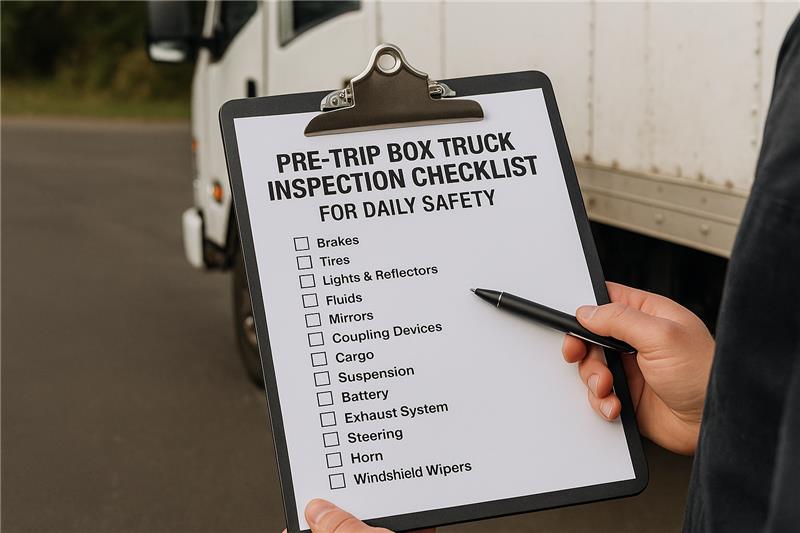
The post-trip checklist mirrors the pre-trip items listed in §396.11(a)(1) — the same 11 component categories. But the post-trip focus is different: you're looking for what changed during operation, what developed under load, and what's deteriorating. Here's each component with the specific end-of-day conditions to watch for.
01
Service Brakes
End-of-day focus: Did brakes pull or grab during operation? Any brake fade on downgrades? New air leaks audible? Unusual heat or smell at any wheel end? Air pressure holding or dropping faster than morning?
02
Parking Brake
End-of-day focus: Holds vehicle stationary after day's operation? Any change in engagement feel or position?
03
Steering Mechanism
End-of-day focus: Any play that wasn't there this morning? Steering wander or pull that developed during the day? Power steering whine or stiffness? New fluid leaks under steering components?
04
Lighting & Reflectors
End-of-day focus: Walk the full perimeter with all lights on. This is the most commonly failed item — lights burn out during operation. Check every clearance marker, tail, brake, and turn signal. Note any cracked or missing lenses.
05
Tires
End-of-day focus: Visual check for nails, cuts, or damage picked up during the day. Any tire significantly hotter than others (indicates possible brake drag or underinflation)? Tread wear patterns developed under load?
06
Horn
End-of-day focus: Still functional? Any change in sound volume or operation?
07
Windshield Wipers
End-of-day focus: If used during the day — still clearing properly? New chips or cracks in windshield from road debris?
08
Mirrors
End-of-day focus: Any new damage from loading docks, tight spaces, or road debris? Mounting still secure after day's vibration?
09
Coupling Devices
End-of-day focus: Fifth wheel still locked tight (tug test)? Air lines intact — no rubbing damage from the day's turns? Electrical cord still connected? Safety chains/devices present?
10
Wheels & Rims
End-of-day focus: Look for fresh rust trails around lug nuts (indicates loosening during operation). Any new cracks visible? Hub seal leaks that developed under operating temperature?
11
Emergency Equipment
End-of-day focus: Fire extinguisher still secured and charged? Reflective triangles still present? Any emergency equipment used or displaced during the day?
How to Report Defects Properly
A vague defect description wastes everyone's time. "Brake problem" tells the mechanic nothing. The goal is a report specific enough that a technician can locate and diagnose the issue without tracking down the driver — especially on overnight repair shifts when the driver isn't available.
"Brake issue"
"Light out"
"Strange noise"
"Steering feels off"
"Tire problem"
VS
"Left rear drive axle brake grabbing above 40 mph — started after 2nd delivery"
"Right rear trailer clearance marker light inoperative — 3rd light from back"
"Grinding sound from front driver-side wheel end — occurs during braking only"
"Steering pulls right on straight road — developed after loading at Facility B"
"Left front steer tire — nail in tread at 4 o'clock position, slow air loss"
Mechanic Sign-Off Process
Once a driver submits a DVIR with defects, the carrier's responsibility begins. The mechanic sign-off process is the step that gets broken most often — and it's the step that auditors check first because a missing repair certification means the vehicle was potentially dispatched with a known, unrepaired defect.
1
Receive DVIR with Defects
Carrier receives driver's signed DVIR. Maintenance team reviews defect descriptions and photos (if digital). Determines which defects require immediate repair (per Appendix G) vs. which can be monitored.
2
Repair or Determine Unnecessary
Carrier must repair any defect that would affect safe operation or cause breakdown. If the defect doesn't meet that threshold, the carrier may certify that repair is "unnecessary" — but this decision must be defensible.
3
Certify on Original DVIR
The mechanic or carrier official signs the original DVIR certifying that each listed defect has been repaired or that repair is unnecessary. This must happen before the vehicle is dispatched again. Penalty for dispatching without certification: up to $15,420.
4
Next Driver Reviews and Signs
Before operating the vehicle, the next driver reviews the DVIR, confirms the repair certification exists, and signs to acknowledge the review. This completes the chain of custody. Missing this signature = audit violation.
Digital Post-Trip Inspection Tools
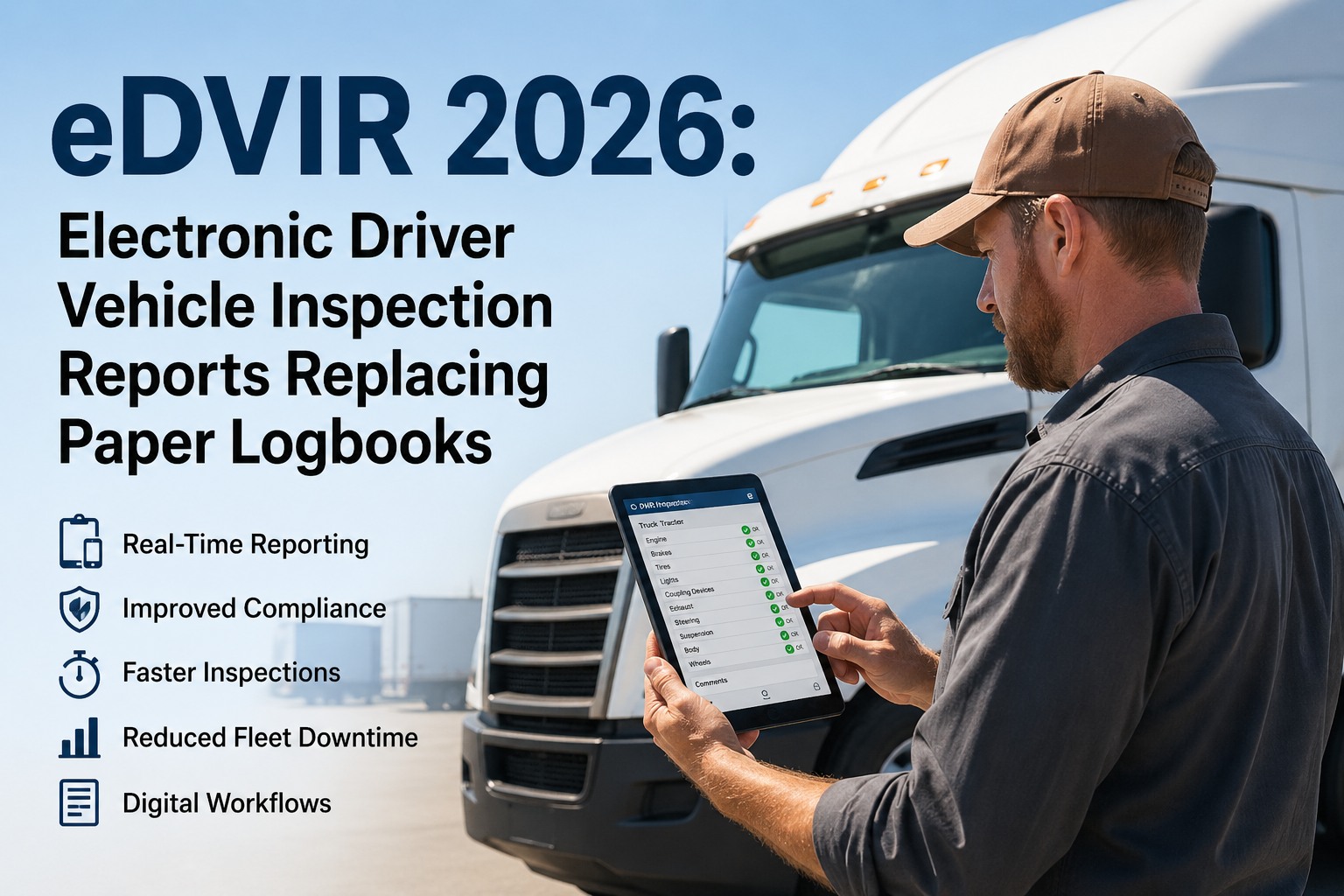
Paper post-trip forms create the largest compliance gap in the DVIR chain: the 12-18 hour delay between when a driver writes a defect on paper and when maintenance sees it. Digital tools close this gap to zero — and deliver measurable improvements in repair turnaround, inspection quality, and audit readiness.
40-67%
Faster inspection completion
Guided checklists eliminate guesswork. Tap-to-select defect categories replace handwriting. Auto-populated vehicle info saves repetitive entry.
35-40%
More defects detected
Required fields prevent skipping items. Photo gates force visual confirmation. Severity ratings prompt deeper evaluation.
0 min
Defect-to-maintenance delay
Instant push notification to maintenance team when defect submitted. Auto-generated work order with photos, location, severity. No paper sitting in a cab overnight.
100%
Chain-of-custody enforcement
System blocks dispatch until mechanic certifies repair. Next driver must acknowledge DVIR before their pre-trip can begin. No broken links.
Replace paper post-trip forms with guided digital inspections.
Start your free HVI trial — instant defect routing, photo documentation, and automatic repair tracking. Or
book a demo to see the complete post-trip workflow.
Post-Trip Best Practices
These practices separate fleets with 99%+ DVIR compliance from those that struggle with audit findings and missed defects.
01
Do the post-trip at the vehicle, not in the cab. The most common "pencil-whipping" pattern is a driver completing the post-trip form from the driver's seat without walking around the vehicle. Get out. Walk. Look. Touch.
02
Report what developed, not just what's broken. A brake that's "starting to pull slightly" is maintenance intelligence. A brake that "locked up on I-80" is an emergency. The post-trip catches trend before failure.
03
Check lights at end of day — every time. Burned-out lights are the #1 "gateway violation" that triggers full roadside inspections. One minute walking the perimeter with all lights on prevents the most common enforcement encounter.
04
Submit the DVIR immediately. Don't wait until you're home or doing paperwork later. Submit it while you're at the vehicle and the inspection is fresh. Digital tools with mobile submission make this instant.
Start free with HVI.
05
Use photos for every defect. A photo of a cracked brake line is worth 1,000 words on a paper form. It tells the mechanic exactly what they're dealing with, proves the inspection was thorough, and provides litigation-grade evidence.
06
File a DVIR even when your company doesn't require no-defect reports. While federal law no longer requires a no-defect DVIR, filing one creates a continuous documentation trail that proves inspections happen every day — not just when something breaks. Smart carriers require this.
CSA Overhaul — February 2026
FMCSA's most significant CSA reform since 2010 is now fully enforced. Vehicle Maintenance is split into two compliance categories: "Vehicle Maintenance" (found during Level I / scheduled maintenance) and "Vehicle Maintenance: Driver Observed" — violations a driver could have or should have caught during pre-trip and post-trip walk-around inspections. This means every burned-out light, low tire, or leaking air line you miss on your post-trip now appears in a separate scoring bucket tied directly to driver inspection quality. Carriers and drivers both carry visibility into this score.
eDVIR Rule Finalized — February 2026
FMCSA has officially finalized that Driver Vehicle Inspection Reports may be created, maintained, and signed electronically — removing the last ambiguous language around paper-based requirements. This clears the regulatory path for carriers still hesitating on digital post-trip tools. Combined with the removal of the spare fuse and liquid-burning flare requirements, the regulations are modernizing rapidly.
Simplified Severity Weights
The old 1-10 severity scale is gone, replaced by a two-tier system: OOS violations = weight 2, all others = weight 1. Over 2,000 individual violation codes are consolidated into approximately 116 violation groups. Multiple violations from the same group during one inspection count as a single violation — but that one violation still hits your score. The best defense is a thorough post-trip that catches issues before the roadside officer does.
12-Month Violation Window
Only violations from the past 12 months (down from 24) will generate a compliance category percentile. This rewards carriers who improve quickly — but also means recent violations carry more weight. A clean 12 months of thorough post-trip inspections and zero Driver Observed violations can reset your Vehicle Maintenance score entirely.
Nuclear Verdict Trends
Average truck accident jury verdicts continue to climb, with several exceeding $100 million in 2024-2025. Plaintiff attorneys specifically target inspection records — looking for patterns of incomplete DVIRs, pencil-whipped post-trips, and known defects that went unrepaired. Digital post-trip records with GPS timestamps, photos, and complete chain-of-custody documentation are the strongest defense against negligent maintenance claims.
The Inspection That Keeps Tomorrow's Truck Running
Pre-trip inspections verify a truck is safe to drive. Post-trip inspections make sure tomorrow's truck is ready to drive. The 5-10 minutes you invest at end of shift create the overnight repair window, the DVIR documentation chain, and the maintenance data that keeps your fleet running, compliant, and defensible. With FMCSA's CSA overhaul making "Driver Observed" violations a separate scoring category, the quality of your post-trip inspection has never been more visible. Make it thorough. Make it specific. Make it digital.
Make Post-Trip Inspections Fast, Thorough, and Compliant
HVI's digital post-trip workflow guides drivers through every §396.11 item, captures photo evidence, routes defects instantly to maintenance, and enforces the repair-certification-review chain automatically. Compliance dashboards show every vehicle's DVIR status in real time.
Frequently Asked Questions
Q: Is a post-trip inspection required by FMCSA?
FMCSA doesn't specifically require a formal "post-trip inspection" in the same way §392.7 requires a pre-trip. However, §396.11 requires the driver to prepare a written report (DVIR) at the completion of each day's work documenting any defects found. The practical effect is the same — the driver must inspect the vehicle to know what to report. Most carriers require a formal post-trip as company policy.
Q: Do I need to submit a DVIR every day even if nothing is wrong?
Not under federal law. Since 2014 (property-carrying CMVs), a DVIR is only required when defects are found. However, most carriers require daily DVIRs regardless — this is a strong best practice that creates continuous documentation for audit defense and maintenance tracking.
HVI makes daily DVIRs take under 5 minutes.
Q: What's the difference between a post-trip inspection and a DVIR?
The post-trip inspection is the physical act of checking the vehicle at the end of your shift. The DVIR is the written documentation of what you found. Think of it as: the post-trip is the inspection, the DVIR is the report. Both happen at end of day, but they're technically separate — the inspection is implied by the reporting requirement.
Q: Who must sign the DVIR after I submit it?
Three signatures may be required: (1) You — the driver who prepared it. (2) The mechanic or carrier official — who certifies defects were repaired or repair is unnecessary. (3) The next driver — who reviews the DVIR and acknowledges the repair status before operating the vehicle. All three create the "chain of custody" that auditors verify.
Q: What happens if the carrier doesn't repair a defect I reported?
The carrier must repair any defect that affects safe operation before dispatching the vehicle. If they certify the defect as "repair unnecessary" on the DVIR, that decision must be defensible — items listed in Appendix G that affect safety must be repaired. Dispatching an unrepaired vehicle with a documented safety defect carries penalties up to $15,420 and creates severe litigation exposure.
Q: Can I do my post-trip inspection electronically?
Yes. Electronic DVIRs are authorized under 49 CFR 390.32 (since 2018), and FMCSA's May 2025 NPRM proposes adding explicit eDVIR language to §396.11. Digital post-trip tools with photo capture, GPS verification, and instant defect routing are increasingly preferred by carriers for compliance quality and speed.
Book a demo to see HVI's digital post-trip workflow.