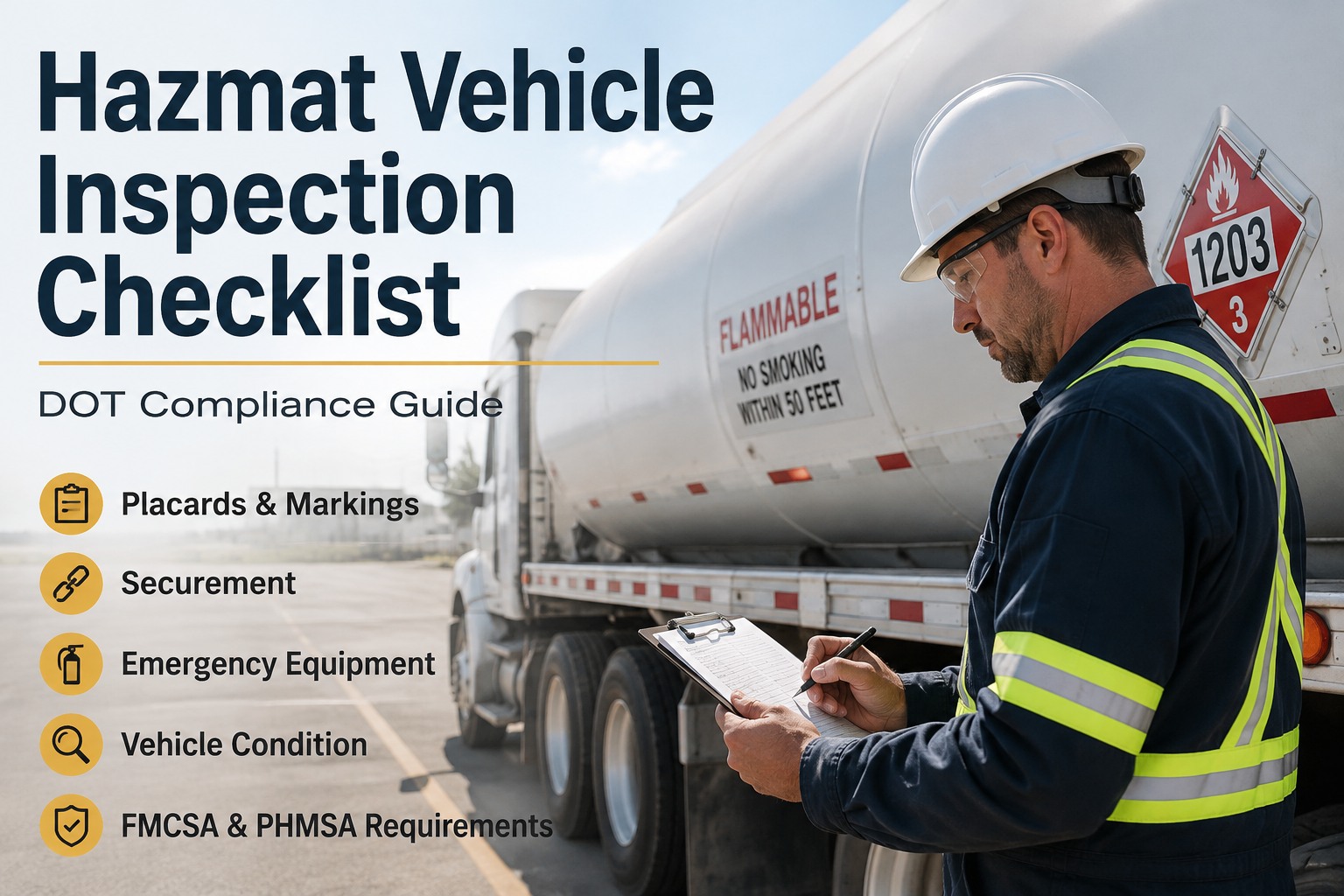
A hazmat vehicle inspection is not one checklist. It is a matrix. Class 3 flammable liquid, Class 8 corrosive, Division 2.1 flammable gas, and Class 1 explosives each carry different placarding rules, segregation requirements, fire extinguisher ratings, warning-device restrictions, and emergency equipment. Using the same checklist across all hazmat loads produces predictable roadside violations under 49 CFR 397. This guide walks the class-by-class matrix and the daily discipline that keeps hazmat units audit-ready — book a demo to see class-specific hazmat inspections in HVI.
Hazmat Inspection Matrix — What Changes By Hazard Class
Same truck. Same driver. Different load. Completely different required equipment and inspection points under 49 CFR.
| Requirement | Class 1 Explosives |
Div 2.1 Flammable Gas |
Class 3 Flammable Liquid |
Class 8 Corrosive |
|---|---|---|---|---|
| Fire extinguisher §393.95 | 10 B:C min | 10 B:C min | 10 B:C min | 10 B:C min |
| Fusees §393.95(g) | Prohibited | Prohibited* | Prohibited* | Allowed |
| Placards all 4 sides §172 | Required | Required | Required | Required |
| Attendance rule §397.5 | Strictest — always | Enhanced | Enhanced | Standard |
| Spill kit type | Class-matched | Gas leak PPE | Hydrocarbon sorbent | Neutralizing sorbent |
| Routing restriction §397.67 | Route plan mandatory | Route plan mandatory | Local restrictions | Local restrictions |
*Fusees prohibited on cargo tanks hauling Div 2.1 flammable gas or Class 3 flammable liquid, loaded or empty. Liquid-burning flares removed from §393.95(f) effective March 23, 2026 — FMVSS 125 reflective triangles only.
The rest of this page walks the 5 required inspection categories for every hazmat load (Vehicle condition / Placards / Documentation / Emergency equipment / Segregation), the class-specific upgrades on top of standard CMV rules, the segregation table under §177.848 that prevents incompatible loads from riding together, and the daily discipline that turns hazmat inspection from an accident-waiting-to-happen into a defensible audit trail. Book a 30-minute demo to see per-vehicle hazmat inspection tracking in HVI.
The 5 required inspection categories — what applies to every hazmat load
Every hazmat inspection covers five categories regardless of hazard class. The class-specific matrix above stacks on top of these baseline requirements — it does not replace them. Skip any category and the load is out-of-service at the next roadside stop under 49 CFR 397, regardless of whether the class-specific requirements were correctly followed.
| Category | What to verify | Regulation |
|---|---|---|
| 1. Vehicle condition | Standard DVIR items (brakes, tires, lights, steering, coupling) with heightened scrutiny; tank integrity for cargo tanks; valves and closures properly sealed | 49 CFR §396.11 + §396.13 |
| 2. Placarding | Correct placards displayed on all four sides; UN/NA numbers visible; color, symbol, and class match cargo; placards secure and undamaged | 49 CFR §172.500 series |
| 3. Documentation | Shipping papers within driver's reach; Emergency Response Guidebook (current edition) onboard; CDL with hazmat endorsement current; TSA background verified | 49 CFR §177.817 |
| 4. Emergency equipment | Fire extinguisher rated per class (10 B:C for hazmat, 5 B:C for standard CMV); three FMVSS 125 reflective triangles; class-matched spill kit and PPE | 49 CFR §393.95 |
| 5. Segregation & securement | Incompatible hazard classes properly separated per segregation table; cargo securement rated to prevent shift; blocking and bracing per material | 49 CFR §177.848 |
The category order matters. Roadside inspectors typically walk them in the same sequence: exterior placarding first (visible from 25 feet), then vehicle condition, then documentation review in the cab, then emergency equipment, then a look at securement and segregation if the load is visible or if the driver opens the trailer. Fleets that structure their pre-trip DVIR in the same sequence catch defects in the order inspectors will find them — giving drivers a chance to remedy before dispatch rather than during a roadside stop. Book a demo to see class-configurable hazmat DVIR templates in HVI.
The 4 class-specific upgrade points that catch out most fleets
Roadside violations on hazmat loads rarely come from missing an entire category. They come from applying the standard CMV rule when the hazmat class requires an upgrade or restriction. Four specific upgrade points account for the majority of hazmat-related out-of-service orders and civil penalties issued in the last 24 months.
Fire extinguisher rating
Standard CMV requires 5 B:C minimum under §393.95. Hazmat loads require 10 B:C minimum. Fleets that spec 5 B:C across the fleet uniformly get written up on every hazmat inspection until the extinguisher is upgraded. Verify rating stamp is 10 B:C or higher on any hazmat unit.
Warning device restrictions
Fusees prohibited on any CMV hauling Class 1.1/1.2/1.3 explosives, or on cargo tanks hauling Class 3 flammable liquid or Division 2.1 flammable gas (loaded or empty). Liquid-burning flares removed from allowed devices under §393.95(f) effective March 23, 2026. Standardize on FMVSS 125 reflective triangles fleet-wide.
Attendance rule violations
§397.5 requires hazmat vehicles to be attended by their driver at all times when parked with limited exceptions (safe haven, driver's residence, secure carrier facility). Fuel stops, meal breaks, and overnight parking outside approved facilities without driver attendance produce automatic violations and, on Class 1 explosives, extended enforcement.
Segregation table errors
§177.848 segregation table forbids certain hazard classes from riding together in the same vehicle even at low quantities. Common error: oxidizers (Class 5.1) loaded with flammable liquids (Class 3) or corrosives (Class 8). Requires per-shipment segregation verification against the table before loading, not after.
All four upgrade points share the same root cause: applying general commercial vehicle rules to hazmat operations without checking the hazmat-specific overlay. The fix is structural: hazmat inspection templates that carry the class-specific requirements built in, so drivers verify the upgraded requirements every time rather than relying on memory or the standard DVIR to catch them. Paper checklists rarely enforce this discipline; well-designed digital templates make it automatic. Book a demo to see class-aware digital hazmat inspection templates in HVI.
The 4 discipline points that keep hazmat units audit-ready
Well-run hazmat programs share four operational disciplines that separate audit-defensible fleets from the ones that fail their first PHMSA or FMCSA compliance review. These are not regulatory requirements — they are the practical routines that satisfy the requirements consistently across every driver, every load, every day.
Pre-trip in inspector sequence
- Exterior placarding first (25-ft visibility)
- Vehicle condition second (DVIR + tank)
- Documentation third (papers + ERG + CDL HME)
- Emergency equipment fourth (10 B:C, triangles, kit)
Photo evidence at capture
- All 4 placards photographed with visible UN/NA
- Shipping papers and ERG onboard photo
- Fire extinguisher gauge in green + rating
- Timestamped audit trail per pre-trip
Training expiration tracking
- Hazmat employee training every 3 years min
- Automated alerts 60 days before expiration
- Central record accessible for PHMSA audit
- Most-cited PHMSA compliance gap when missed
Route + attendance discipline
- Route plan verified per §397.67 for restricted classes
- Attendance rules briefed per §397.5
- Approved safe-haven list current per lane
- Documented driver acknowledgment per trip
The four disciplines work together. Photo evidence on the pre-trip creates an audit trail that placards were verified before dispatch. Training expiration tracking prevents the single most common PHMSA violation. Route planning satisfies the §397.67 requirement that non-explosive hazmat routes are still subject to state/local restrictions carriers must respect. Attendance discipline prevents the §397.5 unattended-vehicle violation that catches many fleets during fuel stops and overnight parking. Together they turn hazmat compliance from a memory-and-vigilance problem into a structural one. Start a free HVI trial to see the 4-discipline workflow applied per hazmat unit.
A hazmat compliance manager on rebuilding inspection after a $34K PHMSA finding
We're a 54-tractor specialty carrier hauling primarily Class 3 flammable liquids and Class 8 corrosives across the Gulf Coast — petrochemical refineries to industrial distributors. Ran clean for 11 years on a paper-checklist DVIR system that all our drivers knew by heart. The 2024 PHMSA compliance review changed how we do inspection.
The audit found three structural gaps. First, our fire extinguishers were spec'd at 5 B:C fleet-wide — correct for standard CMV, wrong for hazmat where 10 B:C is minimum under §393.95. Every hazmat inspection would have written us up if a roadside had caught it first. Second, our hazmat employee training records were partially incomplete — some drivers were 6-9 months past the 3-year recertification window with no automated alerts to catch it. Third, our paper DVIRs used one template for all loads with class-specific requirements listed in the margins as "verify if applicable" — which drivers routinely skipped on Class 3-only runs even when a mixed Class 3 + Class 8 load required both.
Direct fines totaled roughly $34,000 across the three finding categories. Bigger impact: 90-day corrective action plan with mandatory monthly PHMSA reporting until closure, and a safety rating review that came within one grade of Conditional. We restructured over Q3-Q4 2024: fleet-wide fire extinguisher swap to 10 B:C, class-specific digital hazmat DVIR templates that force verification of every class-relevant requirement before submission, automated hazmat training expiration alerts 60 days out, and photo-evidence requirements on placards and emergency equipment every pre-trip. Two subsequent PHMSA follow-up reviews closed with zero findings. The class-aware template alone eliminated 80% of the risk. The paper system was working right up until the day it wasn't.
Frequently asked questions
What is required in a hazmat vehicle inspection?
Hazmat vehicle inspection under 49 CFR covers five required categories on every load, plus class-specific upgrades that vary by hazard class. The five baseline categories: (1) Vehicle condition per §396.11 and §396.13 covering standard DVIR items (brakes, tires, lighting, steering, coupling, exhaust, fuel system) with heightened scrutiny, plus tank integrity and valve/closure sealing on cargo tanks. (2) Placarding per 49 CFR §172.500 series requiring correct placards on all four sides of the vehicle with visible UN/NA numbers, matching color/symbol/class to the cargo, secure and undamaged. (3) Documentation including shipping papers within the driver's reach per §177.817, the current Emergency Response Guidebook (ERG) onboard, CDL with hazmat endorsement (HME) current, and TSA background check verified. (4) Emergency equipment per §393.95 requiring a fire extinguisher rated 10 B:C minimum for hazmat loads (higher than the 5 B:C standard CMV minimum), three FMVSS 125 reflective triangles (liquid-burning flares removed from allowed devices effective March 23, 2026), and class-matched spill kit and PPE. (5) Segregation and securement per §177.848 requiring incompatible hazard classes to be properly separated and cargo secured to prevent shift during transport. Class-specific requirements stack on top: routing restrictions under §397.67 for certain classes, enhanced attendance rules under §397.5 for explosives, and prohibited warning devices (fusees) on Class 1 explosives and cargo tanks hauling Class 3 or Division 2.1.
Do all hazmat vehicles need the same equipment?
No. The core inspection categories apply to every hazmat load, but specific equipment and inspection requirements vary significantly by hazard class. Fire extinguisher rating: 10 B:C minimum for all hazmat under §393.95, upgraded from the 5 B:C standard CMV minimum. Warning devices: three FMVSS 125 reflective triangles for all commercial vehicles; fusees allowed on Class 8 corrosives but prohibited on Class 1.1/1.2/1.3 explosives and on cargo tanks hauling Class 3 flammable liquids or Division 2.1 flammable gas (loaded or empty) under §393.95(g); liquid-burning flares removed from allowed devices for all vehicles effective March 23, 2026. Spill kit: type and sorbent must match cargo class — hydrocarbon sorbent for Class 3, neutralizing sorbent for Class 8 corrosives, gas-leak PPE for Division 2.1, class-matched materials for other classes. PPE: minimum gloves and eye protection matched to materials placarded, with additional respiratory or chemical-resistant equipment required for specific classes. Attendance rules under §397.5: strictest requirements apply to Class 1 explosives (always attended); other classes have enhanced but somewhat less restrictive attendance requirements. Routing restrictions under §397.67: mandatory route plans for explosive materials and radioactive materials; local and state restrictions for other classes based on jurisdiction. Applying a single equipment spec across all hazmat loads produces predictable violations; class-specific inspection templates prevent them.
Who enforces hazmat vehicle inspection rules?
Hazmat regulation is administered by the U.S. Department of Transportation with enforcement shared between two agencies. The Pipeline and Hazardous Materials Safety Administration (PHMSA) administers the Hazardous Materials Regulations (HMR) in 49 CFR Parts 171-180, covering hazmat classification, packaging, marking, labeling, placarding, shipping papers, training requirements, and general transportation standards. PHMSA conducts compliance reviews focused on hazmat handling, training, and paperwork. The Federal Motor Carrier Safety Administration (FMCSA) enforces hazmat-specific rules in 49 CFR Part 397 covering routing, parking, attendance requirements, and emergency response procedures for highway transport, plus general commercial vehicle rules in Parts 390-396 that apply on top of hazmat-specific rules. FMCSA conducts roadside inspections and safety audits that check hazmat compliance alongside general commercial vehicle compliance. State agencies enforce their own hazmat routing designations, permit requirements, and parking restrictions that stack on top of the federal framework. The Environmental Protection Agency (EPA) may regulate certain hazardous substances and hazardous wastes when environmental protection, cleanup, or disposal requirements apply. Practical enforcement typically follows this pattern: FMCSA at the roadside during regular commercial vehicle inspections (any violation may be written against the driver, the carrier, or both), PHMSA through scheduled compliance reviews (typically focused on paperwork, training records, and packaging), state agencies at their weigh stations and hazmat checkpoints. Civil penalties can reach tens of thousands of dollars per violation depending on severity and whether the violation was knowing or repeated; criminal penalties apply for willful disregard, knowing endangerment, or falsification of records.
Are digital hazmat inspections compliant?
Yes, digital hazmat vehicle inspection records are compliant under current FMCSA and PHMSA regulations and are increasingly the operational standard for any carrier serious about compliance. FMCSA has finalized electronic DVIR creation, maintenance, and signature under updated 49 CFR §396.11 language, permitting fully digital pre-trip and post-trip inspections. PHMSA does not prescribe a specific record format but requires records be retrievable and legible on demand; digital records satisfy both requirements as reliably or better than paper. Digital hazmat inspection platforms produce four structural advantages over paper systems. First, photo evidence on placards, shipping papers, emergency equipment, and cargo securement creates a timestamped audit trail that paper signatures cannot match — roadside inspectors and PHMSA auditors both accept photo evidence as verification of pre-trip conditions. Second, hazmat training records for all hazmat employees can be centralized in one system with automated expiration alerts 60 days before the 3-year recertification window closes — solving the most-cited PHMSA compliance gap during audits. Third, class-specific inspection templates can be applied automatically based on the load's hazard class, ensuring the correct upgraded requirements (10 B:C extinguisher, class-matched spill kit, prohibited-device checks, attendance-rule briefing) get verified every time rather than left to driver memory. Fourth, records are retrievable in seconds from any location for the full 14-month annual inspection retention plus 3-month DVIR retention required under 49 CFR Part 396, satisfying the on-demand production requirement that paper archives at HQ frequently fail during roadside or field inspections.
What happens if a hazmat vehicle fails inspection?
Consequences depend on the specific violation and its severity. At a roadside inspection: minor violations (missing paperwork copy, placard damage) typically produce a written warning and require correction before the vehicle continues. Serious violations (missing placards for the actual cargo, incorrect fire extinguisher rating, expired hazmat endorsement, unattended parking of restricted classes) commonly produce an out-of-service order that halts the vehicle at that location until the violation is corrected. Out-of-service orders on hazmat vehicles carry immediate operational impact: the load cannot move, the driver cannot continue, and a corrective action must be documented and inspected before the vehicle is released. Civil penalties are assessed separately by PHMSA and FMCSA and can reach tens of thousands of dollars per violation, with knowing or repeated violations at the upper end of the range. During PHMSA compliance reviews or FMCSA safety audits, multiple hazmat findings can trigger a 90-day corrective action plan with mandatory monthly reporting until closure, and can affect the carrier's safety rating (typically Satisfactory / Conditional / Unsatisfactory). A safety rating downgrade affects insurance premiums (typically 15-40% at next renewal), shipper contract eligibility (many hazmat shippers require Satisfactory rating in their carrier agreements), and future audit selection probability. Criminal penalties apply in cases involving willful disregard for safety, knowing endangerment of persons or property, or falsification of records — potentially including fines and imprisonment for responsible individuals. Because of the compounding downstream impact, hazmat carriers typically treat inspection discipline as one of the highest-ROI investments in the overall safety program.
Right template. Right upgrades. Right documentation. Every hazmat load.
HVI applies the correct class-specific hazmat inspection template based on the load, captures photo evidence on placards, papers, and emergency equipment, verifies segregation before dispatch, tracks hazmat training and CDL HME expirations, and produces the audit-ready records both roadside and PHMSA inspections actually require. Works with your existing telematics, fuel cards, and ELD platforms. Live in under two weeks. No hardware. No credit card.
Trusted by hazmat-registered fleet safety programs across the USA · Ready on day one