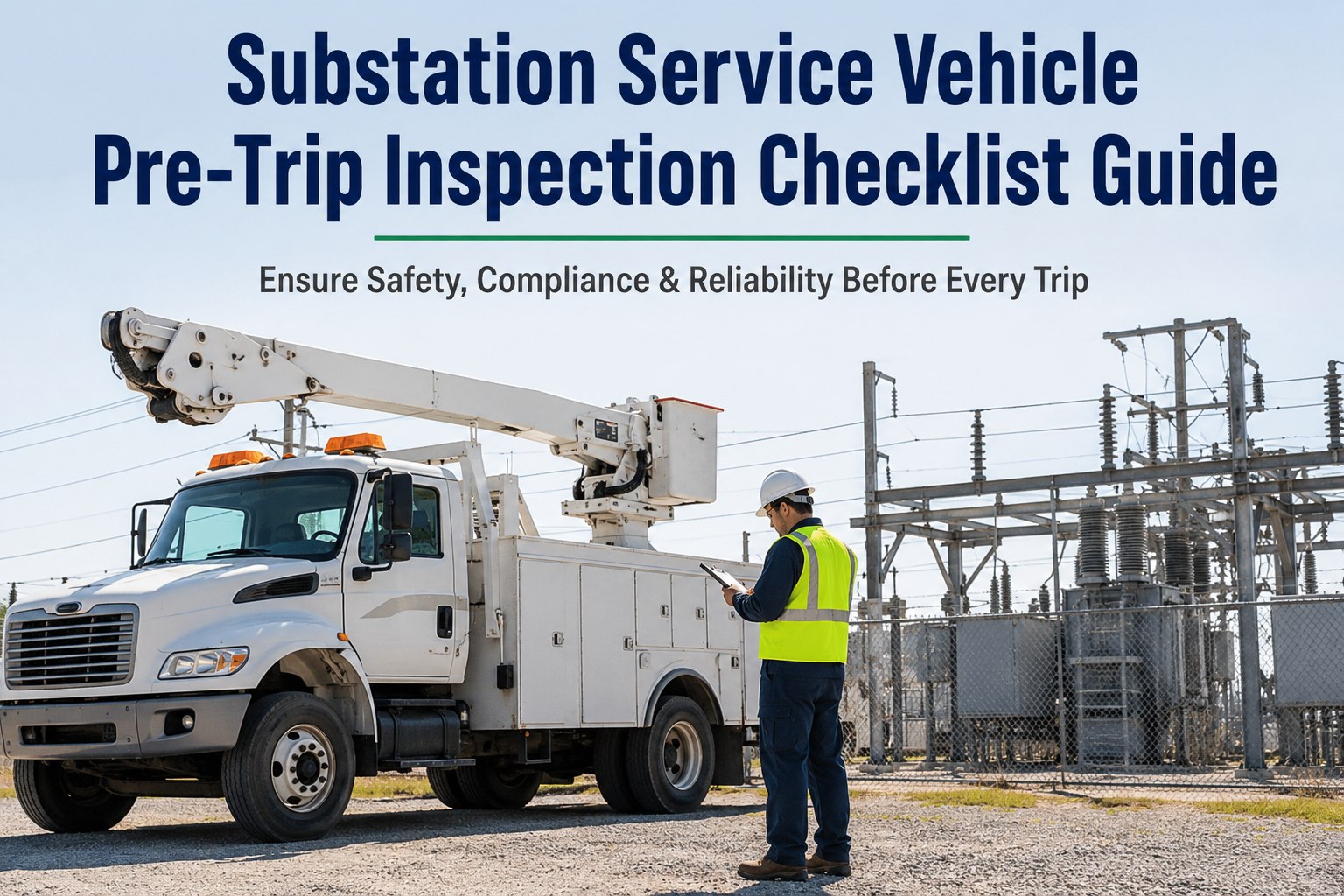
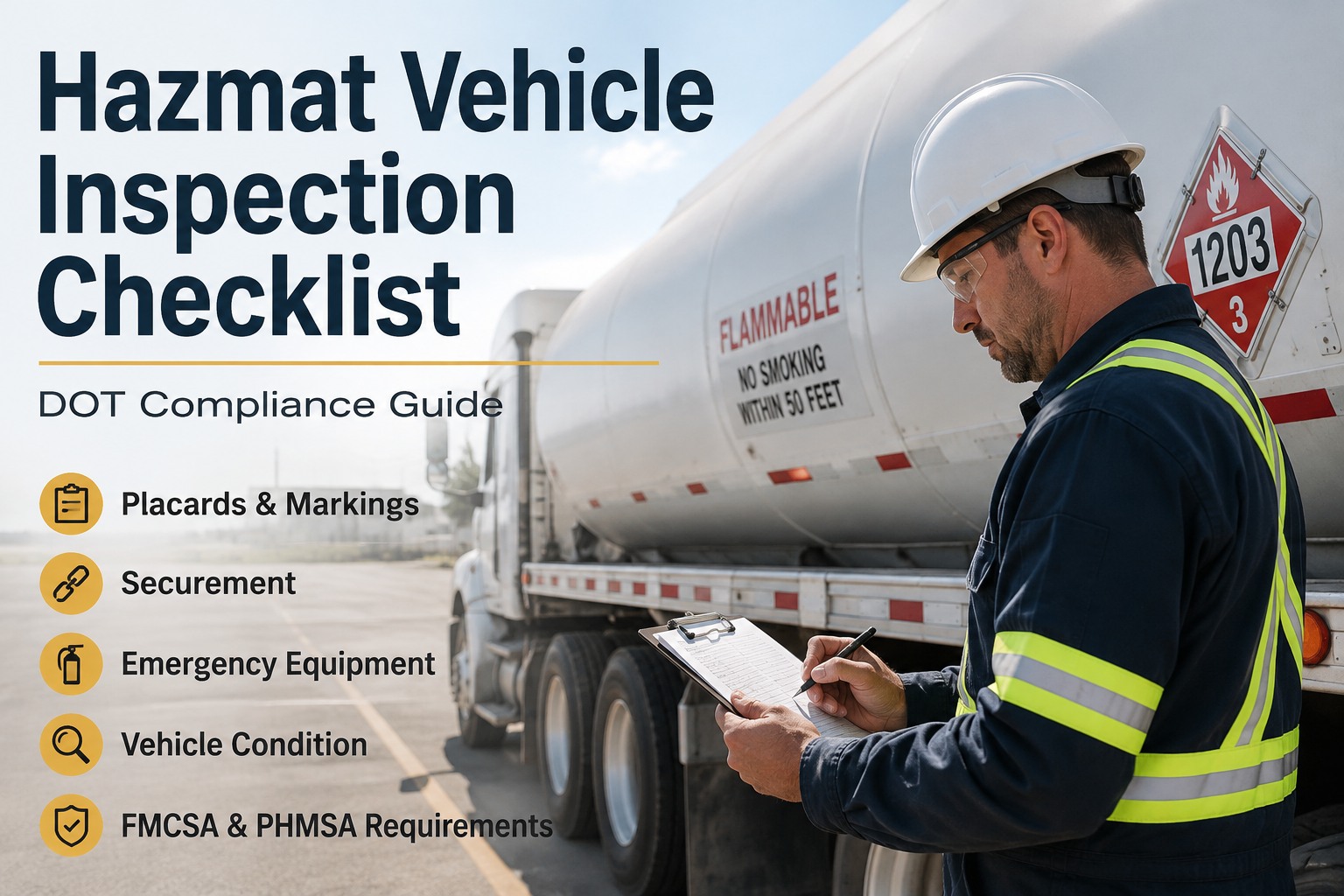
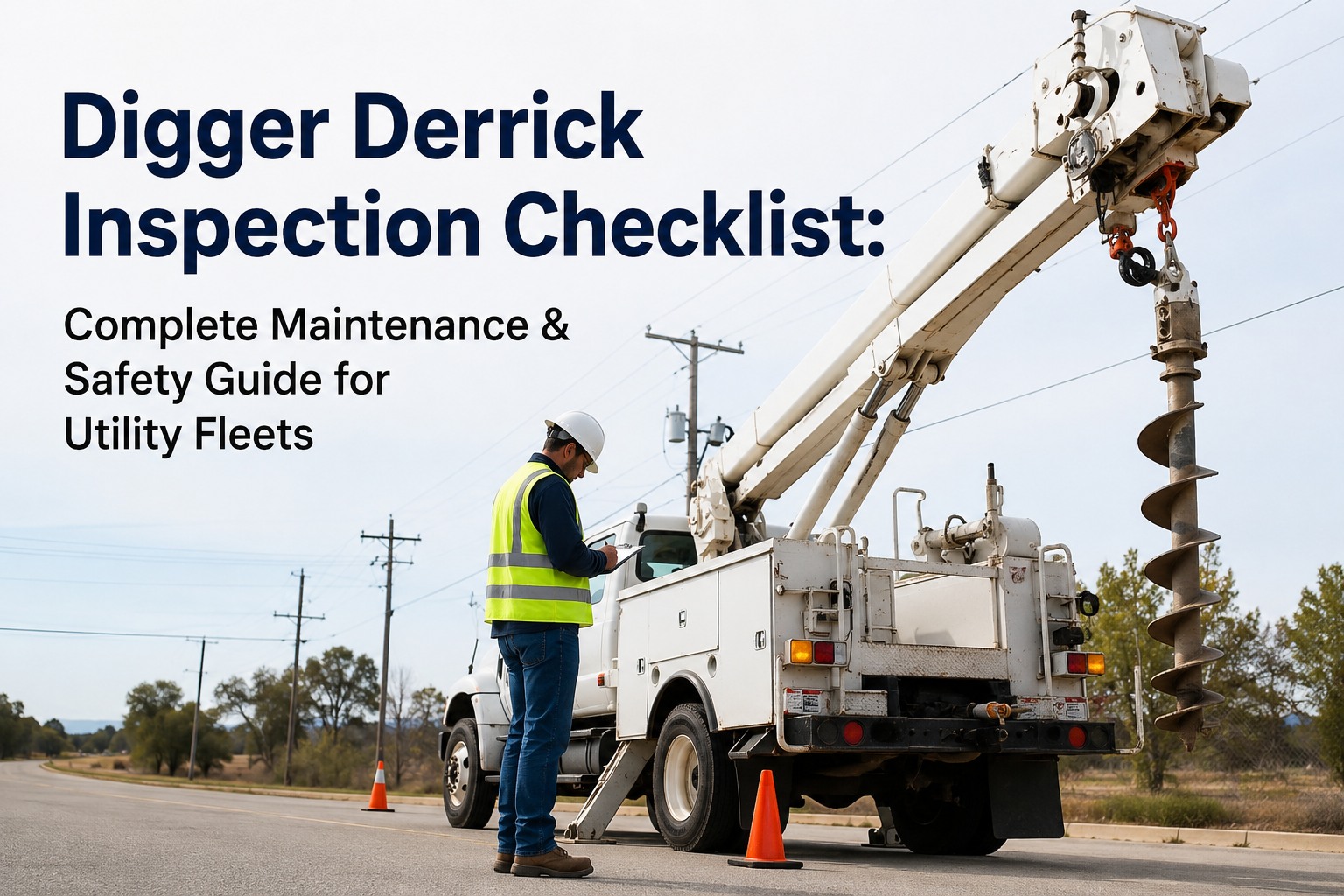
A substation service vehicle rolls out at 5:30 AM with a specific job — a relay test at a 138 kV substation, a switchgear inspection at a distribution station, an SF6 cylinder swap on a breaker. By 6 AM the crew is inside an energized yard with phase-to-phase voltages a single grounding error can turn lethal. By 9 AM they're climbing into a bucket with rubber gloves that better have been air-tested and a hot stick that better not have a crack in the FRP. By noon they're depending on the vehicle's brakes, outriggers, and hydraulics under load on a substation pad. None of that is the place to discover a problem the pre-trip would have caught at the yard. OSHA 29 CFR 1910.269 governs every minute of that day, NFPA 70E layers arc-flash and PPE rules on top, ANSI/ASTM F496/F478/F479 dictate how rubber goods are stored and tested, DOT 49 CFR 396 governs the vehicle itself, and OSHA 1910.137 covers insulating equipment. The pre-trip inspection is the daily verification that all of it is ready to do its job. Run on paper, a defect noted in pencil never reaches the next shift; run digitally, a cracked hot stick or expired glove air-test locks the vehicle out before it leaves the yard. A digital substation service vehicle inspection app turns the pre-trip into a guided, photo-verified, signed-off workflow — vehicle, utility equipment, and PPE all on the asset record, all audit-ready. This is the complete checklist.
OSHA 1910.269 + NFPA 70E + DOT 49 CFR 396
The Substation Service Vehicle Pre-Trip Inspection
Brakes, tires, lights, hot sticks, grounding clusters, SF6 cylinders, rubber goods, FR clothing, and aerial device — verified in sequence, photo-evidenced where it matters, and signed on the asset record in HVI before the vehicle rolls.
1910.269
OSHA rule that governs every shift
$165K
max OSHA willful penalty per violation
10 Sections
on a defensible substation pre-trip
15 min
to run a complete check on HVI
Why a Substation Service Vehicle Is Not a Standard Pre-Trip
A substation service vehicle is a DOT commercial vehicle — and a mobile substation-grade safety system on wheels. Four risks shape the inspection that a generic CMV checklist will miss.
Insulating Equipment
Hot sticks, rubber gloves, blankets, line hose, and sleeves only protect when they're undamaged, dry, and in-date for their dielectric test.
Grounding Equipment
Cluster bars, ground clamps, and jumpers are the line worker's last defense against an inadvertent re-energization. Damaged ferrules or scorched cables kill.
SF6 & Pressurized Gas
SF6 cylinders, nitrogen, and oxygen on board must be secured, valved, and within hydrostatic test dates. A loose cylinder in a crash is a missile.
Aerial & Hydraulics
Vehicle-mounted aerial devices require annual dielectric testing under ANSI A92.2 and a daily hydraulic and structural check before any worker enters the bucket.
The Two-Phase Pre-Trip
HVI splits the substation pre-trip into a vehicle phase (DOT-aligned) and a utility-equipment phase (1910.269 + 1910.137 + NFPA 70E aligned). Both must close in the app before the vehicle is marked operational for the shift.
PHASE 1 — VEHICLE
DOT Pre-Trip (49 CFR 396)
Engine, fluids, brakes, tires, lights, steering, mirrors, coupling, frame, and emergency equipment. Standard commercial-vehicle pre-trip with utility-specific additions for outriggers and chassis-mounted equipment.
~7 minutes
PHASE 2 — UTILITY EQUIPMENT
Substation-Specific Check
Hot sticks, grounding clusters, rubber goods, FR clothing, SF6 and gas cylinders, aerial device, insulated tools, first aid, communications, traffic control. The package that turns a vehicle into a substation work platform.
~8 minutes
The Complete Pre-Trip Checklist — Ten Sections
Every item below is what HVI's substation service vehicle template prompts in sequence. Required fields, photo evidence where it matters, and a signed sign-off before the vehicle rolls.
01
Engine, Fluids & Under-Hood
VEHICLE
Engine oil level & color; no leaks at pan/valve cover
Coolant level & condition; hoses no swelling or sweating
Hydraulic reservoir for outriggers/aerial — level & clarity
Fuel — sufficient for shift; DEF level if equipped
Air cleaner restriction indicator clear
Battery terminals clean, hold-downs tight, voltage at start
Belts & hoses — no cracks, glazing, or chafing
No abnormal noise at idle; no warning lights
02
Brakes, Steering & Suspension
VEHICLE
Air-brake build-up time within spec; no audible leaks
Service brake pulls vehicle straight; firm pedal
Parking brake holds fully loaded on grade
Steering — full lock both directions, no excessive play
U-joints, kingpins, drag link — no looseness
Springs, U-bolts, shackles intact; no broken leaves
Air dryer functioning; no oil in brake system
Anti-lock brake light cycles correctly at start-up
03
Tires, Wheels & Lights
VEHICLE
Tire pressure to manufacturer spec; valve caps in place
Tread depth — steer 4/32" minimum, drive/trailer 2/32"
No cuts to cord, chunking, bulges, or sidewall damage
Wheel lugs visibly tight; no rust streaking
Headlights (high & low), tail, brake, hazards functional
Strobes, beacons, work lights all operational
Mirrors aligned, no cracks; cab markers visible
SMV emblem & reflectors clean and present
04
Outriggers, Aerial Device & Boom
VEHICLE + UTILITY
Outrigger pads deploy fully; no hydraulic seep
Outrigger interlock prevents boom motion unless deployed
Aerial boom — no cracks, weld defects, or paint stress
Boom hoses & rotation manifold — no leaks
Bucket — no cracks; liner intact; lanyard anchor sound
Upper & lower controls respond; emergency stop functional
Annual ANSI A92.2 dielectric test current & tag on boom
Daily function test at low elevation before yard exit
05
Hot Sticks & Insulated Tools
UTILITY
Every hot stick visually inspected — no FRP cracks, splits, or contamination
Tools secure in storage tubes; tubes drained, caps in place
No moisture, oil, or dirt on hot stick surfaces
Annual electrical test date on tag, within current cycle
Insulated hand tools — no cracks in insulation, ratings legible
Voltage detector battery good, self-test passes, tip undamaged
06
Grounding Equipment
UTILITY
Ground cables — no broken strands, no scorching at clamp
Ferrule crimps tight; no exposed copper at sleeve
Clamp jaws clean, threads free, springs functional
Cluster bar — all studs present, no thread damage
Cable size matches available fault current at job site
Periodic continuity test current per utility standard
07
Rubber Goods — Gloves, Blankets, Sleeves
UTILITY
Rubber gloves — air test pre-shift; no pinholes
Glove class matches voltage exposure (Class 0/1/2/3/4)
Glove dielectric test date within ASTM F496 6-month cycle
Leather protectors intact; no exposed metal/staples
Rubber blankets clean, no tears, in canvas bag/tube
Line hose — no splits, end ducts secure
Sleeves rolled correctly, tested in cycle
All rubber goods stored away from heat, ozone, sunlight
08
PPE — FR / Arc-Rated Clothing & Head Protection
UTILITY
FR shirt & pants — ATPV/cal rating meets job's arc-flash boundary
No melted spots, holes, or worn-thin areas on FR clothing
Hard hat — Class E, no cracks, suspension intact
Arc-rated face shield, hood, or balaclava per NFPA 70E PPE category
Safety glasses, hearing protection, EH-rated boots on board
Fall arrest harness — webbing, D-rings, buckles, label legible
09
SF6, Gas Cylinders & Pressurized Equipment
UTILITY
Every cylinder secured in upright rack with chain or strap
Valve protection caps in place during transit
Hydrostatic test date current (typically 5 or 10 years)
Regulators & gauges — no damage, calibration current
SF6 cart leak-checked; recovery bottle within fill limit
DOT placards correct for any reportable quantity on board
10
Emergency, Comms & Job Site
UTILITY
Fire extinguishers — charged, in date, accessible
First aid kit complete; eye wash within expiry
Wheel chocks, cones, flags, signs for traffic control
Two-way radio & cell phone — tested, charged
Job briefing form, switching orders, single-line on board
Reflective vests, work gloves, sunscreen, water
DVIR pad / digital DVIR open in HVI ready for sign-off
Substation keys / access cards verified for the assignment
The Three Items Most Often Missed
Across utility audits, three substation pre-trip items account for the majority of citable findings. Each looks fine at a glance and isn't.
MISS 1
Rubber Glove Air Test
Roll, inflate, listen. ASTM F496 requires the air test before each use — a pinhole big enough to fail a glove is too small to see. The glove that "looked fine" is the glove that kills the lineman.
HVI fix: required pre-shift step with photo of glove + visible test date tag.
MISS 2
Hot Stick FRP Condition
A hairline crack in the FRP, surface contamination, or moisture under the cap defeats the dielectric rating instantly. The annual test passed; today's stick may not.
HVI fix: required per-stick visual + storage tube cap check + test-date verification.
MISS 3
Ground Clamp Ferrule Crimp
A loose or corroded ferrule turns a grounding cluster into ornamental copper under fault current. Visual under sleeve every shift; periodic continuity test on cycle.
HVI fix: per-cable inspection with photo + cycle-tracked continuity test record.
Out-of-Service Criteria — The Stop-Now List
OSHA 1910.269 and 1910.137 don't allow defective protective equipment on an energized job, and 49 CFR 396 doesn't allow a defective vehicle on the road. These items trigger an instant lockout in HVI — the vehicle does not roll.
CRITICAL — DO NOT DEPLOY
Rubber glove fails air test or out-of-date
Hot stick with crack, contamination, or expired test
Ground cable with broken strands or damaged ferrule
Aerial device with annual dielectric out of date
Service or parking brake failure
Steering excessive play or assist failure
Outrigger interlock allows boom motion when retracted
SF6 / gas cylinder unsecured or out of hydro
Backup alarm, horn, or required light inoperable
FR clothing missing or rated below job's arc boundary
Paper Clipboard vs. HVI Substation Workflow
A defect noted in pencil at 5:30 AM never reaches the next shift, the maintenance shop, or the OSHA inspector who arrives after an incident. HVI keeps every check, defect, and work order on one searchable record.
PAPER CLIPBOARD
Glove air test "done" but not verified
Hot stick test dates checked from memory
Ground cable visual logged as one tick mark
PPE category tracked across multiple spreadsheets
Audit prep means days of folder digging
HVI MOBILE APP
Air test step with photo evidence required
Hot stick test dates verified per stick with QR scan
Per-cable ground inspection with continuity cycle tracking
PPE category & FR rating bound to the assignment
Full audit package exports in under 5 minutes
Roll Every Substation Vehicle Off a Verified Pre-Trip
HVI gives investor-owned and municipal utilities a digital pre-trip inspection app aligned to OSHA 1910.269, 1910.137, NFPA 70E, ANSI A92.2, and DOT 49 CFR 396 — pre-built templates for substation service vehicles, line vehicles, digger derricks, and bucket vehicles, with photo-evidenced defects, severity-routed work orders, dielectric test tracking, and a 5-minute audit export. Trusted by 25,000+ users worldwide.
Frequently Asked Questions
What standards govern a substation service vehicle pre-trip?
Four overlapping rule sets apply to every shift. OSHA 29 CFR 1910.269 governs electric power generation, transmission, and distribution work — job briefings, energized work practices, and protective equipment requirements. OSHA 1910.137 governs the electrical protective equipment itself — rubber gloves, sleeves, blankets, line hose, and their inspection and test requirements. NFPA 70E layers arc-flash boundaries and PPE-category selection (CAT 1 through CAT 4) over the OSHA worker rules. ANSI A92.2 governs vehicle-mounted aerial devices — annual dielectric tests, daily function tests, and structural inspection. DOT 49 CFR 396 governs the vehicle itself as a commercial motor vehicle — daily driver vehicle inspection report (DVIR), maintenance, and out-of-service criteria. HVI's substation template encodes all four into one workflow, so the pre-trip produces evidence for every audience at once.
Start a free HVI trial to run the full check.
How often do rubber gloves and hot sticks need to be tested?
ASTM F496 requires rubber insulating gloves to be dielectric-tested every 6 months in service. The test is performed by a certified lab, the test date is stamped on the glove, and the air test is required before each use to catch pinholes that develop between lab tests. Sleeves under ASTM F496 are also on a 6-month cycle. Blankets under ASTM F479 are 12 months in service. Line hose under ASTM F478 is 12 months in service. Hot sticks under OSHA 1910.269(j) and ASTM F711 are typically tested every 24 months for FRP/fiberglass and require a visual and wipe-down before every use. The annual ANSI A92.2 dielectric test on a vehicle-mounted aerial device is the third critical cycle. HVI tracks every cycle by asset, alerts before expiry, and locks the equipment out of service the moment a test goes overdue.
Book a demo to see test-cycle tracking.
What's the difference between a DOT DVIR and a substation pre-trip?
The DOT driver vehicle inspection report (49 CFR 396) covers the vehicle as a commercial motor vehicle — service brakes, parking brake, steering, lights, tires, wheels, horn, mirrors, windshield wipers, coupling, and emergency equipment. A substation pre-trip is everything in a DVIR plus a complete check of the utility equipment that turns the vehicle into a work platform: hot sticks, grounding clusters, rubber goods, FR clothing, SF6 and gas cylinders, the aerial device and outriggers, insulated tools, voltage detectors, and the job-specific PPE. The DVIR protects the public on the road; the substation pre-trip protects the line worker at the job site. HVI runs both as one connected workflow so a single sign-off produces both records — and a failure in either phase locks the vehicle out.
Sign up for a free HVI trial to run both in one workflow.
What's the most commonly missed item on a utility pre-trip?
The rubber glove air test, followed by hot stick FRP condition, followed by ground cable ferrule inspection. All three look fine at a glance and aren't — and all three are repeat findings in OSHA enforcement audits. The air test catches pinholes too small to see; ASTM F496 requires it before every use, but on paper it's the easiest step to check off without actually doing. Hot stick FRP cracks, surface contamination, and moisture under the storage cap defeat the dielectric rating instantly — the annual test that passed three months ago is no guarantee about today. Ground clamp ferrules corrode and loosen; a single bad crimp turns the grounding cluster into ornamental copper when fault current arrives. HVI's template makes each of these three a required step with photo evidence and a verification of the test-date tag — so the most-missed items become the least-missed ones.
Schedule a demo to see the three required steps.
How does HVI handle the aerial device dielectric test?
Each vehicle-mounted aerial device gets its own asset record on HVI with its ANSI A92.2 annual dielectric test date stored as a tracked cycle. HVI alerts the fleet manager, the safety lead, and the driver 60 days, 30 days, and 7 days before the test goes due. The day after the test passes, the certificate is uploaded to the asset record and the next cycle starts. If the test goes overdue, the vehicle auto-locks in HVI — the daily pre-trip cannot close, the vehicle is marked out of service, and a supervisor alert fires. The same approach handles the daily function test (low-elevation cycle of boom motions before yard exit), the upper- and lower-control verification, and the emergency-stop check. The annual test certificate, the daily function-test records, and any defect history all export together as the bucket vehicle's audit pack for OSHA, ANSI, or insurance review.
Sign up for a free HVI trial for aerial device tracking.
Can HVI work for a utility with multiple substation crews and vehicles?
Yes — that's how most utility customers run it. Each substation service vehicle, line vehicle, digger derrick, and bucket vehicle has its own asset record with a QR code on the cab. Whoever climbs in scans the code, the right template loads on their phone pre-populated with the vehicle's hour meter and any open defects from previous shifts, and the incoming driver must acknowledge open items before signing. Defects route to a shared maintenance work-order queue across the fleet, with severity routing — Critical defects auto-lockout, Alert defects open same-day work orders, Monitor items trend to PM. Supervisors get a fleet-wide dashboard showing every vehicle's status, last inspection, open defects, and overdue dielectric tests. The audit pack for any vehicle, driver, or date range exports in under five minutes — the same record that protects the line worker on the job protects the utility in a prudency review two years later.
Book a demo to see HVI's fleet view.