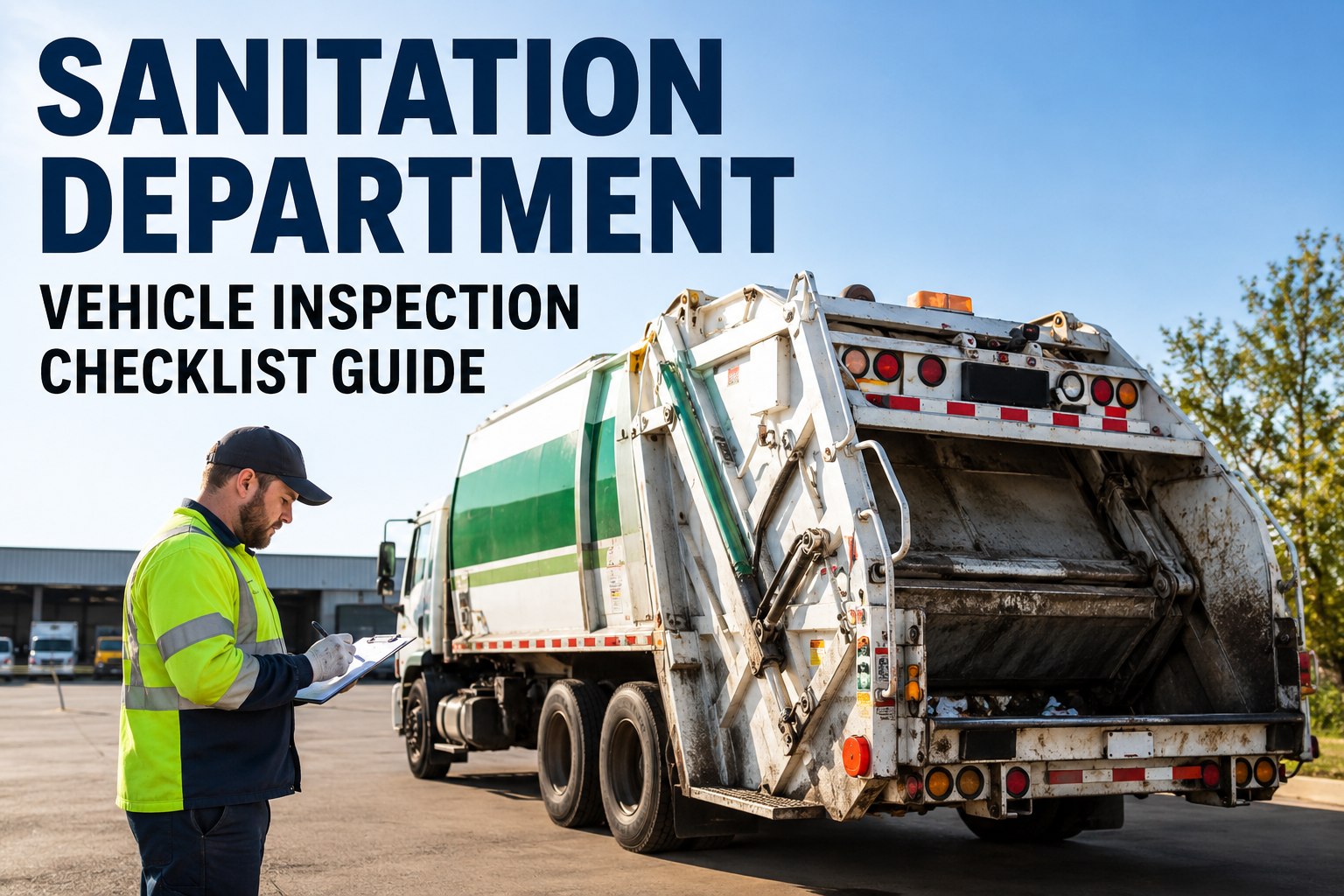
A sanitation department vehicle isn't a truck — it's a mobile industrial machine that operates in the tightest, most pedestrian-dense environment in the fleet world. A rear-loader on residential collection runs 800–1,200 stops in a shift; a front-loader on commercial hits 100 dumpsters between 4 AM and noon; an automated side-loader (ASL) grabs and inverts a cart every 20 seconds, hydraulic arm cycling 400 times a day. Every one of those cycles is a chance for something to fail: a hydraulic packer cylinder that leaks under compaction load, a tailgate hinge that walks out of its bushing, an automated arm sensor that misses a pinch point, brakes fading on a fully loaded 60,000 lb chassis, a hopper packer blade that engages when a worker is still in the danger zone. Refuse collection is one of the most dangerous jobs in the US — the Bureau of Labor Statistics ranks "refuse and recyclable material collectors" consistently among the top 10 most-fatal occupations, with fatality rates 6–8× the national average. Every one of those fatalities has a root cause that ties back to either an unsafe operating practice or a mechanical failure the pre-trip should have caught. OSHA 29 CFR 1910.178 (powered industrial trucks) applies to loading equipment; DOT 49 CFR 396 (driver vehicle inspection reports) applies to the CDL chassis; ANSI Z245 governs refuse collection vehicle safety. Miss a required inspection and the citation follows — and if the missed defect caused an injury, the citation is willful. A digital sanitation fleet inspection app runs the pre-trip on a phone or tablet, enforces every required field, requires photo evidence on defects, routes them to fleet maintenance instantly, and stores the signed record for the audit. This guide is the complete pre-route checklist for municipal refuse fleets.
DOT 49 CFR 396 + OSHA 1910.178 + ANSI Z245
The Sanitation Department Vehicle Pre-Trip Inspection
Chassis, brakes, hydraulics, packer & body, lift arm, safety devices, and PPE — every system verified, photo-evidenced where it matters, and signed off in HVI before the truck rolls at 4 AM.
6–8×
refuse worker fatality rate vs national average
800+
stops on a typical residential route
400
packer/arm cycles per shift on an ASL
49 CFR 396
DOT rule requiring the daily DVIR
Why a Refuse Truck Pre-Trip Isn't a Standard DVIR
A garbage truck is a CDL Class B chassis plus a hydraulically-driven work platform — and the second half is where the injury and downtime concentrate. Four risks shape the inspection every generic pre-trip misses.
Packer & Body
Hydraulic packer cylinders cycle under 3,000+ psi. A worn seal or cracked hose at the tailgate is a spray of fluid across the hopper danger zone.
Automated Arm
The ASL arm is a powered industrial truck under OSHA 1910.178 — sensors, limit switches, and grip pressure all inspected daily. A missed sensor = a struck-by injury.
Loaded-Chassis Brakes
A packer truck grows from 30,000 to 60,000+ lb during a route. Brakes must stop the fully loaded chassis at stop 800 as reliably as at stop 1.
Pedestrian Zone
Refuse trucks operate on residential streets with kids, cyclists, and joggers. Backup alarms, lights, mirrors, and cameras are pedestrian survival, not paperwork.
The Two-Phase Refuse Truck Pre-Trip
HVI splits the sanitation pre-trip into a chassis phase (49 CFR 396 DVIR-aligned) and a body phase (ANSI Z245 + OSHA 1910.178 aligned). Both must close in the app before the truck is marked ready for the route.
PHASE 1 — CHASSIS
DOT DVIR (49 CFR 396)
Engine, fluids, brakes (air + service + parking), tires, wheels, lights, steering, mirrors, coupling, frame, and emergency equipment. Standard commercial truck pre-trip with refuse-specific loaded-weight brake test.
~7 minutes
PHASE 2 — BODY & LIFT
Refuse-Specific Check
Hydraulic packer, tailgate, hopper, packer blade, ejector, lift arm (ASL/FL), fork tines, grip mechanism, safety sensors, backup camera, PPE, spill kit, hopper gates. The part that turns a chassis into a refuse collection platform.
~8 minutes
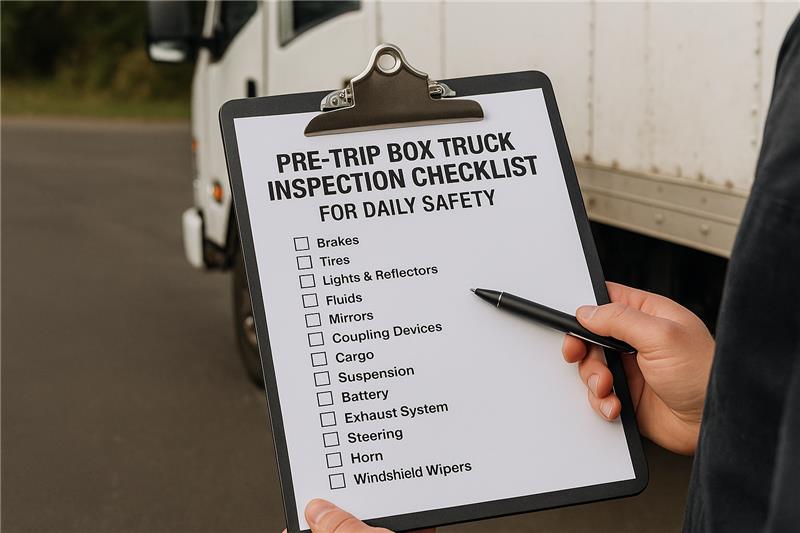
The Complete Pre-Trip Checklist — Ten Sections
Every item below is what HVI's sanitation truck template prompts in sequence. Required fields enforced, photo evidence on defects, hour meter and mileage auto-captured, and a signed sign-off before the driver rolls out of the yard.
01
Engine, Fluids & Under-Hood
CHASSIS
Engine oil level & condition; no leaks at pan or valve cover
Coolant level & freeze protection; hoses no swelling or sweating
Fuel & DEF levels sufficient for the route
Power steering reservoir at spec
Air cleaner restriction indicator clear
Battery terminals clean, hold-downs tight, cranks strong
Belts & hoses — no cracks, glazing, or chafing
No warning lights at idle; regen status normal
02
Air Brakes, Service & Parking
CHASSIS
Air build-up from 85 to 100 psi within DOT limit
Air governor cut-in / cut-out at 100–125 psi
Low-air warning at 60 psi; spring brake pop at 20–45 psi
Static air leak <3 psi/min with foot off brake
Applied leak <4 psi/min with foot on brake
Service brakes pull straight; firm pedal; loaded-weight stop test
Parking brake holds fully-loaded truck on grade
ABS light cycles off at start-up; no active fault
03
Tires, Wheels & Suspension
CHASSIS
Steer tire tread ≥4/32"; drive/trailer ≥2/32"
No cord cuts, chunking, bulges, or sidewall damage
Tire pressure to spec; valve caps present
Wheel lugs tight; no rust streaking at studs
Hub oil level correct; no seal leaks
Springs, U-bolts, shackles intact; no broken leaves
Air-bag suspension — no cuts or leaks; ride height correct
Frame rails no cracks; body-to-frame bolts tight
04
Lights, Mirrors & Warning
CHASSIS + BODY
Headlights, tail, brake, hazards, turn signals functional
Strobes / beacons on cab and body operational
Work lights at hopper & body illuminated
Backup alarm audible over ambient (10+ ft range)
Horn — city + air horn both functional
Mirrors: convex, spot, hopper, curb-side aligned
Backup camera powered on with clear picture
Side-view cameras (blind spot) clean and streaming
05
Hydraulic System — Body
BODY
Hydraulic reservoir at sight-glass; fluid clear, not milky
No leaks at PTO, main pump, or hydraulic tank
Every packer, tailgate, and ejector hose — no bulges, no cracks
Cylinder rods — no scoring, pitting, or active seep
Suction & return filters within service interval
No pooling under truck; drips traced to source
Hydraulic pressure gauges respond on cycle
Quick-disconnects secure; safety clips in place
06
Packer, Tailgate & Hopper
BODY
Packer blade / sweep panel cycles full stroke without hesitation
Tailgate raises & locks; safety prop pin functional
Ejector panel travels full length under load
Hopper floor no cracks, no punch-through, drain clear
Tailgate seal intact; no leachate escape at road speed
Body-up interlock prevents chassis motion when raised
07
Lift Arm — Automated Side or Front Loader
1910.178 + Z245
ASL / FL arm cycles full extend, grip, invert, retract
Grip pressure to spec; no slip during test cycle
Proximity & presence sensors clean and responding
Arm stops when zone sensor blocked (safety verify)
Fork tines (FL) — no cracks, straight, safety chain intact
Joystick controls — no sticking, neutral returns correct
Emergency stop reachable from operator position
Arm reach & lift range unobstructed by fluid leaks
08
Cab, Seat Belt & Operator Controls
CHASSIS
Windshield & side glass — no cracks impairing vision
Wipers & washer fluid functional both sides
Seat belt — latch, retraction, webbing intact
Standing/riding platform (rear-load) — grab handles secure
Rider-position sensor / body-in-place switch functional
Steering — no excessive play; smooth power assist
All warning lights & buzzers cycle correctly at start-up
HVAC / defrost functional (visibility)
09
Emergency, PPE & Spill Response
BODY
Fire extinguisher — charged, in date, accessible
First aid kit stocked; bloodborne pathogen kit present
Spill kit for hydraulic fluid / diesel leak on route
Wheel chocks, cones, warning triangles in cab
High-vis vests for driver & helpers (ANSI Class 3)
Work gloves, safety glasses, hearing protection on board
Reflective ID markings clean and visible
Two-way radio & cell phone tested with dispatch
10
Route Documentation & Compliance
CLOSING
CDL / medical card current for driver
Route sheet / RFID tablet loaded & synced
DVIR from previous shift reviewed; open defects acknowledged
Hour meter / odometer captured for PM scheduling
Registration, insurance, IFTA credentials on board
DVIR signed & submitted in HVI before yard exit
Out-of-Service Criteria — The Stop-Now List
49 CFR 396 defines when a commercial vehicle cannot roll. 1910.178(q)(7) says the same about the loading equipment. These items trigger an instant lockout in HVI — the truck stays in the yard.
CRITICAL — DO NOT DISPATCH
Service brake failure or applied air leak >4 psi/min
Parking brake fails to hold loaded on grade
Steering excessive play or power assist failure
Steer tire below 4/32" or with cord-cut damage
Hydraulic hose bulge, exposed reinforcement, or active spray
Packer blade or ejector uncontrolled motion
Body-up interlock or ASL zone sensor non-functional
Backup alarm or backup camera inoperable
Tailgate safety prop pin missing or damaged
Seat belt missing, damaged, or non-functional
The Three Most-Missed Refuse Truck Items
Across municipal fleet audits, three items account for the majority of missed defects on refuse trucks. Each one looks fine at a glance and isn't.
MISS 1
Loaded-Weight Brake Test
A brake check at 30,000 lb passes; the same brake at 60,000 lb after Stop 800 doesn't. Empty-truck testing hides the real condition of pads, drums, and slack adjusters.
HVI fix: post-route brake check as a required end-of-shift step, flagging fade.
The interlock that prevents the chassis from moving while the body is raised is a struck-by prevention. Untested until it's tested — usually too late.
HVI fix: functional test required on pre-trip; photo of interlock light state captured.
MISS 3
Rider-Position Sensor
On rear-load trucks, the sensor that detects a helper riding the step is what prevents the packer from cycling. A tape-defeated sensor is a fatality waiting to happen.
HVI fix: functional test with photo of un-defeated switch required daily.
Paper Clipboard vs. HVI Municipal Fleet Workflow
A municipal fleet runs dozens of trucks across multiple drivers, shifts, and routes. Paper DVIRs get lost, back-filled, or filed with skipped fields; HVI keeps every check, defect, and hour reading on one searchable record per asset.
PAPER DVIR
Fields skipped; dates back-filled at end of shift
Hydraulic leak "we'll fix it tomorrow" never reaches shop
No photo evidence of hopper crack or hose bulge
Route-hour tracking manual, PMs slip past
Public records & audit prep take days
HVI MOBILE APP
Required fields enforced; timestamps locked to server
Every defect auto-creates a work order, severity-routed
Photo evidence required on every defect flag
Hour meter auto-captured; PMs scheduled by real usage
Audit and public-records exports in under 5 minutes
Run Every Municipal Refuse Truck Off a Verified Pre-Trip
HVI gives sanitation departments and public works fleets a digital DVIR + refuse-body inspection app aligned to DOT 49 CFR 396, OSHA 1910.178, and ANSI Z245 — pre-built templates for rear-loaders, side-loaders, ASL/ARL, front-loaders, roll-offs, and street sweepers. Photo-evidenced defects, severity-routed work orders, PM scheduling by actual hours, and public-records audit exports in minutes. Trusted by 25,000+ users worldwide.
Frequently Asked Questions
What standards govern a sanitation department vehicle inspection?
Three overlapping rule sets apply to every refuse truck. DOT 49 CFR 396 (Federal Motor Carrier Safety Regulations) governs the chassis as a commercial motor vehicle — the driver vehicle inspection report (DVIR), out-of-service criteria, brakes, tires, steering, lights, coupling, and emergency equipment. OSHA 29 CFR 1910.178 governs the loading equipment (automated side-loader arm, front-loader, powered forks) as a powered industrial truck — daily examination before placement in service, and no operation with any condition adversely affecting safety. ANSI Z245.1 (safety requirements for mobile refuse collection and compaction equipment) covers the packer, hopper, tailgate, safety interlocks, and rider-position controls. State DOT rules may layer additional requirements. HVI's sanitation truck template encodes all three into one workflow, so one pre-trip produces evidence for every audience.
Start a free HVI trial to run the full check.
Why is a refuse truck pre-trip different from a standard DOT DVIR?
A standard DVIR under 49 CFR 396 covers the chassis — brakes, tires, lights, steering, mirrors, coupling, and emergency equipment. A refuse truck adds the body: the hydraulic packer that cycles 3,000+ psi under compaction, the tailgate that raises with a safety prop, the ejector panel that runs the length of the body under load, the ASL or front-loader arm that grabs and inverts a cart 400 times a shift, the rider-position sensor on the rear step that keeps the packer from cycling when a helper is at risk, the body-up interlock that prevents the chassis from moving while the body is raised. All of that is where refuse-worker injuries concentrate — and none of it is in a generic DVIR. HVI runs both the chassis DVIR and the body/lift check as one connected workflow, so a single sign-off produces both records.
Book a demo to see the two-phase check.
What items are most commonly missed on a garbage truck pre-trip?
Three items account for the majority of missed defects in municipal fleet audits. First, the loaded-weight brake test — a brake check at 30,000 lb passes, but the same brake at 60,000 lb after Stop 800 doesn't. Empty-truck testing hides pad, drum, and slack-adjuster condition. HVI adds a post-route brake check as a required end-of-shift step that catches fade. Second, the body-up interlock — the sensor and control that prevent the chassis from moving while the body is raised. Untested until it's tested, usually too late. HVI makes the functional test a required daily step with photo evidence of the interlock light state. Third, the rider-position sensor on rear-load trucks — the switch that detects a helper riding the step is what prevents the packer from cycling. A tape-defeated sensor is a fatality waiting to happen; HVI requires a photo of the un-defeated switch daily.
Sign up for a free HVI trial to catch the three-missed items.
How does HVI handle the automated side-loader arm safety check?
The ASL arm is a powered industrial truck under OSHA 1910.178 and a lifting mechanism under ANSI Z245 — both rule sets require daily verification before service. HVI's ASL template walks the operator through the full functional sequence: arm extends to full reach, grips a cart with correct pressure (no slip on test cycle), lifts and inverts, dumps into the hopper, retracts. The proximity and presence sensors are tested by deliberate obstruction — the arm must stop when the zone is blocked. Joystick controls are checked for sticking and correct neutral return. The emergency stop must be reachable from the operator position and functional. Any fault at any step auto-generates a work order and can flag the truck out of service. The record includes photo evidence of test-cycle completion so the fleet manager and safety lead see exactly what was verified.
Schedule a demo to see the ASL check.
Can HVI produce public-records and audit exports for a municipal fleet?
Yes — that's a core reason municipal customers choose HVI. Every DVIR, defect, work order, hour meter, and operator certification is stored on the asset record indefinitely, searchable by truck, driver, date range, defect type, or route. When public-records requests arrive under state open-records laws, when DOT/FMCSA audits a compliance review after an incident, or when the city council asks for fleet condition data before budget season, the audit package exports in under five minutes for any truck, driver, or date range — covering DVIRs, defect resolutions, PM records, work orders, and hour-based maintenance history. Municipal audit pass rates on digital systems run roughly 96% versus 73% on paper, and public-records production time drops from days to minutes.
Sign up for a free HVI trial for municipal fleet exports.
Does HVI work for a mixed municipal fleet — refuse, street sweepers, plows, dump trucks?
Yes. Every asset class in a public works or sanitation fleet can have its own template on HVI: rear-loaders, ASL/ARL side-loaders, front-loaders, roll-off trucks, recycling collectors, street sweepers, snow plows, dump trucks, tractors, and light-duty pickups. Each vehicle gets its own asset record and QR code; whoever climbs in scans the code, the right template loads on their phone with the vehicle's hour meter and any open defects, and the driver must acknowledge open items before signing. Defects route to a shared maintenance work-order queue across the fleet, with severity routing — Critical items auto-lockout, Alert items open work orders, Monitor items feed the PM scheduler. Fleet managers get one dashboard showing every asset's status, open defects, PM-due, and certification expiry — from the entire refuse fleet through the seasonal snow plow rotation.
Book a demo to see municipal fleet coverage.