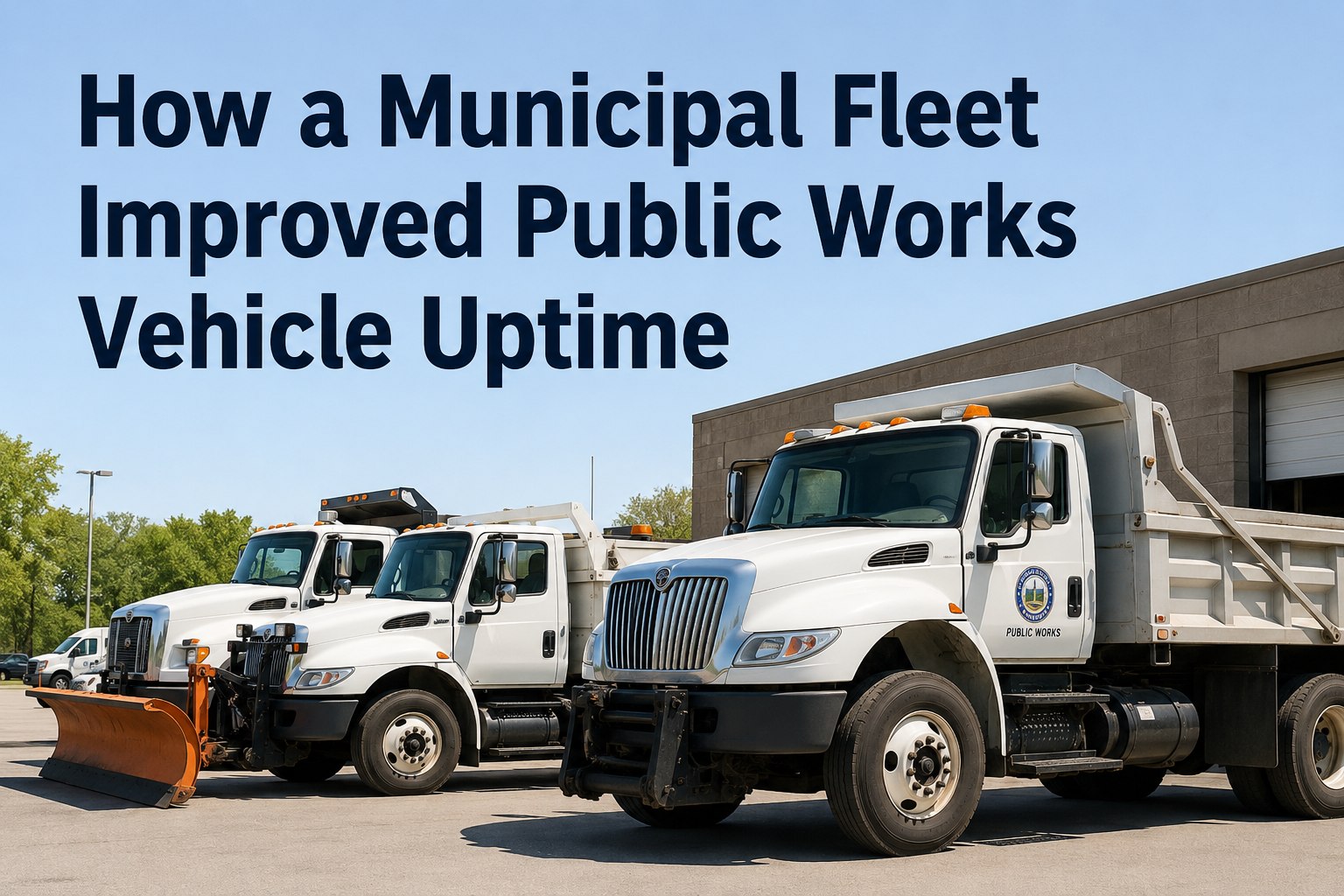
How a Municipal Fleet Improved Public Works Vehicle Uptime

By Ava Phillips on June 18, 2026

how-a-municipal-fleet-improved-public-works-vehicle-uptime

A municipal public works fleet is one of the hardest things in the equipment world to keep running — not because the vehicles are exotic, but because there are so many kinds of them. A single public works department might run dump trucks, plow trucks, street sweepers, loaders, aerial bucket trucks, vactor units, and pickups, each on a different duty cycle, each needing different service, all maintained by a small shop on a tight government budget that's scrutinized line by line. When a plow truck is down during a snow event or a sweeper sits idle in spring, it's not just a maintenance metric — it's a service the public notices and a council member asks about. This is the story of how one mid-sized municipal fleet turned around chronically low vehicle uptime, not by buying new trucks they couldn't afford, but by fixing the maintenance workflow itself: digital inspections that caught problems early, defects that became tracked work orders instead of sticky notes, and repairs that actually got closed out. A digital inspection and maintenance program was the lever. Here's the problem they had, what they changed, and the uptime they got back. The figures illustrate the pattern public fleets report, not a single audited account — but the mechanism is exactly what a disciplined workflow delivers.

A Down Plow Truck Isn't a Metric — It's a Service the Public Notices
HVI gives a public works fleet one system across every vehicle type — digital inspections that catch defects early, work orders that route and get closed, PM alerts by usage, and reports that show council exactly where uptime and budget go.

The Problem: Low Uptime, No Visibility

The fleet's availability was chronically low, and nobody could say exactly why. The symptoms were the familiar ones of a maintenance operation running on paper and memory across too many vehicle types.

Trucks Down When Needed

A plow truck failing mid-storm or a sweeper down in spring — vehicles unavailable exactly when the service mattered most and the public was watching.

Defects on Sticky Notes

Problems were reported verbally or on paper that got lost. A defect noticed Monday might never reach the shop — or reach it after the breakdown.

Repairs Left Open

Work started but not closed out, no clear status, and no one sure whether a truck was actually fixed and road-ready or still waiting on a part.

Nothing to Show Council

When leadership asked why uptime was low or where the budget went, the shop had no data — just anecdotes, which don't survive a budget hearing.

The root problem wasn't the trucks or the techs — it was that the maintenance workflow had no system. Defects, work orders, PM schedules, and repair status all lived in people's heads and on paper, so nothing connected and nobody had visibility across the diverse fleet.

The Change: Fix the Maintenance Workflow

The turnaround didn't start with vehicles — it started with the workflow. One system now ran inspections, defects, work orders, and PM across every vehicle type. Four things changed.

1

Digital Inspections on Every Vehicle

Operators ran a guided pre-trip on a phone — adapted to each vehicle type, from plow truck to sweeper to bucket truck — so developing problems were caught at the walk-around, not at the breakdown.

2

Defects Became Tracked Work Orders

A flagged defect routed straight to the shop with a photo as a work order — assigned to a technician, prioritized, and visible. No more sticky notes or lost verbal reports.

3

Repairs Got Closed Out

Each work order moved through clear states — open, in progress, parts on order, complete — so the shop and the dispatcher always knew whether a truck was road-ready, and nothing sat half-finished.

4

PM Scheduled by Usage

Engine-hour and mileage-based PM alerts fired before service was due on each vehicle — so a hard-run plow in winter and a light-duty pickup were each serviced on their own real schedule, not one calendar.

The whole turnaround rested on connecting what had been disconnected: inspection to defect, defect to work order, work order to closure, and usage to PM — one workflow across every vehicle type. sign up for a free HVI trial and connect your maintenance workflow.

The Results: Uptime Back, Visibility Gained

Within a couple of quarters of running the connected workflow, availability climbed and the shop changed character. These figures illustrate the kind of improvement public fleets report when the workflow gets fixed.

↑ Uptime
availability climbed
Vehicles available when needed — fewer trucks down during storms, sweeps, and peak service windows.
Faster
repair closure
Work orders moved through to completion instead of stalling — trucks back in service sooner.
Planned
not reactive
The shop shifted from chasing breakdowns to scheduled PM and early-caught defects.
Data
for council
Reports on uptime, cost, and PM compliance the fleet manager could put in front of leadership.

Why It Worked: The Connected Workflow

The gain came from closing the gaps in a chain that used to break at every handoff. When inspection, defect, repair, and record connect, a problem flows to resolution instead of falling through.

1

Inspect

Operator catches a developing defect on the guided daily check and flags it with a photo.

2

Route

The defect becomes a work order, assigned to a tech and prioritized in the shop queue.

3

Close

The repair is completed, verified, and the truck marked road-ready — the loop finished, not left open.

4

Record

Everything logs to the vehicle's history — feeding uptime, cost, and the reports leadership sees.

Each broken handoff in the old way — the lost sticky note, the open repair nobody tracked, the PM that slipped — was a place a truck went down. Connecting the chain end to end is what turned chronic low uptime into a fleet that's available when the public needs it.
For a public fleet, the visibility matters as much as the uptime — being able to show council, in data, why availability improved and where the budget went is what protects the program at hearing time. schedule a live demo to see the workflow and reporting.

What Made It Stick Across a Diverse Fleet

The reason it held — across dump trucks, plows, sweepers, loaders, and pickups alike — is that one system handled them all without forcing every vehicle into the same mold.

One system, every vehicle type — checklists adapt per vehicle, but inspections, work orders, and PM all live in one place.

Usage-based PM per asset — a hard-run plow and a light pickup each get serviced on their own real schedule.

Nothing falls through — defects route automatically and repairs close out, so problems don't get lost between handoffs.

Built-in accountability — reporting gives the fleet manager the data to defend the budget and prove the gains.

Get Your Public Works Fleet's Uptime Back

Digital inspections adapted to every vehicle type, defects routed to tracked work orders, repairs closed out with clear status, usage-based PM alerts, and uptime and cost reporting for leadership — one system across dump trucks, plows, sweepers, loaders, and the whole municipal fleet. Available when the public needs it. Trusted by 25,000+ users worldwide.
Frequently Asked Questions

Why is uptime so hard to maintain on a municipal public works fleet?
Mostly because of diversity and constraint. A single public works department runs many different vehicle types — dump trucks, plows, sweepers, loaders, aerial bucket trucks, vactor units, pickups — each on a different duty cycle and needing different service, all maintained by a small shop on a closely scrutinized government budget. When the workflow runs on paper and memory, defects get lost, repairs stall half-finished, and PM slips, so trucks go down unpredictably — often right when the service matters most, like a plow during a storm. Fixing the workflow so inspection, defect, repair, and PM connect across every vehicle type is what restores uptime. Sign up for a free HVI trial to improve uptime.
How does fixing the maintenance workflow improve vehicle availability?
By closing the gaps where trucks used to go down. When a digital inspection catches a developing defect early, that flag routes straight to the shop as a tracked work order instead of a sticky note that gets lost; the work order moves through clear states to closure so nothing sits half-finished; and usage-based PM alerts service each vehicle before failure. Each of those was previously a broken handoff — a lost report, an open repair nobody tracked, a slipped PM — and each was a place a vehicle became unavailable. Connecting the chain end to end means problems flow to resolution rather than falling through, which is what lifts availability. Schedule a demo to see the workflow.
Can one system handle many different vehicle types?
Yes — that's exactly the point for a public works fleet. A good system adapts the inspection checklist to each vehicle type (a plow truck gets different checks than a sweeper or a bucket truck) while keeping the inspections, defects, work orders, and PM schedules all in one place. That means the shop manages the whole diverse fleet through one workflow and gets comparable data across every asset, rather than juggling separate paper systems per vehicle type. Usage-based PM also lets a hard-run plow and a light-duty pickup each follow their own real service schedule instead of being forced onto one calendar. Sign up for a free HVI trial for your whole fleet.
Why does repair closure matter so much?
Because a repair that's started but not closed out is a truck whose status nobody actually knows — and that uncertainty quietly kills availability. When work orders move through clear states (open, in progress, parts on order, complete), the shop and the dispatcher always know whether a vehicle is genuinely road-ready or still waiting, so road-ready trucks get back into service immediately and stalled ones get the attention they need. Tracking closure also surfaces bottlenecks, like repairs repeatedly stuck waiting on parts, that you can then fix systemically. Open, untracked repairs are one of the biggest hidden drains on a fleet's uptime. Schedule a demo to see work-order closure.
How does this help at budget time?
It gives the fleet manager data instead of anecdotes. One of the hardest parts of running a public fleet is justifying the maintenance program and budget to leadership and council, and that's nearly impossible when the shop runs on paper. A connected system produces reporting on uptime, maintenance cost per vehicle, PM compliance, and repair turnaround — concrete numbers that show why availability improved and where the money went. That visibility both protects the budget at hearing time and helps make the case for replacing a vehicle that's become too expensive to keep, backed by its documented cost history. Sign up for a free HVI trial for budget-ready reporting.

Share This Story, Choose Your Platform!

Start Free Trial Book a Demo