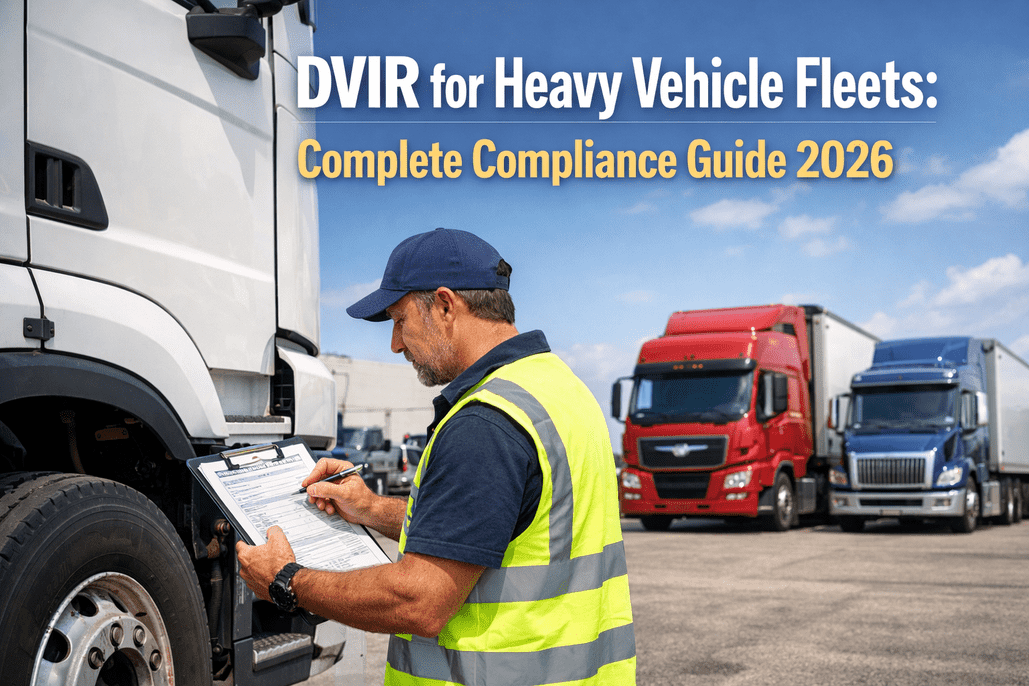
DVIR requirements under 49 CFR 396.11 are audited in 89% of FMCSA compliance reviews, and only 7% of carriers pass cleanly. The rule is a 3-signature chain of custody from driver defect report to carrier repair certification to next-driver acknowledgment under 396.13. Skip any link and the chain is a citable violation. This guide walks the chain, the 11 required components, the 90-day retention rule, and the March 23 2026 eDVIR final rule — book a demo to run the 3-signature chain digitally in HVI.
The 3-Signature DVIR Chain — Break One Link, Break the Chain
Every DVIR that reports a defect is a legally binding chain from driver discovery through carrier repair to next-driver sign-off. Auditors don't audit the DVIR — they audit the chain.
Driver
Carrier / mechanic
Next driver
FMCSA audits the DVIR chain in 89% of compliance reviews. Only 7% of motor carriers pass without a citation. One missing signature on one report is a violation.
The rest of this page walks the 11 mandated inspection components under 49 CFR 396.11, the difference between property-carrying and passenger-carrying DVIR rules, the 90-day retention requirement under 396.11(a)(4), the March 23 2026 eDVIR final rule, and the compliance failures auditors cite most. Book a 30-minute demo to see the 3-signature chain enforced digitally in HVI.
The 11 mandated inspection components under 49 CFR 396.11
49 CFR 396.11(a)(2) specifies the minimum vehicle components every DVIR must cover. The list is federal minimum — carriers may inspect more, but never fewer. Missing any category on the DVIR template is a template-deficiency finding that carries per-day civil penalty for continued non-compliance.
| # | Component | What to check |
|---|---|---|
| 1 | Service brakes (incl. trailer connections) | Function, air leaks, warning devices, chamber condition |
| 2 | Parking brake | Holds vehicle under drivetrain load; spring brake integrity |
| 3 | Steering mechanism | Play, tightness, no binding, no lash beyond spec |
| 4 | Lighting devices & reflectors | All required lamps functional; conspicuity tape present |
| 5 | Tires | Tread depth, sidewall condition, inflation, no exposed cord |
| 6 | Horn | Audible warning device functional |
| 7 | Windshield wipers | Both blades functional; washer fluid present |
| 8 | Rear-vision mirrors | Both sides intact, correctly positioned |
| 9 | Coupling devices | Fifth wheel or hitch condition; kingpin lock; safety chains |
| 10 | Wheels & rims | No cracks, no missing lug nuts, no wheel-end oil leak |
| 11 | Emergency equipment | Fire extinguisher (charged), warning triangles, spare fuses |
Two rules trip carriers. First: pencil-whipping — marking items pass without actually inspecting — carries criminal exposure in addition to civil fines, and industry data showing 95% of DVIRs report no defects raises quality-of-inspection questions with every auditor. Second: the 11 categories are the federal minimum — adding a driver-comfort inspection line or a fuel-level line is legal, but removing a category (many older paper templates omit emergency equipment or coupling devices) is a template-deficiency violation regardless of what the vehicle's actual condition was. Book a demo to see 11-component DVIR templates aligned to 49 CFR 396.11 in HVI.
When is a DVIR required — property vs passenger
49 CFR 396.11 sets different rules by vehicle type. The distinction matters because a passenger-carrying carrier that treats DVIRs as "only when defects" is out of compliance every single day the fleet operates, and a property-carrying carrier that files no-defect DVIRs is doing extra paperwork the rule doesn't require — but that many carriers still choose to do for audit and litigation defense.
Property-carrying CMV
DVIR required only when defects or deficiencies are discovered. Since 2014 amendment, no-defect DVIRs are not federally required. Pre-trip inspection under 49 CFR 392.7 is still mandatory — but produces no required paperwork.
Passenger-carrying CMV
DVIR required every day regardless of defects. Buses, motorcoaches, and shuttle operations must file a completed DVIR at the end of each day's work, whether any defect was found or not. No 2014 exemption applies to passenger operations.
Company policy add-ons
Many property-carrying fleets require daily DVIRs regardless of defects as company policy. The rationale: consistent daily records provide far stronger audit and litigation defense than intermittent defect-only records. Company policy is enforceable through employment terms.
Driveaway-towaway & intermodal
Different rules apply under 49 CFR 396.11(d) & (e). Driveaway-towaway operations have specific procedures for towing vehicles to purchasers. Intermodal equipment providers have separate DVIR obligations under Part 385 Subpart E for chassis and containers.
The pre-trip inspection under 49 CFR 392.7 is separate from the DVIR. 392.7 requires the driver to be satisfied the vehicle is in safe operating condition before driving — but produces no required paperwork. Many fleets file combined pre-trip + post-trip DVIRs to consolidate the driver's daily inspection responsibilities into one record, which is legal and audit-friendly, but not federally required as combined. Confirming current FMCSA requirements before implementing any DVIR policy is essential — the rule was amended in 2014 (no-defect exemption for property), in 2018 (390.32 electronic authorization), and again in 2026 (explicit eDVIR under 396.11/396.13). Book a demo to see property vs passenger DVIR templates configured per vehicle type in HVI.
The March 23 2026 eDVIR final rule — what actually changed
Electronic DVIRs were permissible under 49 CFR 390.32 since 2018, but industry ambiguity persisted about whether electronic signatures satisfied all three links in the 396.11/396.13 chain. FMCSA closed the gap. On February 19, 2026 (Vol. 91, No. 33), FMCSA published a final rule under Docket FMCSA-2025-0115 that added explicit eDVIR authorization to both 49 CFR 396.11 and 396.13, effective March 23, 2026. Supported by ATA, OOIDA, and NTTC in comments, the rule removed all remaining ambiguity about electronic operation.
What the rule did
- Added explicit language to 396.11 allowing electronic creation & maintenance of DVIRs
- Added explicit language to 396.13 for electronic pre-trip review records
- Unambiguously authorized electronic signatures for all 3 chain parties — no wet ink required
What the rule did NOT do
- Did not change the 11-component inspection minimum
- Did not change the 90-day retention requirement under 396.11(a)(4)
- Did not reinstate no-defect DVIR reporting for property-carrying CMVs
What was already legal
- Electronic DVIRs were permissible under 390.32 since 2018
- Cloud storage already satisfied retention requirements
- E-SIGN Act digital signatures already legally binding
What every fleet should do now
- Confirm current DVIR system captures all 3 signatures with time-stamp
- Verify template covers all 11 mandated components
- Extend retention beyond 90 days (industry standard: 12-24 months)
73% of paper DVIRs never reach the office intact per industry data; 96% of digital fleets pass a focused compliance review. Paper remains legal, but the compliance-pass rate difference tells the operational story. Cloud retention makes 12-24 month history effectively free while providing far stronger audit and litigation defense than the 90-day minimum. Start a free HVI trial to run the 3-signature chain digitally with cloud retention.
A safety director on the DOT compliance review that turned on one DVIR
We're a 47-tractor regional dry van. Passed our biennial DOT compliance review three years running on paper DVIRs. Fourth year, auditor pulled 90 days of DVIRs for a sample of 6 units, traced the chain on every report with a defect. Found 3 DVIRs where the next-driver acknowledgment signature was missing — drivers had operated the truck after a defect was reported and certified repaired, but never signed the 396.13 review acknowledgment. All three drivers had been with us 8+ years; nobody meant anything by it.
Auditor cited 396.13 on all three, plus one 396.11(a)(3) where the carrier certification was there but undated. Four violations on one 90-day sample. Downgraded us from Satisfactory to Conditional. Insurance premium went up 22% the following renewal. Two of our better shippers required a Satisfactory rating and paused new loads until we requested a re-rating.
Rolled out digital DVIRs the same quarter. System forces the next-driver acknowledgment before the truck starts on the dispatch app. Signature can't be skipped because the workflow blocks progress. Zero chain-break findings in the 18 months since. The problem was never that our drivers were careless — it was that paper let the chain break silently. Digital doesn't.
Frequently asked questions
What are the DVIR requirements under 49 CFR 396.11?
49 CFR 396.11 requires every commercial motor vehicle driver to prepare a written report at the completion of each day's work documenting any defects or deficiencies discovered during or after operation. The report must cover 11 minimum vehicle components: service brakes (including trailer connections), parking brake, steering mechanism, lighting devices and reflectors, tires, horn, windshield wipers, rear-vision mirrors, coupling devices, wheels and rims, and emergency equipment. Any defect found must be described with sufficient specificity that the carrier or qualified person can determine whether repair is required for safe operation. The driver must sign and date the report. For property-carrying CMVs, since a 2014 amendment, a DVIR is only required when defects are discovered — no-defect reports are not federally required (though many carriers still file daily for audit defense). For passenger-carrying CMVs (buses, motorcoaches, shuttles), a DVIR is required every day regardless of whether defects were found. The pre-trip inspection under 49 CFR 392.7 is separate and does not itself produce required paperwork — but is still mandatory. Auditors cite DVIR violations in 89% of FMCSA compliance reviews and only 7% of motor carriers pass focused compliance reviews without a DVIR-related citation.
What is the DVIR retention requirement?
The motor carrier must retain the original DVIR, the certification of repairs, and the certification of the driver's review for a minimum of three months (90 days) from the date the report was prepared, under 49 CFR 396.11(a)(4). All three documents must be retained — keeping only the driver's original report without the repair certification and the next-driver acknowledgment creates an incomplete record that auditors cite. Because offsite audits now routinely request records with 48-hour notice, best practice is to keep DVIRs well beyond the 90-day minimum — industry standard is 12-24 months. Cloud storage makes extended retention effectively free while providing significantly stronger audit and litigation defense than the federal minimum. The 90-day requirement applies to both paper and electronic DVIRs, and cloud storage satisfies the retention requirement under 49 CFR 390.32 (electronic records general provision) as well as under the March 23 2026 eDVIR final rule (Docket FMCSA-2025-0115). Fleets under civil litigation frequently need to produce DVIR records 2-5 years after the event; a 90-day retention policy is insufficient for litigation defense even where technically compliant with the FMCSA rule.
Are electronic DVIRs legally compliant?
Yes, fully. Electronic DVIRs have been permissible under 49 CFR 390.32 since 2018, and on February 19, 2026, FMCSA published a final rule (Docket FMCSA-2025-0115, effective March 23, 2026) that explicitly added electronic DVIR authorization to both 49 CFR 396.11 and 396.13, removing all remaining ambiguity. The rule did three things: added explicit language to 396.11 stating DVIRs may be created and maintained electronically, added explicit language to 396.13 authorizing electronic pre-trip review records, and unambiguously authorized electronic signatures for all three parties in the DVIR chain (driver defect report, carrier repair certification, next-driver review acknowledgment) — no wet ink is required. The rule did not change the 11-component inspection minimum, did not change the 90-day retention requirement, and did not reinstate no-defect reporting for property-carrying CMVs. E-SIGN Act digital signatures are legally binding for all three signatures in the chain. Cloud storage satisfies retention. Paper remains legal — but industry data shows 73% of paper DVIRs never reach the office intact and only 7% of paper-based carriers pass a focused compliance review, versus 96% of digital fleets.
What is the 3-signature chain of custody for a DVIR?
Every DVIR that reports a defect is a legally binding chain of three signatures connecting defect discovery to safe re-dispatch. Signature 1 (49 CFR 396.11): the driver completes the post-trip inspection at end of day's work, documents any defects across the 11 mandated components, signs and dates the report. Signature 2 (49 CFR 396.11(a)(3)): before the vehicle is dispatched again, the carrier or a qualified person certifies each reported defect either (a) has been repaired or (b) does not require immediate repair for safe operation; signs and dates the certification. Dispatching a vehicle with an unrepaired safety defect can carry per-occurrence civil penalty up to $16,864. Signature 3 (49 CFR 396.13): the next driver, before operating the vehicle, reviews the last DVIR and the carrier's repair certification, then signs to acknowledge that the report has been reviewed and required repairs made. Auditors trace this chain on every DVIR in a sample: one missing signature on one report is a citable violation under 396.11 or 396.13. The chain is why 89% of FMCSA compliance reviews audit DVIRs and only 7% of carriers pass without a citation. Digital DVIR workflows that block dispatch until each signature is captured effectively eliminate chain-break findings.
Should driver DVIR obligations be treated as company-specific policy or federal requirement?
The federal DVIR requirements under 49 CFR 396.11 and 396.13 apply to any driver operating an interstate commercial motor vehicle under DOT jurisdiction. Company policy may add to but not subtract from those requirements. Common company additions that are legal and often advisable: daily DVIR filing regardless of defects (rather than only when defects are found, which is the federal minimum for property-carrying); inclusion of additional inspection items beyond the 11 federal minimums (fuel level, cargo securement details, additional fluid checks); combined pre-trip + post-trip DVIRs in a single record; extended retention beyond 90 days (12-24 months industry standard). Common company assumptions that are not legal: reducing inspection scope below the 11 federal minimums (template deficiency violation), reducing retention below 90 days (record-completeness violation), skipping the next-driver acknowledgment on shift changes (396.13 violation), allowing dispatch before repair certification on any reported defect (396.11(a)(3) violation with civil penalty exposure). State-level requirements may add further obligations — California, New York, and several other states have specific state inspection or reporting requirements on top of federal. Always confirm current FMCSA requirements and applicable state law before implementing any DVIR policy, and update procedures whenever amendments are published (2014 no-defect exemption, 2018 electronic authorization, 2026 explicit eDVIR authorization).
The chain the auditor traces. Enforced by workflow. Never broken by hand.
HVI runs the 3-signature DVIR chain digitally: driver post-trip captures 11 mandated components with electronic signature and time-stamp; defects auto-route to a corrective work order requiring carrier repair certification before dispatch; next driver receives the prior DVIR and certification on their mobile screen and must acknowledge before operating. Cloud retention beyond 90 days. Audit-ready export in under 15 minutes. Compliant with the March 23 2026 eDVIR final rule from day one. Live in under two weeks. No hardware. No credit card.
Trusted by fleets running FMCSA-compliant DVIR chains across USA & Canada · Ready on day one