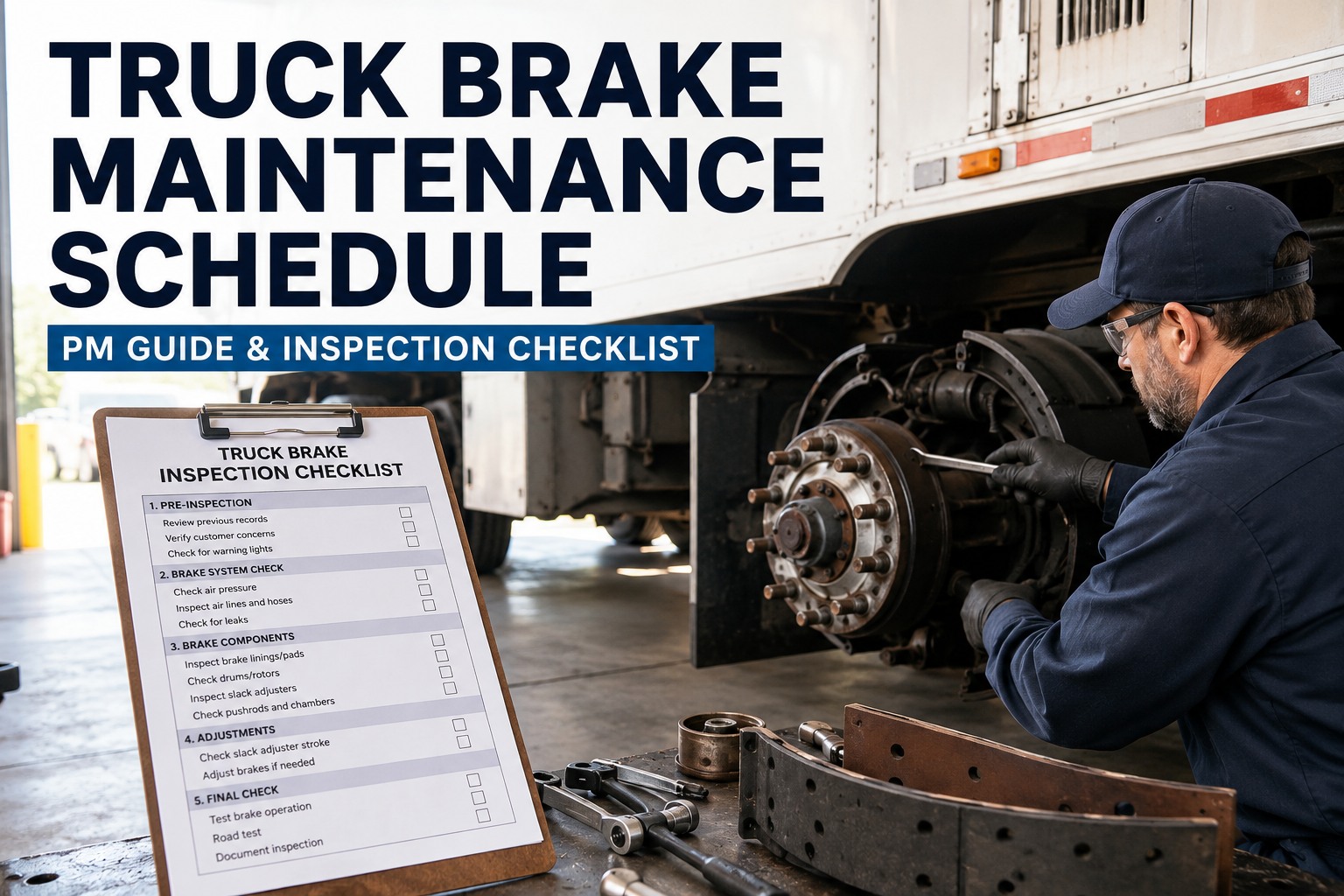
A truck brake maintenance schedule is FMCSA §393.47's silent partner — the regulation defines the wear limits, but the schedule defines when you catch them. Brakes account for 29-30% of all truck-related crash factors per FMCSA research, and 2025 CVSA Brake Safety Week caught 12.4% of trucks with brake violations serious enough for out-of-service orders. The gap between fleets that pass every inspection and those that don't isn't luck — it's a systematic PM schedule with defined intervals. Book an HVI demo for automated brake PM.
Four wear limits. Four PM intervals. Zero out-of-service violations.
The regulation tells you the minimum lining thickness. The schedule tells you when to measure it. Both together keep the fleet moving.
Two-pad shoe minimum. Single-strip shoe: 3/16" (4.8mm)
Drive/trailer axles. Measured at shoe center. Wear indicator overrides.
Disc pads. Increasing OEM adoption 2020+ replacing traditional drums.
Class 3-6 medium-duty trucks. Straight trucks not using air brakes.
§393.47 wear limits — the numbers that trigger OOS
Every truck brake maintenance schedule starts with knowing the exact federal wear thresholds. Under 49 CFR §393.47(d), a commercial motor vehicle cannot be operated with brake lining or pad thickness below the specified minimums. Falling below any one threshold triggers immediate out-of-service designation under CVSA criteria.
The wear limit depends on three variables: axle position (steering vs non-steering), brake type (air drum, air disc, hydraulic), and whether a wear indicator is stamped on the lining. When a wear indicator is present and visible, that indicator overrides the thickness measurement — touching the indicator alone triggers OOS regardless of remaining material.
If 20% or more of the required or equipped brakes on a commercial motor vehicle combination are defective or out-of-adjustment, the entire vehicle combination is placed out-of-service under CVSA North American Standard Out-of-Service Criteria. On a typical 5-axle tractor-trailer with 10 brake positions, that's 2 defective brakes triggering fleet-stopping enforcement. This is why one bad lining can hold the whole load.
Understanding the 20% rule is what separates fleet-scale brake maintenance from per-truck maintenance. A fleet-wide PM schedule doesn't just prevent individual truck OOS — it prevents the cascading regulatory exposure of multiple trucks failing the same inspection sweep. Book an HVI demo to see brake wear tracked per position across your fleet
The wear limits also interact with CVSA's cracking, contamination, and loose-lining rules under North American Standard Out-of-Service Criteria Part II. A lining at 3/16" thickness is compliant on measurement alone — but if that lining has cracks exceeding 1-1/2" in length, cracks exceeding 1/16" in width, oil or grease contamination, or loose segments, it's OOS regardless of remaining material. Best-in-class fleets inspect for all four defect conditions at every 90-day service, not just thickness.
The 4-tier brake PM schedule — interval by interval
Best-in-class fleets structure brake PM in four cascading tiers. Each tier catches a different failure horizon — daily catches immediate risk, annual catches long-cycle wear. Skipping any tier leaves a blind spot the next enforcement inspection will find.
Driver-executed 7-step in-cab air brake test plus visual walkaround. Governs whether the truck leaves the yard.
- Static air pressure check (governor cut-in/cut-out)
- Applied leakage test (max 3 PSI/min single, 4 PSI/min combination)
- Low-air warning (activates at 60 PSI or less)
- Emergency brake system test (parking spring apply)
- Foot valve full-application response
- Visual walkaround: hoses, chambers, slack adjusters
- Documentation on DVIR under §396.11
Technician-executed pushrod stroke measurement and chamber inspection. Catches adjustment drift before it becomes a violation.
- Pushrod stroke measurement at 90-100 PSI per §393.47
- Air chamber diaphragm inspection (cracks, ballooning)
- Slack adjuster travel and clearance verification
- Air line inspection for chafing, kinks, moisture
- Air dryer function check (purge cycle audible)
- Wheel bearing endplay verification
Full brake service including lining measurement, drum inspection, and foundation brake component assessment.
- Lining thickness measurement at shoe center (all positions)
- Drum inspection for heat cracks, out-of-round wear, scoring
- S-cam roller and bushing wear inspection
- Return spring tension and condition
- Anchor pin bushing wear
- Brake shoe alignment and travel
- Wheel-end grease service
Comprehensive review integrating all-year data. Sets replacement schedule for the year ahead.
- Drum replacement / turning decision (below turn limit)
- Air compressor rebuild or replacement assessment
- Complete air system pressure test
- ABS diagnostic scan and sensor verification
- Trailer brake control valve function
- Component life projection for next 12 months
- Federal annual inspection under §396.17 (integrated)
The four tiers together represent 40-50 specific inspection points on brake systems alone — more than a driver can carry mentally. Digital PM platforms with hour/mile-triggered work orders keep every tier on schedule automatically. Start a free trial to configure the 4-tier brake PM schedule for your fleet.
The 6 brake components that drive fleet violations
CVSA violation data consistently shows six brake components producing the vast majority of out-of-service orders. Each component has a specific failure mode, wear signature, and prevention lever.
OOS trigger: Below §393.47 wear limit, cracks exceeding 1/16" width or 1-1/2" length, oil/grease contamination, loose lining segments. Prevention: 90-day thickness measurement with per-position tracking; replace at 2x wear limit for margin.
OOS trigger: Pushrod stroke exceeding chamber type limit at 90-100 PSI. Most common single roadside violation. Prevention: 30-day stroke measurement with digital gauge; never manually adjust to hide underlying mechanical issue.
OOS trigger: Cracked diaphragm, corroded housing, mismatched size on same axle, non-manufactured combinations. Prevention: 30-day visual inspection; replace both sides of axle simultaneously; verify chamber type matches OEM spec.
OOS trigger: Heat cracks, contamination, above manufacturer turn limit, out-of-round wear exceeding spec. Prevention: 90-day drum surface inspection; replace above turn limit rather than pushing another cycle.
OOS trigger: Chafing at frame or crossmember contact points, kinks reducing airflow, moisture accumulation causing internal corrosion. Prevention: 30-day visual with dye test; route protection where lines contact frame; alcohol-injection dryers in extreme cold.
OOS trigger: ABS malfunction lamp illuminated, sensor fault codes stored, hydraulic modulator failure. Prevention: Annual diagnostic scan; sensor gap verification when wheel-end serviced; addressed at every PM regardless of driver report.
Every component on the list is a preventable failure with a proper PM schedule. The reactive fleets fight roadside violations component-by-component; the proactive fleets prevent them at scheduled intervals. Digital fleet analytics platforms track each component's wear cycle per position, catching failures before they become citations. Book an HVI demo to see per-position brake component tracking
Position tracking matters more than most fleet managers appreciate. On a 5-axle tractor-trailer, brake wear is not uniform across the 10 wheel positions. Steer axle brakes wear differently than drive axle brakes; trailer axle brakes wear differently than tractor drive brakes. Duty cycle, driver behavior, load distribution, and route topology all influence position-specific wear. Fleets tracking wear at the axle level miss the variance that individual positions reveal.
The digital brake PM workflow — from work order to audit trail
Paper brake inspection forms create three predictable failure points: missed intervals, incomplete measurements, and lost documentation at the moment of DOT audit. Digital PM workflows eliminate all three by design.
Truck hits 30-day or 90-day interval by mileage or calendar. Work order generates automatically with the correct scope for the tier — not a generic PM checklist, but the exact brake system tasks for that specific interval.
Every measurement captured digitally with camera evidence for lining thickness, drum condition, chamber diaphragm. GPS timestamp on every measurement. Wheel-position tags on every reading (steer left, steer right, drive-1 left, etc.).
When a lining measurement approaches §393.47 wear limit within 10%, the system flags the position for replacement scheduling. Trucks approaching OOS threshold don't get dispatched until the flag clears.
Every brake PM history retrievable by truck, by date, by CVSA inspection date. FMCSA audit requires records; digital retrieval eliminates the shoebox of paper forms that DOT auditors love to see fail.
The four-step workflow represents the difference between fleets that dread CVSA Brake Safety Week and fleets that welcome the enforcement window as validation of their PM discipline. Start a free trial to build the workflow for your fleet.
The economics support the workflow investment. A single CVSA OOS violation costs $150-400 in immediate fines plus $2,000-4,000 in lost revenue during the enforcement hold plus indirect costs from driver dead-time, customer service failure, and CSA score deterioration that drives insurance premium increases over the following 24 months. On a fleet-wide basis, one Brake Safety Week catching 6-8 trucks with violations represents $30,000-$50,000 in direct and indirect cost that a $200/month digital PM platform prevents entirely.
From a Fleet Maintenance Manager running 180 tractors through 3 CVSA Brake Safety Weeks
We used to lose 6-8 trucks per CVSA Brake Safety Week — not to accidents, to violations. Lining under limit, pushrod stroke over spec, an air line chafed at a crossmember. Each one a $150-400 fine plus a truck out-of-service. Fleet-wide cost per Brake Safety Week was $12,000-$18,000 in lost revenue plus fines.
We implemented digital brake PM with per-position tracking and pushrod stroke logging at every 30-day service. Last year's Brake Safety Week: zero OOS violations across 180 tractors. The regulation didn't change — our visibility did. Every truck had current measurements on file, every technician was accountable to per-position tracking, every wear approaching limit was already flagged for replacement before the inspector arrived.
Frequently asked questions
What's the FMCSA minimum brake lining thickness for commercial trucks?
Under 49 CFR §393.47(d), the minimum brake lining/pad thickness depends on axle position and brake type. Steering axle air drum brakes: 3/16" (4.8mm) at shoe center for continuous strip lining, or 1/4" (6.4mm) at shoe center for shoes with two separate pads. Non-steering axle air drum brakes: 1/4" (6.4mm) at shoe center. Air disc brakes on any axle: 1/8" (3.2mm) pad thickness. Hydraulic disc, drum, and electric brakes: 1/16" (1.6mm). If the lining has a manufacturer wear indicator stamped or scored on it, contact with that indicator triggers out-of-service regardless of remaining material thickness. Best-in-class fleets schedule replacement at 2x the minimum wear limit — for example, replacing steer axle linings at 1/2" rather than waiting to reach 1/4" — to build safety margin between scheduled service and OOS threshold. Fleet CFOs should understand that the wear limit is the OOS floor, not a service target. Falling below any threshold triggers not just the individual truck OOS but potentially the 20% rule cascading across an entire tractor-trailer combination.
How often should a truck's brakes be inspected?
A best-practice truck brake maintenance schedule uses four tiers of inspection at four intervals. Daily: driver-executed 7-step in-cab air brake test plus visual walkaround before dispatch, documented on the DVIR under §396.11. This catches immediate risks like leaks, weak governor cut-out, or damaged chambers. 30-day: technician-executed pushrod stroke measurement at 90-100 PSI per §393.47, chamber inspection, slack adjuster travel verification, air line inspection. This catches adjustment drift before it becomes a citation. 90-day: full brake service including lining thickness measurement at every wheel position, drum inspection for heat cracks and out-of-round wear, S-cam roller and bushing assessment, return spring condition. This catches wear-related failures approaching OOS threshold. Annual: complete overhaul review with drum replacement/turning decisions, air compressor assessment, ABS diagnostic scan, component life projection for the next 12 months, and integration with §396.17 annual DOT inspection. Fleets running only annual or only pre-trip inspection miss the middle intervals where preventable failures develop — and pay for it during CVSA Brake Safety Week enforcement operations.
What is the CVSA 20% rule for brake violations?
The CVSA 20% rule states that if 20% or more of the required or equipped brakes on a commercial motor vehicle combination are defective or out-of-adjustment, the entire vehicle combination is placed out-of-service under the North American Standard Out-of-Service Criteria. The rule applies to the total number of brakes required for the vehicle combination including trailers. On a typical 5-axle tractor-trailer with 10 brake positions (2 per axle × 5 axles), the 20% threshold hits at 2 defective brakes — a single trailer axle with two out-of-adjustment brakes takes the entire tractor-trailer OOS. On a 3-axle tractor with 6 brake positions, 2 defective brakes trigger OOS at exactly 33%. This is why fleet-scale brake PM is fundamentally different from individual-truck maintenance. A well-maintained tractor pulling a trailer with defective brakes doesn't get to keep operating — the CVSA officer places the entire combination OOS until repairs are completed and re-inspected. Fleet PM programs need per-position tracking across all pulled equipment, not just power units, to protect against 20% rule enforcement.
How do I measure pushrod stroke correctly for compliance?
Pushrod stroke measurement is the single most common brake violation category during CVSA roadside enforcement, and correct measurement procedure matters legally. Per 49 CFR §393.47, measurements must be taken with the air system pressurized between 90 and 100 PSI. Below 90 PSI, the reading appears falsely compliant (less pressure produces less stroke). Above 100 PSI, the reading appears falsely non-compliant (over-pressure produces excess stroke). A 20 PSI deviation from the 90-100 PSI window produces approximately 1/4-inch error in the stroke measurement — enough to move a compliant brake into OOS territory or hide a genuine violation. Standard procedure: build air pressure to 100 PSI, shut off engine, allow slight decay to 90-100 PSI window, apply parking brake, chock wheels, release parking, mark the pushrod at chamber, apply full brake application, measure the pushrod travel from marked point to fully-applied position. Compare to the chamber type stroke limit (varies by chamber: Type 12 limit 1.75", Type 20 limit 1.75", Type 24 limit 1.75" for standard-stroke; long-stroke chambers have their own limits). Automatic slack adjusters exceeding limit should never be manually adjusted to hide the excess stroke — the underlying mechanical issue (slack adjuster itself, foundation brake, or installation) needs diagnosis and repair.
Can a fleet reduce brake violations with digital PM software?
Yes — and the magnitude of reduction is well-documented across fleet case studies. Digital PM platforms with hour/mile-triggered work orders reduce brake violations 60-80% within 12 months of deployment when properly implemented. The mechanism is four-fold. First, no missed intervals: work orders auto-generate at the correct milestone, eliminating the paper-schedule slippage that causes 30-day and 90-day services to be deferred. Second, per-position tracking: every wheel end has an independent wear history, not a single "brakes" line item. Positions approaching wear limit are flagged for replacement scheduling before the truck is dispatched. Third, photo evidence and digital signatures: technicians capture wear measurements with camera evidence and GPS-timestamped signatures, creating an audit-trail that eliminates deferred documentation. Fourth, instant retrieval during DOT audits: brake PM history retrievable in seconds instead of hours of paper searches, and the difference between passing and failing a compliance review. Fleets typically report zero-to-minimal OOS violations during CVSA Brake Safety Week within the second year of digital PM deployment, compared to industry average of 12.4% of trucks caught with brake violations serious enough for OOS. The ROI on brake-specific PM software typically hits within one CVSA enforcement week cycle through avoided fines, avoided OOS revenue loss, and avoided CSA score deterioration that drives insurance premium increases.
Zero missed intervals. Zero missed measurements. Zero surprises at CVSA Brake Safety Week.
HVI's preventive maintenance module ships with the 4-tier brake PM schedule pre-configured for FMCSA §393.47 compliance. Lining wear tracked per position; pushrod stroke logged at every 30-day service; automatic OOS threshold alerting flags trucks before dispatch; audit-ready records retrievable in seconds. Live for your fleet in under two weeks — typical result: 60-80% brake violation reduction within the first year.
§393.47 compliance · Per-position wear tracking · CVSA-safe audit exports · SOC 2 Type II