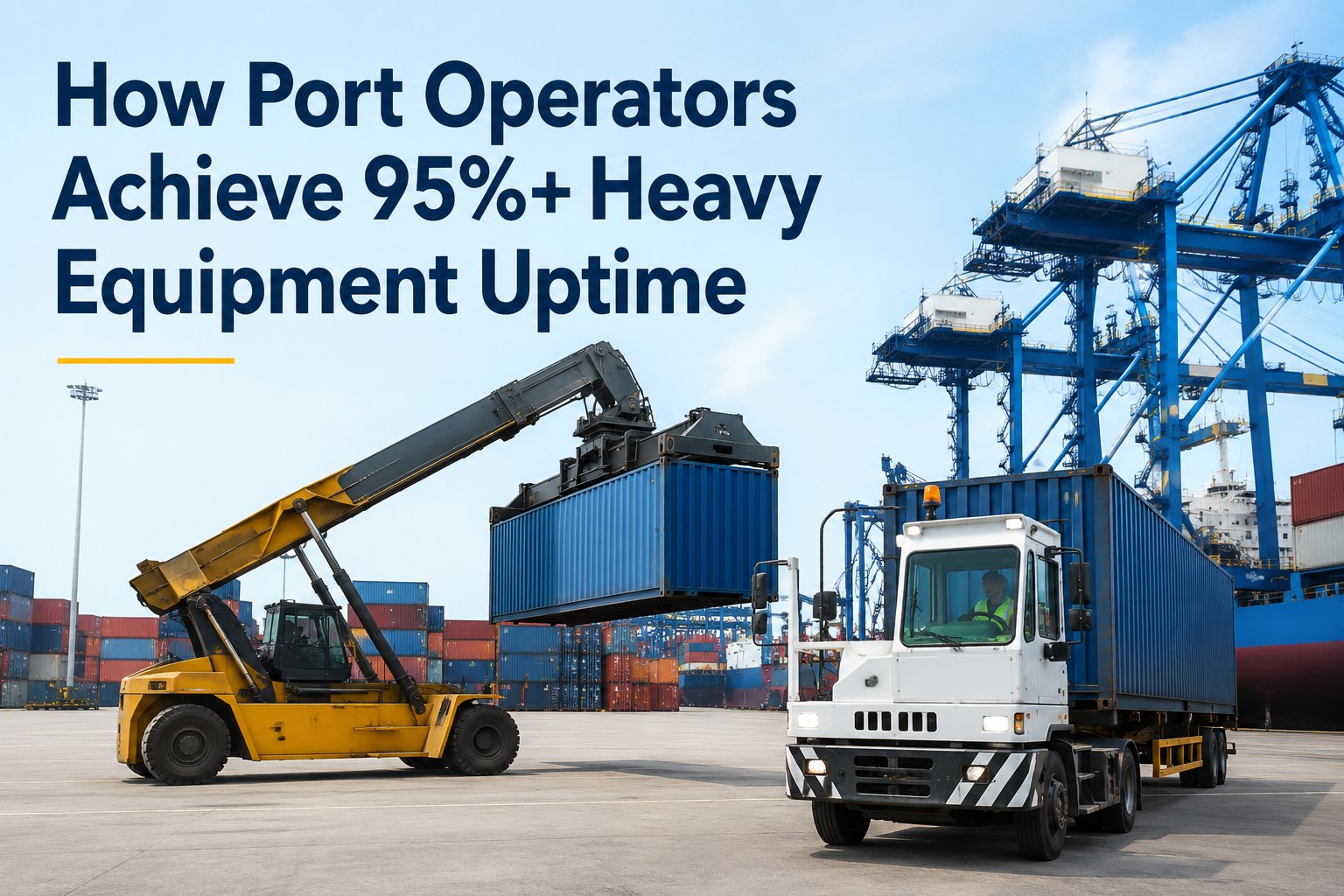
How Port Operators Achieve 95%+ Heavy Equipment Uptime

By Ava Phillips on June 23, 2026

how-port-operators-achieve-95-percent-heavy-equipment-uptime

At a container terminal, equipment availability isn't a maintenance metric — it's the whole business. When a ship-to-shore crane goes down during a vessel window, the berth clock keeps running, demurrage accrues, and the delay cascades through the yard. Industry benchmarks put each 1% improvement in STS crane availability at more than $500,000 a year for a busy terminal, and the top operators run vessel turnaround under 20 hours at 35 to 40 crane moves per hour — numbers that simply aren't reachable if RTGs, reach stackers, and terminal tractors aren't ready when called. Yet many terminals still run on manual spreadsheets and reactive repairs, with small and mid-size ports lagging large seaports in digitalization by roughly 30%. The operators clearing 95%+ uptime aren't lucky — they've built a system: pre-shift digital inspections, hour-based preventive maintenance, and one live view of every asset. HVI inspection and maintenance software is how terminals turn that system on. This page breaks down the uptime equation, the equipment that drives it, and the playbook the best operators follow.

PORT & TERMINAL OPERATIONS
How Top Operators Hit 95%+ Equipment Uptime
95%+ uptime is engineered, not hoped for. HVI gives container terminals pre-shift digital inspections, automated preventive maintenance, and one real-time view of every crane, reach stacker, and tractor — so equipment is ready before the vessel is.
$500K+
annual value of each 1% gain in STS crane availability
35-40
crane moves/hour at top-tier terminals
+8-12%
availability lift from digital transformation
75%
of failures predictable with the right data

The Uptime Equation

Uptime isn't one lever — it's the product of four. A terminal hits 95%+ only when every factor is working; weakness in any one drags the whole number down. Here's what the best operators control.

Pre-Shift Readiness

Every machine inspected before it runs, so a fault is caught in the yard at shift start — not discovered mid-lift over a vessel.

×

PM Compliance

Service done on the hour-meter, every time. PM compliance is what prevents the cascading failures that take a machine out for days.

×

Fast Defect-to-Fix

A flagged defect becomes a work order instantly, with the part and tech lined up — shrinking the gap between found and fixed.

×

Fleet Visibility

One live view of every asset's status, so dispatch never assigns a machine that's overdue, flagged, or already down.

=
95%+

Equipment uptime that vessel windows and SLAs depend on

Each of those factors is a feature, not a hope — HVI builds the inspection, the PM trigger, the work order, and the dashboard into one system. sign up for a free HVI trial and start engineering your uptime.

The Equipment That Decides Throughput

Terminal throughput rides on a handful of asset classes, each with its own failure patterns. HVI gives every class a tailored inspection and maintenance routine — because a quay crane and a yard tractor don't break the same way.

Ship-to-Shore (STS) Cranes

The highest-stakes asset — an outage stalls vessel turnaround directly. Hoist motors, spreaders, and limit switches need disciplined condition checks.

RTG & RMG Cranes

Yard backbone. RTGs carry higher maintenance per move from diesel powertrains and rubber-tire wear — exactly the items a pre-shift inspection catches.

Reach Stackers

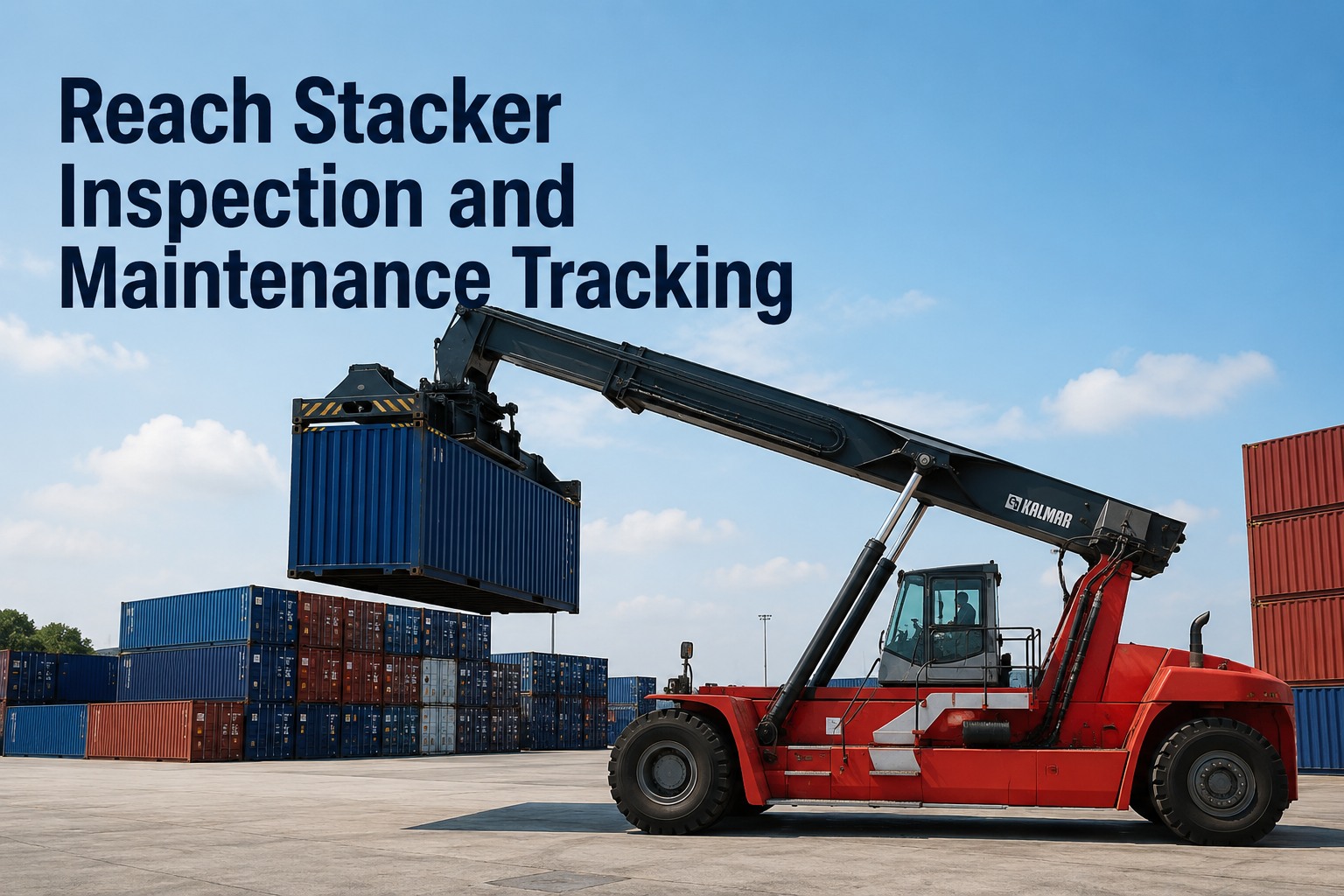
Flexible movers for intermodal and specialty lifts. Boom, hydraulics, and spreader twistlocks are the wear points to track shift by shift.

Terminal Tractors

High-cycle workhorses moving boxes between quay and yard. Brakes, fifth wheels, and tires fail under constant duty — daily checks keep them rolling.

From a quay crane to the smallest yard tractor, HVI runs the right checklist on the right asset and rolls every result into one terminal-wide picture. schedule a demo to see asset-specific inspection profiles.

Reactive vs. The 95% Playbook

The gap between a terminal that limps along on breakdowns and one that engineers uptime comes down to whether maintenance happens before or after the failure. Here's the contrast.

REACTIVE TERMINAL

Faults discovered mid-operation, over a vessel
PM tracked on spreadsheets, intervals missed
Emergency repairs at premium cost and lead time
No failure history — same fault recurs
Dispatch guesses which machines are ready

95% PLAYBOOK WITH HVI

Faults caught at pre-shift inspection, in the yard
Hour-based PM fires automatically, on time
Planned repairs on the terminal's schedule
Full asset history surfaces recurring patterns
Live dashboard shows every machine's true status

The 90-Day Uptime Roadmap

Operators don't reach 95% overnight — they get there in stages. Industry data shows basic PM scheduling alone can deliver a 15% uptime gain in 90 days. Here's the path HVI supports, step by step.

1

Days 1-30 · Digitize Inspections

Replace paper with guided pre-shift checklists per asset class. Every crane, stacker, and tractor checked the same way, every shift — defects flagged with photos.

2

Days 30-60 · Automate PM

Set hour-based service triggers from inspection meter readings so preventive work fires on time. This is where the fast 15% uptime gain shows up.

3

Days 60-90 · Close the Defect Loop

Route every flagged defect to a work order with parts and labor attached, shrinking defect-to-fix time and cutting emergency repairs.

4

Day 90+ · Manage by Data

Use asset history and the live fleet view to predict failures, plan replacements, and benchmark availability toward the 95%+ tier.

The roadmap is the same one top terminals followed — and HVI is the platform that runs every stage of it, from the first digital checklist to data-driven reliability. start a free HVI trial and begin your 90-day climb.

What Hitting 95% Returns

Uptime isn't an end in itself — it's what protects every downstream number a terminal is measured on. Here's where the gains land.

Revenue Protected

With each 1% of STS availability worth $500K+ a year, sustained uptime turns directly into protected throughput revenue and avoided demurrage.

Lower Maintenance Cost

Predictive, data-driven maintenance delivers up to 40% maintenance savings by replacing emergency repairs with planned work.

Faster Vessel Turnaround

Ready equipment sustains 35-40 moves/hour and sub-20-hour turnaround, keeping berths productive and shipping lines on schedule.

Safety & Compliance Proof

Timestamped, signed inspections give a clean audit trail and a defensible record — vital for high-load lifting operations.

Engineer Your Way to 95%+ Uptime

HVI brings pre-shift digital inspections, hour-based preventive maintenance, defect-to-work-order routing, and a live fleet view for every STS crane, RTG, reach stacker, and terminal tractor into one platform. Catch faults in the yard, plan repairs on your schedule, and keep equipment ready before the vessel is. Trusted by 25,000+ users worldwide.
Frequently Asked Questions

How do port operators actually reach 95%+ equipment uptime?
Not by luck — by building a system. The terminals that sustain 95%+ run a disciplined pre-shift inspection on every asset, automate preventive maintenance from hour-meter readings, route every defect straight to a work order, and watch the whole fleet on one live dashboard. Together those close the gaps where uptime leaks: faults found mid-operation, missed service intervals, slow repairs, and dispatch assigning machines that aren't ready. HVI builds all four into one platform, which is why each becomes a repeatable process rather than a hope. Sign up for a free HVI trial to build the system.
Why is crane availability worth so much to a terminal?
Because throughput rides on it directly. Industry benchmarks value each 1% improvement in ship-to-shore crane availability at more than $500,000 a year for a busy terminal, since an STS outage during a vessel window stalls turnaround, triggers demurrage, and cascades delays into the yard. Top operators hold vessel turnaround under 20 hours at 35 to 40 crane moves per hour — pace that's impossible if cranes aren't reliably ready. That's why prioritizing crane readiness and PM compliance gives the highest financial return of any uptime investment. Schedule a demo to see crane inspection workflows.
How quickly can digital inspections improve uptime?
Faster than most operators expect. Industry data shows basic PM scheduling can deliver around a 15% uptime gain within 90 days, and broader digital transformation lifts availability by roughly 8 to 12%. The reason it's quick is that most unplanned failures are preventable — a worn tire, a fluid leak, or a failing limit switch caught at a pre-shift inspection becomes a planned fix instead of a mid-vessel emergency. With HVI, a terminal can digitize inspections in the first month and start seeing the PM-driven gains shortly after. Sign up for a free HVI trial to start the climb.
Can HVI handle every equipment type in a terminal?
Yes. A quay crane, an RTG, a reach stacker, and a terminal tractor each fail differently, so HVI lets you build asset-specific inspection profiles and maintenance schedules for every class — then rolls all of them into one terminal-wide view of status, open defects, and upcoming service. RTGs, for instance, carry higher maintenance per move from their diesel powertrains and rubber tires, so their checklists emphasize those wear points, while STS crane profiles focus on hoist motors, spreaders, and limit switches. Every asset, one system. Schedule a demo to see multi-asset management.
What about predictive maintenance and failure prediction?
Predictive maintenance starts with consistent, structured data — and that's exactly what digital inspections and a complete asset history generate. With the right data, studies put failure prediction as high as 75% and predictive programs at up to 40% maintenance savings. HVI lays the foundation: every inspection, defect, hour reading, and repair logged to the machine so patterns become visible, recurring faults get traced to root cause, and replacements get planned before failure. The 95% tier is reached by managing maintenance with data instead of reacting to breakdowns. Sign up for a free HVI trial to build your data foundation.

Share This Story, Choose Your Platform!

Start Free Trial Book a Demo