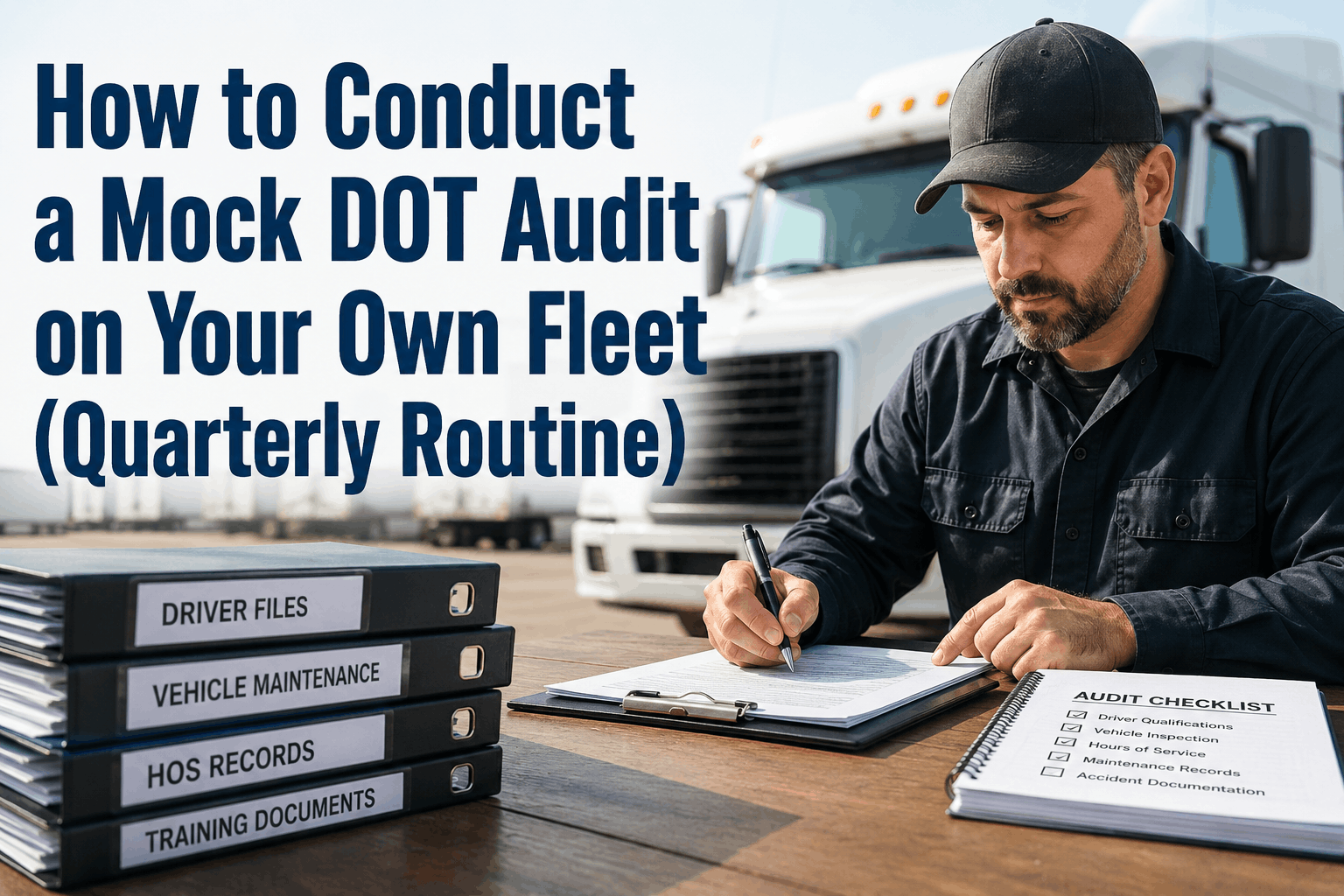
The carriers who pass DOT audits are not the ones with perfect records — they are the ones who find their own problems first. FMCSA's data is consistent on this point: only 7% of motor carriers pass a focused compliance review without a single violation, but among carriers running documented quarterly mock audits, that pass rate climbs above 78%. The difference is not luck or paperwork volume. It is the discipline of running the same audit on yourself every 90 days that an FMCSA officer would run on you with 14 days' notice. A proper mock DOT audit takes one safety manager, four days of focused work each quarter, and a structured protocol that covers the same six evaluation factors and 11 automatic-failure conditions FMCSA uses. This guide walks carriers and owner-operators through the exact routine — the audit scope, document sampling protocol, finding-tracking template, and 30-day remediation plan — that turns mock audits from a paperwork exercise into a compliance multiplier. HVI's inspection & maintenance software auto-generates the inspection and maintenance side of this audit trail, so when quarter-end comes, the data is already organized — your only job is reviewing it.
Find Your Compliance Gaps Before FMCSA Does
HVI auto-tracks inspections, defects, maintenance, and driver assignments — the categories that produce 60% of DOT audit findings. When your quarterly mock audit starts, half the data is already organized and exportable in one click.
Why Quarterly — And What "Mock" Actually Means
The mock audit is not a fire drill before a real audit. It is a recurring 90-day discipline that mirrors what FMCSA will do — same scope, same sampling, same evaluation criteria. Here is why the quarterly cadence works.
14 days
Average notice you get from FMCSA before an audit. Not enough time to fix systemic issues — only enough to find them.
90 days
Minimum DVIR retention window. A quarterly cadence ensures every record auditors can request was reviewed by you first.
78%
Fewer violations reported by carriers running documented quarterly mock audits compared to unprepared peers.
40%
Faster completion time on real audits because records are pre-organized and gaps already remediated.
The 4-Day Quarterly Audit Routine
A solo safety manager can complete a thorough mock audit in four focused days. Owner-operators with a small fleet can do it in two. Here is the recommended sequencing — day by day, action by action.
Lock the audit window: pull the calendar dates for the prior 90 days. Every record you sample comes from this window.
Print FMCSA's Safety Audit Evaluation Criteria (Appendix A to Part 385) — your checklist. Do not use simplified versions.
Assign roles: who plays auditor, who plays records custodian. Rotate the auditor role each quarter for institutional knowledge.
Pull your latest SMS profile from csa.fmcsa.dot.gov. Flag any active threshold violations as priority focus areas.
Run the 6-factor sample protocol (next section). Pull DQ files, drug/alcohol records, HOS logs, vehicle maintenance files, accident register, and insurance.
Random selection: pick 10% of drivers (minimum 3), 10% of vehicles (minimum 3), and 30 consecutive days of HOS for each sampled driver.
Export 90 days of DVIRs from HVI for sampled vehicles. Verify the 3-signature chain is complete on every defect.
Time the retrieval. Anything beyond 30 minutes is a real-audit risk signal — even if records are eventually found.
Score each sampled record against the FMCSA criteria. Use the finding tracker template (next section) — log every gap, not just severe ones.
Categorize findings by severity: critical (automatic-fail trigger), acute (would generate citation), pattern (recurring administrative gap).
Check all 11 automatic-failure conditions explicitly. One trigger = audit fail regardless of everything else.
Document the mock audit itself — date, scope, samples reviewed, findings, owner. Real auditors look favourably on this evidence.
Build the 30-day remediation plan (template below). Every critical finding gets an owner, a deadline, and a verification step.
Brief the team: safety manager, dispatcher, maintenance lead, drivers affected. Findings without context become findings repeated.
Schedule the next quarterly audit on the calendar — 90 days out. Treat it as a non-movable internal deadline.
File the audit report in your "Safety Management Controls" folder. This file becomes your defence the next time auditors question your program.
Days 2 and 3 are where HVI saves the most time. Inspections, defects, work orders, and maintenance history are already organized — sample selection becomes a filter and export, not a filing-cabinet hunt.
Start free with HVI.
The 6 Audit Categories You Must Sample
FMCSA evaluates carriers across six factors. A real mock audit samples each category with the same rigour an auditor would apply. Here is the scope per category — and which ones HVI fully automates.
01
General Records
USDOT registration, MCS-150 currency, MC/MX authority, BOC-3 filing, operating authority documents
Manual review
02
Driver Qualification (DQ) Files
CDL validity, MVR pulls (initial + annual), medical certificates, application, road test certificates, employment history (3 years), Clearinghouse queries
Manual review
03
Drug & Alcohol Testing
Pre-employment, random pool documentation (50% random drug, 10% random alcohol), post-accident, reasonable suspicion records, return-to-duty documentation
Manual review
04
Hours of Service (HOS) & ELD Records
ELD logs for sampled drivers (30+ consecutive days), supporting documents, ELD malfunction records, edit/annotation history, ELD registration status
ELD-tracked
05
Vehicle Maintenance & Inspection
DVIRs (90 days), annual inspections (14 months), repair records, defect-to-repair documentation, 3-signature chain completeness, maintenance schedules
HVI auto-tracked
06
Accident Register & Insurance
3-year accident register, FMCSA-reportable incidents, insurance certificates (current + lapsed period coverage), claim files, post-accident testing where applicable
Manual review
Document Sampling Protocol — How Auditors Actually Pull Records
Auditors do not review every record. They sample. A proper mock audit replicates the same sampling logic — random selection across a defined window — so you find the same gaps an auditor would find. Here is the protocol.
Driver sample size
10% of active drivers, minimum 3 — random selection across tenure
Vehicle sample size
10% of fleet, minimum 3 — mix of vehicle types and ages
HOS log depth
30 consecutive days per sampled driver, drawn from last 6 months
DVIR depth
All 90 days for sampled vehicles — defect, repair, next-driver signatures verified
Drug pool verification
Random selection log + actual test results — match every name against pool
Accident register window
Full 3-year history — verify every reportable crash documented
Annual inspection coverage
100% of vehicles — every annual inspection within 14 months
HVI's compliance dashboard supports the protocol directly — filter by date range, vehicle, or driver, then export sample sets in seconds.
Book a demo to see audit-sample exports in action.
The 11 Automatic-Failure Conditions to Check First
Some findings cannot be remediated. They are "bright-line" violations — one trigger and the audit fails regardless of every other strength. Check these eleven first. If any are present, the rest of the mock audit is academic until they are fixed.
1Using a driver without a valid CDL
2Using a disqualified or out-of-service driver
3Using a driver before pre-employment drug test results received
4No random drug/alcohol testing program in place
5Failure to implement an alcohol or controlled-substance testing program
6Driver with a positive drug/alcohol test still operating
7No valid medical examiner's certificate for any driver
8Operating a CMV declared out of service before repairs
9Failing to maintain required financial responsibility / insurance
10Knowingly falsifying records of duty status, DVIRs, or testing
11Operating without required operating authority (interstate)
The Finding-Tracking Template
Every gap found during the audit goes into a single tracker. The template below is the minimum information auditors expect to see if they ever review your safety management program — and the structure that makes remediation actually happen.
Finding #
Category
Severity
Description
Owner
Deadline
001
DQ Files
CRITICAL
Driver Smith — medical cert expired 12 days ago
Safety Mgr
Today
002
Maintenance
ACUTE
Unit 4721 — annual inspection 8 days overdue
Maint. Lead
5 days
003
DVIR
ACUTE
3 vehicles — missing mechanic signature on repair cert
Maint. Lead
7 days
004
HOS
PATTERN
Driver Jones — 4 unidentified driving events Q3
Safety Mgr
14 days
005
Drug Pool
PATTERN
Random pool documentation missing 1 month
Safety Mgr
10 days
The 30-Day Remediation Plan
A finding without a remediation plan is just a complaint. Real auditors care less about whether you have gaps and more about whether you have a working process to close them. Here is how to structure the 30 days after the mock audit.
WEEK 1
Critical Findings
Close every critical finding — expired credentials, OOS vehicle issues, missing insurance. These cannot wait. Document each closure with date, action taken, and verification evidence.
WEEK 2
Acute Findings
Address citation-level gaps: missing signatures, late annual inspections, incomplete DQ files. Assign owners and verify each item before week-end. No carryover.
WEEK 3
Pattern Fixes
Address recurring administrative gaps — unidentified driving, drug pool tracking, training records. Pattern findings need process fixes, not just record fixes.
WEEK 4
Verification & Documentation
Verify every finding is closed. Update the tracker with closure dates and evidence. File the complete mock audit package — this is your safety management evidence.
The Quarterly Discipline That Changes Audit Outcomes
Real audit performance is decided long before the auditor arrives. Carriers who run quarterly mock audits know what their gaps are, have closure evidence on file, and produce records in minutes rather than days. The 4-day routine outlined here is not theoretical — it mirrors FMCSA's actual evaluation criteria (Appendix A to Part 385), uses the same sampling logic auditors apply, and produces the same finding categories real audits generate. Owner-operators can run a streamlined version in two days. Mid-sized fleets need the full four. Either way, the cadence is what matters: every 90 days, no exceptions, documented in writing. HVI's inspection & maintenance software handles the data-heaviest portion of this routine — DVIRs, defects, work orders, maintenance schedules, and annual inspections are all auto-tracked, sample-ready, and exportable in seconds. The remaining categories (DQ files, drug program, accident register, insurance) stay your responsibility — but the quarterly cadence ensures none of them surprise you. Start free today or book a 30-minute demo to see how HVI accelerates the inspection-and-maintenance side of your next mock audit.
Make Quarterly Mock Audits Effortless with HVI
Inspection records pre-organized. Defects auto-routed to work orders. Annual inspections tracked. 3-signature chain enforced. Audit-ready exports in 15 minutes. Trusted by 25,000+ users worldwide.
Frequently Asked Questions
Q: How often should a carrier run a mock DOT audit?
At minimum, quarterly. Every 90 days. The quarterly cadence aligns with FMCSA's 90-day DVIR retention window and gives carriers four chances per year to find and close gaps before real auditors do. Carriers running documented quarterly mock audits report 78% fewer violations than unprepared peers.
Q: Can an owner-operator run a mock audit alone?
Yes — a single-truck owner-operator can complete the routine in two days instead of four. The scope is the same (all 6 categories, all 11 automatic-failure checks), but the sample sizes shrink to one driver, one vehicle. HVI consolidates the inspection and maintenance data, leaving DQ file, drug program, and insurance review as the main manual tasks.
Start free with HVI.
Q: What is the "Safety Audit Evaluation Criteria" checklist auditors use?
Appendix A to Part 385 of the Federal Motor Carrier Safety Regulations. It is FMCSA's published evaluation methodology — the same six factors and 11 automatic-failure conditions every certified auditor applies. Use this document as your mock audit checklist, not simplified third-party versions. It is available free at the FMCSA website.
Q: Should we document our mock audits even if we find no gaps?
Especially then. A documented mock audit with zero findings is your strongest evidence of a working safety management program. Auditors weigh "safety management controls" heavily — and a quarterly self-audit log demonstrates organizational commitment to compliance, which influences how auditors interpret borderline findings.
Book a demo to see HVI's compliance dashboard.
Q: How does HVI accelerate the mock audit process?
HVI auto-tracks the inspection and maintenance categories — DVIRs, defects, work orders, annual inspections, and the 3-signature chain. During the mock audit, sample selection becomes a filter operation, retrieval takes under 15 minutes, and the 3-signature chain enforcement means you cannot have missing signatures to find. That eliminates roughly 60% of typical mock audit findings before you start.
Q: What if our mock audit reveals an automatic-failure condition?
Fix it the same day. Period. Automatic-failure conditions (expired CDL, no drug program, OOS vehicle in service, missing insurance) cannot be remediated retroactively in front of an auditor — but they can be closed before any auditor arrives. Document the closure with date, action, and evidence. Then schedule an interim mock audit 30 days later to verify it stayed closed.
Start free today.