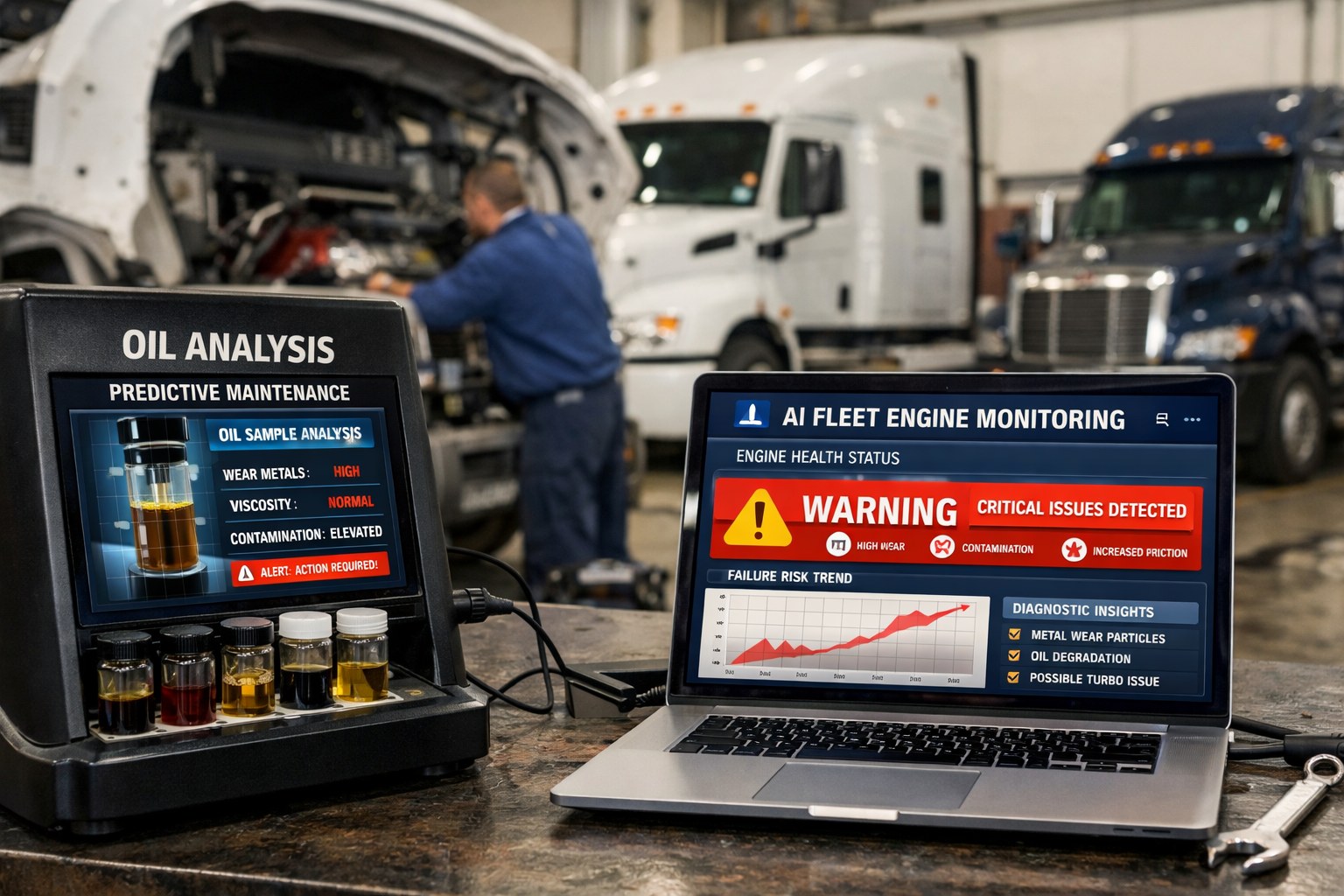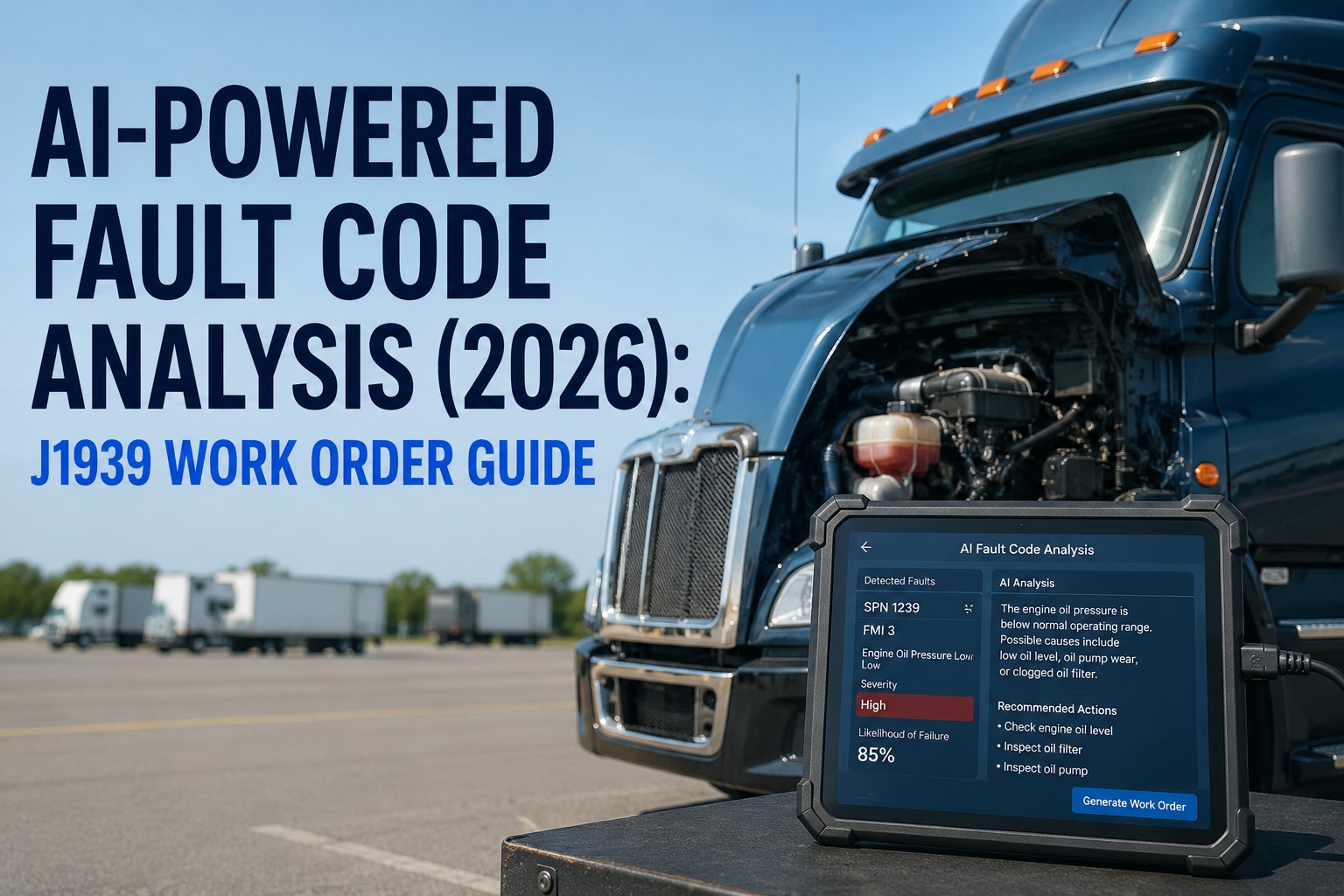
A Class 8 truck rolling down I-80 generates more than 2,000 data points per second from its engine, transmission, and aftertreatment. Somewhere in that stream, an NOx sensor drifts out of spec — SPN 5246 FMI 4 fires — and the code sits inside the ECU until the DEF system forces a derate 400 miles from home. AI-powered fault code analysis is the answer: continuous J1939 monitoring, ML triage against historical repair records and automated work orders that fire before the code becomes a breakdown. Book a demo
The signal-to-noise problem — and how AI solves it
A busy fleet's telematics stream is 90% noise. AI's job is finding the 10% that matters, before it becomes a breakdown.
The math isn't subtle. Without triage, a 100-truck fleet's maintenance team sees ~40 fault codes per day and has time to investigate maybe five. The wrong five get investigated. With AI-powered fault code analysis, the same team sees three to five prioritized work orders per day — each with SPN/FMI decoded, probable cause identified, part number recommended, and estimated labor time attached. It's not a magic upgrade to the mechanics; it's the elimination of the guesswork that consumed 45 minutes per code before the mechanic even opened the bay.
Anatomy of a J1939 fault code — what SPN + FMI actually means
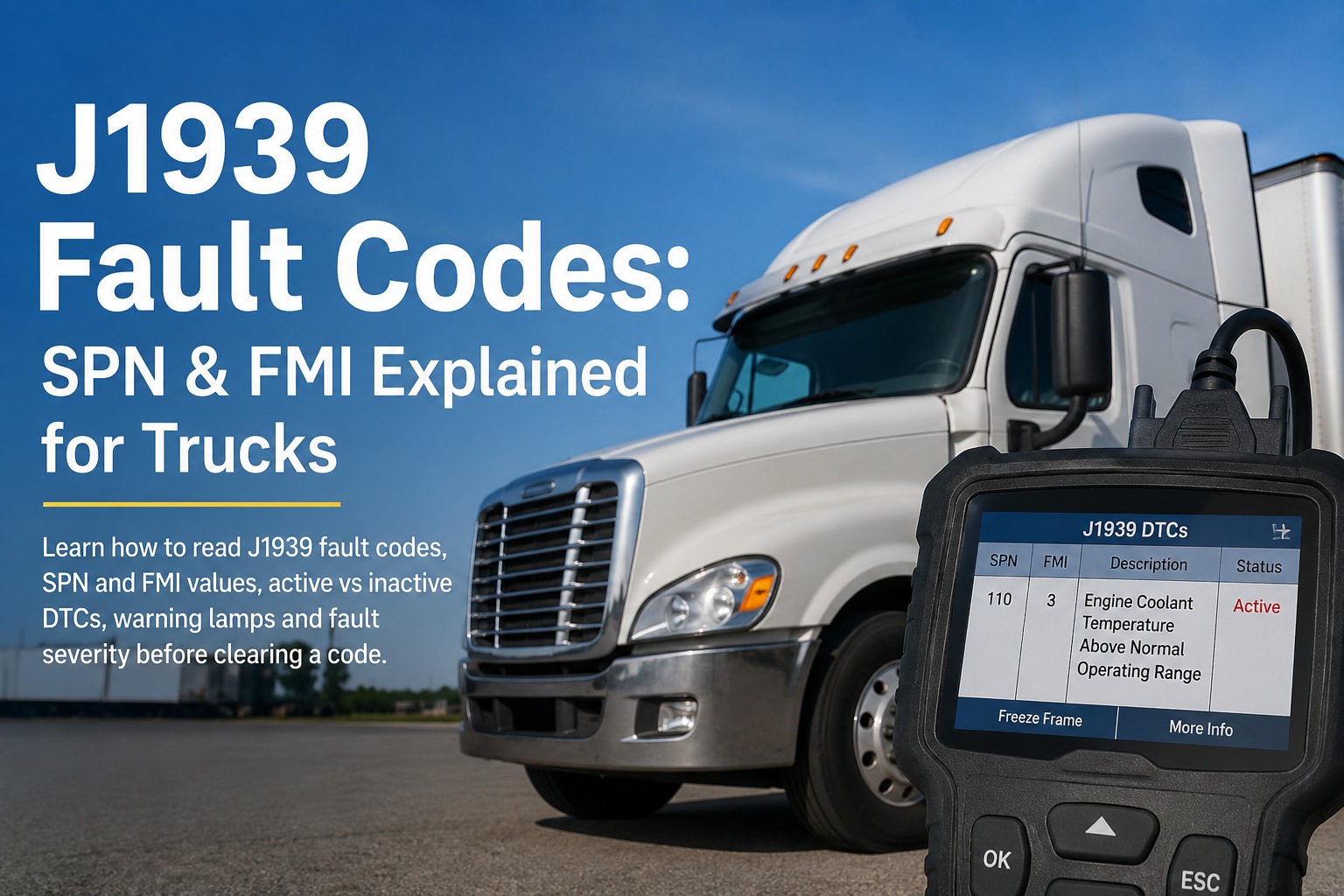
Every J1939 diagnostic trouble code has the same three-part structure regardless of engine manufacturer — Cummins, Detroit Diesel, PACCAR, all speak the same language on the CAN bus. Understanding the anatomy is what turns "SPN 3251 FMI 16" from a scan-tool riddle into a targeted repair.
The anatomy above is why AI matters at all. A raw "SPN 3251 FMI 16" tells a technician nothing without a reference table, OEM documentation, and cross-reference to fleet-specific repair history. An AI-powered decoder produces the plain-English translation instantly, along with historical context: this SPN has fired on this specific truck three times in six weeks, which changes the priority completely. Book a demo to see SPN/FMI decoded live from your telematics feed
The three-tier severity system — what actually gets flagged, and when
The core AI job isn't decoding codes — that's a lookup table. The real work is sorting the day's fault stream into severity tiers that match the fleet's actual response capacity. Every good AI fault system runs three tiers, each with a different action path.
The tier logic is deceptively important. Fleets that treat every fault code as critical waste labor investigating noise. Fleets that treat every fault code as low-priority get roadside failures on codes that should have been caught. Good AI triage lands in the middle — and adapts per truck based on that unit's history, mileage, and criticality to the current route.
Manual vs AI — the same fault code, two different workflows
Here's what actually changes at the shop floor when AI-powered fault code analysis sits between the telematics feed and the work-order queue. The comparison is the same fault code, same truck, two very different response paths.
The dollars behind that gap are unsubtle. Catching a DPF fault early — the classic SPN 3251 story — costs around $200 in labor and parts. The same fault escalated to roadside costs $2,000–$8,000+ including towing, emergency parts, hotel stays, and missed delivery penalties — before counting the $800–$1,200 daily revenue lost on the stranded tractor. Multiply across a 100-truck fleet and the annual difference between AI-triaged and manual workflow lands in seven figures. Book a demo to see fault-to-work-order automation on live fleet data
The automated work order pipeline — from CAN bus to assigned tech in seconds
The end-to-end pipeline behind AI-powered fault code analysis is worth walking through step-by-step. Nothing in it is magic; every stage is a specific technical operation that adds context to the raw fault. The result is a work order that arrives at the mechanic's screen already useful.
-
01Ingestion — J1939 stream from telematics
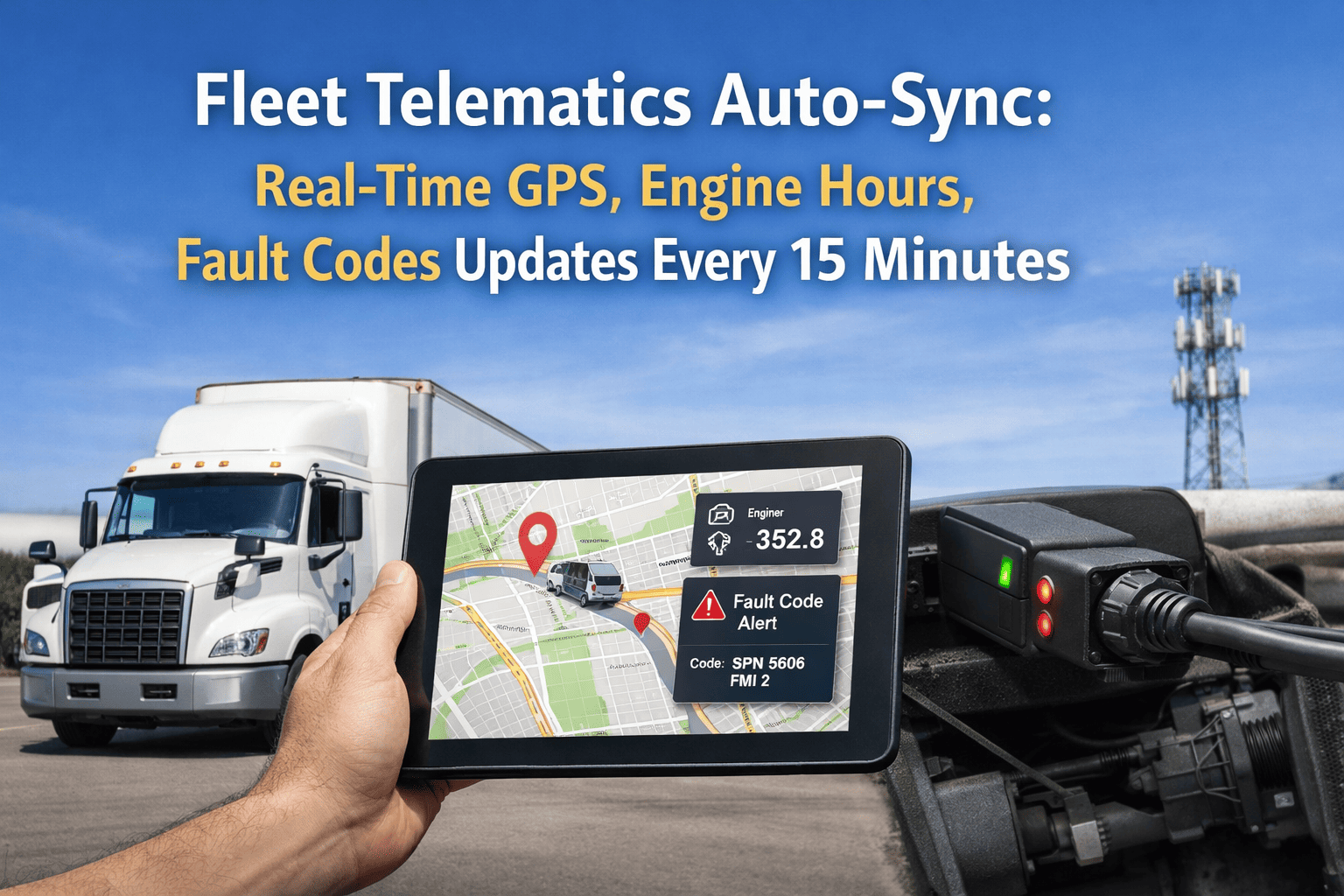
Telematics device on the truck (Samsara, Geotab, Teltonika, PeopleNet, Omnitracs) reads fault codes off the J1939 CAN bus in real time. Codes stream to the fleet platform via API within seconds of firing at the ECU. No middleware, no manual pull, no waiting for the truck to return to yard.
-
02Decoding — SPN + FMI into plain English
Raw "SPN 3251 FMI 16" is decoded against the SAE J1939 reference tables and OEM manufacturer-specific extensions (Cummins, Detroit Diesel, PACCAR, Volvo). Output: "DPF backpressure elevated, above normal operating range, moderate severity" — the language the technician actually needs.
-
03Prioritization — severity + unit-history context
Machine learning models trained on historical repair records apply the three-tier severity classification (Critical / Warning / Info), factoring in the specific truck's fault history. A first-time DPF code on a well-maintained unit is different from the third DPF code in six weeks on a truck already flagged for aftertreatment issues.
-
04Recommendation — part number + labor estimate
Based on decoded SPN/FMI and unit history, the AI recommends probable cause, suggested repair action, part numbers (checked against parts inventory), and labor time estimate. If the recommended part is below reorder threshold, an order is triggered simultaneously.
-
05Assignment — work order to available technician
Prefilled work order routes to the shop queue with SPN, FMI, freeze-frame data, decoded description, probable cause, recommended part, labor estimate, and unit history all attached. The technician opens a fully-scoped WO instead of a mystery code — and starts the repair with the correct part in hand.
The pipeline runs continuously across the entire fleet, on every telematics-connected truck. The maintenance team sees a queue of ready-to-work orders sorted by severity, not a dashboard of raw fault codes to investigate. That shift — from investigation to execution — is where the labor savings and predictive maintenance ROI actually land. Start free and connect your first telematics feed on day one
The predictive maintenance ROI — four numbers that matter
Every AI fault code analysis pitch eventually arrives at the ROI question. The math anchors on four numbers that show up consistently across industry benchmarks and published deployment case studies.
The most-underrated benefit isn't in any of the four numbers above. It's the compounding effect: every fault the AI catches early feeds the historical dataset the AI uses to prioritize the next fault. A fleet that runs AI-powered fault code analysis for 18 months develops a per-unit failure signature that's substantially more accurate than the OEM-generic baseline it started with. The system gets better at spotting problems specifically on your fleet, on your routes, in your climate. Book a demo to see per-unit failure signatures on live fleet data
From a Maintenance Director who cut unplanned downtime 47% in 12 months
We had Samsara pulling J1939 codes for two years before we ever did anything with them. There were 220 stored fault codes across 90 trucks that had never been reviewed — sitting on a dashboard nobody had time to open. Our downtime rate was 8.4%, mostly unplanned. My PM compliance was fine, but we were still getting caught out on codes we should have seen.
Twelve months after connecting AI fault code analysis, unplanned downtime dropped to 4.5%. The wins weren't glamorous — DPF regens caught before forced-regen thresholds, NOx sensors replaced at PM instead of on the shoulder, coolant sensor drift flagged before it triggered a derate. Nothing exotic. Just codes we already had, finally acted on. The system saved my team 200+ tech-hours a month on cross-referencing alone. The rest was ROI.
Frequently asked questions
What is AI-powered fault code analysis, and how does it differ from a regular scan tool?
AI-powered fault code analysis is a real-time diagnostic layer that ingests J1939 fault codes from the truck's CAN bus (via telematics), decodes them from raw SPN/FMI numbers into plain-English descriptions, classifies each fault by severity using machine learning models trained on historical repair records, and auto-generates prefilled work orders with recommended parts and labor estimates. A traditional scan tool (like a Nexiq USB Link or handheld reader) requires a technician to plug into the diagnostic port at the truck, pull codes, and manually cross-reference each SPN/FMI against OEM documentation and repair history — a process that takes 45+ minutes per vehicle and still gets diagnosis wrong roughly 30% of the time. AI-powered fault code analysis does the equivalent work continuously and automatically for every truck in the fleet, in real time, without a tech touching a scan tool. The bigger difference is context: an AI system knows this specific truck's fault history, so a first-time DPF code on a healthy unit gets triaged differently from the third DPF code in six weeks on a truck with a pattern of aftertreatment issues. The scan tool sees the fault; the AI sees the pattern. That contextual awareness is what enables predictive maintenance rather than reactive repair.
What are SPN and FMI in J1939 fault codes?
SPN and FMI are the two halves of every J1939 diagnostic trouble code, and together they form the precise diagnostic language used across all Class 6–8 commercial vehicles regardless of engine manufacturer. SPN stands for Suspect Parameter Number and identifies WHAT component or signal has the fault. There are over 10,000 standardized SPNs defined by SAE J1939, covering everything from coolant temperature (SPN 110) to DEF tank level to turbo speed to DPF differential pressure (SPN 3251) to SCR catalyst efficiency (SPN 3226) to NOx sensor readings (SPN 5246). Every SPN has the same meaning on a Cummins engine, a Detroit Diesel, or a PACCAR — that's the point of the standard. FMI stands for Failure Mode Identifier and describes HOW the component failed. There are 32 standardized FMI values ranging from 0 to 31. The most common critical ones: FMI 0 (data valid but dangerously above normal), FMI 3 (voltage above normal, shorted high), FMI 7 (mechanical system not responding), FMI 12 (bad intelligent device), FMI 14 (special instructions), FMI 16 (data valid but above normal — moderately severe). Together, a code like "SPN 3251 FMI 16" tells a technician the DPF differential pressure sensor is reading above normal but not critically — likely soot loading approaching forced-regen threshold. The SPN + FMI pair converts a light on the dashboard into a targeted repair action.
How does AI fault code analysis prioritize which faults to act on first?
Well-designed AI fault code systems apply a three-tier severity classification that maps to different action paths and response times. Critical tier: stop-engine and safety-of-flight faults that require the truck to be pulled off the road within the current shift — typically FMI 0 (dangerously above normal), FMI 7 (mechanical system not responding), and specific SPN combinations known to precede imminent failures (NOx sensor faults with DEF derate risk, high-severity coolant temperature codes, brake system faults). Action: auto-create emergency work order, notify dispatch, assign to next available technician. Warning tier: degradation detected but not immediate; addressed at next available PM slot or scheduled shop visit within 500–2,000 miles. Examples include DPF backpressure warnings (SPN 3251 FMI 16), voltage-above-normal circuit codes (FMI 3), and SCR catalyst efficiency degradation. Action: queue for next PM, order part in advance, assign tech at check-in. Info tier: low-severity or intermittent codes tracked for pattern analysis; act only if frequency crosses threshold. Examples: pending codes below occurrence threshold, intermittent connector faults that self-clear, FMI 12 (bad intelligent device that resolves on next key cycle). Action: log to unit history, trigger alert if pattern repeats, include in next PM review. The AI adjusts tier assignments based on each truck's specific fault history — a first-time code on a well-maintained unit is treated differently from a repeat code on a truck already showing a failure pattern.
Does AI fault code analysis work with my existing telematics provider?
Almost certainly, yes. Modern AI fault code analysis platforms integrate with all major commercial fleet telematics providers via standard APIs — including Samsara, Geotab, Teltonika, PeopleNet, Omnitracs, and 20+ others in the market. If your trucks already have GPS tracking through any mainstream telematics device, the J1939 diagnostic capability is almost always already there — it just needs to be activated and connected to the AI platform. Over 90% of vehicles manufactured in 2026 ship with embedded telematics capable of streaming J1939 data. That said, integration quality matters: pre-built native connectors to your specific telematics provider avoid the middleware, custom API work, and ongoing maintenance overhead that come with generic integrations. Before committing to any AI fault code platform, confirm three things: (1) native integration with your current telematics provider (not through a generic middleware layer); (2) support for both J1939 (heavy-duty, Class 6–8) and OBD-II (light and medium-duty, Class 1–5) if your fleet is mixed; and (3) support for manufacturer-specific proprietary codes from your engine OEMs (Cummins, Detroit Diesel, PACCAR, Volvo). Fleets running mixed telematics providers (common after acquisitions) should confirm the platform handles multiple sources with unified fault triage rather than treating each provider as an isolated silo.
How does HVI's AI diagnostics work with the rest of the fleet platform?
HVI runs AI-powered fault code analysis as one integrated layer of the fleet management platform rather than a bolt-on diagnostic tool — which matters because the value of an early-caught fault code depends on what happens next in the workflow. HVI ingests J1939 fault codes via native integrations with Samsara, Geotab, Teltonika, and other major telematics providers; decodes SPN/FMI into plain-English descriptions using the SAE J1939 reference plus OEM-specific extensions for Cummins, Detroit Diesel, PACCAR, and Volvo; and applies severity triage based on each truck's specific fault history and unit context. When a critical or warning-tier fault fires, HVI auto-generates a prefilled work order attached to the specific unit — with SPN, FMI, freeze-frame data, decoded description, probable cause, recommended part number (checked against on-hand inventory), and labor time estimate. The work order routes into the shop queue alongside DVIRs, PMs, and other scheduled maintenance, so the technician sees a unified queue instead of separate dashboards. Parts inventory automatically reflects the reservation; if the recommended part is below reorder threshold, an order is triggered. Every fault feeds the historical dataset that drives predictive maintenance and per-unit failure signatures, and every closed work order updates the AI's understanding of what actually fixed the fault. Published customer data shows fleets on HVI report approximately 25% lower annual maintenance cost and typical payback around 3 months — and AI-powered fault code analysis is one of the specific mechanisms delivering those results.
Your trucks are talking. Make sure your shop is listening.
HVI reads J1939 fault codes from your telematics feed in real time, decodes SPN/FMI into plain-English descriptions, applies severity triage, and auto-generates prefilled work orders with recommended parts and labor time — on the same platform running your PMs, DVIRs, and inventory. When the signal reaches the shop before the truck does, roadside becomes an outlier.
No credit card · Native Samsara, Geotab, Teltonika integrations · Live fault feed on day one