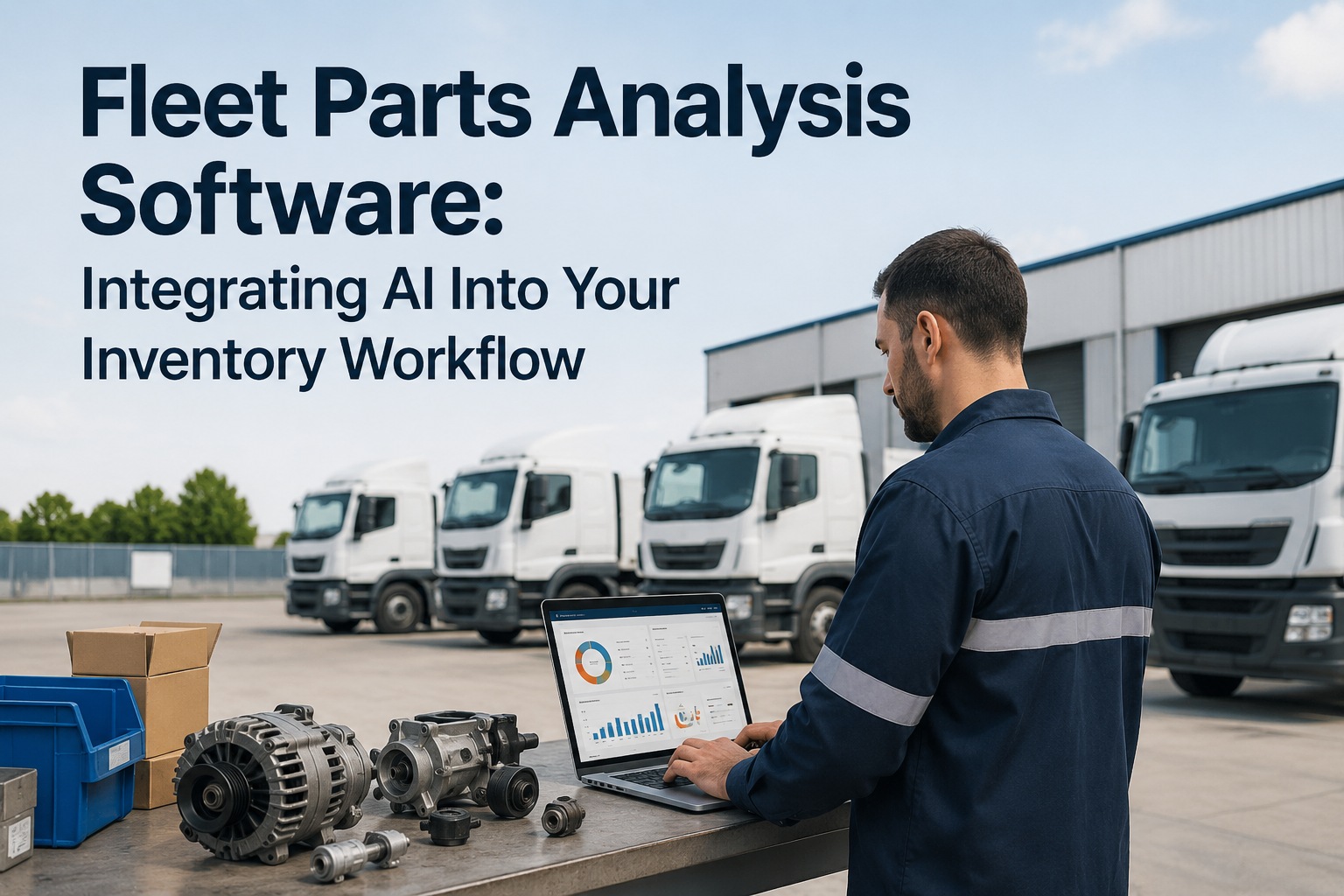
Parts inventory is where most fleet maintenance programs quietly fail. A perfect PM schedule with a perfect technician roster still produces a stranded truck if the brake chamber, alternator, or air dryer isn't on the shelf when the work order opens. Industry data shows 40-60% of maintenance delays trace directly to parts gaps — wrong stock levels, missing reorder points, forgotten lead times, duplicate orders sitting in different drawers. The 2026 answer is AI parts analysis software: predictive forecasting models that learn from telematics streams, failure patterns, and historical demand to keep inventory levels precisely where they need to be. Fleets that integrate AI into their parts workflow report 25% leaner inventory carrying levels, 60% fewer stockouts, 78% reduction in emergency parts orders, and 220-650% ROI within the first year. This guide covers exactly how AI parts analysis software works, the six core capabilities that separate genuine AI platforms from glorified spreadsheets, and how HVI's AI Parts Analysis module delivers each capability inside the broader maintenance workflow you already run. Start your free HVI trial or book a 30-minute demo to see the full integration live.
HVI's AI Parts Analysis predicts demand 3-8 weeks ahead, auto-generates reorder triggers, integrates with your procurement workflow, and eliminates the stockout-to-emergency-repair cascade. 25% leaner inventory, 60% fewer stockouts, 78% fewer emergency orders.
What is AI fleet parts analysis software?
AI fleet parts analysis software is a maintenance technology that uses machine learning, telematics data, and historical failure patterns to forecast parts demand, automate reorder triggers, predict stockouts, and integrate parts inventory directly into work order and procurement workflows — replacing spreadsheet-based "guess-and-restock" management with predictive, data-driven inventory optimization. The result: 25% leaner inventory carrying costs, 60% fewer stockouts, 78% reduction in emergency parts orders, and 220-650% first-year ROI.
Unlike generic inventory management software adapted for fleet use, AI parts analysis platforms like HVI are built specifically around the failure modes, component hierarchies, and lead-time realities of commercial vehicle operations — air brake systems, hydraulic pumps, alternators, injectors, filters, and the 800+ part numbers typical heavy fleet operations track across vendor catalogs.
Why traditional parts management fails fleet operations
Most fleets run parts inventory the same way they ran it in 2005 — manual spreadsheet counts, gut-feel reorder points, emergency orders when stock runs out, surplus orders to "be safe" that sit on shelves for years. The 2026 cost of running parts this way is documented and consistent.
Of maintenance delays trace directly to parts gaps. Vehicle sits idle while a $40 part gets ordered.
Of annual stockouts on critical parts that paper-based inventory systems experience.
Emergency parts orders cost 78% more than scheduled procurement. Expedite fees, premium pricing.
Emergency parts-driven repairs cost 3-5x more than scheduled repairs with parts in stock.
Of parts inventory at typical fleets is "safety stock" that hasn't moved in 24+ months.
Of annual operating hours lost to breakdown repairs in heavy equipment fleets — many parts-driven.
The 6 AI capabilities that transform parts workflow
Genuine AI parts analysis platforms deliver six core capabilities that separate them from inventory tracking software with a "smart" sticker. HVI delivers all six on the same platform that handles inspections, work orders, and PM scheduling.
Machine learning models analyze telematics streams, historical work orders, failure patterns, and seasonal usage to forecast parts demand 3-8 weeks ahead with 80-97% accuracy. HVI learns which parts your fleet actually consumes, not what a vendor catalog suggests.
When stock approaches forecasted thresholds, HVI auto-generates a PO with part number, supplier, quantity, and delivery location pre-populated. Routes through standard approval workflow instead of emergency bypass.
AI digital twin models of individual fleet assets predict when specific components — engines, transmissions, hydraulic units — will reach replacement threshold based on usage stress and condition data.
When predictive maintenance flags a failure, HVI auto-generates a work order WITH parts reserved from inventory, technician assigned, and repair window scheduled during planned downtime. Zero manual entry.
HVI tracks installation date, vendor warranty terms, and component performance — generating warranty claim alerts when a part fails within its warranty window and tracking the claim through resolution.
AI surfaces which parts fail more often than expected, which suppliers produce parts with shorter actual lifespans than warranties promise, and which vehicles consume specific parts at abnormal rates.
Manual parts management vs HVI AI — side-by-side
The economic case for AI parts analysis becomes obvious when you put the two approaches side by side on the metrics that actually matter to fleet financials.
ROI math — what AI parts analysis actually saves
The savings break down across six distinct value streams. Below is the documented annual breakdown for a representative 50-vehicle heavy fleet running HVI AI Parts Analysis versus the same fleet on spreadsheet-based inventory management.
How to integrate AI parts analysis into your workflow
The biggest mistake fleets make with AI parts analysis is treating it as a replacement project ("rip out the old system, install the new one"). The right approach is integration — layering AI intelligence on top of your existing CMMS, work order workflow, and procurement system. Here's the 5-step integration sequence that works.
Import existing parts inventory from spreadsheets or legacy systems into HVI. Part numbers, descriptions, current stock levels, vendor relationships, lead times, unit costs. Clean baseline data is non-negotiable.
Wire HVI to your telematics provider (Samsara, Geotab, Motive, Verizon Connect) and import historical work orders. AI models need 3-6 months of clean operational data to produce accurate forecasts.
Critical parts (brake chambers, alternators, key filters) get aggressive reorder thresholds. Standard parts get cost-optimized thresholds. Long-lead-time parts get extended forecast windows.
Connect HVI to your ERP (SAP, Oracle, QuickBooks, Sage, Viewpoint). AI reorder triggers push structured POs into approval routing instead of emergency bypass. Finance sees parts as line items, not fire drills.
Run AI parts analysis on a pilot fleet (10-25 vehicles) for 60-90 days. Measure stockout rate, emergency order frequency, inventory carrying levels, parts-driven downtime. Then scale to full fleet.
Frequently asked questions
Make your parts inventory predictive, not reactive.
HVI AI Parts Analysis delivers every capability covered in this guide on one integrated platform — AI demand forecasting with 80-97% accuracy, automated reorder triggers with SAP/Oracle/QuickBooks integration, component-level digital twins, closed-loop WO-to-parts integration, warranty tracking, and failure pattern analytics. Most fleets recover the annual subscription cost from a single averted stockout within the first 90 days.
No credit card required · Live in 2-4 weeks · 95% positive ROI within first 12 months