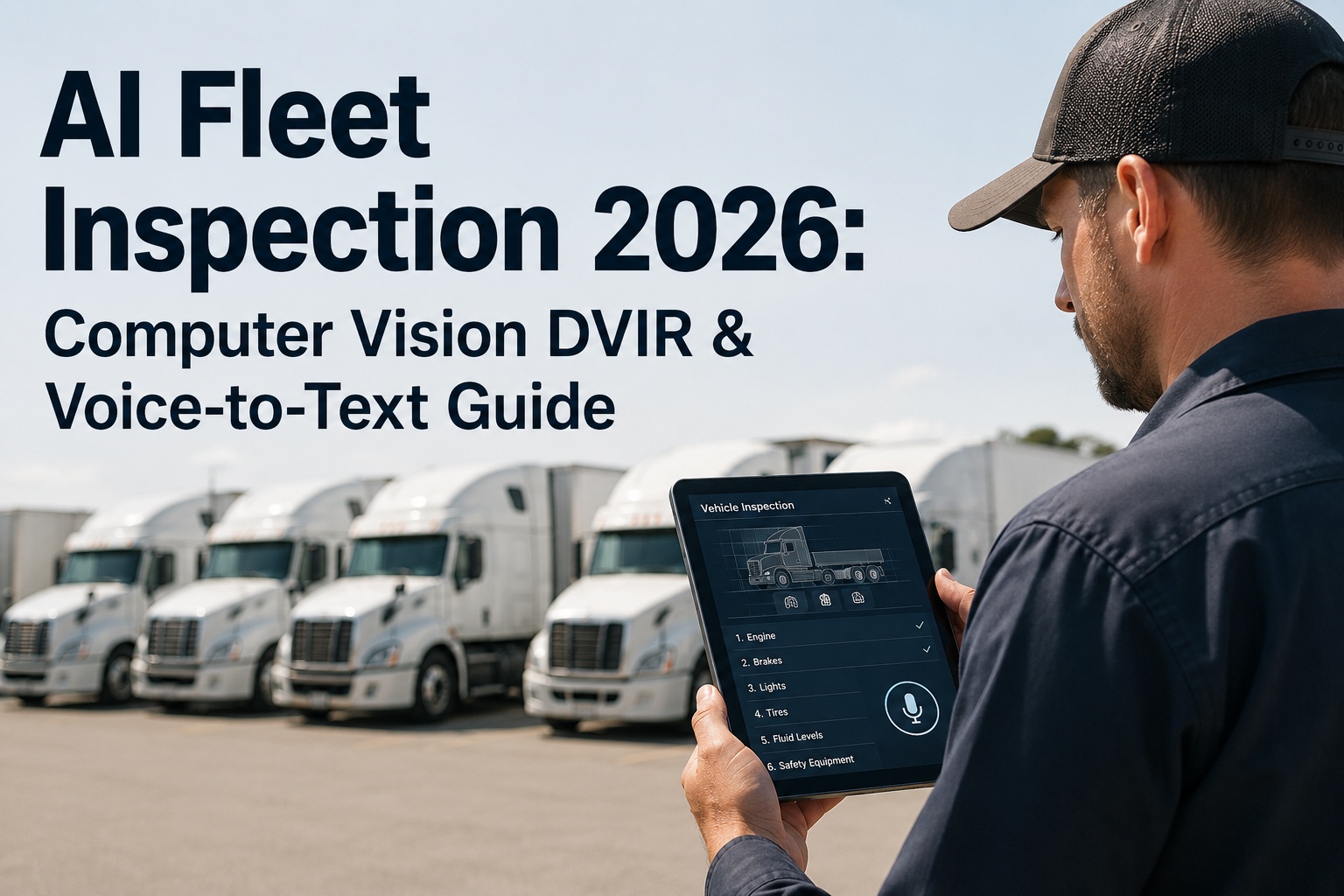
Every fleet SaaS demo in 2026 opens the same way: "we have AI." Yet fewer than one in five vendors selling AI fleet inspection can name the model architecture, cite the training set size, or point to a measurable inspection outcome that wasn't possible without AI. The rest is marketing. Meanwhile, real AI capability — computer vision trained on 30+ million vehicle images, voice recognition tuned for diesel-cab noise, predictive models flagging component failures 2-4 weeks before they happen — has already become the compliance and operational baseline for competitive fleets. On March 23, 2026, FMCSA's final rule FMCSA-2025-0115 came into effect, explicitly authorizing electronic DVIRs under 49 CFR 396.11 and 396.13. The regulatory ground shifted. The technology matured. And the honest question every fleet director should be asking their AI vendor is: which model, which training set, which measurable outcome. This guide separates real AI fleet inspection from the marketing version — and covers what actually works, what doesn't, and how to evaluate vendors without getting sold. Book a demo to see the receipts on your fleet.
Three AI capabilities. Real numbers. Not marketing.
Every claim below carries a specific training-set size, accuracy metric, and business outcome — the receipts every AI vendor should show but most won't
Computer Vision DVIR
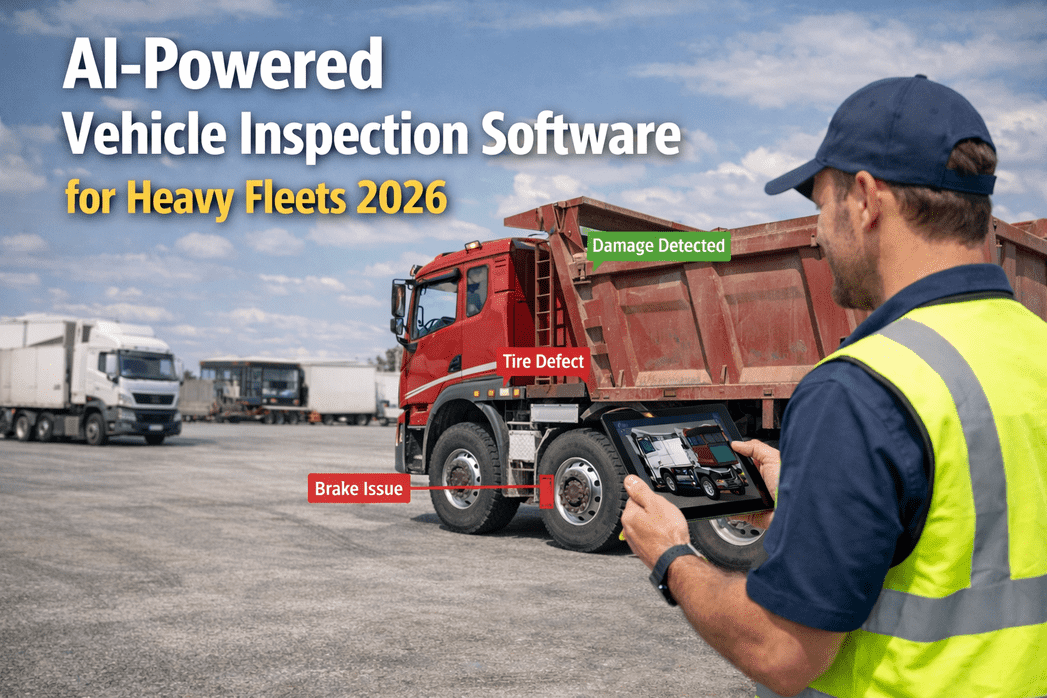
Deep-learning models analyze inspection photos to detect defects across the vehicle — catching what human inspectors miss under time pressure, poor lighting, or fatigue.
Voice-to-Text Reporting
Drivers complete DVIRs by speaking naturally — hands-free, screen-free, works in diesel-cab noise. Voice-to-text captures defect descriptions verbatim.
Predictive Defect Alerts
Pattern-analysis models trained on inspection history, telematics, and component wear rates forecast failures before they surface as roadside events or breakdowns.
The "AI-washing" problem in fleet software
Six months into 2026, "AI" is the most-abused word in fleet SaaS marketing. Every vendor claims it. Very few can back it up. The pattern is consistent across product categories: vague capability claims, no model architecture disclosure, no training-set specifications, no accuracy benchmarks published, and no measurable business outcomes tied to specific AI features. This gap between claim and substance is the AI-washing problem — and it costs fleets real money when they pay for capabilities that don't exist.
The pattern is universal: real AI comes with specific numbers, and marketing AI comes with adjectives. Every claim below the middle column is a red flag if the vendor can't name the underlying model, cite the training data, or produce a case study with measured outcomes. Book a demo to see the specific model architecture behind every AI capability in HVI
Computer vision DVIR — the real specs behind the marketing
Computer vision is the AI capability most likely to be both real and impactful in fleet inspection. It works by pipelining a driver's smartphone photo through a deep-learning model trained on tens of millions of real-world vehicle images — identifying which component the photo shows, mapping damage at the pixel level, and classifying severity by type. Here's what the actual technical specs look like when they exist.
Production computer-vision models for fleet inspection are trained on 30 million+ real-world vehicle images covering Class 6-8 tractors, trailers (dry van, flatbed, reefer), heavy equipment, and light commercial vehicles. Training set diversity across lighting conditions, weather, and viewing angles is more important than raw count — a 5-million-image dataset with diverse conditions outperforms a 20-million-image dataset shot in ideal lighting.
163+ vehicle components across the walkaround inspection pipeline: brake chambers, slack adjusters, air lines, wheel bearings, tire tread and sidewalls, lighting circuits, mirrors, glass, coupling systems (kingpin, fifth wheel), suspension components, frame rails, cross members, cargo doors, and specialty hardware. Each component gets its own recognition model layered into the broader detection pipeline.
21+ distinct damage categories, each with severity levels: cracks (hairline, moderate, structural), corrosion (surface, penetrating, critical), wear patterns (uneven, excessive, edge damage), leaks (small drip, active leak, running leak), missing components, improper installation, and functional failures. Severity classification determines whether the defect creates an alert, a work order, or an immediate out-of-service flag.
95-99% defect detection accuracy in production conditions — compared to 70-80% for trained human inspectors and 24% for inspectors under time pressure at 5 a.m. yard exit. The AI applies the same rigor to inspection #200 as inspection #1, works in low light, and doesn't skip components because dispatch is pushing for departure.
Voice-to-text DVIR — hands-free inspection that actually works
Voice-to-text for DVIRs was a novelty in 2022, became functional in 2024, and became genuinely fleet-ready in 2026. The technical breakthrough is noise-cancelled speech recognition tuned specifically for diesel-cab environments — a Class 8 idling on the yard is a challenging acoustic environment that consumer speech recognition (Siri, Google Assistant) handles poorly. Fleet-purpose voice recognition solves this.
"Brake system — check chambers, slack adjusters, air lines. Good or defect?" Driver responds "Good" or "Defect — hairline crack on left front chamber." No screen interaction.
Verbatim transcription of driver's spoken defect notes. 94% accuracy in fleet-cab environments with HVAC, engine idle, and road noise. Transcription auto-attaches to the DVIR record with timestamp.
Voice defect triggers app to prompt "photograph the left front brake chamber." Driver takes a photo. Computer vision analyzes it and confirms the defect, flags severity, adds to record.
DVIR submission with defects auto-generates a maintenance work order. Vehicle flagged unavailable for dispatch until repair certified. Driver gets audio confirmation "Inspection complete, three defects logged, vehicle held pending brake repair."
Total elapsed time: under 4 minutes for a full Class 8 walkaround. Zero screen taps required. DVIR completion rates on voice-enabled inspections consistently hit 99%+ — compared to 71% on paper and 96% on standard digital DVIRs. Start a free trial to test voice-driven inspection on your fleet this week.
Predictive defect AI — catching failures before they happen
Computer vision catches defects that already exist. Predictive AI catches the ones that will exist. The technique: pattern-analysis models trained on historical inspection data, telematics feeds, component wear rates, and maintenance history — identifying trajectories that historically preceded failures.
DVIR defect history, mileage accumulation, engine-hour patterns, fault code frequency, roadside inspection outcomes, component age vs OEM-published wear curves, and inspection photo trends over time. No single signal predicts failure — the pattern across signals does.
Component failures are typically flagged 2-4 weeks in advance. This is enough runway to schedule the repair during a planned maintenance window, avoid emergency roadside events, order parts without expediting, and coordinate with dispatch.
89% reduction in preventable breakdowns. $8,500 per truck per year in repair savings from catching wear before it becomes catastrophic damage. Cost per prevented roadside event averages $760-$1,900. The math on predictive AI is straightforward when the model is accurate.
Real predictive AI is measurable in dollars, not adjectives. The vendor should be able to tell you exactly what signals feed the model, how the prediction window is calibrated, and what published outcomes it has produced on real customer fleets. Book a demo to see live predictive alerts on your fleet's inspection and telematics data
What FMCSA rule FMCSA-2025-0115 changed on March 23, 2026
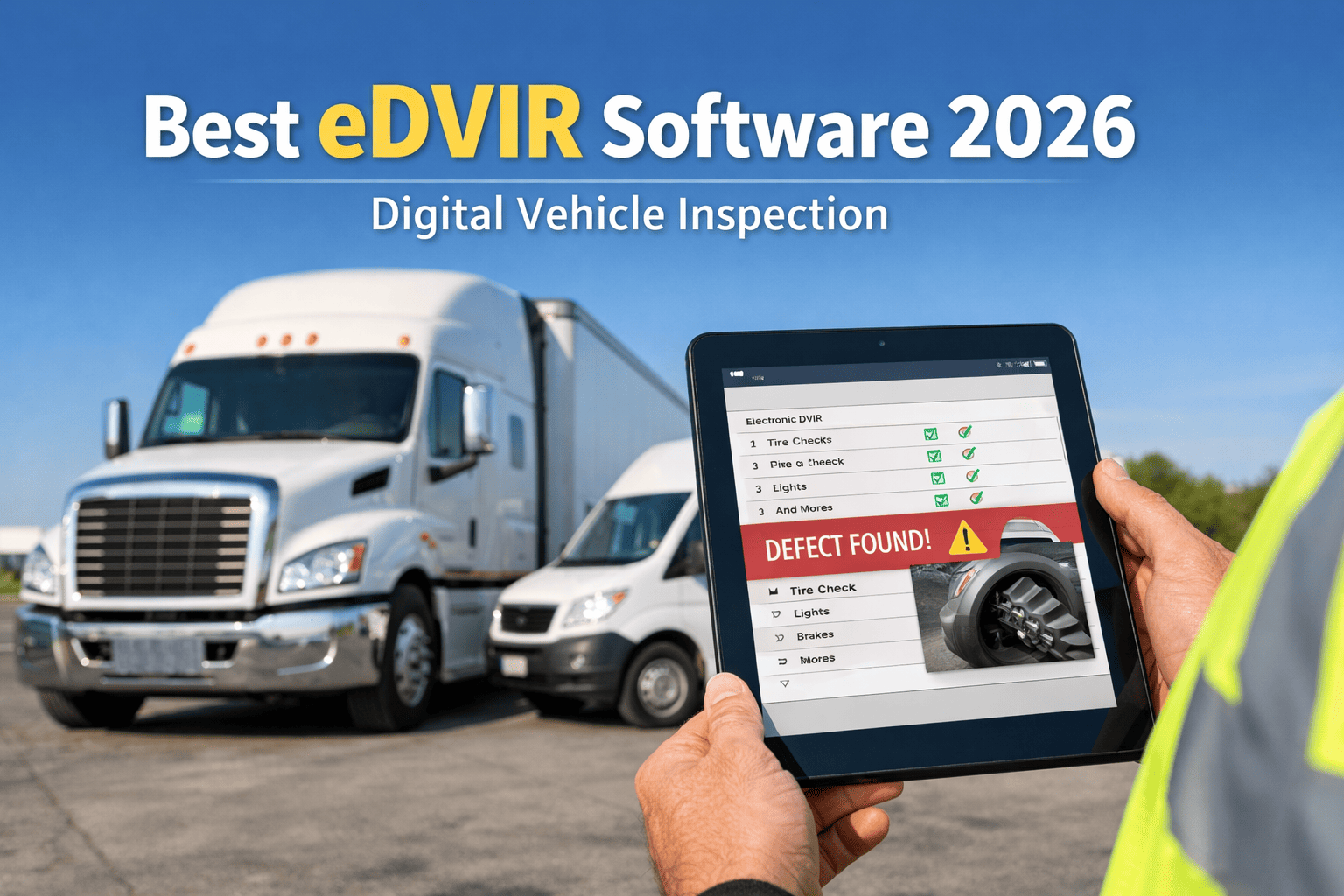
The regulatory ground shifted this year. FMCSA published final rule FMCSA-2025-0115 on February 19, 2026, and it took effect March 23. The rule explicitly authorizes electronic DVIRs under 49 CFR 396.11 and 396.13 — and digital signatures now fully replace the wet-ink requirement that had lingered for decades. The American Trucking Associations, Owner-Operator Independent Drivers Association, and National Tank Truck Carriers all supported the rulemaking.
- Timestamped photographs of any defects noted
- GPS-verified inspection location
- Digital driver signature (replaces wet-ink)
- Full component checklist covering FMCSA-required categories
- Three-signature chain: driver → reviewer → mechanic
- Retention of at least 3 months (industry best practice: 12 months)
An AI-generated eDVIR with photo verification exceeds the minimum standard — not just meets it. The rule doesn't make AI mandatory, but it makes the digital foundation on which AI inspection runs the explicit legal norm. Paper DVIRs remain permitted but are increasingly disadvantaged during audits. Book a demo to see FMCSA-2025-0115-compliant eDVIRs generated by AI on your fleet
The 6-question AI vendor honesty checklist
Every AI fleet vendor should answer these six questions specifically, with numbers or model names. Answers wrapped in adjectives ("cutting-edge," "advanced," "proprietary") without underlying specifics are marketing, not technology.
Real answer: names the model type (CNN, ViT, YOLO variant, custom architecture). Vague answer: "proprietary neural network."
Real answer: number of images, vehicle types covered, diversity of conditions. Vague answer: "large dataset."
Real answer: percentage across specific defect types under real-world conditions. Vague answer: "high accuracy."
Real answer: named engine, accuracy in fleet-cab noise, offline capability. Vague answer: "voice-enabled."
Real answer: specific data sources, prediction window, false-positive rate. Vague answer: "AI-powered predictions."
Real answer: named customer, specific metrics before/after, published percentages. Vague answer: "customers see great results."
Any vendor that can't answer four of the six with specifics is selling marketing AI, not real AI. This checklist works across every category — inspection, maintenance, dispatch, compliance — because real AI capability leaves the same fingerprints regardless of application domain. Start a free trial and put HVI through the same 6 questions on your own fleet.
From a VP of Operations who ran the checklist on 8 vendors
We evaluated 8 AI fleet inspection vendors in Q4 2025. All 8 opened the pitch with "our AI." Two of them could answer four of my six questions. Only one could answer all six with specifics — model architecture, training-set size, published accuracy numbers, speech engine details, predictive signal sources, and case studies with named customers and measured outcomes.
Six months into deployment, our DVIR completion rate went from 74% to 98%. We're catching 41% more defects at pre-trip than we did before. Our first-year insurance renewal came in 12% below the prior year specifically because our CSA scores dropped. And the payback on the platform crossed break-even at day 47. The AI marketing gap is real. Ask the questions. Get the numbers. The vendor that shows the receipts is the vendor that delivers the outcomes.
Frequently asked questions
What is AI fleet inspection and how does it work?
AI fleet inspection combines three distinct capabilities in one workflow: (1) Computer vision analyzes photographs taken during driver walkaround inspections, using deep-learning models trained on 30+ million real-world vehicle images to detect defects across 163+ components and 21+ damage types with 95-99% accuracy; (2) Voice-to-text technology allows drivers to complete DVIRs by speaking naturally in noisy diesel-cab environments, achieving 94% recognition accuracy while eliminating screen interactions; (3) Predictive defect models analyze inspection history, telematics data, and component wear rates to flag failures 2-4 weeks before they occur. The workflow: a driver photographs their vehicle during a walkaround, the AI analyzes each photo in real time, the driver optionally speaks defect descriptions that get auto-transcribed, and the system generates a DOT-compliant electronic DVIR with photo evidence, timestamps, GPS location, and digital signatures. Defects auto-generate maintenance work orders. The complete AI inspection typically takes 5-7 minutes versus 30-45 minutes for paper-based walkarounds.
Is AI-generated DVIR compliant with FMCSA rules?
Yes, unambiguously. On February 19, 2026, FMCSA published final rule FMCSA-2025-0115, which explicitly authorized electronic DVIRs under 49 CFR 396.11 and 396.13. The rule took effect March 23, 2026, and digital signatures now fully replace the previous wet-ink requirement. The American Trucking Associations, Owner-Operator Independent Drivers Association, and National Tank Truck Carriers all supported the rulemaking. An AI-generated DVIR with photo verification exceeds the minimum FMCSA compliance standard: every inspection produces a compliant electronic report with timestamped photographs of any defects, GPS-verified inspection location, digital driver signature, complete component checklist covering FMCSA-required categories, and the three-signature driver-reviewer-mechanic chain. Records must be retained for a minimum of 3 months under 49 CFR 396.11, though industry best practice is 12 months for audit defensibility. Paper DVIRs remain legal but are increasingly disadvantaged during compliance reviews where digital records with photo evidence can be produced in seconds versus hours of filing-cabinet searches.
How accurate is AI computer vision compared to human inspectors?
Production computer vision models for fleet inspection achieve 95-99% defect detection accuracy across 163+ vehicle components and 21+ damage categories. Trained human inspectors typically achieve 70-80% accuracy under normal conditions. Under real-world time pressure — 5 a.m. yard-exit walkarounds with dispatch pushing for departure — human accuracy can drop to 24% based on published UVeye research comparing AI systems against manual inspections. The accuracy gap is not marginal. It translates directly into prevented breakdowns, avoided out-of-service orders, and vehicles that stay on the road generating revenue. The AI applies the same rigor to inspection #200 as inspection #1, works consistently in low light and poor weather, and doesn't skip components because of time pressure. Human inspectors catch defects the AI misses in specific edge cases (unusual damage patterns not represented in training data, or components positioned at unusual angles), which is why the best implementations pair AI as the primary detection layer with human verification as the confirmation step — producing higher combined accuracy than either alone.
Do drivers actually use voice-to-text DVIRs in practice?
Yes, and adoption rates are typically higher for voice-enabled inspection than for standard digital DVIRs. Drivers consistently report that voice-driven workflow is faster than tapping through screen forms and eliminates the frustration of touching a small screen while wearing gloves in cold weather or in bright sunlight. The technical breakthrough enabling widespread adoption is noise-cancelled speech recognition tuned specifically for fleet-cab acoustic environments — where consumer speech recognition (Siri, Google Assistant) struggles with diesel engine noise, HVAC fans, and highway wind, purpose-built fleet voice recognition achieves 94% accuracy in the same conditions. DVIR completion rates on voice-enabled inspections consistently hit 99%+ within 30-60 days of deployment, compared to 71% on paper and 96% on standard digital DVIRs. The workflow is inherently hands-free: the app reads each checklist item aloud through Bluetooth audio, the driver responds "Good" or describes any defect verbally, and photos are prompted when defects are noted. Total elapsed time for a full Class 8 walkaround typically runs under 4 minutes with zero screen interactions required.
What ROI can I expect from AI fleet inspection?
Most fleets see positive ROI within 60 days of AI inspection deployment. The first prevented breakdown — which can cost $20,000-$50,000 for major engine or transmission failure caught before it happened — often pays for the platform investment on that single event. Ongoing measurable outcomes across mid-size fleets include: $8,500 per truck per year in reduced repair costs through early defect detection; $3,650 per driver per year in time savings from faster inspections; 15% insurance premium reduction from improved CSA scores driven by fewer roadside violations; 40% more defects caught at pre-trip versus manual inspection; 89% reduction in preventable roadside breakdowns; and DVIR completion rate improvement from a typical 71% on paper to 99% on AI-enabled inspection. Full 12-month ROI typically runs 200-500% of the platform subscription cost. The AI vehicle inspection market grew from $1.9 billion in 2024 to a projected $6.9 billion by 2033 at a 15.8% CAGR, driven specifically by fleets recognizing that manual inspection has a fundamental accuracy ceiling that no amount of training can overcome — while AI's accuracy improves continuously as training data grows.
Ask us the 6 questions. See the receipts on your fleet.
HVI's AI inspection platform runs on production computer vision (30M+ training images, 95-99% accuracy), cab-optimized voice recognition (94% in diesel-cab noise), and predictive-defect models with 2-4 week early warning. FMCSA-2025-0115 compliant. Live for your fleet in under two weeks — typical ROI at day 47.
No credit card · FMCSA-2025-0115 compliant eDVIRs · Works on any iOS or Android device