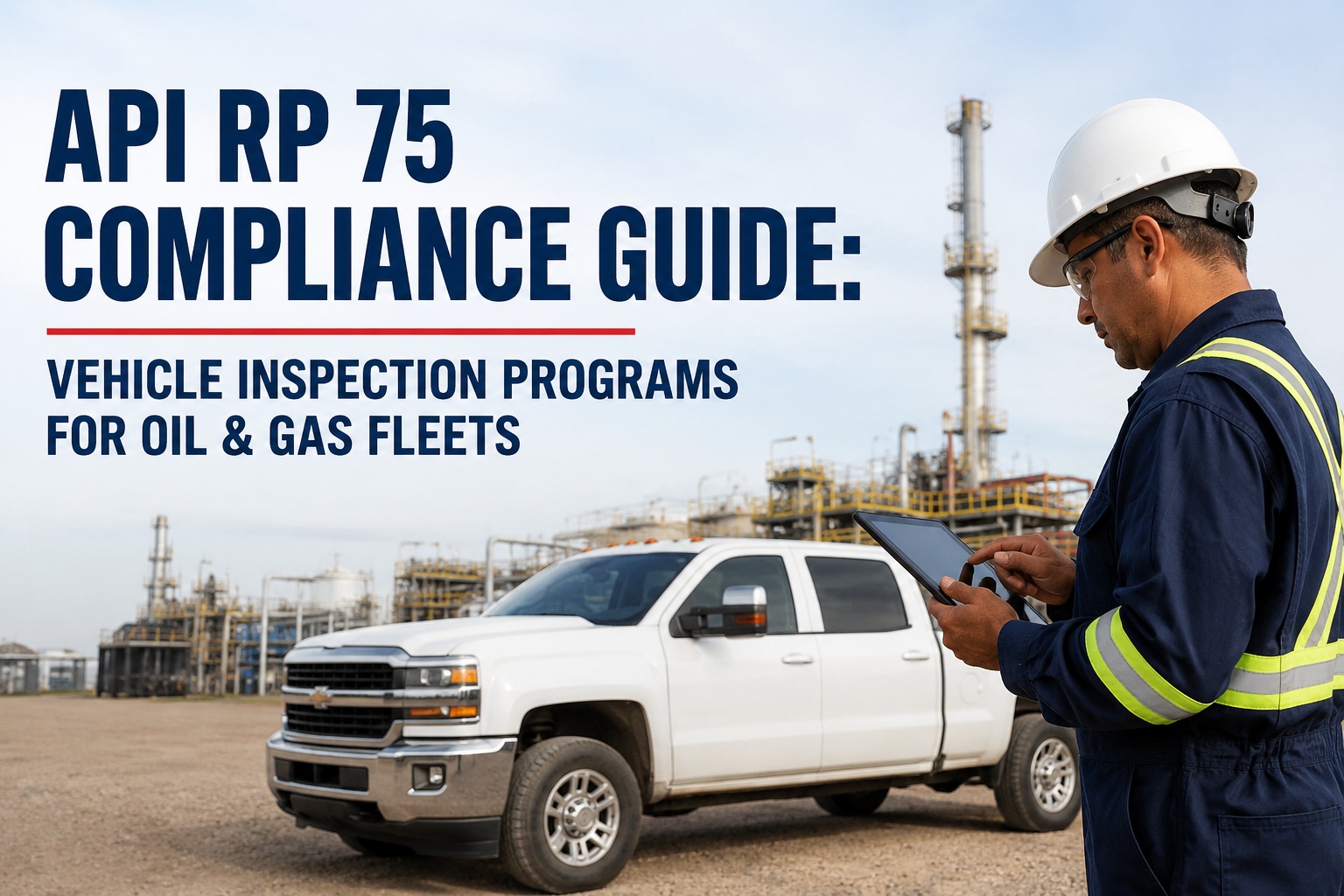
In offshore and oilfield operations, safety isn't managed by a checklist of prescriptive rules — it's managed by a system. API Recommended Practice 75 establishes that system: the Safety and Environmental Management System, or SEMS, a performance-based framework that the U.S. Bureau of Safety and Environmental Enforcement incorporates by reference into federal regulation under 30 CFR 250 Subpart S. The 4th edition, published in December 2019, reorganized SEMS into 14 interdependent elements and — critically for fleet managers — extended its reach to contractors and subcontractors. Vehicles sit squarely inside that system: transportation is one of the highest-frequency hazards in oilfield work, and the trucks, service rigs, and light vehicles moving across a lease fall under SEMS elements covering hazard analysis, mechanical integrity, training, and contractor management. A documented vehicle inspection program is how an operator demonstrates that those elements are being met. The stakes are concrete —SEMS violations can carry civil penalties up to $15,625 per violation per day plus operational suspension and the operating company bears primary responsibility for every vehicle on its site, including ones it doesn't own. This article maps vehicle inspection to the SEMS framework, the elements it satisfies, the contractor gap it closes, and the documentation an audit demands. book a 30-minute walkthrough to see it set up for your operation.
Under SEMS, a vehicle inspection isn't paperwork — it's evidence your safety system actually works.
HVI documents oilfield fleet inspections against the SEMS framework — hazard-based checks, mechanical integrity, corrective-action tracking, and contractor records — with photo-verified, timestamped, audit-ready reports that export in minutes for a BSEE SEMS review.
SEMS, API RP 75, and why it matters
Before mapping vehicles to it, the framework itself. SEMS exists because regulators concluded that a prescriptive "compliance mentality" wasn't catching real operational risk — and the numbers behind it set the stakes.
The 4th edition's shift is the key context: it moved SEMS from prescriptive rules toward a performance-based framework focused on measurable outcomes, and it explicitly extended the system's reach to contractors and subcontractors. For a fleet, that means it's no longer enough to say vehicles are maintained — the operator has to demonstrate, with documentation, that a system identifies vehicle hazards, verifies condition, tracks corrective actions, and covers every contractor asset on the lease. The inspection program is that demonstration.
Why vehicles fall under SEMS
Transportation is one of the most frequent and serious hazards in oilfield operations — which places vehicles inside the safety system, not outside it. Three reasons the fleet is a SEMS concern.
Transportation is a top hazard
Trucks, vacuum and water haulers, service rigs, and light vehicles move constantly across leases and public roads. Motor-vehicle incidents are a leading cause of oilfield injury, so the fleet is a primary risk SEMS must address.
Equipment condition is mechanical integrity
SEMS requires assurance that equipment is fit for service. A vehicle is equipment — its brakes, tires, steering, and load systems are mechanical-integrity items that an inspection program verifies and documents.
The operator owns the risk
The operating company bears primary safety responsibility for all activity on a leased area — including contractor and subcontractor vehicles. A vehicle the operator doesn't own is still the operator's SEMS exposure.
This last point is the one that catches operators out: they're held accountable for incidents they couldn't prevent because they had no visibility into contractor vehicle condition, driver qualification, or inspection records for assets they don't own. The inspection program has to extend to those vehicles too. HVI captures owned and contractor fleet inspections in one place.
The SEMS elements a vehicle program supports
A vehicle inspection program isn't a standalone requirement — it feeds several of the 14 SEMS elements at once. Here's where the fleet program does the work.
Hazards analysis
Transportation hazards are identified and assessed, and the pre-trip inspection is the control that mitigates them — documented as part of the hazard-management element.
Mechanical integrity
Vehicles are kept fit for service through scheduled inspection and preventive maintenance, with records proving each asset's condition over time.
Training & competency
Operators are trained to inspect and operate their vehicles safely, with the training and qualification records SEMS expects on file.
Contractor management
Contractor selection and performance monitoring — including vehicle inspection compliance and certification currency — is documented as part of the contractor-management element.
Recordkeeping & audit
SEMS requires program elements to be documented and available at field and office locations — the inspection record is exactly that evidence, ready for the periodic SEMS audit.
Corrective action
Deficiencies found on inspection are assigned, tracked, and closed — the corrective-action loop that turns a found defect into a documented, verified fix.
A single digital inspection program feeds all of these at once — versus a stack of paper that satisfies none of them cleanly. sign up free and document your fleet against the SEMS elements, or book a demo to see SEMS-aligned inspection reporting.
The contractor-fleet visibility gap
The single hardest part of SEMS fleet compliance is the part the operator doesn't own. Closing the contractor gap is where most programs fail — and where the biggest exposure sits.
No visibility, full liability
The average upstream operator has no systematic view of contractor vehicle condition, driver qualification, or inspection records — yet carries primary responsibility for every one of those assets on the lease.
Extend the program outward
Closing the gap means extending inspection authority to every third-party asset on site, so contractor vehicles are inspected and documented to the same standard as owned ones.
Score and benchmark contractors
A per-contractor scorecard — inspection compliance, certification currency, corrective-action response — turns contractor oversight into a tracked KPI, exactly the systematic monitoring SEMS expects.
Operators get held accountable for incidents they had no visibility to prevent — closing the contractor gap is how you both reduce the risk and prove you were managing it. sign up free and bring contractor vehicles into one documented program.
The documentation an audit demands
SEMS is audited, and the audit lives or dies on documentation. Program elements must be documented and available at field and office locations — which is exactly where paper falls apart.
Available field & office
SEMS requires records available at both field and office locations. Digital inspections sync from the lease to the office automatically — no driving paper forms back to a filing cabinet.
Bulk export for audit
When a SEMS auditor asks, the full inspection and corrective-action history exports in minutes with one-click drill-down to any individual record — not days of assembling files.
Compliance as a tracked KPI
Inspection compliance rate tracked over time demonstrates active, continuous monitoring — the performance-based evidence the 4th edition framework is built around.
The 4th edition's performance-based approach rewards exactly this: not a binder that proves a policy exists, but data that proves the system is working continuously. A compliance rate trended over time and a corrective-action loop that closes are stronger audit evidence than any static document. HVI produces both automatically.
Paper checklists vs. HVI
Both technically record an inspection. Only one documents against the SEMS elements, extends to contractor vehicles, tracks corrective actions, and exports an audit-ready package on demand.
Paper / reactive
- Inspections logged on paper, not mapped to SEMS
- No visibility into contractor vehicle condition
- Deficiencies noted but not tracked to closure
- Records stuck in the field, not at the office
- A SEMS audit means days of assembling files
- No compliance KPI to prove continuous monitoring
With HVI software
- Inspections documented against the SEMS elements
- Owned & contractor vehicles in one program
- Every deficiency tracked to a verified corrective action
- Records sync field-to-office automatically
- Full audit package exports in minutes
- Compliance rate tracked as a KPI over time
per violation, per day — avoided. SEMS non-compliance carries civil penalties up to $15,625 per violation per day plus possible operational suspension, and the operator owns the exposure for every vehicle on the lease, contractor assets included. A documented inspection program mapped to the SEMS elements is what turns that exposure into demonstrated compliance. HVI makes the inspection, the corrective action, and the audit record one connected system.
Frequently asked questions
What is API RP 75 and how does it relate to SEMS?
API Recommended Practice 75 is the American Petroleum Institute's guidance for establishing, implementing, and maintaining a Safety and Environmental Management System, or SEMS, for offshore oil and gas operations. It originated after a 1990 finding that the prescriptive regulatory approach had pushed industry into a "compliance mentality" that wasn't catching real operational risk, so a more systematic framework was developed. The U.S. Bureau of Safety and Environmental Enforcement incorporates API RP 75 by reference into federal regulation under 30 CFR Part 250 Subpart S, making SEMS mandatory for covered operations. The 4th edition, published in December 2019, reorganized the framework into 14 interdependent elements, shifted from prescriptive rules toward a performance-based approach focused on measurable outcomes, and extended SEMS to contractors and subcontractors. In short, API RP 75 is the recommended practice; SEMS is the system it defines; and the federal regulation makes it enforceable. HVI's inspection and maintenance software documents fleet inspections against that framework. sign up free and align your fleet with SEMS.
How do vehicle inspections support SEMS compliance?
Vehicles fall inside SEMS because transportation is one of the most frequent and serious hazards in oilfield operations, and a documented vehicle inspection program feeds several of the 14 SEMS elements at once. It supports hazards analysis, because the pre-trip inspection is the control that mitigates identified transportation hazards. It supports mechanical integrity, because scheduled inspection and preventive maintenance keep vehicles fit for service with records proving condition over time. It supports training and competency through operator qualification records, and contractor management through documented inspection compliance for third-party vehicles. And it supports recordkeeping and corrective action, since SEMS requires program elements to be documented and available, and deficiencies to be tracked to closure. A single digital inspection program satisfies all of these cleanly, where a stack of paper satisfies none of them well. HVI's inspection and maintenance software maps fleet inspections directly to these elements. book a demo to see SEMS-aligned inspections.
Is an operator responsible for contractor vehicles under SEMS?
Yes. Under API RP 75, OSHA Process Safety Management, and the SEMS regulations, the operating company bears primary safety and compliance responsibility for all activities on a leased area — including those conducted by contractors and subcontractors. The 4th edition of API RP 75 made this explicit by extending the SEMS framework's reach to contractors and subcontractors. The practical problem is that the average upstream operator has no systematic visibility into contractor vehicle condition, driver qualification status, or equipment inspection records for assets it doesn't own — which means operators get held accountable for incidents they had no ability to prevent. Closing that gap requires extending the inspection program to every third-party asset on site, inspecting and documenting contractor vehicles to the same standard as owned ones, and tracking each contractor's inspection compliance and certification currency as a monitored KPI. HVI's inspection and maintenance software brings owned and contractor fleets into one documented program. sign up free and close the contractor gap.
What documentation does a SEMS audit require for fleet vehicles?
SEMS requires that program elements be properly documented and available at both field and office locations, so for a fleet that means inspection records, preventive-maintenance history, corrective-action tracking, operator training and qualification records, and contractor inspection compliance — all retrievable on demand. The challenge with paper is precisely this availability requirement: forms stuck in a truck on a remote lease aren't available at the office, and assembling a complete audit package from paper can take days. A digital program solves it by syncing records from field to office automatically, exporting the full inspection and corrective-action history in minutes with one-click drill-down to any individual record, and tracking inspection compliance rate as a KPI over time. That last point matters under the 4th edition's performance-based approach, which values data proving the system works continuously over a static binder proving a policy exists. HVI's inspection and maintenance software produces all of this audit-ready. book a demo to see audit export.
How does HVI support API RP 75 and oilfield fleet compliance?
HVI is an inspection and maintenance software platform that turns oilfield fleet inspection into documented SEMS evidence. Operators run hazard-based pre-trip and scheduled inspections from a phone or tablet — covering the brakes, tires, steering, and load systems that are mechanical-integrity items — with mandatory photo capture, and it works offline on remote leases and syncs to the office automatically so records are available at both field and office locations as SEMS requires. Every deficiency auto-creates a tracked corrective action assigned and closed to completion, and the platform brings contractor and subcontractor vehicles into the same program with per-contractor scorecards for inspection compliance and certification currency, closing the visibility gap that creates operator liability. It keeps timestamped training and qualification records, tracks compliance rate as a KPI over time to demonstrate continuous monitoring, and exports a full SEMS-ready audit package in minutes with drill-down to any record. The result maps fleet activity directly to the SEMS elements. book a demo and we'll map the software onto your operation on the call.
Turn every fleet inspection into documented proof your SEMS program works.
HVI documents oilfield fleet inspections against the SEMS framework — hazard-based checks, mechanical integrity, corrective-action tracking, training records, and contractor oversight — syncs field-to-office, tracks compliance as a KPI, and exports an audit-ready package in minutes. Bring owned and contractor vehicles into one program and turn $15,625-a-day exposure into demonstrated compliance.
No credit card required · Live in under two weeks · SEMS-aligned inspections + contractor oversight + corrective-action tracking + audit-ready export in one platform