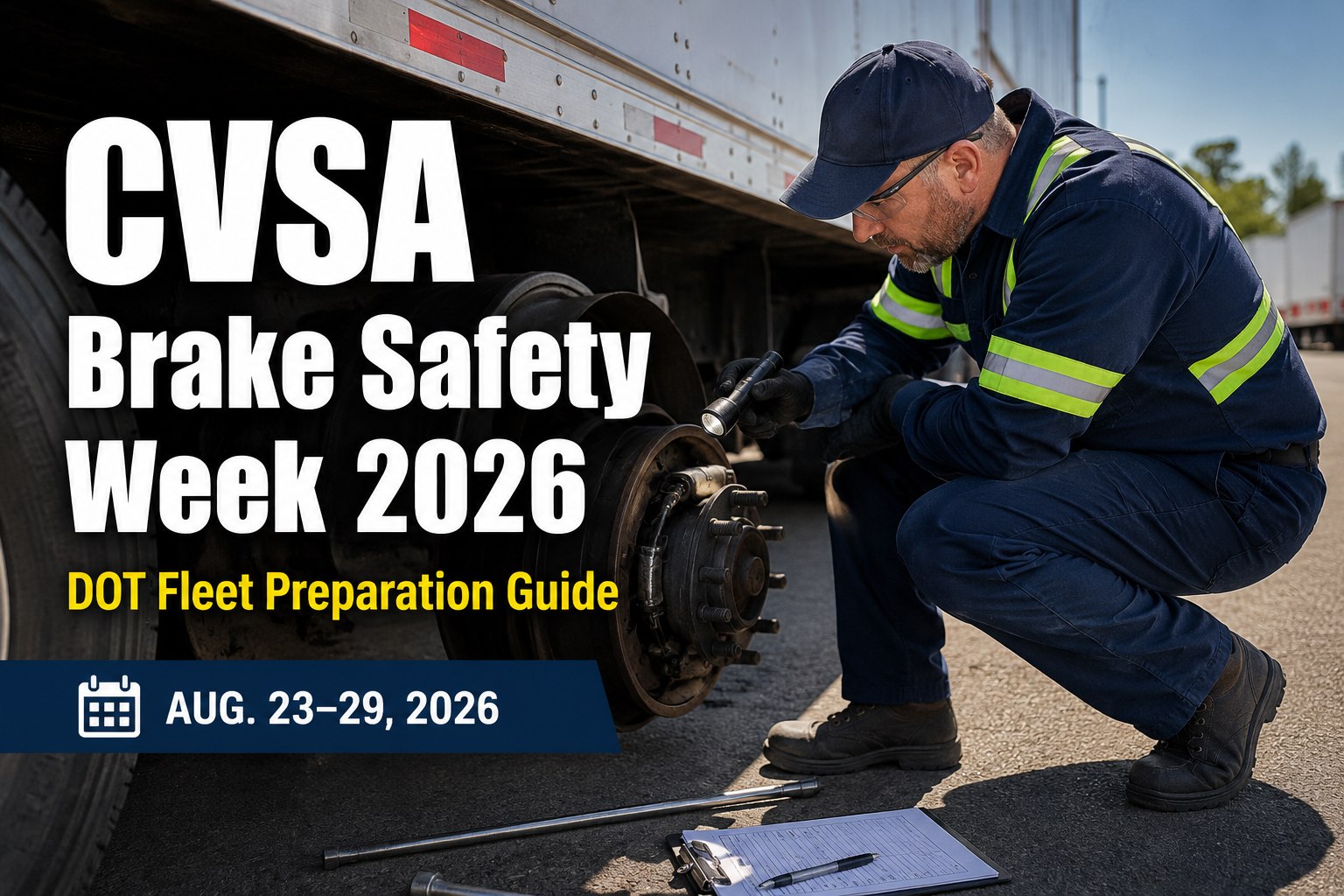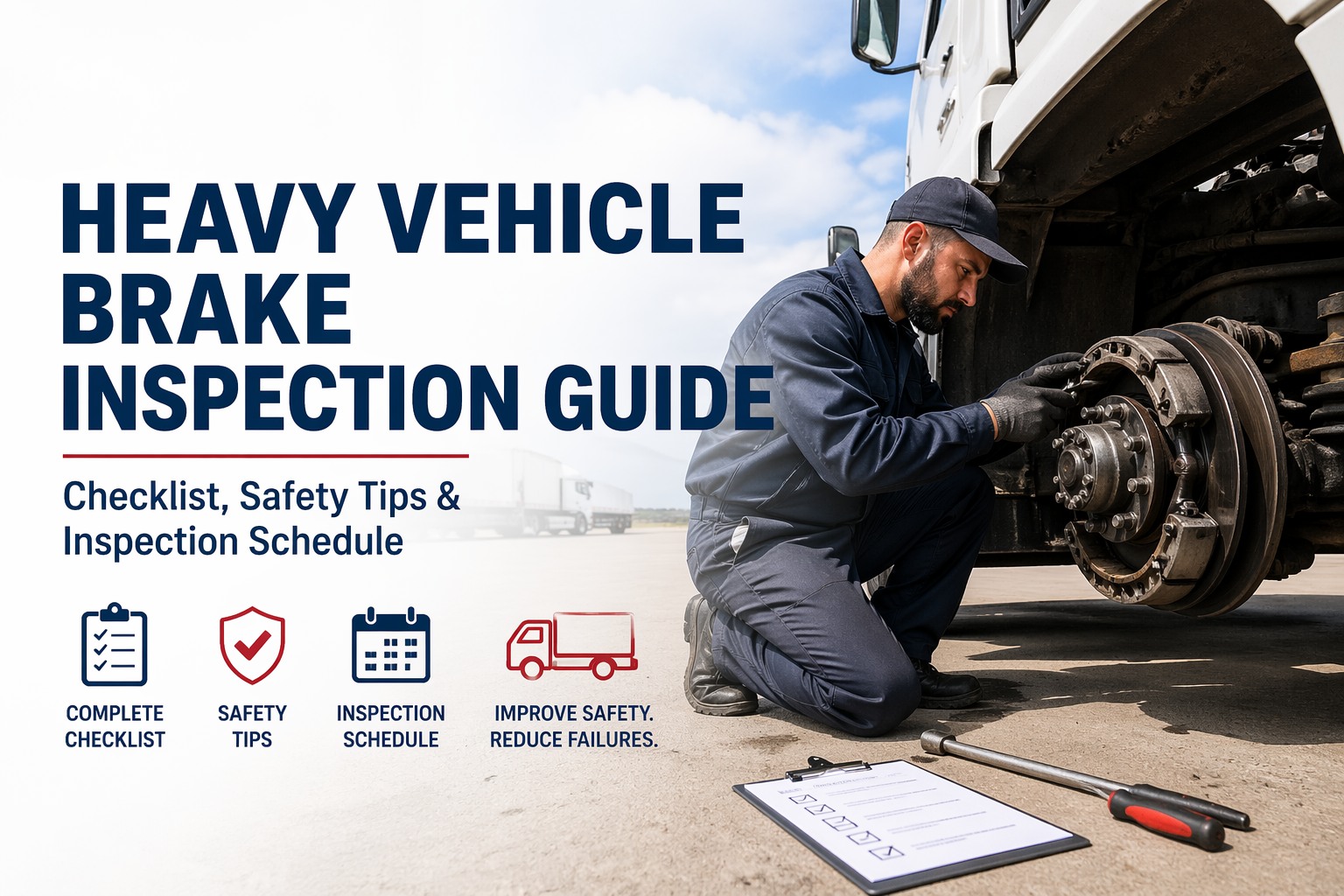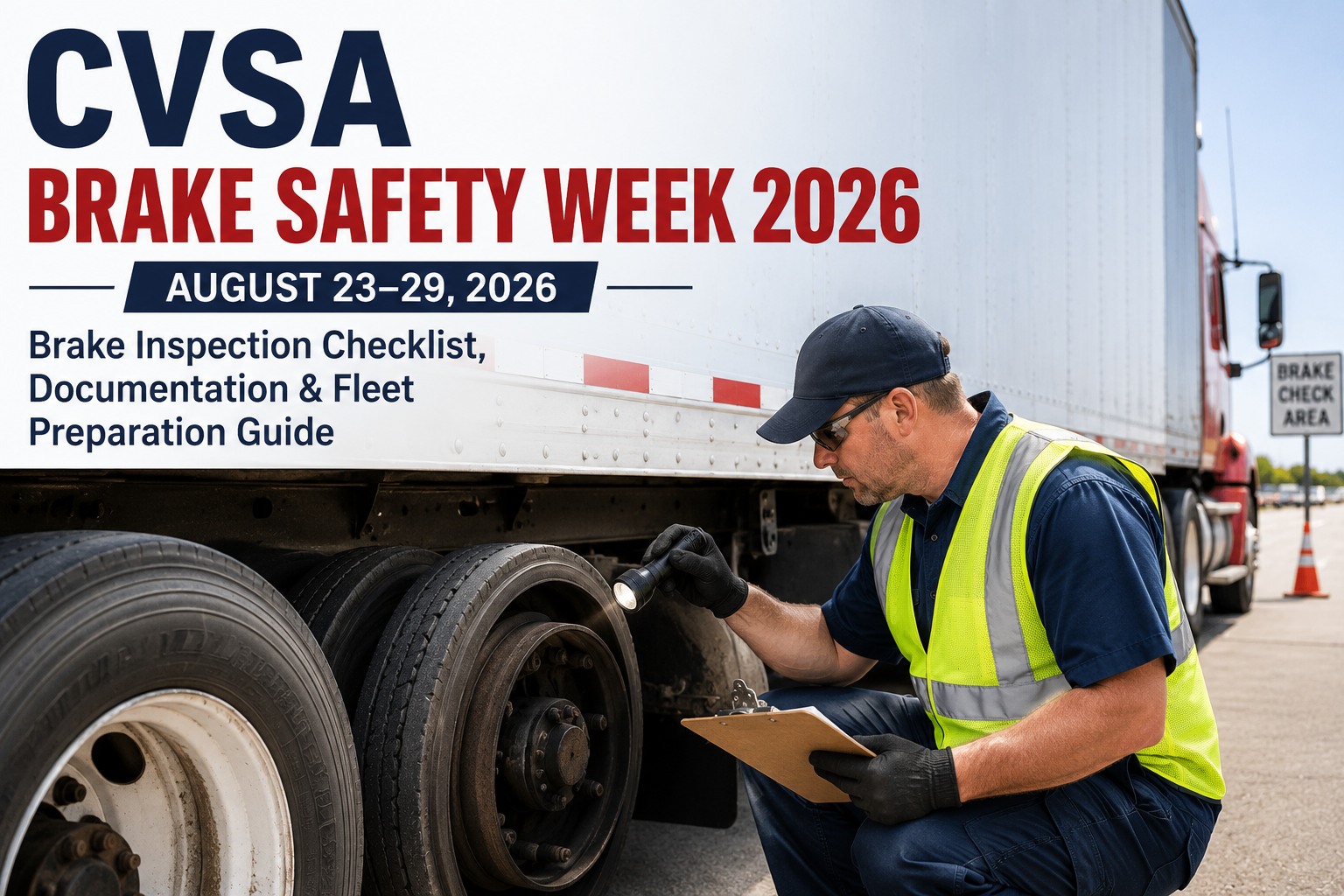
Every August, thousands of trucks get pulled onto the scales for one reason: their brakes. Brake Safety Week 2026 runs August 23–29, and this year inspectors are zeroing in on brake drums and rotors — the components most likely to be cracked, rusted, or worn past spec without anyone noticing. Last year 15% of inspected vehicles were placed out of service for brake violations, almost all of it preventable. This CVSA Brake Safety Week 2026 guide covers exactly what inspectors will check, the drum and rotor defects that fail a vehicle, and how to get your fleet ready before the blitz. Book a 30-minute walkthrough to see brake checks run digitally on your fleet.
CVSA Brake Safety Week 2026: Prep Guide & Inspection Checklist
Everything your fleet needs before the August 23–29 enforcement blitz — this year's drum and rotor focus, the brake defects that trigger an out-of-service order, and how to catch them in the shop instead of at the scale.
- Focus areaDrums & rotors
- RegionUS · Canada · Mexico
- ProgramOperation Airbrake
- 2025 OOS rate15.1%
-
15.1%
of vehicles inspected during 2025 Brake Safety Week were placed out of service
CVSA 2025 results -
~41%
of all vehicle out-of-service orders are brake-related — the single top cause
CVSA Roadcheck data -
313
vehicles hit the 20% defective-brakes rule in one day of 2026 Brake Safety Day
CVSA Brake Safety Day 2026 -
43.5%
minimum braking efficiency required to pass a performance-based brake test
North American OOS Criteria
What Brake Safety Week 2026 is
Brake Safety Week is a seven-day enforcement and education blitz run by the Commercial Vehicle Safety Alliance under its Operation Airbrake program, in partnership with FMCSA. For those seven days — August 23–29 this year — inspectors across the US, Canada, and Mexico put extra focus on brake systems during their roadside inspections, most of them full North American Standard Level I checks. Any vehicle with a brake-related out-of-service violation gets pulled off the road until it's fixed. And it's not just the week you need to worry about: CVSA also runs an unannounced one-day Brake Safety Day at a random point each year, so brake compliance is a year-round exposure, not an August event. The fleets that treat the date as a checkpoint, not a deadline, are the ones that roll through clean. See how HVI keeps brakes inspection-ready year-round
This year's focus: brake drums & rotors
Every Brake Safety Week names a focus area, and for 2026 it's the same high-risk pair as last year: brake drums and air disc rotors. These matter because a cracked or broken drum or rotor doesn't just weaken braking — a piece that breaks loose at speed can come off the vehicle and hit someone. Inspectors will be capturing defect data on both, so this is exactly where to concentrate your prep. Here's what fails each one.
Brake drums
- Cracks extending through the outer portion of the drum
- Visibly broken or missing pieces
- Repairs that don't meet manufacturer specifications
- Any defect documented in the DVIR
Air disc rotors
- Cracks or broken pieces on the friction surface
- Excessive rust that can mean the brake is inoperable
- Grooves showing metal-to-metal contact from worn pads
- Wear that has exposed the center vents
On the 2026 Brake Safety Day, rusted rotors on air disc systems were the single most common defect — a reminder that these fail quietly between services. Include drums and rotors in every pre-trip and post-trip, and document what you find. Log drum and rotor checks with photos
The full brake inspection checklist
Drums and rotors are the focus, but inspectors run the whole brake system. Here's what a Level I brake inspection covers and the conditions that put a vehicle out of service. Measure the items that are measured — pushrod stroke and lining aren't eyeball checks.
Air brake system — full check
Measured, per axle- Pushrod / slack adjuster stroke within limits (measured at 90–100 psi)
- Brake lining and pad thickness above minimum
- Drums and rotors free of cracks, breaks, and excessive wear
- No mismatched air brake chamber sizes on an axle
- Air hoses and tubing not cut, chafed, bulging, or leaking
- Air loss rate within the allowed limit; no audible leaks
- Spring (parking) and emergency brakes hold and function
- Tractor protection system and low-air warning operational
- ABS indicator lamp completes its self-test and goes out
Out of service if: 20% or more of the brakes on the vehicle are defective, air loss exceeds the allowed rate, a brake hose is damaged through the outer casing, lining is below minimum, or a performance-based test comes in under 43.5% braking efficiency.
That 20% defective-brakes rule is the one that catches the most vehicles — one weak wheel end at a time adds up fast across a combination. Book a demo to see stroke and lining captured per position
Your 3-week prep timeline
Preparation happens before inspection week, not during it. Replacing a worn drum in your own shop is a fraction of the cost of an emergency roadside repair and the downtime that comes with an out-of-service order. Here's how to work backward from August 23.
-
3 weeks out
Audit & schedule
Pull brake-defect history from your DVIRs, flag every unit due for a brake service, and get worn drums and rotors on the shop schedule. Order parts now so a supply delay doesn't strand you.
-
2 weeks out
Measure & repair
Measure pushrod stroke and lining at every wheel end, inspect drums and rotors for cracks and rust, and fix what's out of spec in a controlled shop environment — cheaper and faster than roadside.
-
1 week out
Verify & document
Re-check repaired units, confirm ABS lamps and low-air warnings work, and make sure every brake defect and repair is documented in the DVIR. A clean, provable record is your best defense at the scale.
-
Inspection week
Run tight pre-trips
Drivers include drums and rotors in every pre-trip. Don't route around scales — a clean truck that earns a CVSA decal is less likely to be reinspected for up to three months.
The brake defects that actually fail vehicles
The 2026 Brake Safety Day data shows where trucks really get caught. These are the conditions worth prepping hardest against.
-
Top count
313
in one day
20% defective brakes
The single largest violation category. One-fifth or more of the vehicle's brakes impaired enough to be defective.
-
Focus
Rust
most common
Rusted rotors
Rusted air disc rotors were the most common single defect on Brake Safety Day — they fail quietly between services.
-
Hoses
121
OOS in a day
Hoses & tubing
Cut, chafed, or leaking brake hoses are a fast, common rejection — easy to catch on a walkaround.
-
Air
43.5%
min efficiency
Air loss & efficiency
Excess air loss and sub-43.5% braking efficiency on a PBBT both sideline a vehicle on the spot.
Expert view
Brake Safety Week used to be a fire drill. The week before, we'd scramble to check every unit, and we'd still get a couple pulled for something a driver drove past for weeks — a rotor rusting up, a pushrod creeping out of adjustment.
Once drivers were recording stroke and lining numbers on every pre-trip, the trend showed up early. We fix the wheel end before it's a violation now, and August is just another week. The rotors are the sneaky ones — you don't hear them, so if nobody's looking at them, they rust right past spec.
— Tony S., Maintenance Manager, regional carrier
How HVI gets your fleet brake-ready
Everything Brake Safety Week rewards — measured brakes, documented drums and rotors, defects fixed before dispatch — is exactly what a digital inspection platform does. Here's the direct mapping.
Scramble the week before
- Brake checks are a once-a-year fire drill
- Stroke and lining eyeballed, never recorded
- Rusted rotors go unseen between services
- Defects noted on paper, lost before the shop sees them
- Emergency roadside repairs at full cost
Ready year-round with HVI
- Brake checks built into every pre-trip and post-trip
- Measurement fields for stroke and lining, tracked over time
- Mandatory drum and rotor photos catch rust early
- Defects auto-route to a work order before dispatch
- Worn parts replaced in the shop, on your schedule
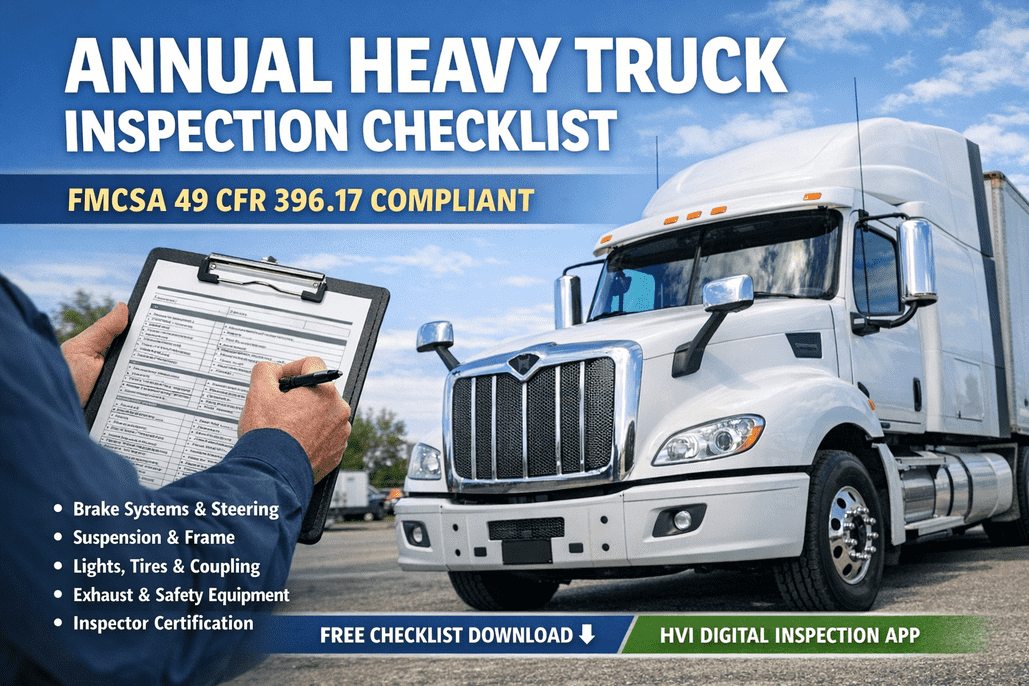
It's the same play that protects you at the annual inspection and on the CSA score: catch the defect early and document it. Sign up free and put brake checks on every phone
Frequently asked questions
When is Brake Safety Week 2026?
CVSA Brake Safety Week 2026 runs August 23–29, 2026. It's a seven-day enforcement and education initiative held across the United States, Canada, and Mexico under CVSA's Operation Airbrake program, in partnership with FMCSA. During the week, inspectors conduct commercial motor vehicle inspections — most of them full North American Standard Level I checks — with extra emphasis on brake systems. Separately, CVSA also holds an unannounced one-day Brake Safety Day at a random point during the year, so brake compliance is a year-round requirement rather than a single scheduled event.
What is the focus area for Brake Safety Week 2026?
The 2026 focus area is brake drums and air disc rotors. Inspectors will capture and report data specifically on the condition of these components, in addition to running the standard full brake inspection. Drums and rotors matter because a cracked or broken one reduces braking efficiency and can throw pieces off the vehicle at speed. For drums, inspectors look for cracks through the outer portion and broken or missing pieces. For rotors, they check for cracks or broken pieces on the friction surface, excessive rust that can indicate the brake is inoperable, grooves showing metal-to-metal contact from worn pads, and wear that has exposed the center vents.
What brake violations place a vehicle out of service?
The most common is the 20% defective-brakes criterion: if one-fifth or more of a vehicle's brakes have a condition that impairs braking ability enough to be considered defective, the vehicle is placed out of service. Other out-of-service conditions include air loss exceeding the allowed rate, an audible leak at a brake chamber, brake lining below minimum thickness, a brake hose damaged through its outer casing, cracked or broken drums and rotors, inoperative parking or emergency brakes, and a braking efficiency below 43.5% on a performance-based brake tester. A vehicle placed out of service cannot operate until the violation is corrected.
How should a fleet prepare for Brake Safety Week?
Preparation happens before inspection week, not during it. Start about three weeks out by pulling brake-defect history from your DVIRs and scheduling any units due for brake service, ordering parts early to avoid supply delays. Two weeks out, measure pushrod stroke and lining at every wheel end, inspect drums and rotors for cracks and rust, and repair anything out of spec in your own shop — far cheaper than an emergency roadside fix. In the final week, re-verify repaired units, confirm ABS and low-air warnings work, and make sure every defect and repair is documented. During the week, run tight pre-trips that include drums and rotors, and don't route around scales — a clean inspection earns a CVSA decal valid up to three months.
Do digital inspections help with brake compliance?
Yes, in two direct ways. First, a guided digital brake check gives pushrod stroke and lining their own measurement fields recorded at every wheel position, so a slack adjuster creeping out of adjustment or a lining wearing thin shows up as a trend before it becomes a violation. Second, mandatory drum and rotor photos surface the quiet failures — like the rusted rotors that were the most common defect on the 2026 Brake Safety Day — so they get fixed in the shop instead of flagged at the scale. Defects route straight to a work order, giving you a documented, provable brake-maintenance record that holds up during any roadside inspection or audit.
Get your fleet brake-ready before August 23
HVI puts a guided brake inspection on every driver's phone — measurement fields for pushrod stroke and lining, mandatory drum and rotor photos, and instant defect routing to maintenance. Catch the worn component in the shop on your schedule, not at a scale house during Brake Safety Week.
No credit card · No hardware · Live on your fleet in under two weeks