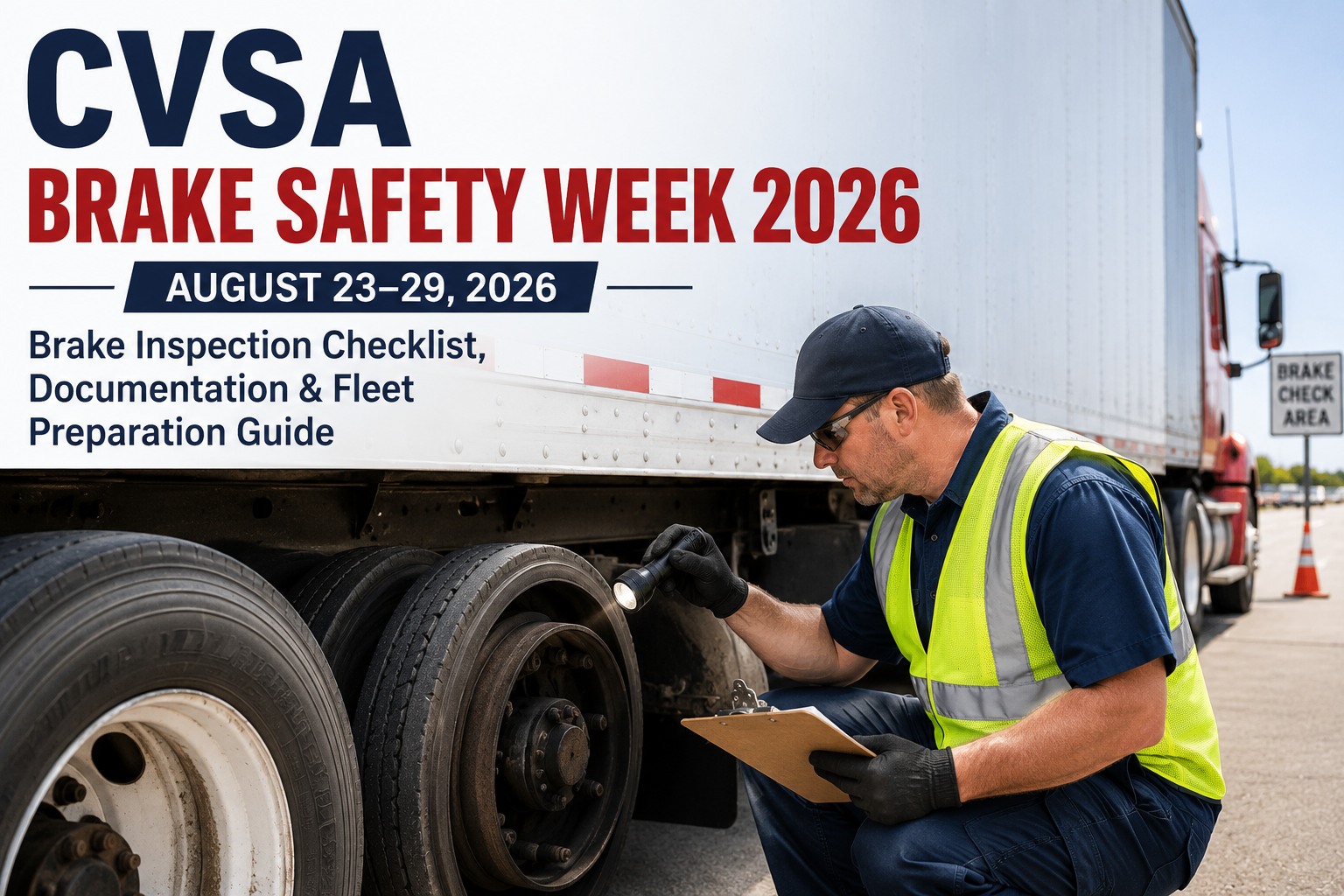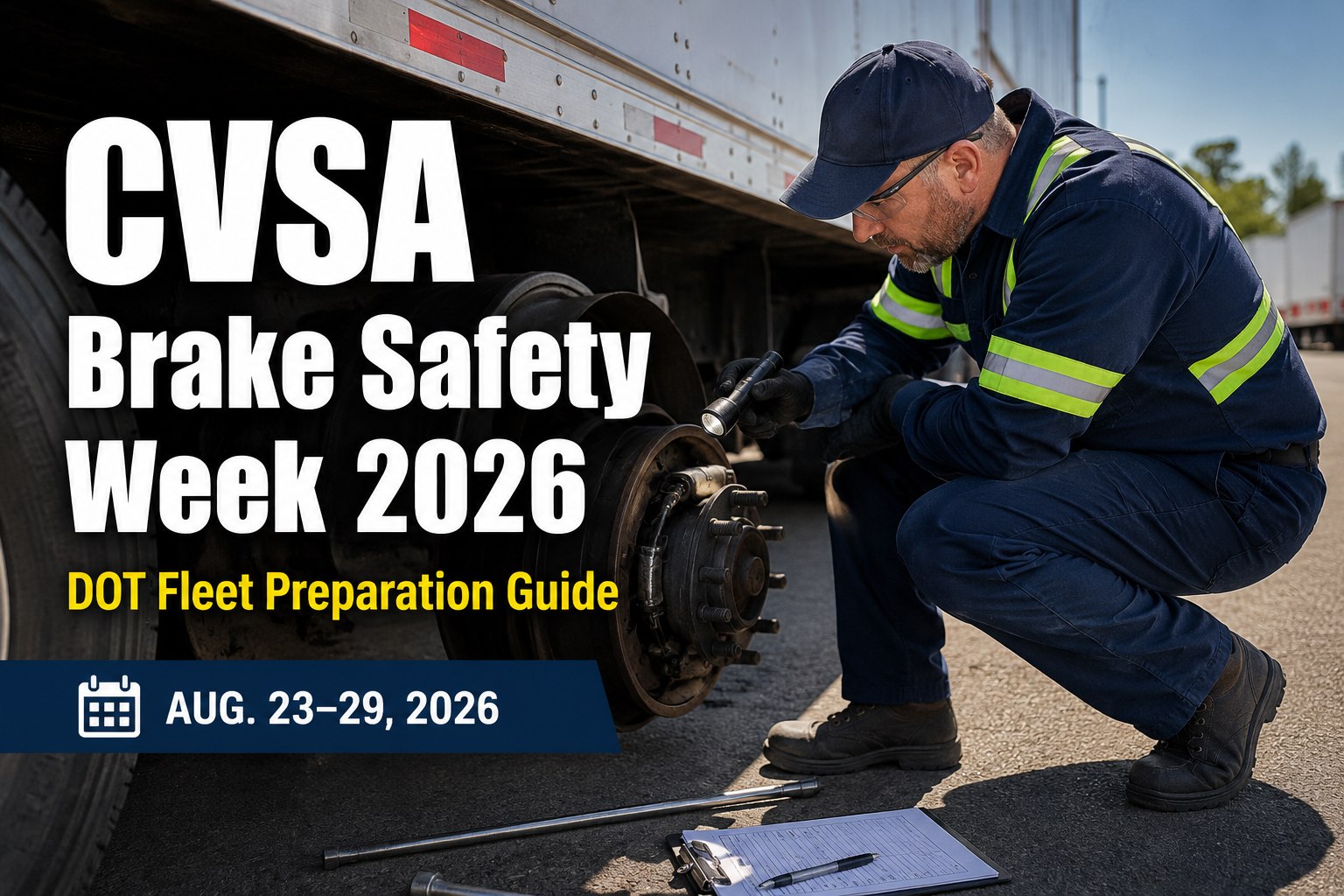
CVSA Brake Safety Week 2026 runs August 23-29 across the United States, Canada, and Mexico — and for the second consecutive year the focus is specifically brake drums and air disc brake rotors. Last year's numbers explain why: 15,175 commercial vehicles inspected, 2,296 placed out of service, a 15.1% OOS rate. One in seven trucks failed during a week the industry knew was coming. This DOT fleet preparation guide covers the 2026 focus area's specific out-of-service criteria on drums and rotors, the 8 triggers Level IV inspectors watch for, the 5-step prep checklist to run in August, and why the CVSA-announced week isn't the only exposure — a separate unannounced Brake Safety Day can happen any day this year. Book a demo to see brake compliance tracked continuously against CVSA thresholds.
CVSA Brake Safety Week 2026
The 2026 focus is drums and rotors. Here's what that means at the inspector's eye level — and what triggers automatic out-of-service.
Brake Safety Week is the announced portion of CVSA's Operation Airbrake program, which has run in partnership with FMCSA since 1998 and inspected over 3.4 million brake systems since inception. The unannounced portion — a one-day Brake Safety Day that can happen at any point in 2026 — is the reason "getting ready for August" is the wrong frame. Year-round brake compliance is the only defense, because the surprise inspection day gives no runway to prepare. August is when the reporting concentrates. The exposure is every day.
The 4 numbers from 2025 that shape 2026 preparation
CVSA's 2025 Brake Safety Week results are the operational baseline for what 2026 will look like. These four numbers are what every fleet manager should know before August 23.
- 15,175 CMVs inspected during 2025 Brake Safety Week across North America
- 15.1% Placed out of service — 1 in 7 trucks — for brake-related violations
- 6 of 20 Top 20 vehicle violations reported by FMCSA in 2025 were brake-related
- Level IV Primary inspection type — targeted brake system, not a full Level I
The Level IV distinction matters. A truck that just passed a Level I roadside inspection and holds a valid CVSA decal can still be selected for a Level IV during Brake Safety Week, because the Level IV is a targeted single-system focus that operates outside the decal rules. That means recent passes don't provide a shield — every truck is potentially in scope. Book a demo to see brake compliance dashboarded per vehicle continuously
The 2026 focus area — drums and rotors OOS criteria
CVSA has selected brake drums and air disc brake rotors as the 2026 focus for the second consecutive year. Inspectors will capture and report data specifically on these components. Here is exactly what triggers automatic out-of-service on each.
Brake Drums
- Crack length exceeding 1/2 the width of the friction surface
- Any crack extending to the mounting surface or flange
- Wear exceeding the OEM-stamped discard dimension
- Heat checking or scoring beyond wear-limit specification
- Any oil or grease contamination on the friction surface
- Missing sections or pieces broken off the drum body
Air Disc Brake Rotors
- Cracks extending radially through the friction surface
- Cracks in the vane structure of ventilated rotors
- Thickness measurement below OEM minimum specification
- Excessive scoring, heat checking, or discoloration
- Contamination from wheel-seal leaks or grease
- Missing mounting hardware or loose rotor-to-hub attachment
CVSA's concern with the 2026 focus area is not only violation counts. It's the safety implication of a broken drum or rotor piece dislodging at highway speed. That's why the "cracks extending to mounting surface" criterion is treated so seriously — a mounting-surface crack indicates the drum could separate. Start free and get photo-verified brake drum inspections built into every pre-trip
The 8 brake OOS triggers Level IV inspectors watch for
Even with the 2026 focus on drums and rotors, Level IV inspectors check the full brake system for OOS criteria. Any single trigger below is enough to ground the truck at the roadside. These are the practical items to audit before August 23.
Every OOS trigger above is catchable at a proper pre-trip inspection, with the exception of hidden air-system deterioration that only surfaces at higher pressure. A rigorous 15-minute in-cab air brake test plus photo-verified visual walk-around covers 7 of the 8 triggers before the truck leaves the yard. Book a demo — see the full 8-item brake pre-trip enforced on every DVIR
The 5-step pre-Brake-Safety-Week preparation checklist
Run this sequence in the weeks leading up to August 23. Each step compounds — doing them in order produces the clean fleet-wide brake status that eliminates most Level IV exposure. Estimated time: about 30 minutes per truck for a proper audit.
-
01
Audit every vehicle's brake status against the 8 OOS triggers
Start with the fleet-wide roster. For each vehicle, run through the 8 triggers: pushrod stroke, defective-brake count, drum/rotor cracks, air leaks, air pressure drop rate, lining thickness, low-pressure warning, and ABS indicator. Flag any borderline items for shop attention within the next 7 days.
-
02
Measure pushrod stroke on every wheel end
Physical measurement, not visual estimate. Use a brake stroke indicator or tape measure at the pushrod. Chamber type determines the OOS limit — Type 30 standard fails at 2 inches, Type 30 long-stroke at 2.5 inches. Any reading within 0.2 inches of the OOS limit needs shop attention before August.
-
03
Photograph every drum and rotor in the 2026 focus area
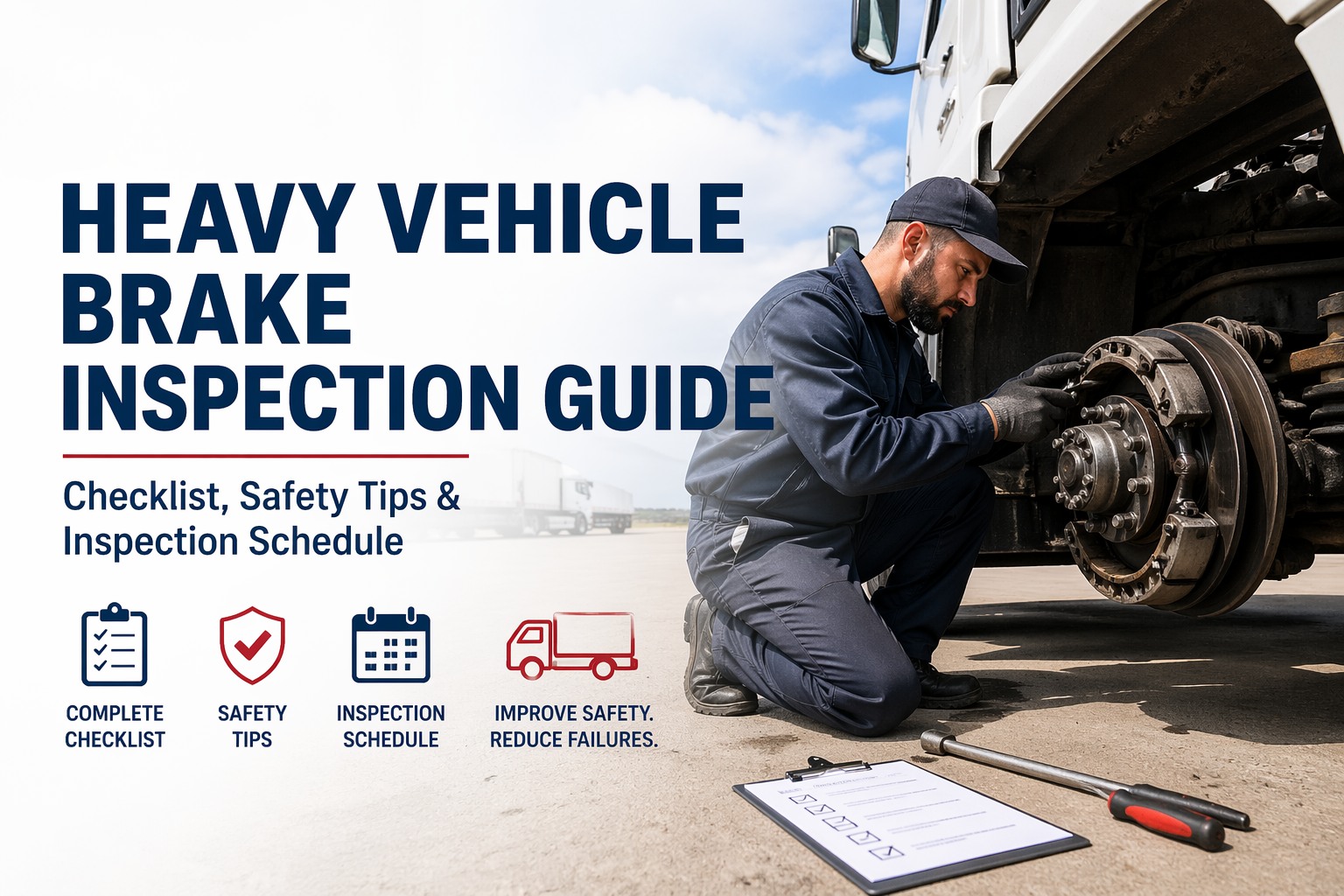
The 2026 focus is specifically drums and rotors. Pull wheels or use inspection ports to photograph each drum's friction surface and each rotor's face and edge. Document baseline condition. Any crack, heat checking pattern, or contamination captured now is documented before roadside catches it.
-
04
Coach drivers on the 7-step in-cab air brake test
Every driver should run through the in-cab air brake test at every pre-trip: leak-down test, pressure build test, low-pressure warning activation, spring-brake pop-out, ABS indicator, service-brake application, and parking-brake hold. This is the driver's line of defense against the OOS triggers a technician can't catch in the shop.
-
05
Monitor daily brake events during and after the week
Brake Safety Week discipline should not end on August 29. The unannounced Brake Safety Day can happen any day this year with no warning. Post-week: continue photo-verified drum/rotor checks in every pre-trip, keep pushrod stroke measurements in the DVIR, and track defect trends. The fleets that never worry about Brake Safety Week are the ones inspecting this way year-round.
The fleets that produce clean Brake Safety Week results consistently aren't the ones that ran a special audit in August. They're the ones running this five-step discipline year-round, treating the August window as visibility rather than a test. Start free and build the year-round brake discipline that makes August routine
From a maintenance director who caught the crack before Level IV did
Two weeks before last year's Brake Safety Week, we ran drum photos on every tractor. Truck 47 came back with a hairline crack we would have called cosmetic three years ago. Under the current OOS criteria that crack was within a millimeter of the "extending to mounting surface" threshold. We swapped the drum that afternoon.
That truck ran a Level IV on August 27. Passed clean. The old habit was checking drums during PM, which meant every 20,000 miles. Now we photo-check drums every pre-trip. It's 15 seconds per wheel end on the phone. The 15 seconds catches the one thing that matters in this year's focus area.
Frequently asked questions
When is CVSA Brake Safety Week 2026?
CVSA Brake Safety Week 2026 runs Sunday, August 23 through Saturday, August 29, 2026 — a seven-day focused inspection and enforcement initiative across the United States, Canada, and Mexico. CVSA announced the dates in a May 29, 2026 press release. Brake Safety Week is the announced portion of Operation Airbrake, CVSA's brake-safety program run in partnership with FMCSA since 1998. During the week, trained and certified CVSA inspectors conduct commercial motor vehicle inspections with special emphasis on brake systems and components. In addition to the announced week, CVSA holds a separate unannounced one-day Brake Safety Day at some point during 2026 with no advance notice — a design feature to ensure carriers maintain year-round brake readiness rather than a seasonal one. Since Operation Airbrake's inception in 1998, more than 3.4 million brakes have been inspected under the program.
What is the focus of Brake Safety Week 2026?
The 2026 focus area is brake drums and air disc brake rotors — the second consecutive year CVSA has selected these components as the emphasis. Inspectors will report data on the condition of drums and rotors specifically, alongside the standard brake-related out-of-service violation reporting. CVSA's rationale is safety-driven: brake drums and rotors directly affect braking efficiency, and broken pieces of drums or rotors can dislodge from a vehicle in motion and injure or kill other motorists. Specific out-of-service triggers on drums include cracks longer than half the width of the friction surface, any crack extending to the mounting surface or flange, wear exceeding the OEM-stamped discard dimension, heat checking or scoring beyond wear-limit specification, oil or grease contamination on the friction surface, and missing or broken sections. Rotors trigger OOS for cracks extending radially through the friction surface, cracks in the vane structure of ventilated rotors, thickness below OEM minimum, excessive scoring or heat checking, contamination from wheel-seal leaks or grease, and missing mounting hardware. The focus area does not exclude other brake components from inspection — Level IV inspectors will still check pushrod stroke, air leaks, lining thickness, ABS function, and other brake-system items — but drum and rotor condition receives the specific reporting emphasis.
What inspection type is used during Brake Safety Week?
Brake Safety Week inspections are primarily Level IV — a specialized inspection targeting a specific vehicle system, in this case brakes. Level IV is distinct from Level I (full driver + vehicle inspection, the most comprehensive), Level II (walk-around vehicle + driver without under-vehicle), Level III (driver-only), and Level V (vehicle-only without driver present). Critically, Level IV inspections operate outside the CVSA decal program: a truck that passed a Level I inspection and holds a valid CVSA decal from that pass can still be selected for a Level IV during Brake Safety Week. This is a common source of surprise for fleets — the decal is not a shield during single-system enforcement campaigns. Level IV inspections typically focus on air brake system components including air hoses, lines, and reservoirs (checking for audible leaks); brake component condition including drums, rotors, and linings; brake adjustment via pushrod stroke measurement at each wheel end; slack adjuster function; ABS system status; and low-pressure warning function. Inspectors will document the condition of the 2026 focus area — drums and rotors — with additional data-collection detail. Vehicles found with brake-related OOS violations, or any other OOS violations discovered incidentally, are placed out of service until repairs are completed.
What were the 2025 Brake Safety Week results?
CVSA's 2025 Brake Safety Week ran from August 24-30, 2025 with the same focus on brake drums and air disc brake rotors as the 2026 campaign. Inspectors examined 15,175 commercial motor vehicles across the United States, Canada, and Mexico. Of those inspected, 2,296 vehicles — 15.1% — were placed out of service for brake-related violations. That translates to roughly one in seven trucks failing the inspection during a week when the industry knew inspectors were specifically focused on brakes. Contextualizing that 15.1% figure: brake violations account for the largest percentage of all out-of-service violations year over year during roadside inspections. FMCSA data from 2025 shows that six of the top 20 vehicle violations reported nationally involved defective, worn, or out-of-adjustment brakes. And during the 2025 CVSA International Roadcheck (the May campaign focused on Level I inspections), brake violations accounted for nearly 24% of all vehicle OOS violations. The 15.1% Brake Safety Week failure rate is why CVSA's own materials position preparation as year-round rather than seasonal — the announced week produces the data, but the underlying operational compliance is what determines outcomes.
How should fleets prepare for Brake Safety Week?
Effective preparation runs on two timelines. First, the pre-week audit: run through every vehicle against the eight OOS triggers (pushrod stroke, defective-brake count, drum/rotor cracks, air leaks, air pressure drop rate, lining thickness, low-pressure warning function, ABS malfunction indicator). Any borderline items get shop attention before August 23. Physically measure pushrod stroke on every wheel end — visual estimates are unreliable — using a brake stroke indicator or tape measure at 90-100 PSI with engine off. Photograph every brake drum's friction surface and every rotor's face for the 2026 focus area documentation. Coach every driver on the complete 7-step in-cab air brake test to run at each pre-trip. Second, the year-round discipline: brake adjustment can drift outside allowable limits within 3,000-5,000 miles of heavy-braking service, so PM intervals of 15,000-25,000 miles are not enough to keep brakes reliably in spec. Daily pre-trip pushrod stroke checks, photo-verified drum/rotor inspections, and rigorous DVIR documentation are what produce clean Brake Safety Week results in August. The unannounced one-day Brake Safety Day scheduled for 2026 with no advance notice is the operational reason year-round discipline is not optional — the CVSA week is visibility, the year-round monitoring is defense.
Turn the August window into just another week
HVI drives the pre-trip discipline that surfaces brake defects before Level IV inspectors do. Pushrod stroke measurement fields in every daily inspection. Chamber-type tracked per vehicle. Photo-verified drum + rotor checks. Auto-flagging on approach to OOS limits. Live on your fleet in under two weeks — and the August 23 morning becomes just another Sunday.
No credit card · No hardware · Brake tracking live day one