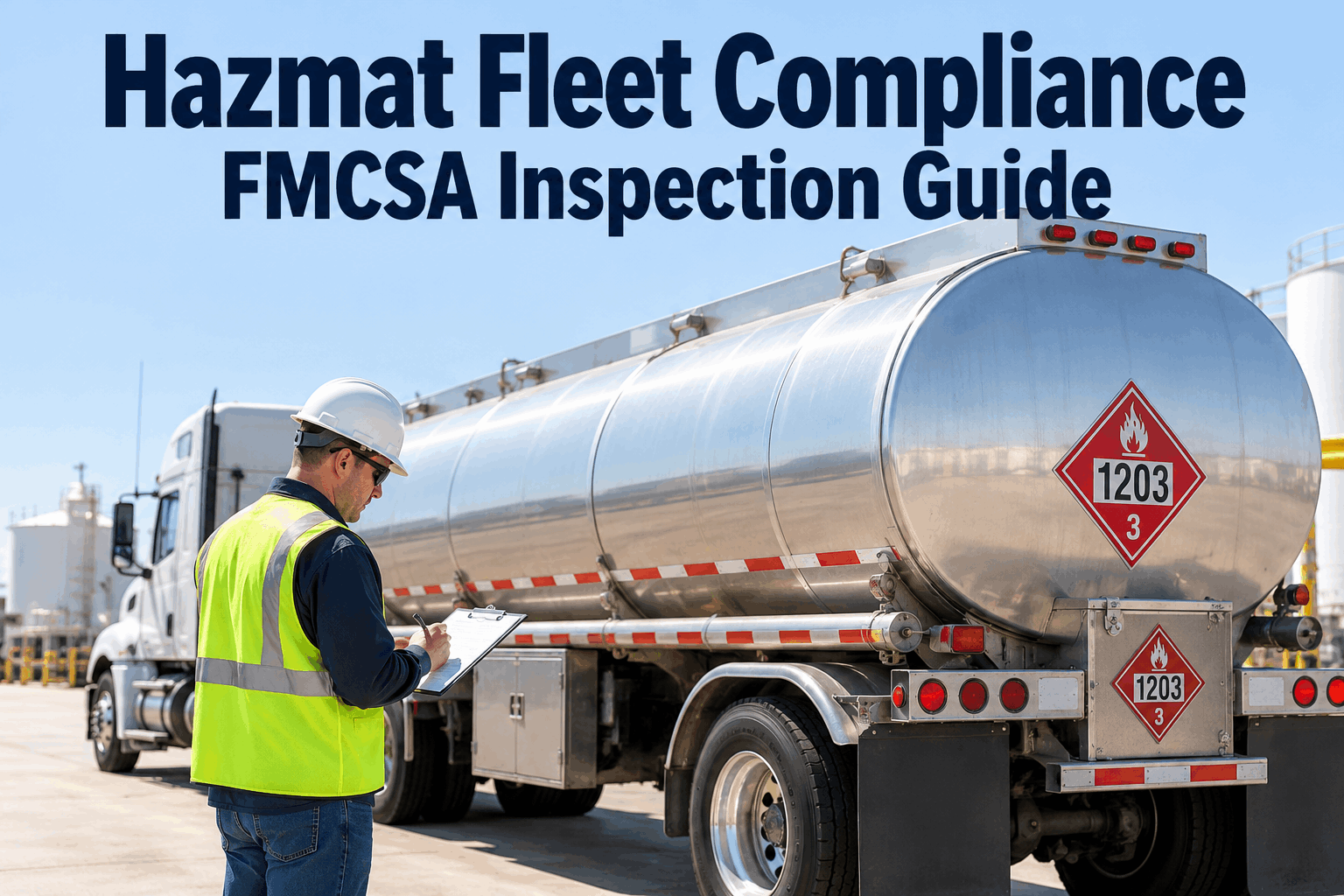
Hazmat fleet compliance isn't one inspection you pass and forget. It's a stack of certifications, tests, and endorsements that each expire on a different clock and a lapse on any single one puts a placarded vehicle out of service. The trap is that they never all come due together. Book a demo to see every clock tracked in one place.
Hazmat fleet compliance runs on six different clocks — not one
Endorsements, training, registration, tank tests, and med cards all renew on their own cadence. Miss one and the load can't roll. The job isn't remembering — it's tracking each clock per vehicle and per driver.
The reason hazmat fleet compliance slips isn't laziness. It's that no two clocks line up. An endorsement lapses while training is fresh; registration is current while a tank test quietly comes due. Below is the full set of moving parts, the cadence each one runs on, and exactly where a program leaks — plus how to keep every clock visible per asset and per driver.
Seven obligations, seven ownerswhat a hazmat compliance program actually has to carry
Roadside inspection is the moment of truth, but the program behind it is broader than any single walkaround. These seven obligations each have their own rule, their own record, and their own way of lapsing. This is separate from the daily hazmat vehicle inspection checklist — these are the standing credentials and certifications behind it.
PHMSA registration
Carriers hauling placarded quantities register annually with PHMSA under 49 CFR §§107.601–107.620 and carry the certificate. The year runs July 1 to June 30.
Clock: annualDriver HME + TSA
Every hazmat driver needs the H (or X) endorsement on the CDL, backed by a TSA Security Threat Assessment renewed every five years. An expired HME on a placarded load is an immediate out-of-service.
Clock: 5-year172.704 training
All hazmat employees — not just drivers — get general, function-specific, safety, and security training, refreshed every three years. Loaders and paperwork preparers count too.
Clock: 3-yearPlacarding & marking
Placards on all four sides per 49 CFR Part 172, matched to the load's class, with UN/NA numbers where required. Wrong, missing, or faded placards are the most-cited violation at roadside.
Clock: per loadCargo tank testing
Spec tanks (DOT 406, MC 307, MC 331 and others) carry visual, pressure, leakage, and thickness tests on separate intervals under §180.407. Each one has to be current for the spec to hold.
Clock: multi-intervalSecurity plan
Carriers moving the materials listed in §172.800 develop a written transportation security plan, review it at least annually, and train staff on it under §172.802.
Clock: annual reviewShipping papers & records
Shipping papers within the driver's reach per §177.817, current ERG onboard, and inspection and training records retained and producible on demand.
Clock: per trip + retentionNotice what they have in common: none of them is a "do it once" task. Every one is a recurring obligation with a record behind it, and the record is what an auditor asks for. Book a demo to see the seven obligations tracked per vehicle and driver.
Why hazmat fleet compliance needs more than one remindereach obligation, its cadence, and what a lapse triggers
Here's why a single reminder date doesn't work for hazmat fleet compliance: every obligation runs on a different cadence, so on any given week something is approaching due while everything else looks fine. Read the third column — the consequence is rarely a warning.
| Obligation | Renewal cadence | What a lapse triggers |
|---|---|---|
| Hazmat endorsement (HME) | TSA assessment every 5 years | Immediate OOS + driver violation |
| 172.704 training | Refresher every 3 years | Top-cited PHMSA review finding |
| PHMSA registration | Annual · due June 30 | Civil penalty; operate out of compliance |
| Cargo tank tests | Multi-interval · §180.407 | Tank loses spec; requalification needed |
| Medical certificate | Up to 24 months | Driver not qualified to operate |
| Security plan review | At least annually · §172.802 | Stale plan; finding at compliance review |
| Annual vehicle inspection | Every 12 months · §396.17 | OOS; no valid inspection on file |
Seven cadences, seven due dates, all sliding independently across the year. A spreadsheet can hold them, but it can't warn you — and the one clock you forget to look at is the one that lapses. Book a demo to see multi-interval tracking with early alerts.
Do you even need a security plan?the §172.800 threshold most fleets get wrong
The security plan is the obligation fleets most often miss entirely — because they assume it's only for explosives. It isn't. Under 49 CFR §172.800, the trigger is the material and quantity you move, and the line falls in more places than people expect.
- Any quantity of a material that requires placarding under Subpart F
- Table 1 §172.504 materials in bulk — any amount
- Large bulk quantities of most hazard classes
- Select agents, certain toxic-by-inhalation and radioactive materials
- Non-placarded, limited-quantity shipments
- Materials and amounts outside the §172.800 list
- Still bound by all other hazmat rules — this is only the plan trigger
If your fleet regularly runs placarded loads, assume the plan applies, then confirm against §172.800 for your exact materials. And remember the recurring part: the plan has to be reviewed at least annually and staff trained on it, so it becomes one more clock on the board. Start free and attach your security-plan review date to each affected asset.
Where compliance quietly lapsesthe three gaps auditors find first
When a PHMSA compliance review turns up findings, it's rarely the obvious stuff. It's the edges of the program — the records nobody owns because they don't belong to a driver or a truck. These are the three that catch fleets most often.
Non-driver training
172.704 covers loaders, dispatchers, and anyone preparing shipping papers. Fleets track driver training carefully and forget the warehouse — the single most-cited documentation gap at reviews.
The parked-tank clock
A tank sitting out of service still ages toward its test dates. Pull it back into hazmat service past an interval and it needs requalification first. The clock runs whether the tank moves or not.
TSA renewal drift
The HME looks valid on the CDL, but the underlying TSA assessment expires on its own five-year cycle. Miss the renewal window and the endorsement is unusable the day it lapses.
Every one of these is a clock with no natural owner. That's exactly the kind of thing a system is for — assign it to a profile, set the interval, and let the alert do the remembering. Book a demo to see the gaps closed before an audit finds them.
How HVI keeps every hazmat clock visibleprofiles, intervals, and audit export in one place
The fix isn't more diligence — it's one place where every obligation has a due date, an owner, and a record. HVI's region-configurable profiles and multi-interval tracking turn a scattered pile of certificates into a live compliance board.
Configure profiles
Set which obligations apply to each vehicle and driver by region and material. A propane tanker, a chemical hauler, and a van each carry the right set of clocks.
Capture the record
Store the HME, TSA date, training certificate, registration, tank test, and med card against the profile — with photo evidence and the exact expiry on each.
Alert & export
Every interval is watched, with early warnings before each due date, and a full audit package exported on demand — not reconstructed from a folder of paper.
This is the same records-and-alerts discipline the oilfield fleet in our oilfield fleet compliance case study used to reach zero violations across a full year — applied to hazmat's specific clocks. It pairs naturally with HVI's safety management and analytics and reporting tools, and for spec tanks specifically, the cargo tank testing intervals guide goes deeper on §180.407.
We never failed on a truck being unsafe. We failed on paper. An HME that looked fine on the license but had a lapsed TSA behind it. Two loaders whose training was three years and one month old. A tank that aged past a test interval while it sat in the yard.
None of it was hard to fix once we could see it. We built a profile for every vehicle and every driver, put each obligation on its own clock, and set the alerts early. The next compliance review was the calmest day we'd had in years — the inspector pulled records in minutes and left with nothing to write up.
Hazmat fleet compliance FAQsthe questions carriers ask before an audit
What does hazmat fleet compliance actually require?
It's a set of recurring obligations: PHMSA registration, driver HME with TSA assessment, 172.704 training for all hazmat employees, correct placarding, cargo tank testing where applicable, a security plan for §172.800 materials, and accessible shipping papers and records. Each renews on its own schedule.
How often does a hazmat endorsement have to be renewed?
The CDL hazmat endorsement is backed by a TSA Security Threat Assessment renewed every five years. If that assessment lapses, the endorsement can't be used — even if the license itself still shows it. Track the TSA date, not just the CDL expiry.
Which fleets need a hazmat security plan?
Under 49 CFR §172.800, a written security plan is required for anyone offering or transporting the listed materials — including any quantity that requires placarding and Table 1 §172.504 materials in bulk. It must be reviewed at least annually. Confirm against §172.800 for your exact materials.
Do non-drivers need hazmat training?
Yes. 49 CFR §172.704 covers every hazmat employee — loaders, dispatchers, and shipping-paper preparers, not only drivers. Training refreshes every three years, and missing non-driver records is the most common documentation finding at PHMSA compliance reviews.
Can software keep a hazmat fleet audit-ready?
It can track it. HVI stores each obligation against a per-vehicle or per-driver profile, watches every renewal interval, sends early alerts, and exports an audit package on demand. It doesn't file registrations for you, but it makes sure no clock lapses unnoticed.
Stop tracking hazmat compliance in seven places at once
Put every endorsement, training date, registration, tank test, and med card on one live board — configured per vehicle and driver, watched with early alerts, and exported for any review in minutes. Live for your fleet in days.
No credit card · configure your first profiles on day one