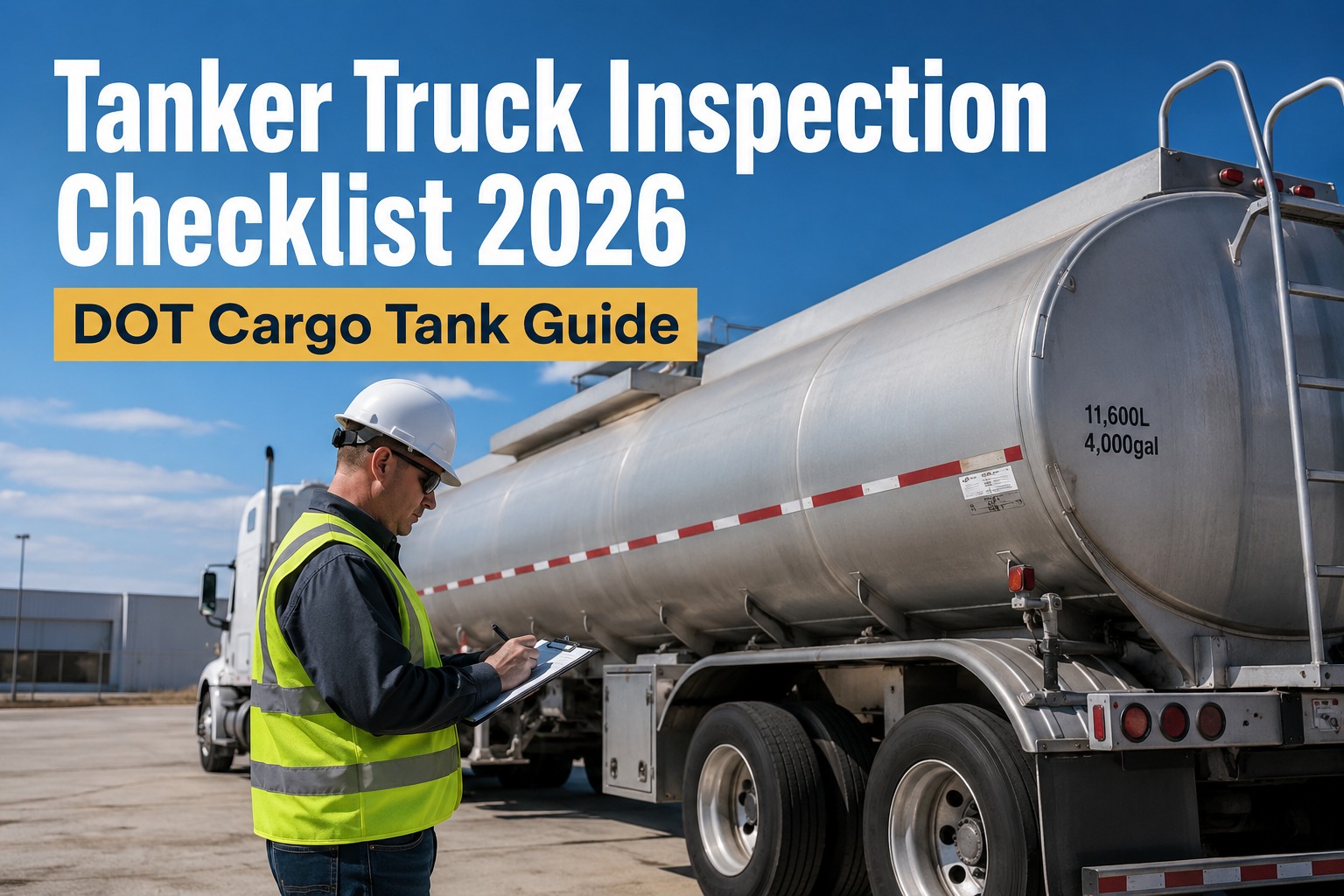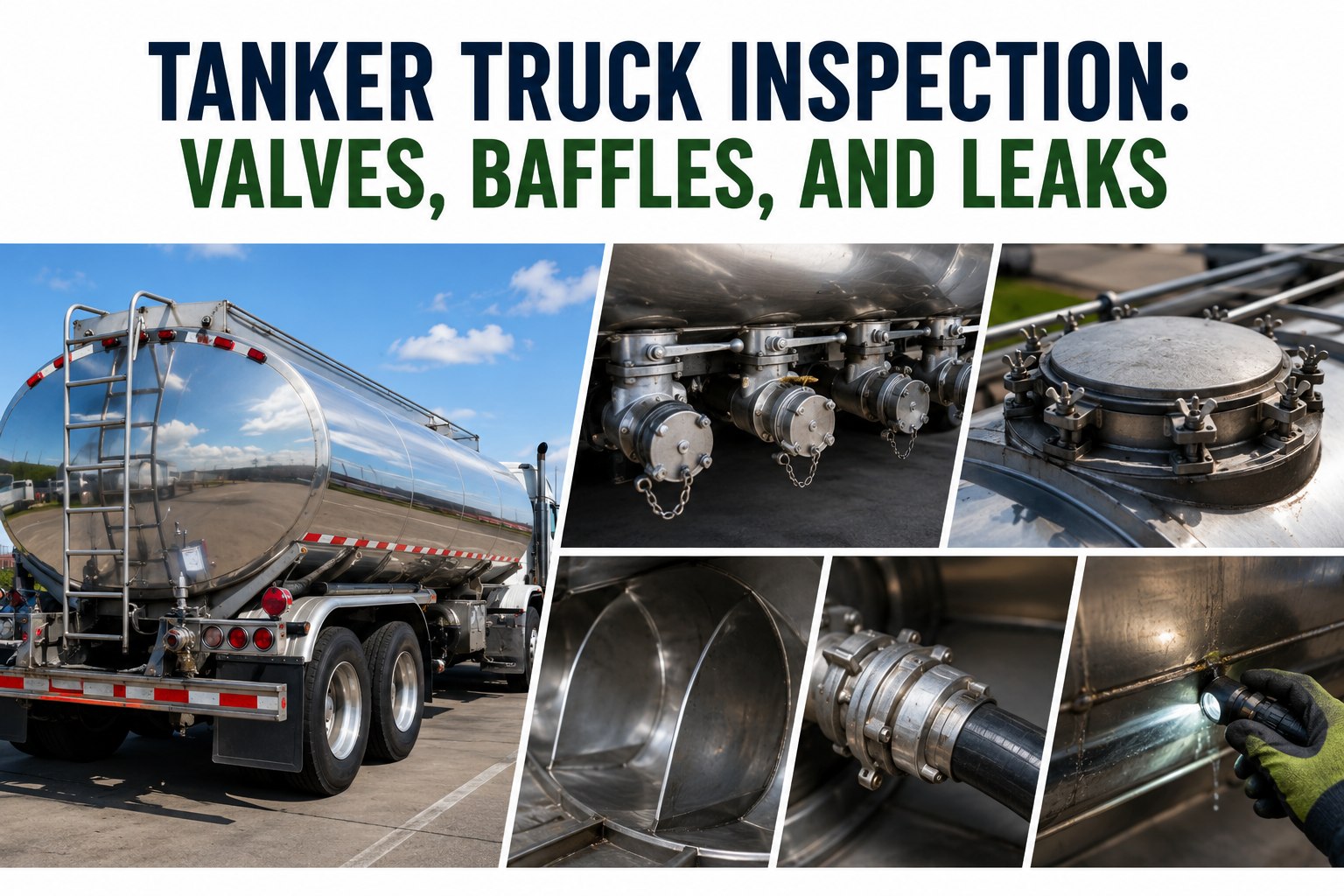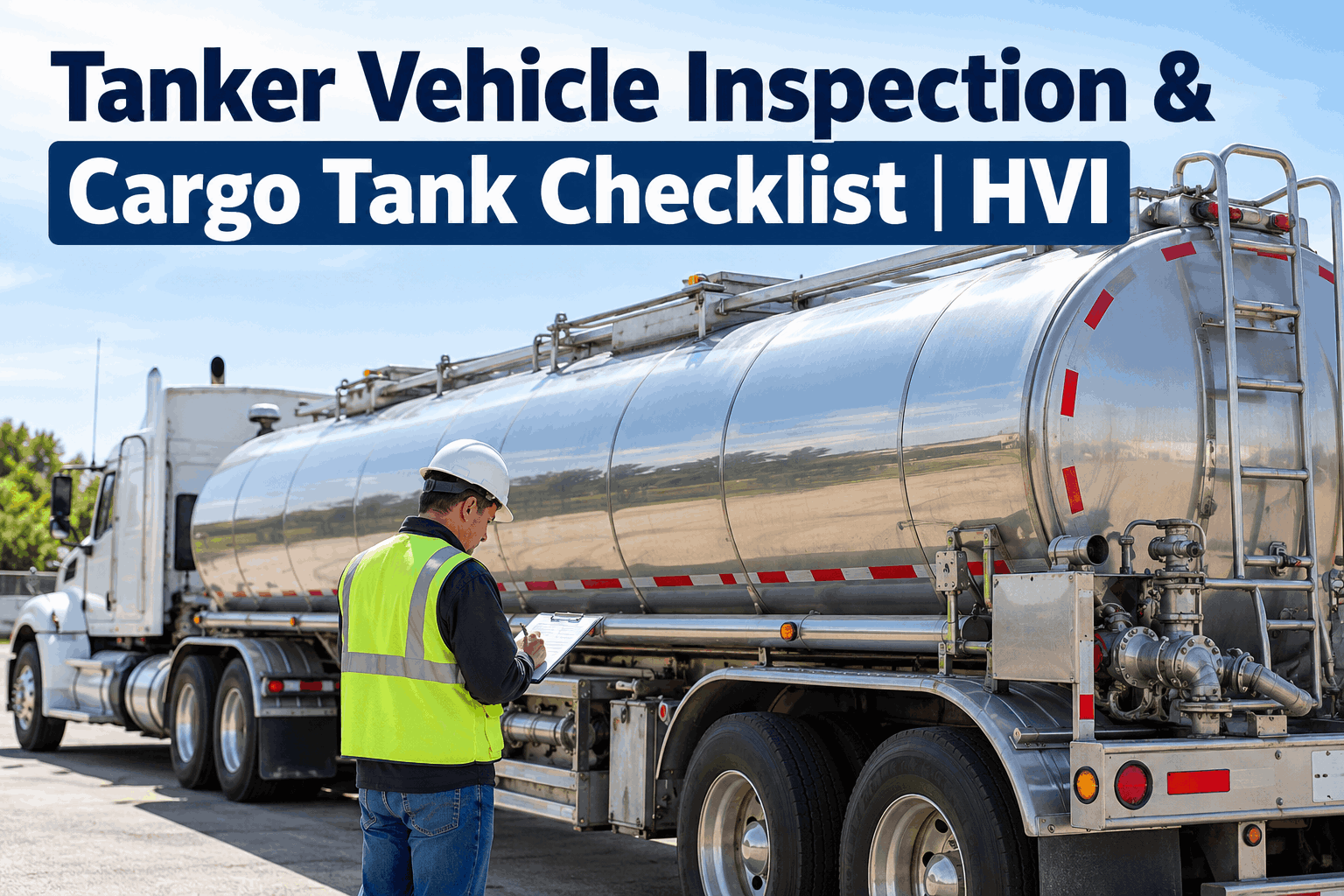
A tanker vehicle inspection is a different job from a dry van's — when your cargo is 9,000 gallons of liquid that surges, seeps, and vents, every manhole gasket, relief valve, and discharge fitting becomes a potential spill, fire, or rollover. This guide walks the cargo-tank body top to bottom, the daily closure checks a driver or technician runs before and after each load. Book a demo once you see the walk.
The Cargo Tank Walk That Keeps a Load Inside the Tank
Federal testing certifies the tank every few years. Between those tests, a leak-tight tanker depends on the daily walk — dome to underside, every closure verified before the wheels turn.
- 1Tank topManholes, vents, relief valves
- 2Shell & headsDents, corrosion, weld seams
- 3UndersideValves, hoses, drains, grounding
- 4StructureRollover rail, mounting, coupler
Below is that walk in full — the four zones of the cargo-tank body, the closures that have to seal, the rollover protection that has to be intact, and the way HVI keeps every check on a recurring clock instead of a driver's memory.
Three inspections, three clockswhy the daily walk is separate from federal testing
The most common tanker mistake isn't a missed bolt — it's assuming one inspection covers everything. A cargo tank actually lives under three separate schedules, and they don't run on the same clock. Miss the difference and a tank that's "current" on paper can still be unsafe to load today.
Daily walkaround (DVIR)
The driver or technician checks closures, seals, hoses, valves and visible leaks before and after each load. No specialist required — this is the layer this guide covers.
Body & component checks
Scheduled maintenance on the tank body itself — gasket replacement, valve service, vent function, rollover-rail integrity — on a time or usage cadence set by the shop.
Federal certification tests
External/internal visual, pressure, leakage and thickness testing under 49 CFR 180.407, on multi-year intervals, by a Registered Inspector. Certifies the tank; it does not replace the daily walk.
We cover the federal six-test interval matrix in depth in our separate 49 CFR 180.407 cargo tank testing guide — this page stays on the daily and periodic body walk that fills the gap between those certifications. To put both layers on one recurring schedule, book a demo of HVI's tanker inspection templates
Zone 1 — the tank topmanholes, vents and relief valves
The top of the tank is where a load escapes — as liquid over a full manhole gasket or as vapor through a stuck vent. It's also the most-skipped zone, because it means climbing. Every closure up here has to seat leak-tight.
Gasket seated and uncracked, cover latched fully, no product weep at the rim. A hardened or nicked gasket is the top source of liquid loss on a full load.
Normal vents free of debris, gaskets intact, nothing wedged open. A blocked vent can pressurize or collapse a tank; a stuck-open one leaks vapor and fails leak-tightness.
No corrosion, no visible weep, nothing painted over or bent. Bench testing set pressure is a certification task — the daily walk confirms the device is clean, seated and undamaged.
Caps present, threads clean, no residue crust. Missing caps and fouled couplings show up constantly on roadside sanitary and leak checks.
Everything on the top of the tank is a closure with a job: hold liquid in, let pressure move safely, seal when parked. Book a demo to see a dome-cover check with photo evidence attached
Zone 2 & 3 — shell and undersidewhere corrosion hides and product escapes low
Below the top, the walk splits into two halves: the shell and heads you scan for structural damage, and the underside plumbing where most drips actually start. Both zones fail quietly — a seep at a flange or a chafed hose doesn't announce itself until there's a puddle.
- Dents, gouges or distortion on the shell and heads
- Corrosion or abrasion, especially over the upper coupler area
- Cracks or weeping at weld seams and appurtenance welds
- Insulation or jacketing damage exposing bare shell
- Internal & external emergency valves seat and operate
- Product hoses free of chafe, bulges, soft spots or crush
- Discharge fittings, flanges and drain caps in place, no seep
- Grounding / bonding lug and cable intact and clean
A dry, clean underside is the fastest read on a healthy tanker — any fresh stain is a closure that isn't sealing. Recording that with a dated photo turns "looked fine" into a defensible record. Start free and log underside leak checks with photo evidence
Zone 4 — rollover protectionthe guard that decides how a tip ends
Tankers roll over far more readily than dry freight — a high center of gravity plus liquid that surges toward the outside of a turn. When it happens, the rollover protection around the top-mounted fittings is what stands between a survivable tip and a full product release. It only works if it's intact, so it's part of the daily walk, not an afterthought.
Rollover rail / damage rail
Bars and rails around manholes and vents straight and solidly mounted — not bent from a prior contact or dock strike. A crushed rail transfers impact straight to the closures it's meant to protect.
Tank-to-frame mounting
Mounting pads, U-bolts and saddle hardware tight and uncracked. Loose mounting lets the tank shift on the frame under surge load and stresses every fitting on top.
Upper coupler & kingpin area
Coupler area clean and corrosion-free where it meets the tank. This is separate from the fifth-wheel coupling check — see our fuel tanker DVIR walkaround guide for the coupling side.
Read the finding, know the movewhat a walkaround defect means for the load
The value of the walk is in acting on it. A driver who spots a weep needs to know in the moment whether it parks the truck or gets a note for the shop. This is the read HVI turns into an automatic status the moment a defect is logged.
| What you find | What it means | Move |
|---|---|---|
| Weep at a manhole gasket under load | Closure not leak-tight — active liquid loss | Do not load / out of service |
| Missing vapor coupling cap | Sanitary & leak-check failure at roadside | Fix before dispatch |
| Chafed or soft product hose | Discharge failure risk during transfer | Tag & replace before next transfer |
| Bent rollover rail | Reduced protection for top fittings | Schedule body repair |
| Light surface corrosion on shell | Monitor — not yet a containment issue | Log, photo, trend it |
Every row is a decision a driver shouldn't have to make from memory at 5 a.m. Book a demo to see a logged defect flip a tanker to out-of-service automatically
From a fleet safety manager who runs liquid bulk
Our tanks were current on every federal test and we still had a driver dispatch with a hardened dome gasket. It seeped a few gallons at the first hard stop. The certification says the tank is sound — it says nothing about whether today's walk got done. Once the dome, vents and hoses were a photo-required template that had to close before the load released, that gap shut. The daily walk was the thing we were trusting to memory, and memory was the leak.
How HVI holds the tanker walktemplates, photos and a recurring clock
The tanker problem isn't knowing what to check — it's making sure it happens every load, on a body that runs on time-based intervals rather than chassis mileage. That's exactly what HVI's configurable templates and PM scheduling handle.
Configurable tanker templates
Build the dome-to-underside walk once and reuse it across the fleet — fuel, chemical, food-grade or water, each with its own closure and sanitary items.
Photo evidence per closure
A dated photo at each gasket, vent and fitting turns a checkbox into a defensible record — the difference between "looked fine" and proof it was sealed.
Time-based PM scheduling
Periodic body checks and certification due-dates ride a calendar clock, not an odometer — HVI reminds before each is due so a tank never lapses.
Records built for audit
Every walk, defect and photo is retained and searchable, so a roadside or FMCSA review is a lookup, not a scramble through paper.
See how the daily walk, periodic body checks and certification dates live on one screen inside HVI's inspection platform, or line them up alongside preventive maintenance in a quick demo
Tanker inspection: quick answers
What is the difference between a tanker walkaround and cargo tank testing?
The walkaround is a daily driver or technician check of closures, valves, hoses and leaks before and after every load. Cargo tank testing (49 CFR 180.407) is periodic certification — visual, pressure, leakage and thickness tests done by a Registered Inspector years apart. The walk fills the gap between certifications; it doesn't replace them.
What should a daily tanker vehicle inspection cover?
Work the tank in zones: the top (manholes, vents, relief valves, vapor couplings), the shell and heads (dents, corrosion, weld seams), the underside (emergency valves, product hoses, fittings, grounding), and structure (rollover rail, mounting, coupler area). The goal is confirming every closure is leak-tight and nothing seeps.
Why do tanker bodies run on time-based intervals instead of mileage?
The chassis wears with miles, but the cargo tank's gaskets, valves, vents and certification cycles age on the calendar and on load cycles — a low-mileage tanker can still be overdue. HVI schedules body checks and certification due-dates on a time clock so they don't get missed by tying everything to the odometer.
What tanker findings should stop a load from dispatching?
Anything breaking containment or protection: a weeping manhole gasket, a stuck or damaged relief valve, a leaking emergency valve, or a missing closure cap. These fail leak-tightness and should hold the truck until repaired. Lighter items like surface corrosion or a slightly bent rail get logged, photographed and scheduled rather than parking the tank.
How does HVI help with tanker inspection and records?
HVI lets you build a configurable tanker walkaround template, require a photo at each closure, and put periodic body checks and certification dates on recurring reminders. A logged defect can flip a tank out of service automatically, and every record is retained and searchable for a roadside or FMCSA audit.
Turn the cargo-tank walk into a check that has to close before the wheels turn
HVI runs the dome-to-underside walk before and after every load, captures a photo at each closure, keeps periodic body checks and 180.407 certification dates on a recurring clock, and turns a logged defect into an instant out-of-service status. The gap between federal tests stops being a memory problem. Live in under two weeks.
No credit card · Tanker template ready on day one · Photo evidence built in