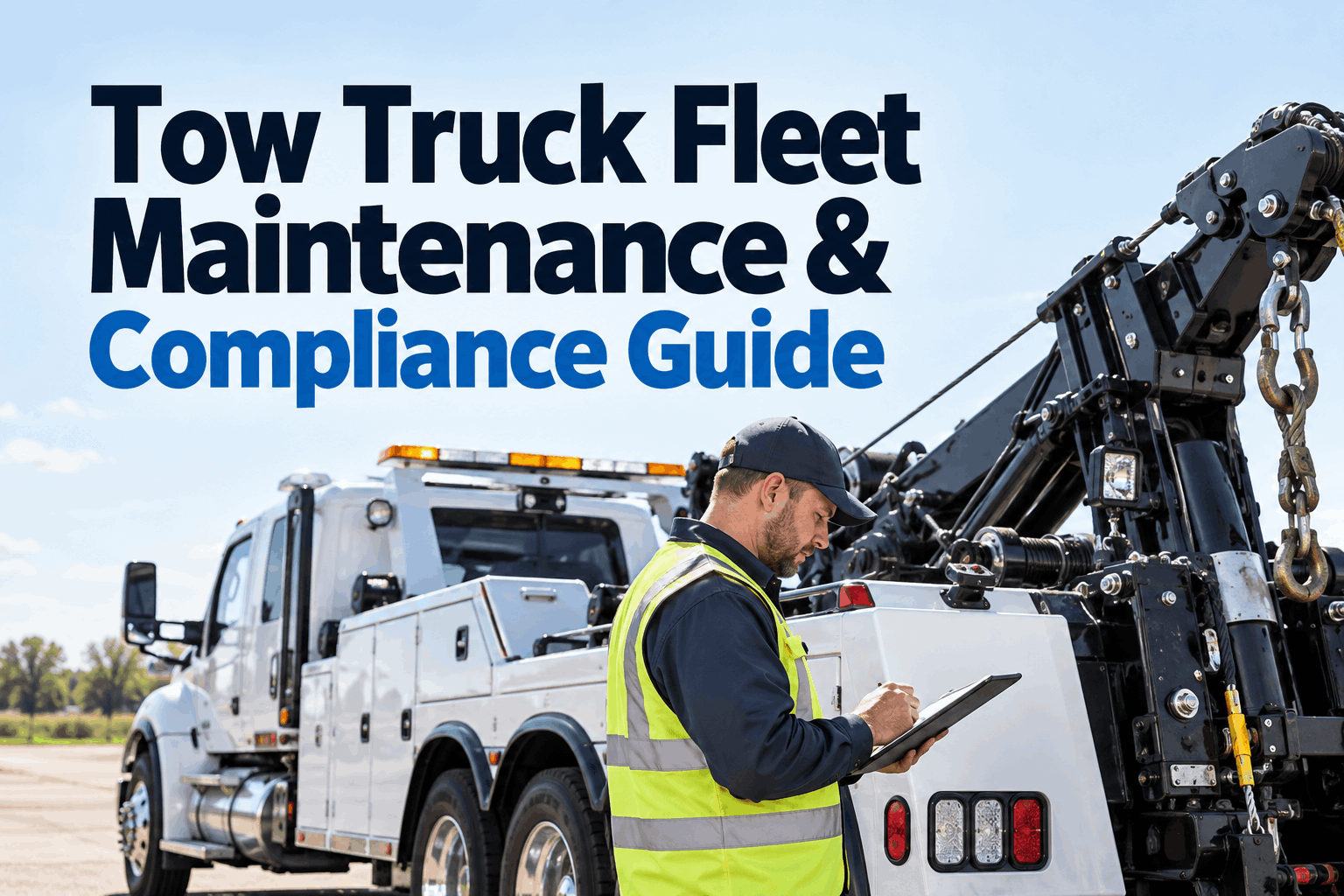
Every tow truck is really two machines bolted together — a highway truck the DOT makes you inspect, and a recovery rig that earns the money and can hurt someone if it fails under load. Towing fleet maintenance only works when both halves get checked, yet the winch, boom, hydraulics and rigging are the parts no DVIR line forces anyone to look at. If the money-making half of your fleet runs on trust, book a demo to see both halves on one inspection.
A Tow Truck Is Two Machines — and Towing Fleet Maintenance Has to Cover Both
One half is the truck the DOT forces you to inspect. The other is the recovery rig that pays the bills and carries the real risk — and nothing but your own program makes anyone check it. A unit can be road-legal and still unfit for the next call.
The half nobody forces you to check
What fails on the recovery side of tow truck maintenance — and what it costsThe chassis gets inspected because a roadside officer will write you up if it doesn't. The recovery rig gets inspected only if you decide it does — and it's the half that fails under load, with a vehicle hanging off it. You can build recovery checks into your maintenance management the same way the truck side already is.
None of these show up on a standard DVIR, which is exactly why they drift. A winch cable with a few broken wires still spools fine — right up until the pull that finds the weak spot.
The PM schedule that keeps a wrecker earning
Tiered preventive maintenance for a towing fleet — truck and recovery gear on one clockInspection catches what's wrong today; a preventive-maintenance schedule stops it going wrong at all. Most towing fleets run tiered PM by miles and hours, with the recovery gear folded into every service instead of left for "when it breaks."
Safety and lube: brakes, lights, tires and fluids, plus a quick winch, cable and rigging look-over.
Oil and driveline: everything in PM A plus oil, filters, engine, driveline and a hydraulic fluid service.
The yearly big one: full DOT inspection, alignment, boom and cylinder service, and a cable retirement review.
Major and seasonal work: rebuilds, winch and hydraulic overhauls, and winterizing before the busy season.
HVI triggers each tier automatically by odometer and engine hours, so a wrecker never quietly runs past a service — and the recovery gear gets its due at the same time the oil does.
The pre-call check, both halves in one pass
A tow truck inspection your drivers run before they roll — truck and rig togetherA good tow truck inspection covers the road side and the recovery side in one walk-around. In HVI it's one tap-through on a phone, and any failed item becomes a work order before the truck takes a call. You can book a demo to see this check on your own units.
Truck & DVIR
- Brakes, air lines and parking brake
- Tires, wheels and lugs
- Lights, beacons and markings
- Steering, mirrors and horn
- Fluids and leaks underneath
Winch & cable
- Full cable length — no broken wires or kinks
- End fittings, hooks and splices
- Drum, spooling and winch brake
- PTO engagement and controls
- Synthetic line for cuts or glazing
Boom & hydraulics
- Boom welds, pins and structure
- Cylinders, hoses and fittings
- Fluid level and any leaks
- Controls lift and hold smoothly
- Nameplate rating plate legible
Rigging & tie-downs
- Chains, grade and working load limit
- Straps and webbing for cuts
- Hooks, shackles and snatch blocks
- Bed, deck and slide (carriers)
- Tie-down points and D-rings
Stop trusting the half that pays the bills
HVI puts the truck and the recovery rig on one digital inspection, schedules PM by miles and hours, and turns a flagged winch cable or cracked boom into a work order — so a weak spot gets caught in the yard, not on the shoulder.
Road-legal, but held from recovery
What towing fleet maintenance looks like when the recovery side is tracked tooThis is the difference a two-sided inspection makes: a flagged cable doesn't ground the truck, it grounds the recovery work — the unit can still run a light tow while the rig gets fixed, and nobody sends it to lift a loaded trailer by mistake.
Over a fleet, that's fewer dropped loads, fewer roadside failures, and a maintenance record you can actually defend after an incident. Sign up free to set it up, or book a demo to see both halves tracked live.
We never missed a DOT item — the trucks were spotless for roadside. What nearly ended us was a winch cable. It looked fine, spooled fine, and let go on a heavy recovery with a loaded unit on the hook. After that I stopped treating the wrecker gear as an afterthought to the truck. Now every unit gets one inspection that covers the cable, the boom, the hydraulics and the rigging right alongside the brakes and lights, and a flagged cable pulls the truck off recovery without pulling it off the road. The money half finally gets the same attention the legal half always had.
Bringing it together
Give the recovery rig the same discipline as the chassisTowing fleet maintenance stops being a gamble the moment the recovery rig is on the same program as the truck: one inspection that checks the winch, cable, boom, hydraulics and rigging alongside the brakes and lights, PM scheduled by miles and hours, and every defect routed to a work order. Put both halves on one digital inspection and the money-making side stops running on trust — book a demo to see it on your own trucks.
The towing operations that run for years without a dropped load or a headline aren't the ones with the newest wreckers — they're the ones where the recovery gear gets inspected as seriously as the brakes.
Put your whole towing fleet maintenance on one record
Digital DVIRs, recovery-rig inspections, PM by miles and hours, and defect-to-work-order flow — the truck and the rig in one place, so nothing on the money-making half runs on trust.
Questions towing fleets ask
Towing fleet maintenance and inspection, answeredWhat does towing fleet maintenance need to cover?
Two sides of every unit. The truck side — brakes, tires, lights, steering and fluids — runs on the usual DVIR and DOT schedule. The recovery side — winch and cable, boom, hydraulics, wheel-lift or underlift, and rigging — needs its own regular inspection, because none of it appears on a standard DVIR yet it carries the load and the risk.
How often should a tow truck have preventive maintenance?
Most heavy-duty wrecker programs run tiered PM: a safety and lube service every 5,000–10,000 miles, an oil and driveline service every 10,000–20,000 miles, an annual service that includes the DOT inspection, and major or seasonal work as needed. Recovery components — winch, hydraulics, cables and rigging — fold into those services and get checked before every heavy recovery.
When should a winch cable be replaced?
Take it out of service for broken wires, kinks, flattening, heavy rust, or worn end fittings and splices — and never run a cable with visible damage into a recovery. Because a cable can look fine and still be weakened inside, inspect the full length and the connections before heavy pulls and follow the manufacturer's replacement criteria for your wire rope or synthetic line.
Do tow trucks need DOT inspections and DVIRs?
Yes. As commercial motor vehicles, tow trucks fall under FMCSA rules — a driver vehicle inspection report around each trip and a periodic (annual) DOT inspection, along with brake, light and tire standards. That covers the truck half; the recovery equipment is governed more by manufacturer specs, working load limits and your own safety program than by a single federal checklist.
How does HVI help with towing fleet maintenance?
HVI puts one mobile inspection on each unit that covers the truck and the recovery rig, schedules preventive maintenance by miles and hours, and turns a flagged cable, boom or rigging item into a work order — and it can hold a unit from recovery while keeping it road-legal. It handles inspection, scheduling and records; it doesn't replace your DOT obligations, manufacturer ratings, or operator judgment on a recovery.