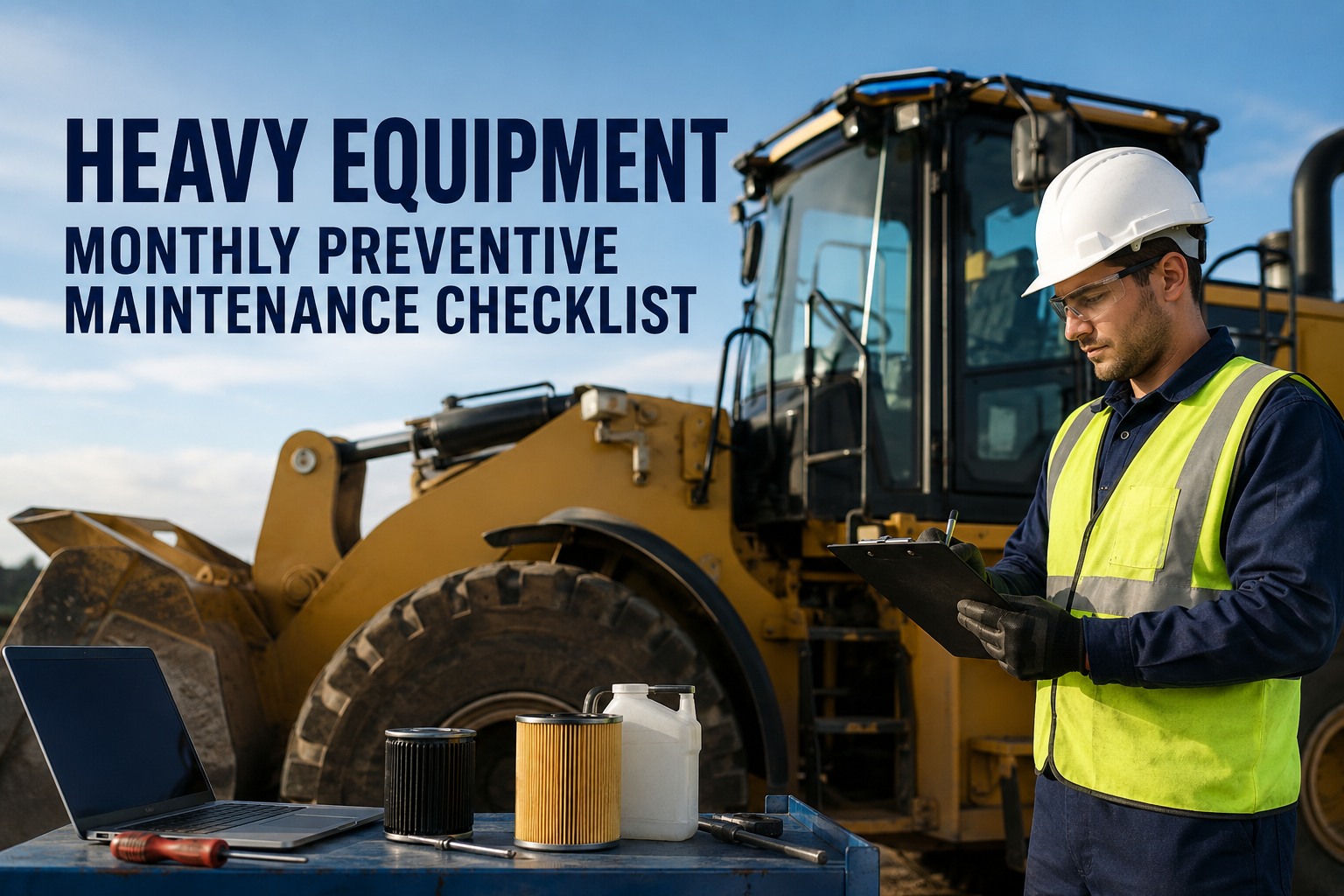
Seventy percent of fleet managers still run reactive maintenance — fixing trucks after they break instead of preventing the breakdown in the first place. The cost of that habit is brutal and measurable: unplanned downtime runs $448 to $760 per vehicle per day, emergency repairs cost three to nine times more than the same work done on schedule, and 78% of that downtime comes from failures that were entirely preventable. A real preventive maintenance program flips the math: structured PM cuts unexpected breakdowns 30–40%, extends vehicle life 20%, and saves $4–8 for every dollar spent. But knowing PM matters and building a program that actually delivers are two different things. This guide walks through the whole thing — the tiered A/B/C/D service framework, the intervals that match your duty cycle, the trigger types, the DOT compliance backbone, the KPIs that prove it's working, and the rollout sequence — so you can move your fleet from firefighting to a program that runs itself. book a 30-minute walkthrough to see it mapped onto your own vehicles.
A preventive maintenance program isn't paperwork. It's the highest-ROI decision in your whole operation.
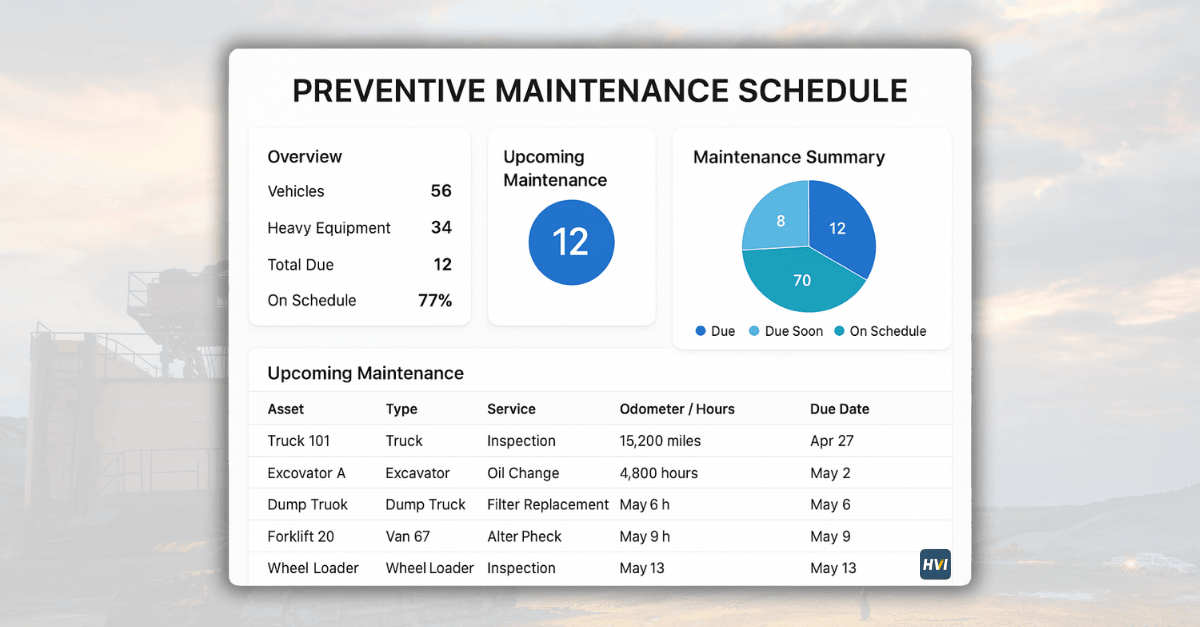
HVI builds your tiered PM schedule, fires every service by mileage, engine hours, or calendar, closes the loop from inspection to work order, tracks DOT compliance, and reports every KPI automatically — so 95% PM compliance stops being a goal and becomes the default.
The cost of doing nothing
Before the schedules and checklists, look at why this matters. Reactive maintenance isn't just slower — it's structurally more expensive, and the gap compounds as your fleet ages.
Fleets without a digital maintenance system run 40–55% reactive maintenance. Fleets on a structured PM program run just 15–20% — and see 15–25% lower total maintenance costs within two years. The difference isn't budget or newer trucks. It's having a system that enforces the schedule.
The five pillars of a program that works
A PM program isn't a checklist taped to the shop wall. It's five moving parts working together — miss one and the whole thing leaks money. Here's the full picture before we go deep on each.
Tiered schedules
A/B/C/D service classes matched to your duty cycle, each building on the last.
Trigger-based timing
Mileage, engine hours, or calendar — whichever comes first, per vehicle.
Inspection-to-WO loop
Every defect found becomes a tracked work order — nothing falls through.
KPIs that matter
PM compliance, MTBF, MTTR and uptime — measured, not guessed.
Digital enforcement
Software that holds the schedule consistent across every truck and tech.
The tiered PM framework: A, B, C, D
The industry standard is a four-tier service framework. Each higher class includes everything in the tiers below it, plus deeper work. These are baseline intervals — tighten them 15–20% for severe duty (heavy haul, stop-and-go, extreme heat, dusty sites).
PM-A 5,000–10,000 mi
Safety & basic service
Engine oil and filter, lubrication, fluid top-offs, brakes, lights, tires, belts and hoses, battery check. The frequent safety-focused inspection that catches small issues early.
PM-B 25,000–30,000 mi
Intermediate service
All PM-A items plus deeper checks — air and fuel filters, drivetrain inspection, suspension, steering, cooling system, brake adjustment, and wear-item replacement as needed.
PM-C 50,000–60,000 mi
Comprehensive service
All PM-B items plus transmission and differential service, wheel alignment, full engine diagnostics, injector and timing inspection, and major wear-component evaluation against limits.
PM-D 100,000 mi / annual
Major service & DOT
Annual comprehensive service with DOT inspection, major component evaluation, and scheduled rebuild or replacement of engine, transmission, or axle components as the data dictates.
A PM-A hitting every few weeks across a whole fleet is impossible to track on a spreadsheet — and a single missed service is all it takes to slide into the 3–9× emergency-repair zone. sign up free and let HVI fire every A/B/C/D service automatically, or book a demo to see tiers customized to your duty cycle.
Three triggers — service on whichever comes first
Mileage alone misses too much. A truck that sits still still ages; a high-hour idler racks up engine wear without miles. The best programs run all three triggers in parallel and service on whichever fires first.
Mileage-based
The classic trigger for over-the-road trucks. Service intervals tied to odometer readings — ideal for long-haul fleets logging predictable highway miles.
Best for: highway & long-haulEngine-hour-based
Most manufacturers base recommendations on ~250 operating hours. Essential for equipment and vocational trucks that idle or work stationary, where miles understate real wear.
Best for: equipment & vocationalCalendar-based
Fluids and seals degrade regardless of use. Low-usage and seasonal vehicles need a calendar floor — at least every 90 days — so a parked truck never silently falls out of spec.
Best for: seasonal & low-usageHVI tracks all three triggers per vehicle simultaneously and schedules the service the moment any one of them comes due — so a stationary high-hour unit and a highway hauler are both serviced correctly without anyone doing the mental math.
The DOT compliance backbone
For commercial fleets, PM and compliance are the same job. Federal rules don't suggest maintenance — they mandate a documented, systematic program. Skip the paperwork and a clean repair still becomes an audit finding.
Requires a systematic inspection, repair, and maintenance program for every vehicle — with records kept for each one.
Driver Vehicle Inspection Reports (DVIR) — daily post-trip defect reporting that feeds your maintenance pipeline.
Annual DOT inspection, mandatory, with a 14-month record-retention requirement on every report.
Now a 12-month violation window — fix your PM program, go 12 months clean, and your Vehicle Maintenance percentile resets entirely.
Brakes, lights, tires, and air systems are the most common out-of-service violations — and every one is a PM checklist item you can close before a roadside inspection ever finds it. sign up free and digitize DVIRs, annual-inspection tracking, and audit-ready records in one place.
The five KPIs that prove it's working
A program you can't measure is a program you can't defend at budget time. These five metrics tell you whether PM is actually delivering — with the 2026 benchmarks to score yourself against.
The single most actionable number here is PM compliance — it directly predicts future reliability. Fleets below 80% compliance suffer 3.5× more unplanned breakdowns than those above 90%, yet the 2026 industry average sits at just 61%, mostly because manual scheduling lets PMs quietly slip. HVI calculates all five KPIs automatically from your inspection and work-order data.
Rolling it out: four phases to 95%
You don't fix a reactive culture overnight. The fleets that hit 95% compliance follow a sequence — each phase builds the foundation for the next.
Inventory & baseline
List every asset, capture current mileage and hours, and pull your last 6–12 months of repair history to find your reactive baseline and worst-offender vehicles.
Define tiers & triggers
Set A/B/C/D intervals per vehicle class, tightened for severe duty, and assign mileage, hour, and calendar triggers. Build the checklist for each service level.
Digitize & close the loop
Move DVIRs and PM checklists to mobile, auto-generate work orders from every defect, and route them so nothing dies in a drawer between inspection and repair.
Measure & tighten
Review the five KPIs on a fixed cadence, act on every drift with an owner and due date, and adjust intervals from real failure data until compliance holds at 95%+.
Spreadsheet PM vs. HVI
Both technically run a schedule. Only one fires every service automatically, closes the inspection loop, and proves compliance to a DOT auditor without a frantic file search.
Spreadsheet / reactive
- PMs slip silently as intervals stack up across the fleet
- Mileage and hours logged by hand, error-prone
- Defects noted on paper, then forgotten
- Emergency repairs at 3–9× the planned cost
- DOT records scattered — audits become a scramble
- KPIs guessed at, never truly calculated
With HVI software
- Every A/B/C/D service fires off mileage, hours or calendar
- Triggers tracked per vehicle, whichever comes first
- Inspections auto-create work orders — loop closed
- Planned-work ratio climbs, emergency cost falls
- DVIRs, annual inspections & records audit-ready
- PM compliance, MTBF, MTTR & uptime calculated live
lower maintenance costs. Fleets that move from reactive to a structured digital PM program cut total maintenance spend up to 30%, reduce breakdowns 30–40%, extend vehicle life 20%, and lift PM compliance from a 61% industry average toward the 95% benchmark. The fleets that get there don't have better trucks or bigger budgets — they have a program that enforces itself.
Frequently asked questions
What are the standard preventive maintenance intervals for heavy vehicles?
Most fleets use a tiered A/B/C/D framework. PM-A (basic safety and oil service) runs every 5,000–10,000 miles, PM-B (intermediate, with filters and drivetrain checks) every 25,000–30,000 miles, PM-C (comprehensive, with transmission, differential, and alignment) every 50,000–60,000 miles, and PM-D (major service with DOT inspection) every 100,000 miles or annually. Equipment and vocational vehicles are often scheduled on engine hours instead — roughly every 250 operating hours. These are baselines: severe-duty cycles like heavy haul, stop-and-go delivery, or dusty sites should tighten intervals 15–20%, and you should always adjust based on oil analysis and inspection findings.
How do I build a preventive maintenance program from scratch?
Work in four phases. First, inventory every asset and capture current mileage, hours, and 6–12 months of repair history to establish your reactive baseline. Second, define A/B/C/D service tiers and intervals per vehicle class, assign mileage, engine-hour, and calendar triggers, and build a checklist for each service level. Third, digitize: move DVIRs and PM checklists to mobile and auto-generate a work order from every defect so nothing falls through the cracks between inspection and repair. Fourth, measure the core KPIs on a fixed cadence and tighten intervals from real failure data. The goal is steady 95%+ PM compliance, which is what separates proactive fleets from reactive ones. This is exactly the workflow HVI's inspection and maintenance software is built to run — it holds your tiers, fires the schedule, and turns every inspection into tracked maintenance, so you can sign up free and stand up the whole program in days, not months.
What's a good PM compliance rate, and why does it matter so much?
The 2026 benchmark is 95% or higher, and anything below 85% is treated as a systemic problem. PM compliance is the percentage of scheduled services completed on time, calculated as completed PMs divided by scheduled PMs. It matters because it's the single most predictive maintenance KPI: fleets below 80% compliance experience about 3.5 times more unplanned breakdowns than fleets above 90%, and a rate below 85% statistically guarantees higher breakdown frequency within 60–90 days. Despite that, the industry average sits near 61% — almost entirely because manual scheduling lets services quietly slip. Automated, trigger-based scheduling is what closes that gap, and it's the core of what HVI's inspection and maintenance software does: it tracks every vehicle's mileage, hours, and calendar, fires each service before it slips, and reports your live compliance rate so you always know where you stand. book a demo to see your fleet scored against the 95% benchmark.
What DOT regulations govern fleet preventive maintenance?
Three rules form the backbone. 49 CFR 396.3 requires a systematic inspection, repair, and maintenance program with records for each vehicle. 49 CFR 396.11 covers Driver Vehicle Inspection Reports — the daily defect reporting that feeds your maintenance pipeline. 49 CFR 396.17 mandates an annual inspection with a 14-month record-retention requirement. On top of that, the 2026 CSA scoring overhaul moved to a 12-month violation window, which means a fleet that fixes its PM program and stays clean for 12 months can reset its Vehicle Maintenance percentile entirely. The most common out-of-service violations — brakes, lights, tires, and air systems — are all standard PM checklist items, so a disciplined program directly lowers compliance risk. HVI's inspection and maintenance software keeps this side covered too, digitizing DVIRs, tracking annual-inspection due dates, and retaining audit-ready records automatically, so you can sign up free and walk into a DOT audit without a frantic file search.
How does HVI help run a preventive maintenance program?
HVI is an inspection and maintenance software platform that runs the whole program in one place. It builds your A/B/C/D tiers and fires every service automatically off mileage, engine hours, or calendar — whichever comes due first per vehicle — with severe-duty adjustments built in. Operators run inspections and DVIRs from a phone or tablet with mandatory photo capture on defects, and every defect auto-creates a tracked work order so the inspection-to-maintenance loop never breaks. It tracks DOT annual-inspection dates, retains records for audits, and calculates your core KPIs — PM compliance, MTBF, MTTR, availability, and planned-vs-unplanned ratio — automatically from your own inspection and work-order data. Most fleets see their real performance numbers within hours of starting. book a demo and we'll map the software onto your fleet on the call.
Stop firefighting. Start running a program that runs itself.
HVI builds your tiered PM schedule, fires every service by mileage, hours, or calendar, closes the loop from inspection to work order, keeps DOT records audit-ready, and reports every KPI automatically. Move your fleet off the 61% average and toward 95% compliance — and stop paying 3–9× for breakdowns you could have planned around.
No credit card required · Live in under two weeks · Tiered PM + multi-trigger scheduling + DOT compliance + automatic KPIs in one platform