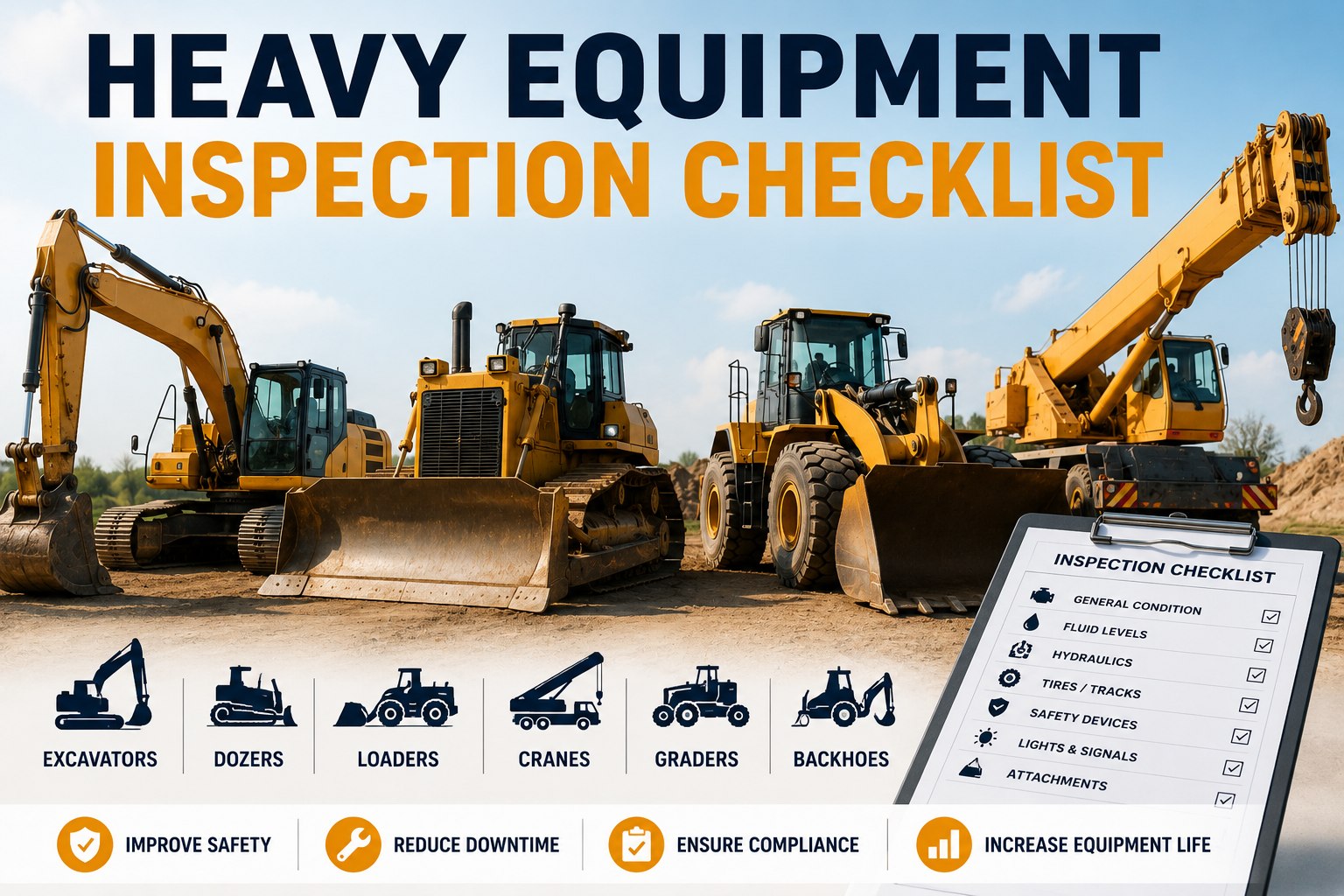
A heavy equipment monthly preventive maintenance checklist is the calendar-driven discipline that runs between your OEM's hour-based service intervals. Hour milestones (250, 500, 1000, 2000) get all the attention in the operator's manual, but the reality of a working shop is calendar-driven: crews come in Monday morning, machines get inspected on a rotation, and defects get logged whether the hour meter says 340 or 480. That monthly cycle is what catches leaking hydraulic hoses before they blow at 3,000 PSI, spots hairline cracks on a bucket ear before it fails mid-load, and tracks the slow creep of tire pressure and coolant contamination that would otherwise show up as a breakdown on the jobsite. This guide walks through the six categories that every monthly heavy equipment PM checklist should cover, the specific line items inside each category, the traffic-light workflow for actioning results, and the digital-vs-paper decision that determines whether your monthly checklist actually reduces downtime or just fills a filing cabinet. Book a demo when you're ready to see the checklist configured for your fleet.
What a working monthly checklist looks like
6 categories · ~40 line items · 45–60 minutes per machine · digital audit trail
The 6 categories of a monthly heavy equipment PM checklist
Every complete monthly PM checklist for heavy equipment breaks down into six inspection categories. Skip a category and you introduce a systematic blind spot; over-inspect within a category and you burn tech hours without proportional yield. This is the tested cross-industry framework.
Fluids & Filters
Engine oil, coolant, DEF, hydraulic fluid, transmission fluid, fuel/water separator. Levels + condition + contamination.
~10 minLubrication
All grease points, pin bushings, slew ring, driveshaft, chain drives. Grease quality + fitting integrity.
~8 minHydraulics
Cylinders, hoses, pumps, valve banks, filters, coolers. Leaks, chafing, seal condition, pressure test.
~12 minTires / Tracks / Undercarriage
Wheel torque, tire pressure & damage on wheeled machines. Track tension, shoe wear, roller integrity on tracked.
~8 minStructural & Attachment
Boom, stick, bucket, blade, frame welds. Bushings, pin retention, ground engaging tool wear.
~10 minElectrical, Controls & Safety
Battery, alternator, wiring harness, lights, mirrors, backup alarm, ROPS/FOPS, seat belt, fire suppression.
~7 minTotal: roughly 45–55 minutes per machine, done right. A wheeled loader runs faster than a tracked excavator; a small skid steer faster than a 40-ton excavator. Track average time per machine class so you can size shop capacity accurately. Book a demo to see the 6-category template configured for your fleet
The detailed monthly checklist — every line item
The overview cards give you the categories. The detail below is what actually gets checked on the shop floor. Every item has a specific pass criterion and a specific defect condition that triggers a work order.
Fluids & Filters
- Engine oil — level between marks, no visible contamination or coolant emulsion; sample for lab analysis at every 3rd check
- Coolant — level at cold, freeze point per spec, refractometer test, visible rust or oil contamination
- Hydraulic fluid — sight-glass level with boom lowered, color check for water contamination (milky/cloudy)
- Transmission & final drive — level check per manufacturer, drain magnet inspection during 3rd month
- DEF / SCR system — level, crystallization check on nozzle, urea concentration test
- Fuel/water separator — drain visible water, filter restriction indicator position
- Air filter — restriction gauge reading, visible dust discharge from ejector valve
Lubrication
- Boom / stick / bucket pins — grease until fresh grease shows, note any excessive play
- Swing bearing / slew ring — grease per manufacturer pattern, listen for rough rotation
- Track adjuster grease (tracked machines) — add per spec, check for grease leaks past seal
- Driveshaft U-joints & slip yokes — grease each fitting, check for radial play
- Cab door hinges, engine hood pivots — light oil per operator's manual
- Chain drives (skid steers, some compact loaders) — chain tension & case oil level
- Grease fitting integrity — missing, damaged, or seized fittings replaced
Hydraulics
- Cylinder rods — scoring, pitting, chrome damage, seal weep patterns
- Hydraulic hoses — chafing on any routing point, sidewall damage, seal weep at crimps
- Hydraulic pump — case drain flow test, unusual noise, pressure at relief setting
- Valve bank — leak-down test, spool return-to-center, external leak evidence
- Hydraulic filter — restriction indicator position, drain plug magnet inspection
- Hydraulic cooler — fin condition, debris packed against cooler face, fan operation
- Auxiliary circuit couplers — check condition, quick-disconnect integrity
Tires / Tracks / Undercarriage
- Tire pressure (wheeled machines) — per manufacturer spec, hot vs cold documented
- Tire condition — tread depth, sidewall cuts, cord ply exposure, chunk missing
- Wheel torque — torque check with calibrated wrench, document values
- Track tension (tracked machines) — sag measurement per manufacturer spec
- Track shoe wear — height measurement against wear limit at multiple points
- Track rollers & idlers — oil leaks at seals, flat spots, damaged flanges
- Sprocket teeth — hook wear, cracked or broken tooth tips
Structural & Attachment
- Boom & stick welds — hairline crack inspection, especially at high-stress transitions
- Frame & chassis welds — mounting brackets, engine mount points, ROPS attachment
- Bucket / blade / attachment — edge wear, tooth condition, mounting pin play
- Quick coupler / attachment lock — positive engagement test, safety pin condition
- Ground engaging tools — teeth, sidebars, wear plates, welded-in replacements
- Counterweight bolts — torque check, safety pin/wire retention
- Handrails, steps, grab bars — secure mounting, no cracks or bent components
Electrical, Controls & Safety
- Battery — terminal corrosion, hold-down, load test if voltage suggests weakness
- Alternator & starter — charging voltage, cranking amps, belt condition
- Wiring harness — chafing at pivot points, connector integrity, corrosion
- Work lights & road lights — every lamp operational, lens condition
- Backup alarm & horn — audible at required decibel, no direction restriction
- ROPS / FOPS — integrity, mounting bolt torque, no unauthorized modifications
- Seat belt, mirrors, camera systems — latching, adjustment, visibility angles
- Fire suppression (if equipped) — pressure gauge, inspection tag, discharge nozzle condition
These 40+ line items sound like a lot until you see the checklist run on a tablet with pre-filled defaults, dropdown responses, and photo capture built into every defect entry. That's the difference between a compliance exercise and an actual reliability discipline. Book a demo to see the full checklist run on a real machine
The 3-status workflow: pass / watch / defect
Every checklist item resolves to one of three statuses. The status determines what happens next — and this is where most paper checklists break down. Written notes get lost, watch items never get followed up on, defects sit in a manager's inbox for a week. A working monthly PM system automates the action per status.
Component performing within manufacturer specification. Logged to the audit trail with timestamp, tech ID, and (ideally) photo. Continues on normal PM cycle until next monthly.
Component within spec but showing early wear signals. Common examples: slight cylinder rod pitting, tire tread approaching lower limit, coolant refractometer trending low. Not urgent but not ignorable.
Component fails inspection criteria. Examples: hydraulic hose with visible chafing to reinforcement, missing grease fitting, cracked ROPS mount, brake pad below wear indicator, active leak.
The 3-status framework is what turns the checklist from documentation into a production system. Every watch item gets a follow-up; every defect gets a work order with a name and a due date. Nothing lives in memory or on a sticky note. Start a free trial to see the workflow auto-populate on your fleet.
Digital vs paper monthly checklists: the real operational difference
Every shop currently runs the monthly checklist somehow — on paper, in a spreadsheet, or on a purpose-built platform. The operational difference is measurable, not aesthetic.
The gap in every row is measured, not stylistic. Fleets that switch from paper to digital typically see a 30–50% reduction in unplanned downtime within two quarters — not because the checklist itself is better, but because the follow-through actually happens. Start a free trial and see the difference on your own machines within a week.
What one missed monthly PM cycle actually costs
The most expensive failure mode isn't the missed inspection itself — it's the defect that would have been caught, allowed to progress, and then failed catastrophically 3 to 8 weeks later on the jobsite. Here's the actual math on a 20-ton excavator with a missed monthly.
The monthly PM isn't a cost line — it's an insurance policy with an ROI that only shows up in the events that didn't happen. Fleets that run consistent monthly checklists across 30+ machines typically avoid 8–15 major cascade events per year — that's $60,000–$120,000 in prevented cost annually on a fleet of that size. Book a demo to see the cascade prevention modeled on your fleet
From a maintenance manager running monthly PM on 47 machines
We ran monthly PM on paper for years. The paperwork was fine on paper — every machine had a checklist in the file cabinet. What we didn't have was any way to prove that the watch items from three months ago had actually been re-inspected, or that the defects had been closed out with real repairs.
Switching to digital changed two things. First, every defect became a work order the moment the tech clicked submit — no more "I meant to write it up but forgot." Second, our unplanned downtime dropped 38% inside two quarters. On 47 mixed machines that's about $180,000 of annual production we weren't losing anymore. The checklist itself didn't change — the follow-through did.
The bottom line on monthly heavy equipment PM checklists
A monthly heavy equipment PM checklist is the calendar-driven backbone of a shop's reliability program. Six categories — fluids & filters, lubrication, hydraulics, tires/tracks/undercarriage, structural & attachment, and electrical/controls/safety — covering roughly 40 line items, running about 45–60 minutes per machine when done right. The framework matters less than the follow-through: every item resolves to pass, watch, or defect, and every non-pass triggers a specific auto-action. Paper checklists document the inspection; digital platforms document AND actuate it — the difference between a file cabinet and a maintenance production system. Fleets that run the monthly discipline consistently prevent the 8–15 cascade breakdowns per year that would otherwise cost six figures in emergency repairs, lost production, and cascade impact. The monthly checklist is the highest-ROI operational discipline available on any heavy equipment fleet — not because it's expensive to run, but because the failures it prevents are so much more expensive than the inspection that catches them.
Frequently asked questions
What should a heavy equipment monthly preventive maintenance checklist include?
A complete monthly PM checklist for heavy equipment covers six inspection categories with roughly 40 total line items. Category 1 (Fluids & Filters): engine oil level and condition, coolant level and freeze point, hydraulic fluid, transmission fluid, DEF, fuel/water separator, air filter restriction. Category 2 (Lubrication): all grease points including boom/stick/bucket pins, swing bearing, track adjusters, driveshaft U-joints, chain drives on skid steers, and grease fitting integrity. Category 3 (Hydraulics): cylinder rod condition, hose chafing check at every routing point, pump case drain, valve bank leak test, hydraulic filter restriction, cooler fin condition. Category 4 (Tires/Tracks/Undercarriage): tire pressure and damage on wheeled machines, track tension and shoe wear on tracked equipment, wheel torque check with calibrated wrench. Category 5 (Structural & Attachment): boom and stick weld inspection for hairline cracks, frame welds, bucket edge condition, quick coupler engagement, counterweight bolt torque. Category 6 (Electrical, Controls & Safety): battery, alternator, wiring harness, all lights, backup alarm, ROPS/FOPS integrity, seat belt, fire suppression if equipped. Every line item should have a specific pass criterion and a documented defect condition that automatically triggers a work order.
How long does a monthly heavy equipment PM take per machine?
A properly executed monthly PM checklist takes 45 to 60 minutes per machine on average, with meaningful variation by machine class. Small compact equipment (skid steers, compact track loaders, mini excavators) typically runs 30 to 40 minutes because there are fewer grease points, simpler hydraulic circuits, and less structural surface to inspect. Mid-size equipment (20-ton excavators, wheel loaders, small dozers) runs 45 to 55 minutes. Large equipment (40+ ton excavators, articulated trucks, large dozers, motor graders) runs 60 to 90 minutes because of more grease points, larger structural inspection area, more sophisticated hydraulic systems, and more electrical/safety components. If your average time per machine is under 30 minutes, the checklist is probably too shallow or techs are skipping items. If it's over 90 minutes on standard-size equipment, either the checklist has too many low-value items or the process itself has too much paperwork friction. Digital checklists typically compress the inspection time by 25 to 40 percent versus paper equivalents because auto-save eliminates the writing and filing overhead without reducing inspection thoroughness.
Does the monthly PM checklist replace OEM hour-based service intervals?
No, they run in parallel. Manufacturer hour-based intervals (250, 500, 750, 1000, 2000 hours depending on OEM) drive the deep service events: engine oil changes, hydraulic fluid replacement, filter changes at specific intervals, comprehensive drivetrain services. Those events are dictated by engine and hydraulic component lifecycle and cannot be arbitrarily rescheduled onto a calendar. The monthly checklist runs alongside these hour intervals as a calendar-driven inspection layer that catches the slow drift between major services — leaking hoses, developing structural cracks, lubrication issues, safety system degradation, and other items that would otherwise progress unchecked between the 500-hour and 1000-hour milestones. Best-practice fleets run both: the hour-based OEM schedule for deep services, the monthly checklist for inspection continuity. The combination catches roughly 90 percent of preventable failures. Fleets that run only hour-based services (which is more common than most managers realize) typically see 3–5 breakdowns per machine per year that would have been caught by a proper monthly inspection cycle.
Should monthly PM checklists be done on paper or digital?
Digital, and the operational gap is meaningful. Paper checklists document the inspection but do not actuate anything downstream — a defect written on paper still requires a human to re-enter it into the work order system, notify the parts department, assign a technician, and follow up. In practice, that manual translation step introduces a 2 to 5 day delay on average and drops roughly 20 to 40 percent of defects entirely due to paperwork loss or transcription errors. Digital checklists on a tablet or phone eliminate this gap: defects become work orders on submission, photos attach automatically, watch items get re-inspection flags at the next monthly, and the entire audit trail is timestamped and searchable in seconds instead of days. The compliance audit benefit alone typically justifies the platform cost — a fleet running paper checklists spends days to weeks assembling audit documentation; a fleet on digital exports the same records in minutes. The operational benefits (faster defect resolution, higher watch-item follow-up rate, missed inspection detection) typically drive a 30 to 50 percent reduction in unplanned downtime within two quarters of deployment.
What's the difference between daily, monthly, and annual heavy equipment inspections?
Each cycle has a different scope, duration, and purpose in the maintenance program. The daily inspection (or pre-trip walkaround) is a 10 to 15 minute operator-conducted visual and functional check performed before every shift — fluid levels, obvious leaks, tire/track condition, safety system operation, warning lights. Its purpose is catching immediate safety hazards before the machine goes to work. The monthly PM inspection is a 45 to 60 minute technician-conducted comprehensive check covering the six categories detailed in this guide. Its purpose is catching slow-progression defects and documenting the machine's condition trending over time. The annual inspection is a 4 to 6 hour deep inspection that typically coincides with a major service event, includes disassembly of certain components for measurement (undercarriage wear measurement, structural NDT crack detection on critical welds, complete brake teardown on braked equipment), plus documentation for DOT annual inspection compliance where applicable. All three cycles feed into the same digital service history — the daily catches immediate issues, the monthly catches drift, the annual catches deep wear that only shows up at component level.
Turn your monthly PM checklist into a system that actually reduces downtime
HVI ships with pre-built monthly PM templates for every heavy equipment class in your fleet. Techs run the checklist on a tablet, defects auto-create work orders with photos attached, watch items auto-flag on the next cycle, and the audit trail is timestamped and searchable. Live for your fleet in under two weeks — typical payback inside a quarter on prevented downtime alone.
No credit card · Templates for excavators, loaders, dozers, trucks, graders, compact equipment