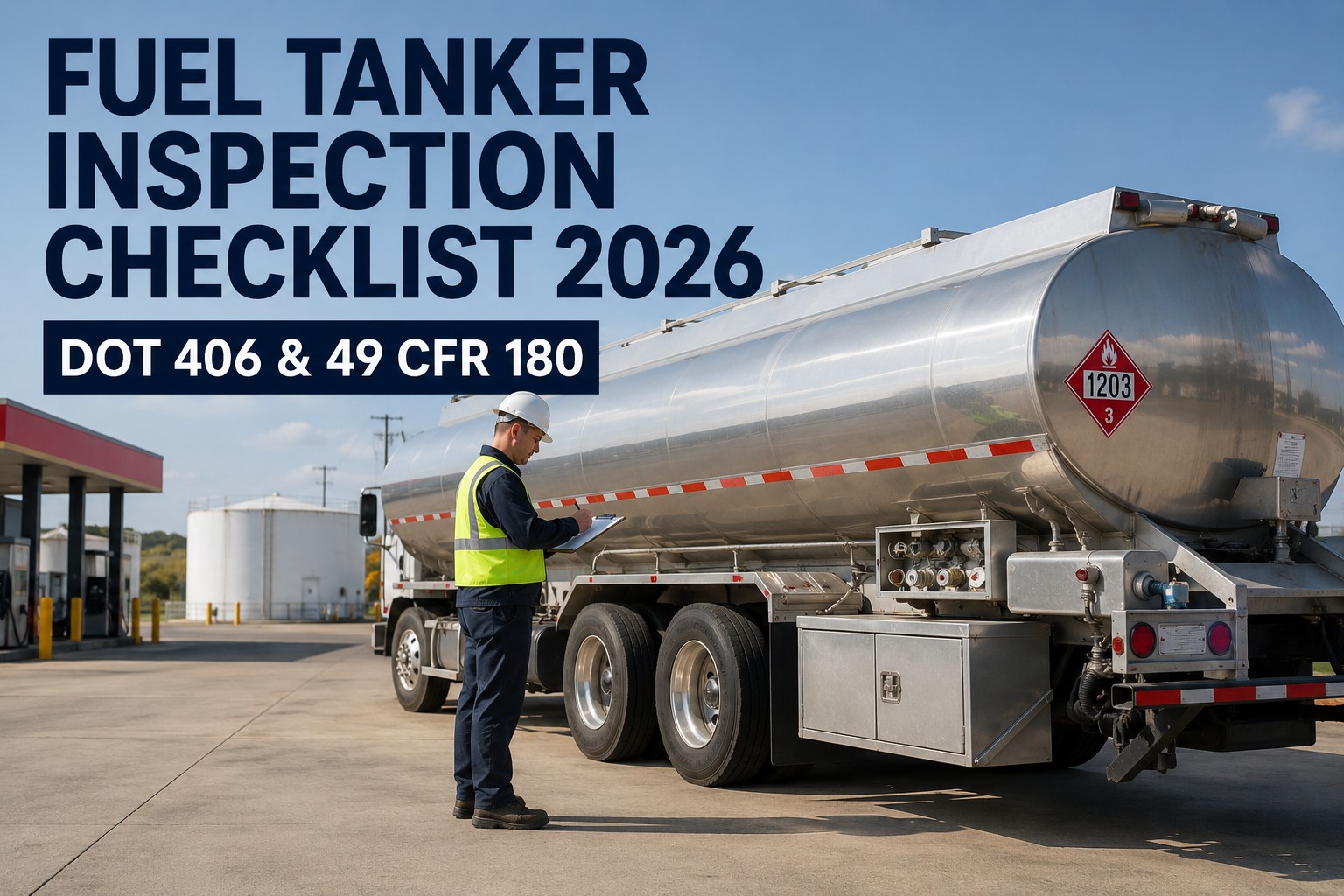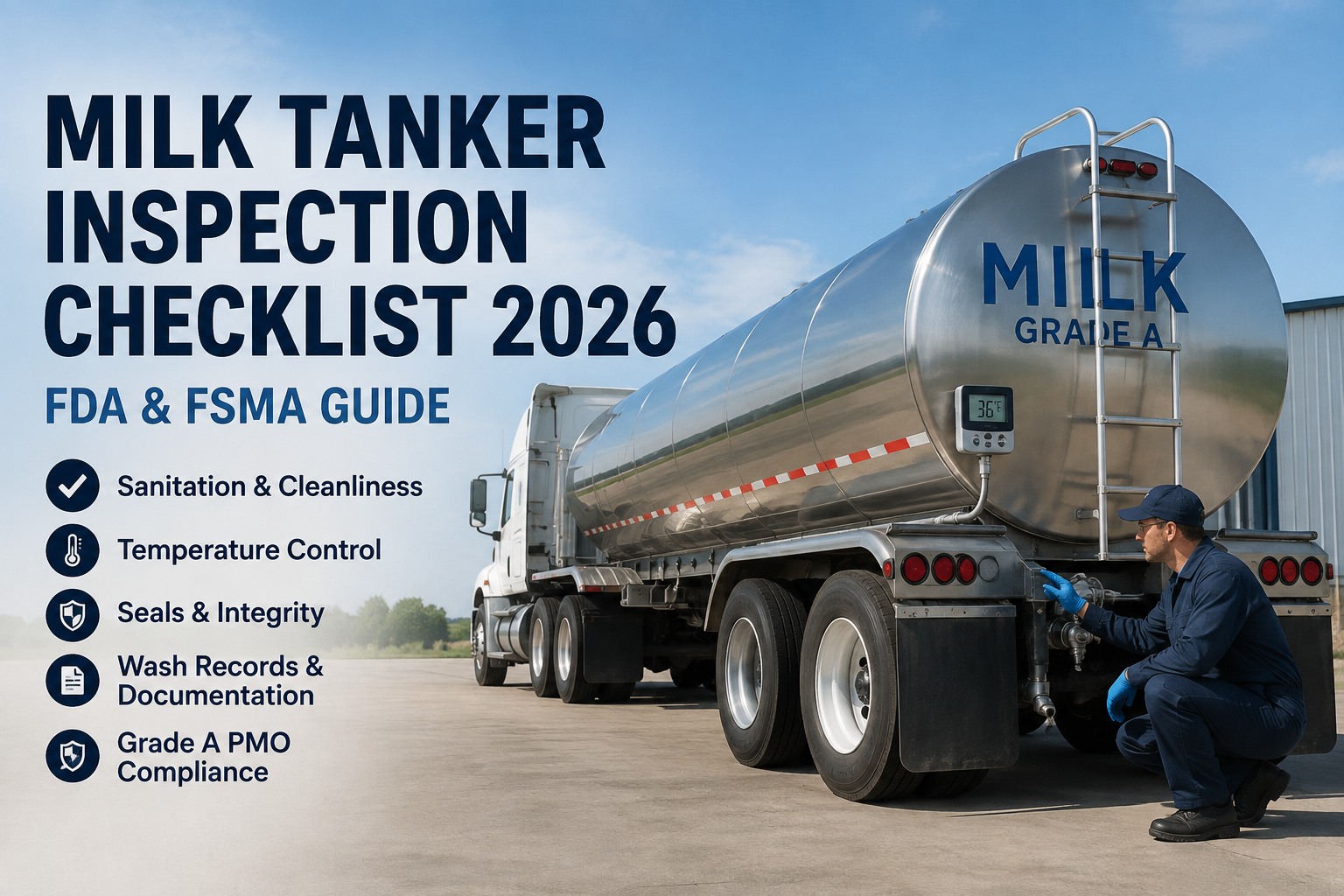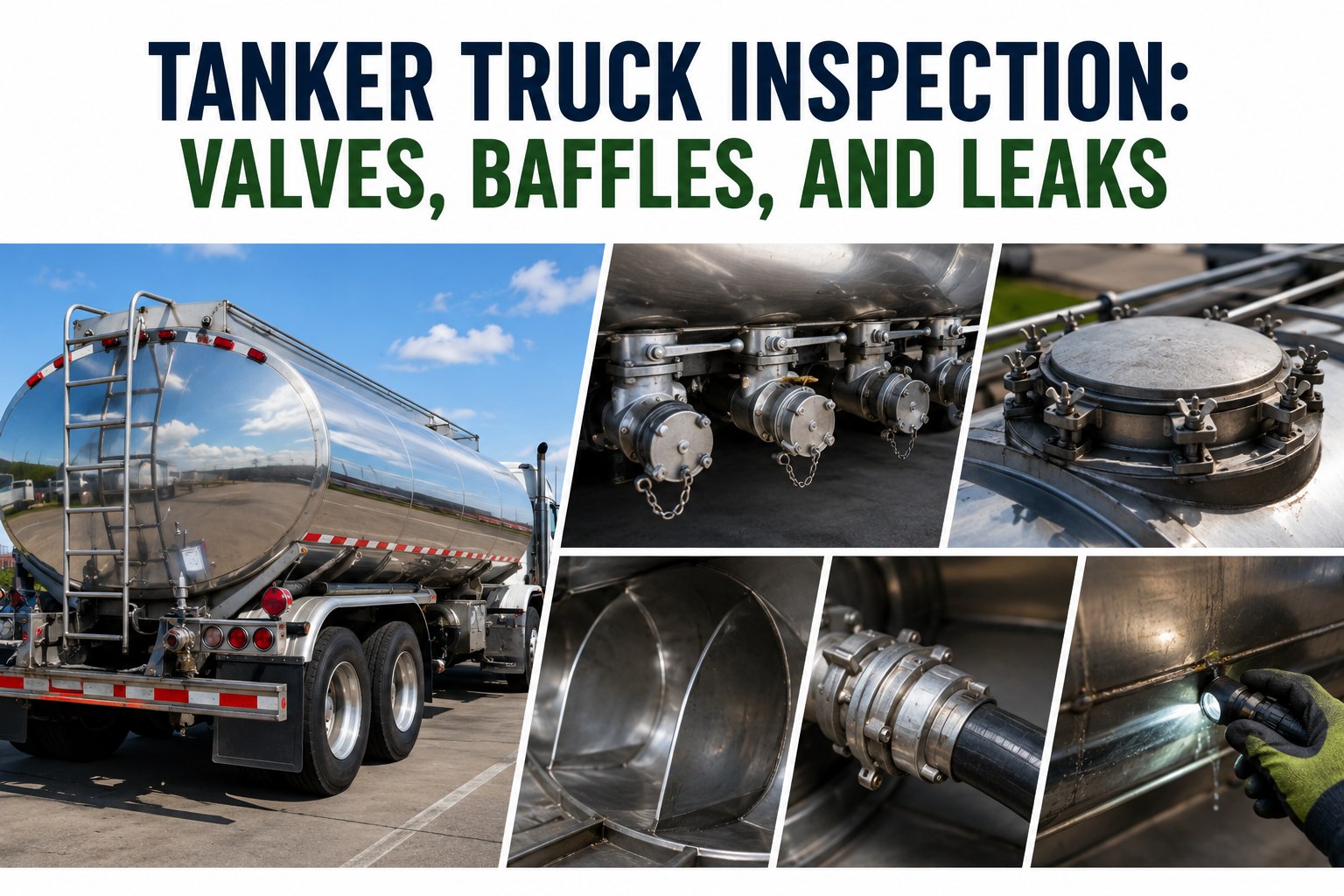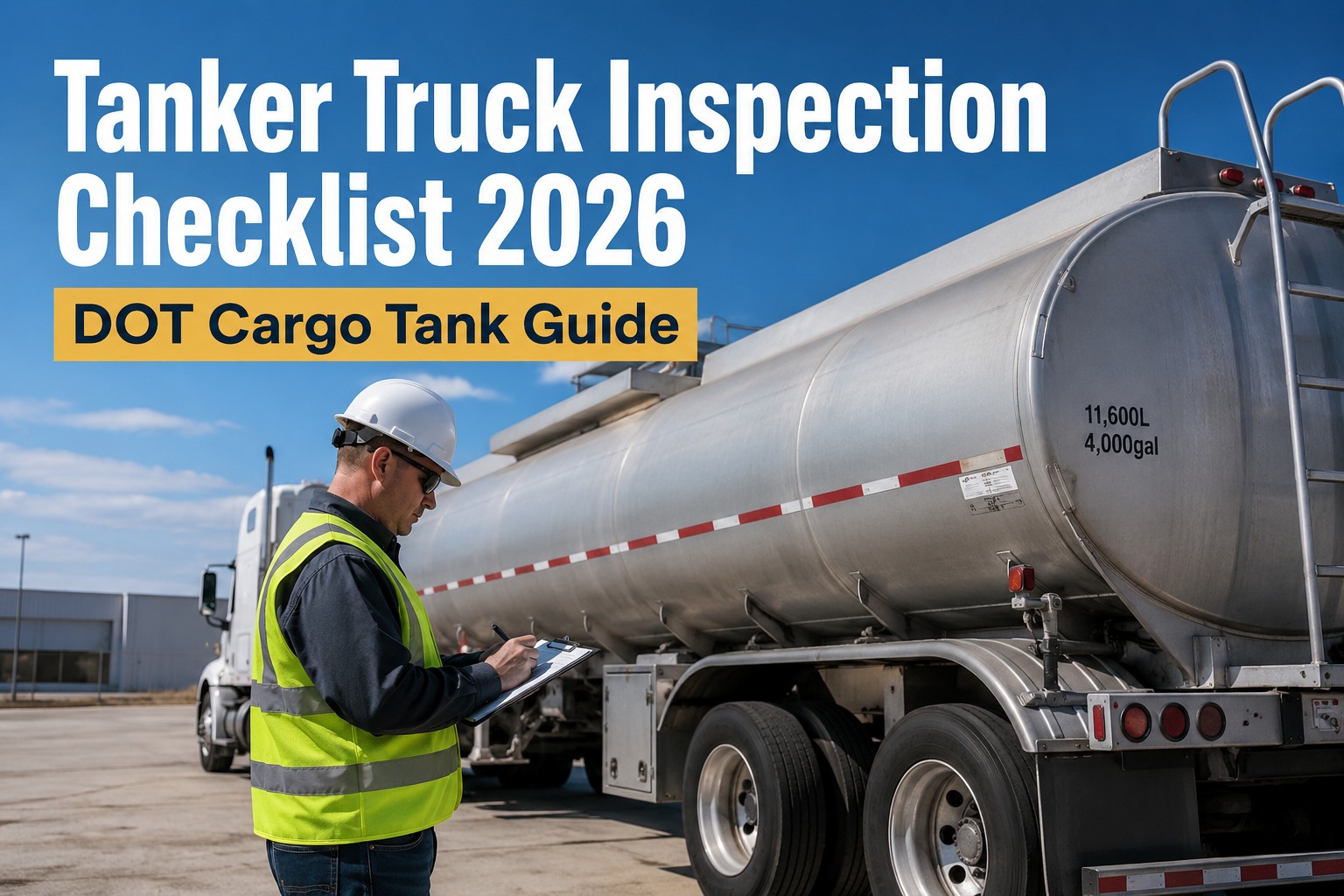
A tanker truck inspection is really six different tests under one federal rule. External visual, internal visual, pressure retest, leakage test, thickness testing, and lining inspection — each with its own interval, its own qualified inspector requirement, and its own marking on the tank. 49 CFR 180.407 defines all of them, and PHMSA enforces them. Miss a due date on any one and the cargo tank cannot legally carry hazmat freight anymore. This guide walks the six tests, the interval matrix per tank spec, and the workflow that keeps every tank current. Book a demo
Six tests, six letters, one certification — the DOT cargo tank inspection rulebook
Every specification cargo tank carries permanent markings for the last completed test of each type. Miss one interval and the certification lapses.
The six-test model is what separates cargo tank inspection from any other DOT compliance discipline. A tractor gets one annual inspection. A cargo tank gets six independent tests on six independent schedules, and every one has to be current for the DOT specification to hold. Which tests apply, and at what interval, depends on the tank specification and the service it operates in — and getting the map right is where fleet compliance either works or doesn't.
The tank specifications you'll actually see — what carries what
Before the interval matrix makes sense, the tank specifications need to. Here are the five specification families that cover almost every commercial cargo tank on the road, with the commodities they typically carry.
The specification is stamped on the tank identification plate at the front head, along with the manufacturer, serial number, MAWP, and design temperature. If you can't read the plate, the whole compliance workflow gets guesswork — and every test decision cascades from that starting point. Photographing and preserving that plate should be the first inspection every fleet does when a tank enters service. Book a demo to see spec-plate data captured and tied to test intervals
The 49 CFR 180.407 test interval matrix — per specification, per test
This is the operational heart of cargo tank compliance. Each specification carries a distinct interval per test type. Miss any interval and the corresponding letter marking on the tank expires; the tank cannot lawfully return to service in that class until the test is redone by a Registered Inspector.
| Specification | External Visual (V) | Internal Visual (I) | Pressure Test (P) | Leakage Test (K) | Thickness (T) |
|---|---|---|---|---|---|
| MC 306 / DOT 406 | 1 year | 5 years | 5 years | 1 year | 2 years |
| MC 307 / DOT 407 | 1 year (6 mo insulated) | 1 year (lined) / 5 years | 5 years | 1 year | 2 years |
| MC 312 / DOT 412 | 6 months | 1 year (lined) | 2 or 5 years | 1 year | 2 years |
| MC 330 / MC 331 | 1 year | 5 years (10 for propane dedicated) | 5 years (10 for propane dedicated) | 1 year | By condition |
| MC 338 (cryogenic) | 1 year | By condition | 5 years | 1 year | N/A |
Two subtleties on the matrix. First: MC 331 in dedicated propane service qualifies for extended 10-year internal and pressure intervals under §180.407(c), verified in 2019 PHMSA interpretation for CVSA. This adds significant fleet economics to propane-dedicated operators but requires strict documentation of dedicated service. Second: uninsulated lined cargo tanks at MAWP 15 psig or less can skip pressure testing entirely if they receive annual external visual and lining inspection — a narrow but useful exemption for specific chemical services. Book a demo to see the 10-year MC 331 dedicated-service documentation workflow
Who can perform each test — the Registered Inspector rules
49 CFR 180.407 draws a hard line between tests that require a Registered Inspector under §180.409 and tests that a qualified employee can perform. Getting this wrong doesn't just invalidate the test — it can also expose the fleet to enforcement action if a subsequent inspection reveals the qualification gap.
External Visual, Internal Visual, and Thickness Testing
Must be performed by a Registered Inspector meeting §180.409 qualifications. That means a person meeting specific training and experience requirements, formally registered with DOT, and certified for the applicable tank specifications.
Pressure Test and Leakage Test
Under §180.407(g)(1)(viii) and (ix), pressure and leakage tests may be performed by a qualified employee who is not a Registered Inspector, provided specific procedural and equipment requirements are met.
The distinction matters practically. A tanker fleet that runs its own maintenance shop can perform pressure and leakage tests in-house with qualified employees at meaningful cost savings versus paying a Registered Inspector for those. But external visual, internal visual, and thickness testing must be scheduled with a Registered Inspector every cycle — there's no in-house shortcut. Cross-referencing the tank's test history against the Registered Inspector's registration record is part of PHMSA's audit process. Book a demo to see Registered Inspector credentials tracked alongside tank test records
Out-of-cycle events — when the calendar doesn't matter
Three events under 49 CFR 180.407 trigger immediate testing regardless of where the tank sits in its normal interval cycle. These are non-negotiable, and missing any one of them puts the tank back into service unlawfully — typically caught during a subsequent audit or roadside incident investigation.
Damage affecting lading retention
Any damage that may adversely affect the tank's ability to hold its lading — from a collision, dropped load, or handling incident — requires immediate pressure testing per §180.407(g) before return to service. Not the next scheduled interval; immediately.
Out of hazmat service for 1+ year
A cargo tank that has been out of hazardous materials transportation service for a year or more must be requalified before returning to hazmat service. The full test regimen — not just the interval that lapsed — may be required.
Repair affecting structural integrity
Any repair affecting the tank's structural integrity requires post-repair testing per §180.413. The suitability of the repair must be determined by the testing specified in the applicable manufacturing specification or §180.407(g)(1)(iv).
The trap here is the "out of service for a year" trigger. Tanks parked seasonally, held in reserve for spot demand, or removed from service for major maintenance can cross the one-year line quietly — and then be returned to hauling hazmat without the full requalification the rule requires. Every fleet running more tanks than active dispatch positions should track parked-tank duration explicitly. Start free and get out-of-service duration tracking on day one
From a Hazmat Fleet Manager running 42 tankers across chemical and petroleum service
We had three specifications in the fleet — DOT 406 for our petroleum haulers, MC 307 for chemical, MC 331 for the propane side. Every tank had different test intervals, and our compliance folder was a stack of Excel sheets. Missed test dates were happening a few times a year, usually caught by a loading terminal that pulled us up on a lapsed K marking. Every lapse meant a truck sitting until we could book a Registered Inspector.
Moving to digital tracking with per-tank test schedules cut the misses to zero over the following 18 months. The Registered Inspector coordination alone saved us maybe 200 hours a year, because we could schedule ahead of due dates instead of scrambling after them. On the propane side, being able to document dedicated service properly let us shift into 10-year internal and pressure intervals — that's real money on 8 tanks. What used to be a compliance risk turned into a cost lever.
Frequently asked questions
What does 49 CFR 180.407 require for cargo tank inspection?
49 CFR 180.407 sets the federal test and inspection requirements for DOT specification cargo tanks used to transport hazardous materials. It defines six distinct test types, each with its own interval, qualified inspector requirement, and permanent marking on the tank per §180.415: External Visual (V) inspection of shell, heads, attachments, piping, and markings; Internal Visual (I) inspection of shell, welds, baffles, and lining requiring manhole access; Pressure Test (P) either hydrostatic or pneumatic at specified pressure to verify vessel structural integrity; Lining Inspection (L) for rubber or specialty linings in corrosive service; Leakage Test (K) using air pressure only — hydrostatic alternative not allowed; and Thickness Test (T) using ultrasonic measurement of shell wall. The intervals vary by tank specification: MC 306/DOT 406 (non-pressure petroleum) requires 1-year V, 5-year I, 5-year P, 1-year K, 2-year T; MC 307/DOT 407 (low-pressure chemical) requires similar frequencies with 6-month external visual on insulated tanks; MC 312/DOT 412 (corrosives) requires 6-month external visual; MC 330/MC 331 (LPG) allows 10-year internal and pressure intervals for dedicated propane service. Every tank must carry permanent markings showing month and year of the last completed test of each type, minimum 32 mm (1.25 inches) high, near the specification plate or on the front head. External and internal visual and thickness testing must be performed by a Registered Inspector meeting §180.409 requirements; pressure and leakage tests may be performed by a qualified employee.
What are the tank specifications (MC 306, DOT 407, MC 331, etc.)?
Cargo tank specifications identify the tank's construction standard, design pressure, and intended service. The five specification families cover almost every commercial cargo tank on the road. MC 306 / DOT 406 are non-pressure atmospheric tanks, typically aluminum construction, non-insulated, compartmented, designed for gasoline, diesel, fuel oil, and most petroleum products. MC 307 / DOT 407 are low-pressure chemical tanks in the 25-40 psi design range, often insulated, steel or stainless construction, used for chemicals, mild acids, milk, food-grade cargo, and general hazmat liquids. MC 312 / DOT 412 are corrosive service tanks, stainless steel or lined carbon steel, with reinforcing rings visible externally, designed for high-density corrosive lading like sulfuric acid, hydrochloric acid, and caustic sodas. MC 330 / MC 331 are high-pressure ASME code stamped pressure vessels for liquefied compressed gases including LPG, propane, anhydrous ammonia, and butane; design pressures typically 100-500+ psi. MC 338 are vacuum-insulated cryogenic tanks with stainless steel inner vessels, designed for very cold service temperatures carrying liquid nitrogen, LNG, liquid oxygen, and liquid hydrogen. The specification is stamped on the tank identification plate at the front head along with manufacturer, serial number, MAWP (maximum allowable working pressure), and design temperature. The specification determines every downstream compliance decision — test intervals, marking requirements, applicable service, pressure relief settings, and requalification triggers — so accurate spec plate documentation is the foundation of the entire tank compliance workflow.
How often does a cargo tank need to be tested?
Cargo tank test intervals depend on the tank specification and the specific test type. For most tanks: External Visual inspection is required annually (every 12 months), with a 6-month interval for insulated MC 307/DOT 407 and MC 312/DOT 412 tanks. Internal Visual is typically every 5 years, with exceptions: MC 331 in dedicated propane service qualifies for a 10-year interval; MC 307 with lining requires 1-year internal visual; MC 312 with lining requires 1-year internal visual. Pressure Testing is generally every 5 years, with the 10-year interval available for MC 331 dedicated propane service, and 2-year intervals for some MC 312 configurations. Leakage Testing is required annually across all specifications; must be performed using air, not liquid (the EPA Method 27 hydrostatic alternative is specifically prohibited for leakage compliance). Thickness Testing is required every 2 years for MC 306/DOT 406 and DOT 407/412 aluminum tanks; MC 330/331 require thickness testing based on condition rather than fixed interval; MC 338 typically not applicable. Beyond the calendar intervals, three events trigger immediate out-of-cycle testing regardless of the normal cycle: damage that may affect lading retention (requires immediate pressure test per §180.407(g)); out of hazmat service for one year or more (requires requalification before return); and any repair affecting structural integrity (requires post-repair testing per §180.413). Missing any interval means the corresponding letter marking on the tank expires, and the tank cannot lawfully return to service in that class until requalified.
Who can perform cargo tank tests?
49 CFR 180.407 draws a distinction between tests requiring a Registered Inspector under §180.409 and tests that a qualified employee can perform. Tests requiring a Registered Inspector: External Visual (V), Internal Visual (I), and Thickness Testing (T) must be performed by a Registered Inspector meeting §180.409 qualifications. A Registered Inspector is a person who meets specific training and experience requirements, is formally registered with the DOT, and is certified for the applicable tank specifications. Additionally, MC 330 and MC 331 hose and piping visual inspection during the leakage test must be performed by a Registered Inspector, per the post-July 2000 amendment. Tests where a qualified employee may perform: Pressure Test (P) and Leakage Test (K) may be performed by a qualified employee who is not a Registered Inspector, provided the procedures in §180.407(g)(1)(viii) and (ix) are followed and equipment and calibration requirements are met. In practice this means tanker fleets that run their own maintenance shops can perform pressure and leakage tests in-house at meaningful cost savings, but must schedule external visual, internal visual, and thickness testing with a Registered Inspector every cycle. Cross-referencing the tank's test history against the Registered Inspector's registration record is part of PHMSA's audit process, so preserving Inspector name, registration number, and inspection date per test event is essential for defensible compliance. Test results must be recorded per §180.417(b) with retention through the next similar test plus one year.
How does HVI help fleets track cargo tank compliance?
HVI ships per-specification cargo tank templates covering MC 306, MC 307, MC 312, MC 330, MC 331, MC 338, and DOT 406, 407, 412 tanks — with the correct 49 CFR 180.407 test intervals pre-built per specification, extended intervals available for MC 331 dedicated propane service, and Registered Inspector assignments per test type. Every tank in the fleet has its six-letter marking status (V, I, P, L, K, T) tracked continuously: last test date, next due date, Registered Inspector on record, and photo evidence of the actual marking on the tank. When a test approaches due, HVI alerts before the certification lapses — typically 30 and 7 days ahead, configurable per fleet. Out-of-service duration is tracked automatically so tanks approaching the 1-year hazmat-service pause trigger get flagged before they cross the line that requires full requalification per §180.407. Every inspection preserves photo evidence, hour meter or mileage, GPS location, and inspector credentials with mechanic sign-off, creating the audit trail PHMSA looks for during compliance reviews. Native integration with Registered Inspector directories keeps scheduling ahead of due dates instead of scrambling after them — the Rachel C. workflow that saved 200 hours per year on a 42-tank fleet. Published customer data shows fleets on HVI report approximately 25% lower annual maintenance cost with typical payback around 3 months, and for tanker fleets, the avoided lapsed-marking scenarios and the ability to unlock the 10-year MC 331 propane extended intervals typically pay back the software within the first year.
Six tests. Six letters. One certification. Lose track of any one and the tank stops being certified.
HVI tracks V, I, P, L, K, and T markings per tank per interval, alerts before certification lapses, and preserves the audit trail PHMSA needs. Pre-built templates for MC 306, 307, 312, 330, 331, 338 and DOT 406, 407, 412. Live in under two weeks.
No credit card · Cargo tank templates ready on day one