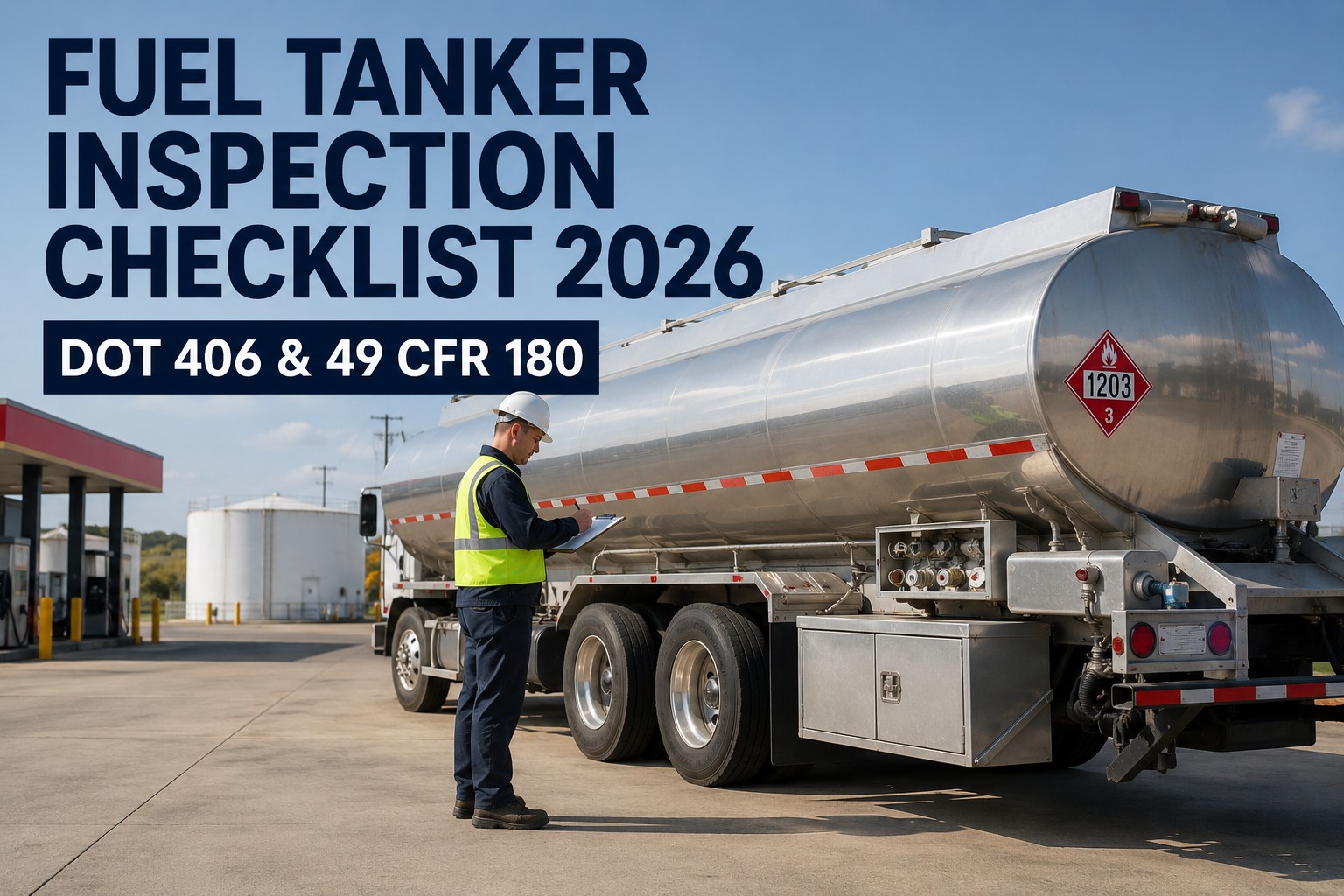
Every DOT 406 petroleum tanker in the fleet runs two clocks at once. The daily clock is the DVIR — brakes, lights, valves, gaskets, seals before every load. The rolling clock is 49 CFR 180.407 — external visual annually, leakage annually, internal visual and pressure test every 5 years. Miss either clock and it costs the same: an OOS at the fuel rack. This fuel tanker inspection checklist covers both clocks and the cycle-tracking discipline every tanker fleet needs. Book a demo
Two inspection clocks run on every tanker. Miss either one and the rack turns you away.
Daily DVIR handles the walkaround. 49 CFR 180.407 handles the cert cycles. On a 30-tanker fleet that's 30 rolling calendars of external, internal, leakage, pressure, and thickness tests running on 1/2/5/10-year cycles — and one missed sticker is a Class III violation at the next scale.
The two clocks — daily walkaround vs rolling cert cycles
Fuel tanker compliance is not one inspection. It's two systems running on different rhythms. Understanding the split is what separates fleets that pass audits from fleets that get surprised by them.
A DVIR fails at pre-trip. A cert cycle miss shows up at a scale-house sticker check, at a terminal rack gate, or during a compliance review audit that goes back 24 months. Both are avoidable with structured tracking. Book a demo to see both clocks tracked in one workflow
The 5 test types — interval, inspector qualification, what they cover
49 CFR 180.407 defines five distinct cargo tank tests. Each has its own interval, its own inspector qualification requirement, and its own consequences when it lapses. The table below is what every fuel-tanker fleet manager should have laminated in the maintenance office.
| Test | Interval | Inspector required | Miss = consequence |
|---|---|---|---|
| External visual (V)Shell, heads, gaskets, valves, appurtenances | 12 months | Registered Inspector | OOS at roadside · sticker check fails |
| Leakage test (K)Hold at test pressure 5 min minimum | 12 months | Registered Inspector or qualified person | OOS · rack refusal at loading |
| Internal visual (I)Interior baffles, bulkheads, welds | 5 years | Registered Inspector | OOS · grounds compliance review flag |
| Pressure test (P)Hydrostatic or pneumatic per 178.346-3 | 5 years | RI oversees; qualified employee may perform | OOS · compliance review flag |
| Thickness test (T)Ultrasonic per 180.407(i) | 2 years (only unlined tanks in corrosive lading; rarely petroleum fuel) | Registered Inspector | OOS · safety-critical for corroded shells |
The chart says one line per test but the calendar work is per tanker times per test. That's what makes fleet-scale cycle tracking a discipline problem, not an inspection problem. Start free and get per-tanker cycle tracking configured this week
DOT 406 vs the older MC 306 — what your spec plate is telling you
The spec plate on the tanker frame tells you exactly which set of rules applies. DOT 406 is the current specification for petroleum fuel tankers (gasoline, diesel, jet fuel). MC 306 is the predecessor spec — still in service on older tankers, still legal to operate, but with slightly different pressure and appurtenance requirements. Confusing the two at inspection time is one of the most common paperwork errors in the audit trail.
Both specs are legal in service, but the paperwork trail must match the spec plate. A 406 tanker with MC 306-labeled inspection records or vice versa is a paperwork violation on top of any physical finding. The digital DVIR should pull the spec directly from the tanker record so this can't be confused at inspection time. Book a demo to see spec-driven inspection templates on 406 and 306 tankers
From a compliance officer running 47 DOT 406 tankers across three terminals
Cycle tracking used to be a spreadsheet on my laptop and a paper folder in each of the three terminal offices. On 47 tankers that meant 188 rolling deadlines. Every quarter I'd catch two or three that were within 30 days of expiring on external visual or leakage, and every year one or two would still slip — sticker expired on the road, driver pulled at a scale, tanker OOS, load couldn't move, and the customer heard about it. The cost of a single OOS event ran anywhere from a $400 fine to $8,000+ in lost delivery revenue and rack fees for the swap-out.
Moving all 188 deadlines into HVI with alerts at 90/60/30 days shifted the whole discipline. Every terminal manager sees the countdown for their tankers, my dashboard sees the fleet-wide picture, and Registered Inspector reports upload directly to the tanker record signed and dated. In the last 14 months: zero expired stickers, zero rack-refusal events at loading, and the FMCSA compliance review last quarter took two days instead of the two weeks it took the previous cycle. Same fleet, same cycles, no more paper.
Frequently asked questions
What does a complete fuel tanker inspection checklist cover?
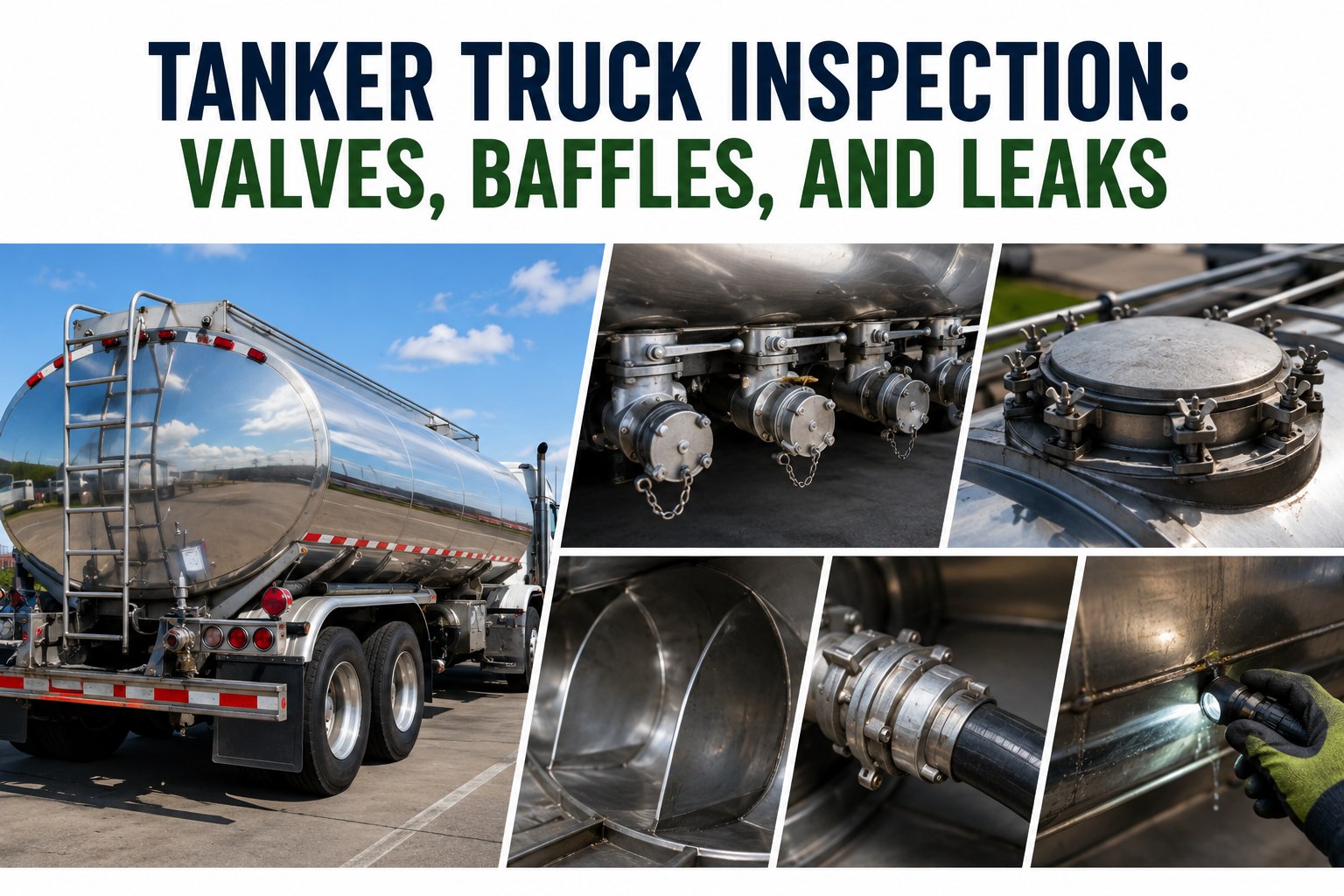
A complete fuel tanker inspection covers two distinct compliance layers. Layer one is the daily DVIR walkaround: standard DOT items (brakes, lights, tires, coupling, driveline) plus tanker-specific items (internal and external emergency valves, vapor recovery couplings, dome covers and manlids, product hoses, discharge fittings, no visible seeps at flanges or manholes), plus sanitary items (manlids sealed, drain caps in place), plus load-specific items (compartment identification correct for product, previous load cleared before product switch), plus documentation verification (current test decals in place, shipping papers per product loaded, hazmat training current per HM 126F requirements). Layer two is the 49 CFR 180.407 cert cycles: external visual inspection annually by a Registered Inspector, leakage test annually, internal visual inspection every 5 years, pressure test every 5 years, and thickness testing every 2 years for unlined tanks in corrosive lading (rare for straight petroleum fuel). The daily DVIR catches the walkaround defects. The cert cycles catch the structural, welded, and functional integrity of the pressure vessel itself. Both must pass every load. A tanker with a valid DVIR but an expired external visual sticker is OOS at the next scale check.
What are the 49 CFR 180.407 inspection intervals for DOT 406 tankers?
DOT 406 petroleum fuel tankers have five distinct test intervals under 49 CFR 180.407. External visual inspection (V) is required every 12 months and covers the shell, heads, gaskets, valves, and appurtenances; a Registered Inspector must perform it. Leakage test (K) is also required every 12 months, holding the tank at its specified test pressure for a minimum of 5 minutes with all valves and accessories in place and operative; performed by a Registered Inspector or a qualified person. Internal visual inspection (I) is required every 5 years, requires the manways to be opened, and examines interior baffles, bulkheads, and welds; Registered Inspector required. Pressure test (P) is required every 5 years, performed as hydrostatic or pneumatic per 178.346-3, and must test all appurtenances; a Registered Inspector oversees but a qualified employee may perform the actual pressure test under specific conditions defined in 180.407(g). Thickness testing (T) is required every 2 years, but only for unlined cargo tanks carrying liquids corrosive to the tank material — this is rarely applicable to straight petroleum fuel service. Additional tests are triggered after damage, after major repairs, or after the tank has been out of service for more than 12 months. Managing these overlapping intervals across a fleet is where cycle tracking software earns its cost multiple times over per year.
What's the difference between DOT 406 and MC 306 tankers?
DOT 406 is the current specification for petroleum fuel cargo tanks, adopted after August 31, 1995. MC 306 is the legacy specification that was in force before that date and remains legal to operate on grandfathered tankers still in service. The two specs are functionally similar — both cover flammable liquids (gasoline, diesel, jet fuel), both use aluminum construction with elliptical cross-section, both operate at low pressure with maximum allowable working pressure in the 2.65-4 psig range, and both use pressure relief valves that open at 3-4.4 psi and reseat at no less than 2.7 psi. The differences show up in specific construction, appurtenance, and testing requirements defined in 49 CFR 178.346 (for DOT 406) versus the legacy MC 306 rules. Older MC 306 tankers can be retrofitted and modified to conform to DOT 406 specifications under 49 CFR 180.405(c). What matters for daily fleet operation: the spec plate on the tanker frame determines which set of inspection and testing rules applies. Test paperwork, inspection reports, and DVIR records must reference the correct spec. Confusion between the two is one of the most common paperwork findings in FMCSA compliance reviews of petroleum tanker fleets. Digital DVIR templates should pull the spec directly from the tanker record so this can't be miskeyed at inspection time.
Who is qualified to perform DOT 406 cargo tank tests?
49 CFR 180.409 governs the qualification of persons performing DOT cargo tank tests and inspections. External and internal visual inspections must be performed by a Registered Inspector — a person registered with DOT under 49 CFR Part 107 Subpart F who meets specific education, training, and experience requirements. Leakage tests may be performed by a Registered Inspector or by a person who has the knowledge and ability to perform the test as required by the subchapter; the person doesn't have to formally register but must be competent to perform and sign off. Pressure retests may use a Registered Inspector for oversight while allowing a qualified employee of the motor carrier or cargo tank owner to perform the actual hydrostatic or pneumatic test, provided the employee is trained and the qualifications are documented per 180.409(d). Thickness testing must be performed by a Registered Inspector using calibrated ultrasonic equipment. Test reports must be signed by the qualified person who performed the work and must be retained on file at the motor carrier or cargo tank facility. The reports are the primary evidence in a compliance review that the required tests were actually performed by qualified personnel; missing or incomplete signatures on test reports are one of the top findings when FMCSA auditors dig into cargo tank fleets.
How does HVI track fuel tanker inspection cycles for multi-tanker fleets?
HVI's cargo tank module handles both compliance clocks on the same platform. Daily DVIR runs in the mobile app with a tanker-specific template covering the standard DOT items plus the fuel-tanker-specific items (emergency valves, vapor recovery couplings, dome covers, product hoses, no-seep verification at flanges, current sticker check, HM 126F training current for the driver). The 49 CFR 180.407 cycle tracker runs per tanker with the five test types (external visual, leakage, internal visual, pressure, thickness) each on their own calendar with the correct interval pre-loaded per DOT 406 or MC 306 spec. Automatic alerts fire at 90/60/30 days before each cycle deadline, routed to the fleet manager, terminal manager, and maintenance scheduler. Registered Inspector reports upload directly to the tanker record signed and dated, with photo verification of the completed test where visual evidence is applicable (sticker application, gasket replacement, weld repair). Compliance-review-ready evidence packs export per tanker or per fleet covering trailing 24 months at any time. For compliance officers like Roger T. running 47 DOT 406 tankers across three terminals, the typical result is zero expired stickers, zero rack-refusal events at loading, and FMCSA compliance reviews closed in days rather than weeks. Book a demo to see the DOT 406 cycle tracker running live.
Two clocks, one dashboard. Every tanker cycle tracked, every sticker current, every audit ready.
HVI runs daily DVIR and 49 CFR 180.407 cycle tracking on the same platform. Alerts at 90/60/30 days on every deadline. Registered Inspector records signed and archived. Compliance review evidence packs export in one click. Live in under two weeks; typical result is zero expired stickers and clean audits.