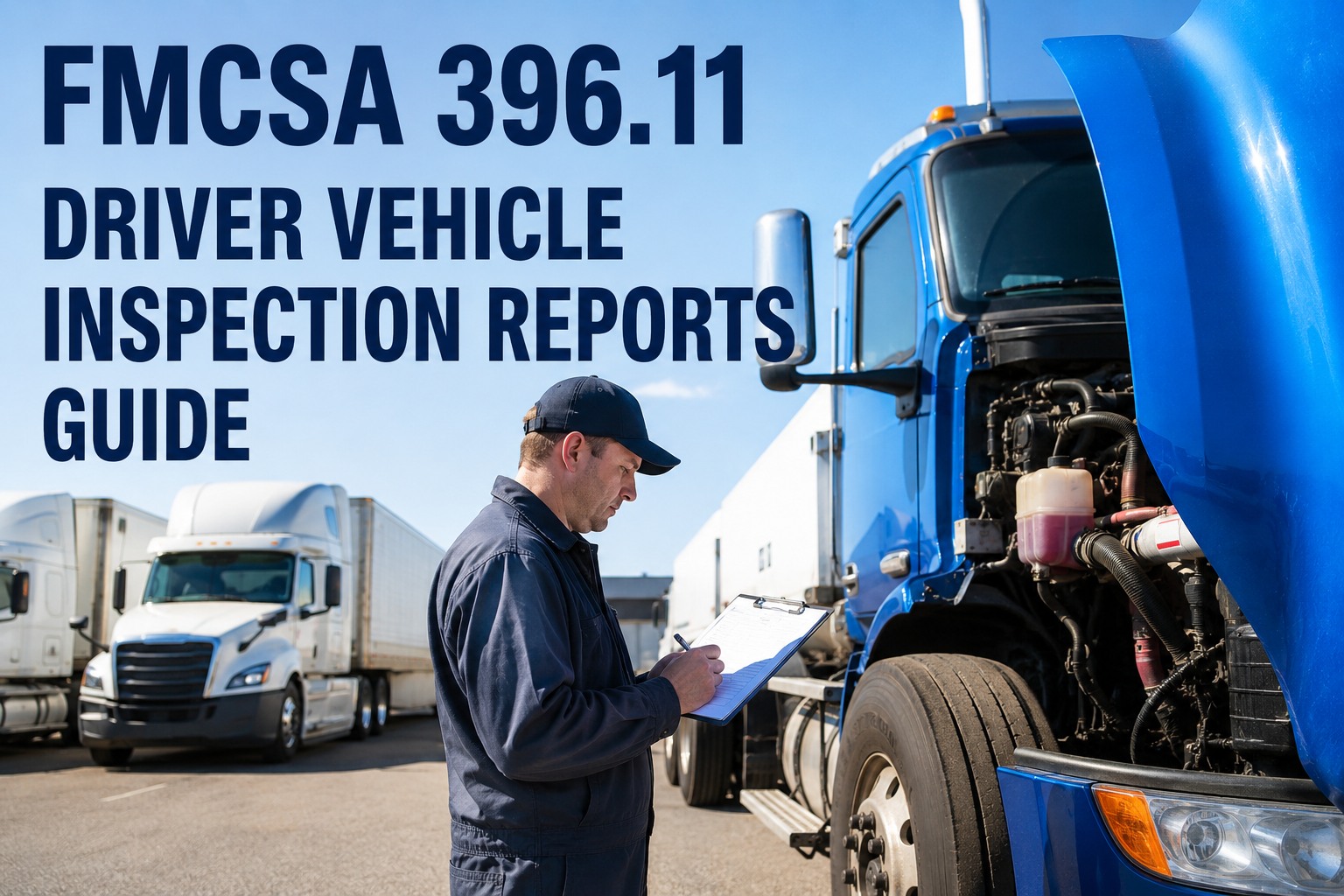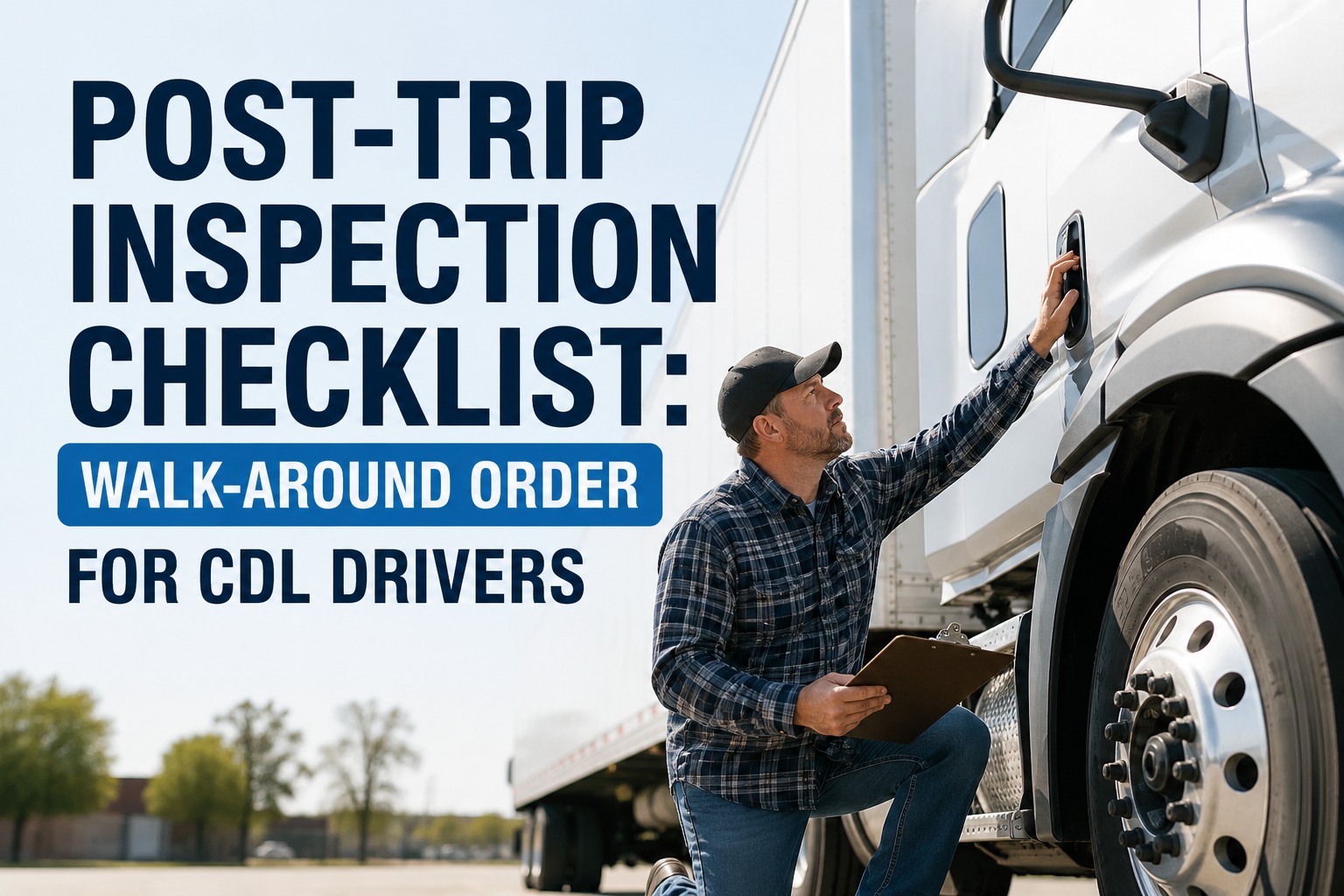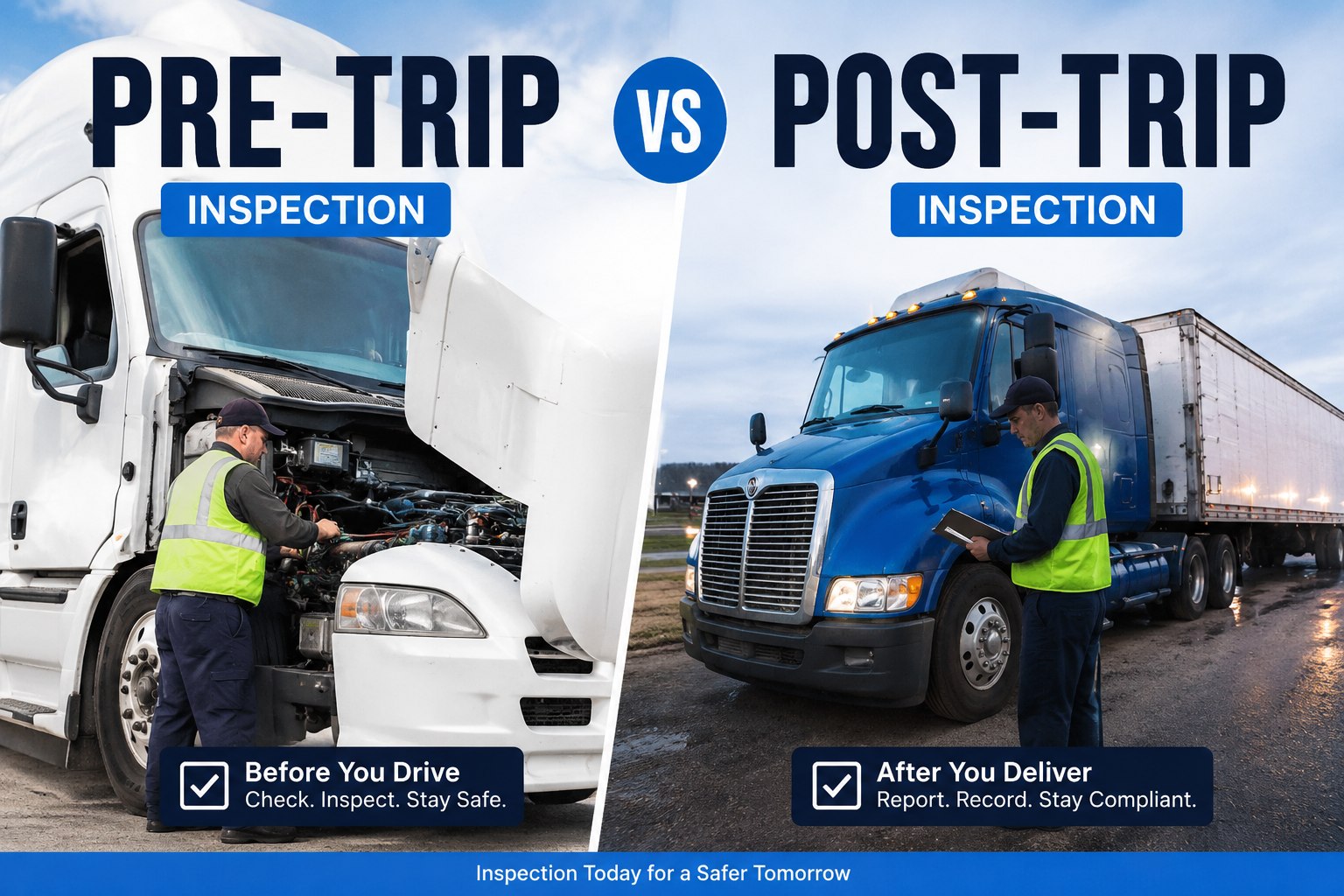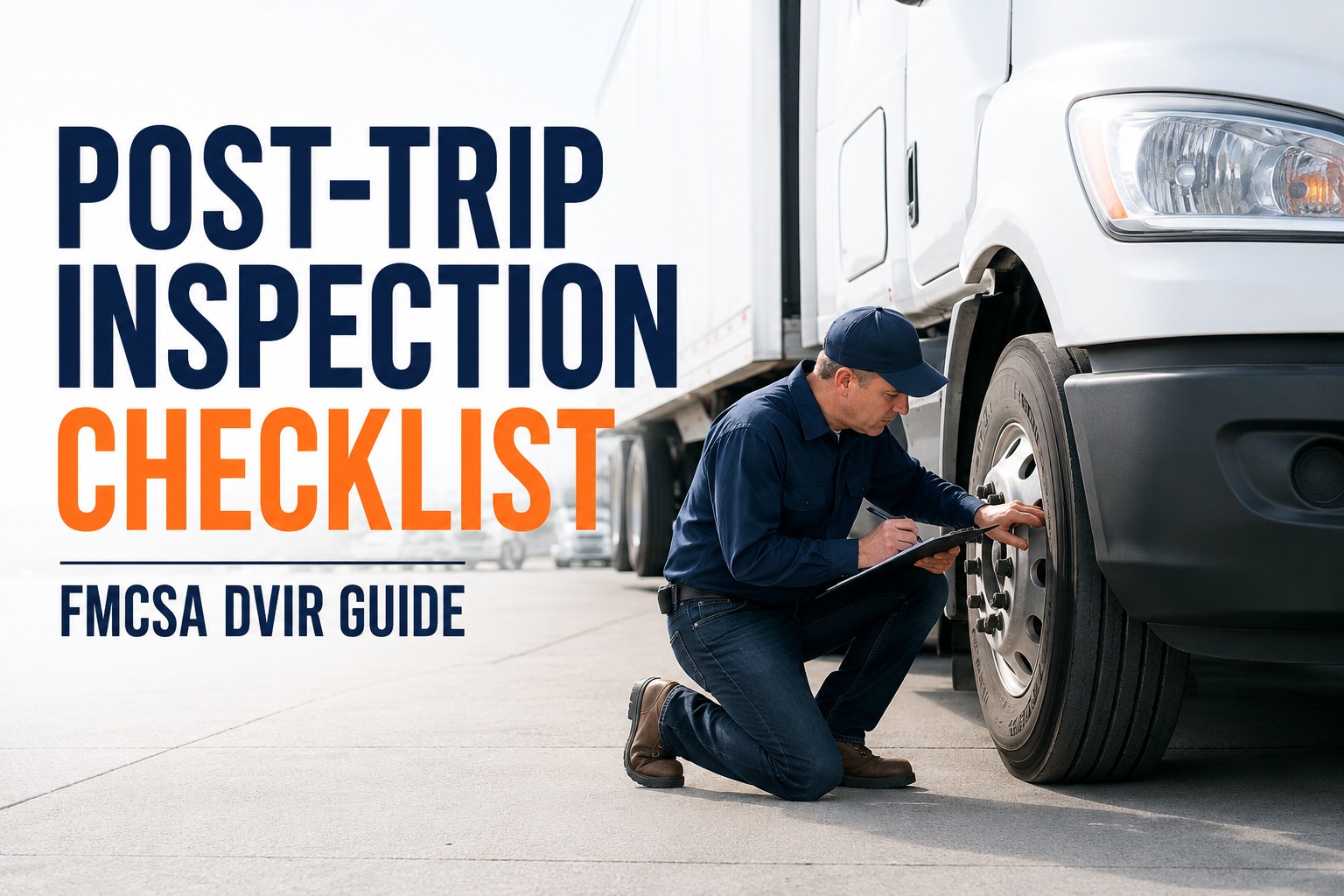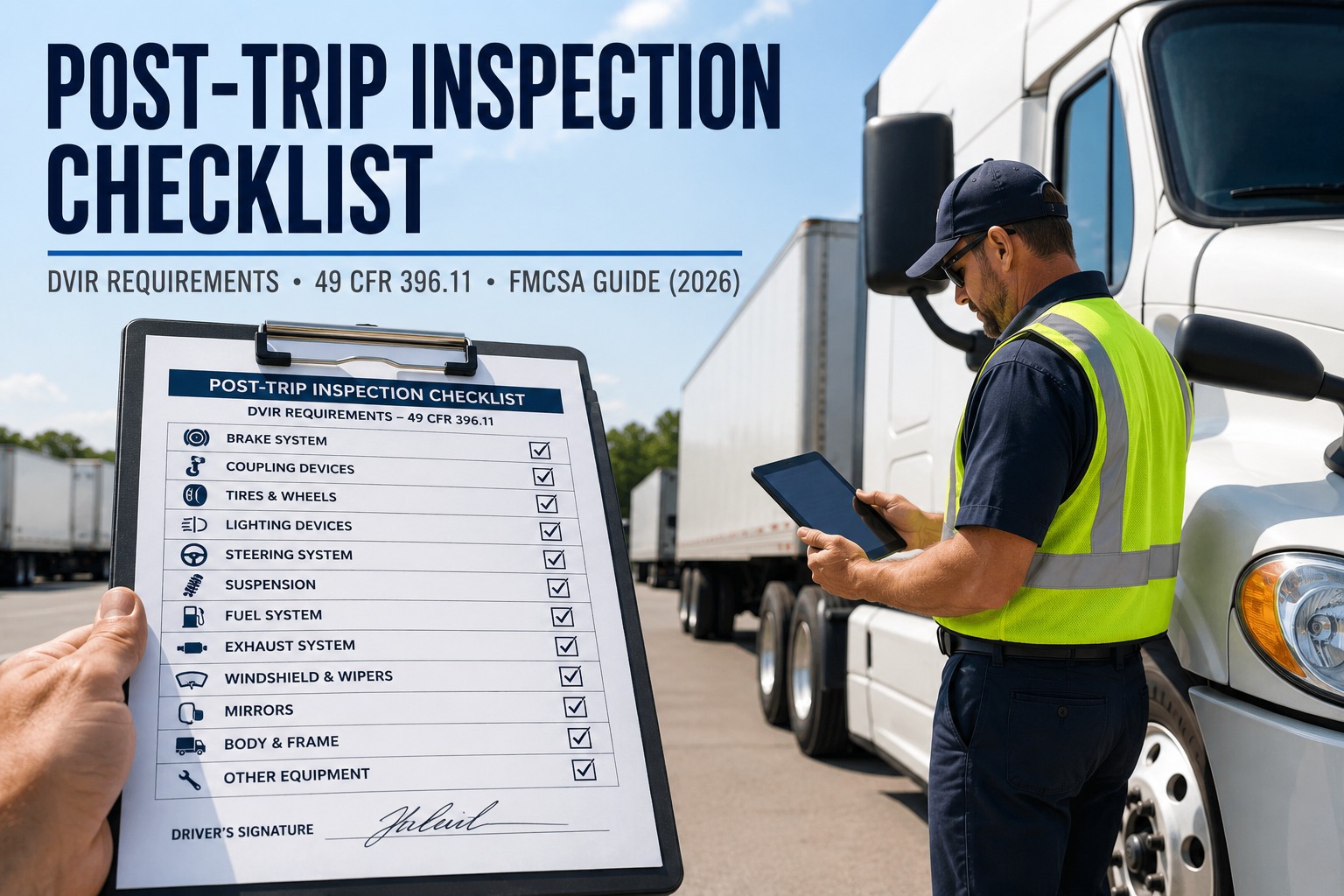
It's the end of a long shift. The truck made it back, the driver's tired, and the walkaround gets a quick glance and a signature. That habit is exactly what FMCSA auditors go looking for — because the post-trip inspection produces the one document cited in nearly nine out of ten compliance reviews: the DVIR. This is the complete post-trip inspection checklist under 49 CFR 396.11 — the 11 components every report must cover, the signature chain that trips fleets up, how long to keep records and the 2026 rule that made electronic DVIRs official. Book a 30-minute walkthrough to see the whole chain run digitally.
The Post-Trip Inspection & DVIR Checklist
Every component a Driver Vehicle Inspection Report must cover under FMCSA 49 CFR 396.11, the three-signature chain of custody most fleets break, and the 2026 rule that made electronic DVIRs official.
-
11
minimum components every DVIR must cover under 49 CFR 396.11
49 CFR 396.11(a) -
90 days
minimum retention for the DVIR, repair cert, and driver acknowledgment
49 CFR 396.11(a)(4) -
~14,000
accidents a year FMCSA estimates DVIRs prevent through early defect discovery
FMCSA estimate -
$15,420
penalty for dispatching a vehicle with an unrepaired safety defect
FMCSA penalty schedule
Post-trip inspection vs. DVIR: the distinction that matters
Here's the nuance most training skips, and it matters during an audit. FMCSA doesn't technically mandate a formal "post-trip inspection" the way it mandates the pre-trip. What 49 CFR 396.11 actually requires is the DVIR — a written report of defects discovered during the day's work. The post-trip inspection is simply how a driver finds those defects. In practice you do both: walk the truck at end of shift, then document what you found. And since 2014, a property-carrying CMV needs no DVIR on a day with zero defects — though nearly every compliance expert recommends filing a "no-defect" report anyway, because it builds a positive record that speaks for itself in an audit. See how HVI logs every inspection, defect or not
The 11 components every DVIR must cover
Section 396.11 lists the minimum parts and accessories the report must address — the same 11 items harmonized with the pre-trip list under 392.7. A defect in any one that affects safe operation or could cause a breakdown has to be documented.
- 1Service brakesincluding trailer brake connections
- 2Parking brake
- 3Steering mechanism
- 4Lighting devices & reflectors
- 5Tires
- 6Horn
- 7Windshield wipers
- 8Rear-vision mirrors
- 9Coupling devices
- 10Wheels & rims
- 11Emergency equipment
Many fleets add company-specific items on top — fluid levels, body damage, load securement, cargo-area condition — which is fine as long as all 11 federal items are always covered. Load the full 396.11 checklist onto every driver's phone
The DVIR chain of custody, explained
This is where fleets actually get cited. A DVIR isn't a single signature — it's a chain that can require up to three, and breaking any link is its own violation for both driver and carrier. Here's the full lifecycle of a reported defect.
-
1
Driver finds & signs
At the end of the day, the driver documents any defect — description, severity, evidence — and signs the DVIR. This starts the chain.
-
2
Carrier repairs & certifies
The carrier repairs any defect affecting safe operation and certifies on the original DVIR that it was fixed — or that repair wasn't needed.
-
3
Next driver acknowledges
Under 396.13, the next driver reviews the prior DVIR and signs to confirm repairs were made before operating. The most-missed signature.
That third acknowledgment is the single most commonly broken link — and the vehicle legally can't be dispatched until defects affecting safe operation are repaired and certified on the original report. Miss the signature and you've got a clean truck with a dirty record. Book a demo to see the chain enforced automatically
The rules that trip fleets up
Most DVIR violations aren't drivers skipping inspections — they're system gaps. These four catch fleets most often during audits.
-
One DVIR per vehicle
Operate more than one vehicle in a day — relay runs, yard moves — and each vehicle needs its own separate DVIR. A common relay-operation miss.
-
All three signatures retained
Keeping only the driver's original report isn't enough. The repair certification and next-driver acknowledgment must be retained too, or the record is incomplete.
-
Repair before dispatch
A vehicle can't be dispatched until defects affecting safe operation are repaired and certified. Dispatching anyway is the most expensive DVIR violation.
-
Records producible in 48 hours
Offsite audits now routinely arrive with 48-hour notice to produce records. Paper DVIRs lost in a filing cabinet are automatic violations.
What a broken DVIR chain costs
The penalties aren't abstract. Break a link and the fines escalate fast — which is why the documentation, not the wrench, is usually what fails an audit.
- Failure to file a required DVIR ~$1,270 / day
- Falsifying a DVIR up to $12,700
- Dispatching with an unrepaired safety defect up to $15,420
Set against those numbers, the honest problem is quality: industry data shows about 95% of all DVIRs report no defects — a rate that raises real questions about how carefully those post-trips are actually done. A guided digital checklist is the cheapest way to make each inspection real and provable. Start free and make every post-trip count
Paper DVIR vs. digital DVIR
The inspection is the same either way. What differs is whether the chain stays intact, and whether you can produce 90 days of records when an auditor calls.
Paper DVIR
- Signatures collected by hand — and easily missed
- Defect handoff relies on a phone call or a note
- No photo evidence of the defect or the repair
- Reports lost in a cab or filing cabinet
- Scrambling to produce 90 days in a 48-hour window
Digital DVIR with HVI
- All three signatures captured digitally with timestamps
- Defects auto-route to maintenance the moment they're logged
- Photo and GPS proof on every defect and repair
- Cloud-stored — never lost, retained as long as you like
- Any DVIR produced in seconds, well inside 48 hours
The 2026 rule made this an easy call: on February 19, 2026, FMCSA published a final rule (effective March 23, 2026) explicitly authorizing electronic DVIRs under 49 CFR 396.11 and 396.13 — digital signatures, mobile submission, and cloud storage are now unambiguously compliant, and FMCSA actively encourages the switch. Book a demo and move your DVIRs digital
Expert view
Our drivers were always doing the post-trip. What we kept getting dinged on was the paperwork behind it — a defect written up, the truck fixed, but the next driver never signed off that he'd reviewed it. On paper, nobody notices until an auditor does.
Going digital fixed the handoff for us. The second a defect is logged it routes to the shop, and the next driver literally can't start his day until he acknowledges the repair. The chain closes itself now, and our last review had zero DVIR findings.
— Jenna L., Fleet Safety Manager, LTL carrier
Frequently asked questions
What is a post-trip inspection and is it legally required?
A post-trip inspection is the end-of-day check a driver performs to find any defects that developed during the day's operation. The subtle point is that 49 CFR 396.11 doesn't technically mandate a formal post-trip inspection the way pre-trip rules do — it mandates the DVIR, the written report of defects discovered during the day. The post-trip inspection is how those defects get found. In practice drivers do both: inspect the vehicle at end of shift, then document any defects on the DVIR. For property-carrying CMVs, a report isn't required on a day with no defects, but most carriers file a "no-defect" DVIR daily anyway as company policy to build a clean compliance record.
What must a DVIR include under 49 CFR 396.11?
A DVIR must cover 11 minimum components: service brakes (including trailer brake connections), parking brake, steering mechanism, lighting devices and reflectors, tires, horn, windshield wipers, rear-vision mirrors, coupling devices, wheels and rims, and emergency equipment. These are harmonized with the pre-trip inspection list under 392.7. The report must list any defect or deficiency that would affect the safe operation of the vehicle or result in a mechanical breakdown, and it must include the driver's signature and the date. If the driver operates more than one vehicle during the day, a separate DVIR is required for each vehicle.
Who has to sign a DVIR?
A DVIR can require up to three signatures, forming a chain of custody. First, the driver who discovers a defect signs the original report. Second, the mechanic or carrier official certifies on that same report that the defect was repaired — or that repair was unnecessary. Third, under 49 CFR 396.13, the next driver reviews the report and signs to acknowledge the repair status before operating the vehicle. That third acknowledgment is the most commonly missed signature and a frequent audit citation. Breaking any link in the chain is a separate violation for both the driver and the carrier.
How long must DVIRs be kept?
The motor carrier must retain the original DVIR, the certification of repairs, and the certification of the driver's review for a minimum of three months (90 days) from the date the report was prepared, under 49 CFR 396.11(a)(4). All three documents must be kept — retaining only the driver's original report without the repair certification and next-driver acknowledgment creates an incomplete record that auditors cite. Because offsite audits now routinely request records with 48-hour notice, best practice is to keep DVIRs well beyond 90 days. Digital storage makes extended retention effectively free and gives far stronger audit and litigation defense.
Are electronic DVIRs legal in 2026?
Yes, fully. Electronic DVIRs were already permitted under 49 CFR 390.32 since 2018, and on February 19, 2026, FMCSA published a final rule (Docket FMCSA-2025-0115, effective March 23, 2026) that explicitly added electronic DVIR authorization to 49 CFR 396.11 and 396.13, removing any remaining ambiguity. Digital signatures, mobile submission, and cloud storage are all fully compliant, and all three chain-of-custody signatures can be captured electronically with timestamps. FMCSA actively encourages the transition to electronic methods, and the rule was supported by the American Trucking Associations, OOIDA, and NTTC.
Put a compliant DVIR on every driver's phone
HVI runs the full post-trip DVIR lifecycle as a guided digital workflow — all 11 components with photo capture, instant defect routing, mechanic repair certification, next-driver acknowledgment, and cloud-stored records producible in seconds. The complete chain of custody, enforced so no link is ever missed.
No credit card · No hardware · Live on your fleet in under two weeks