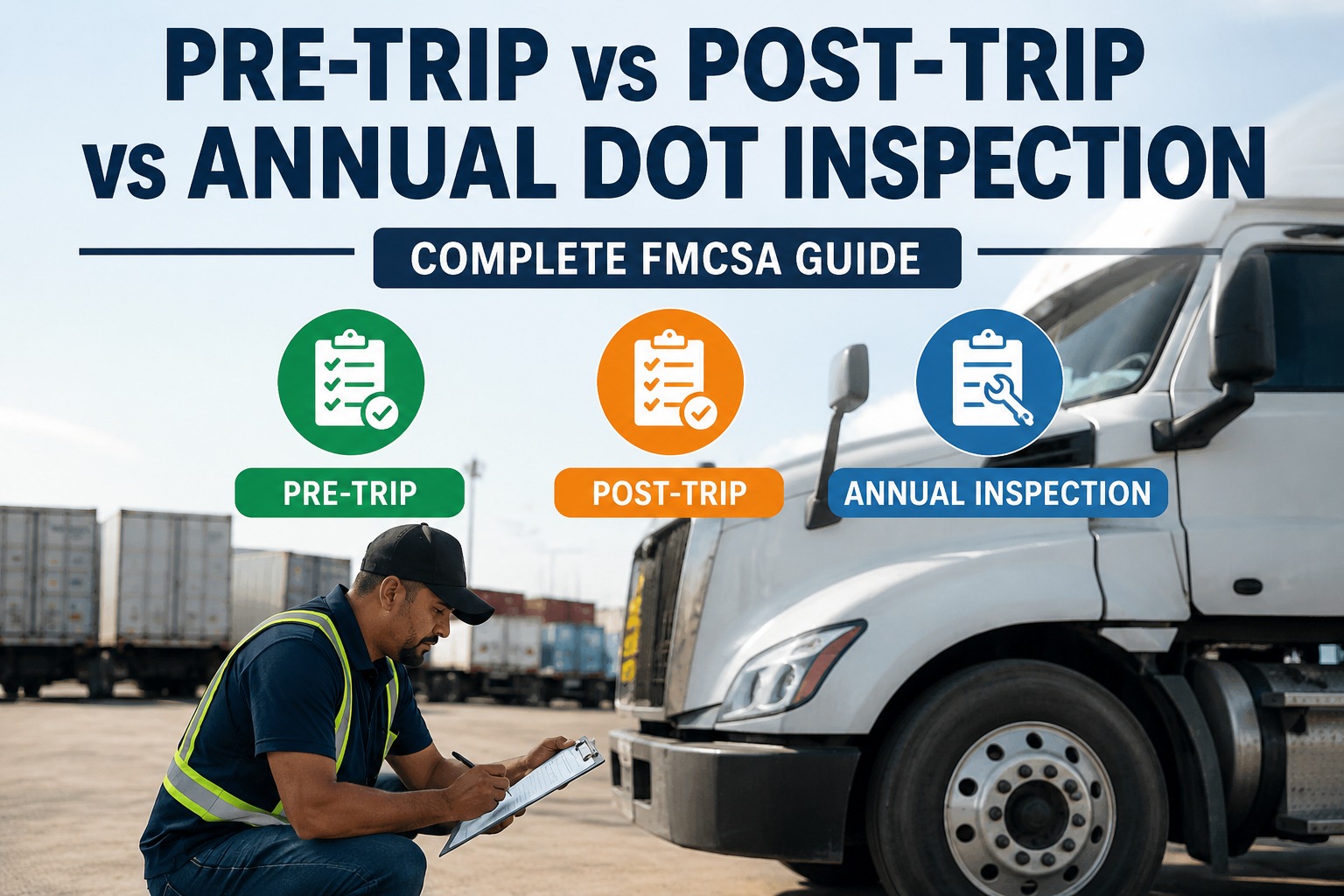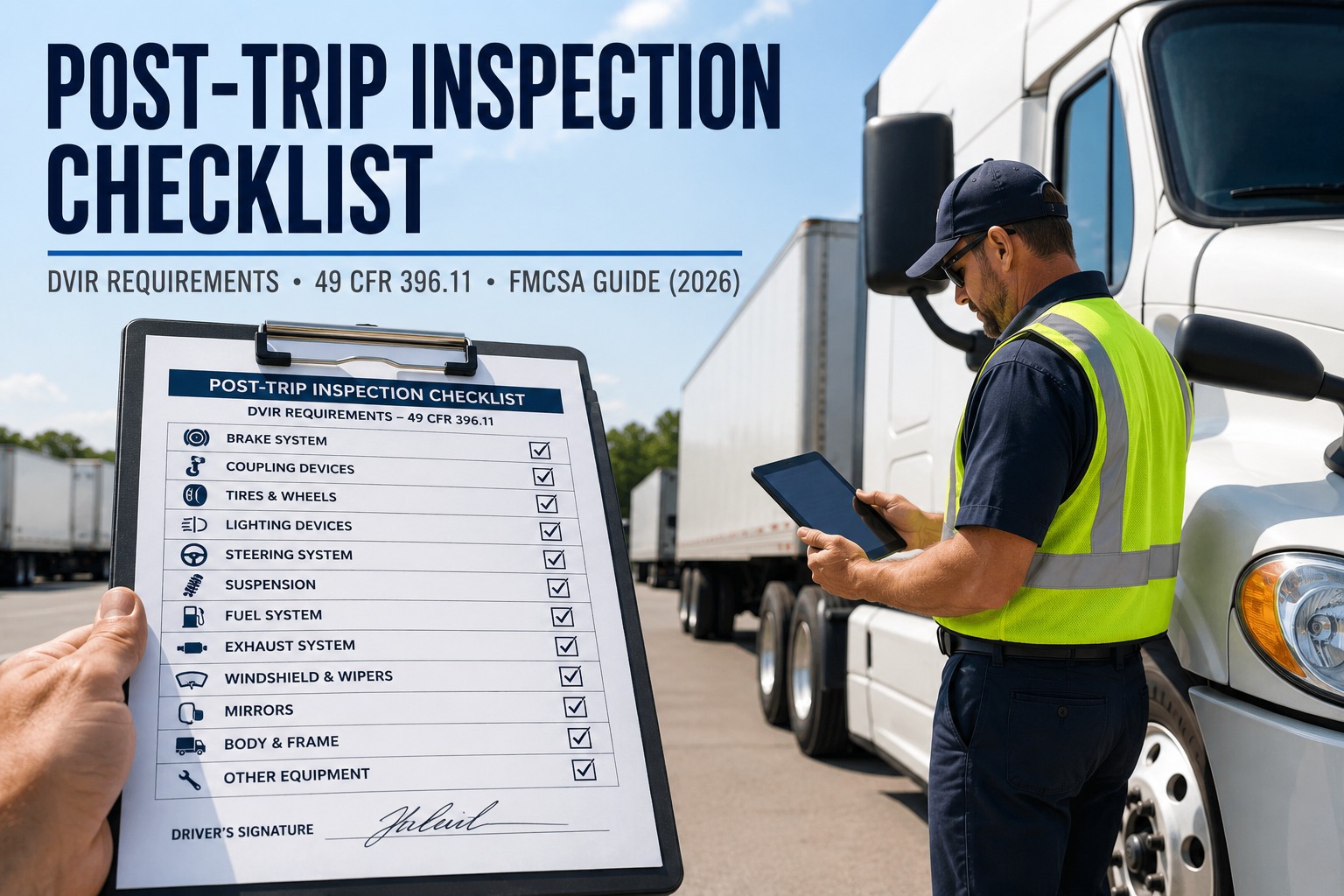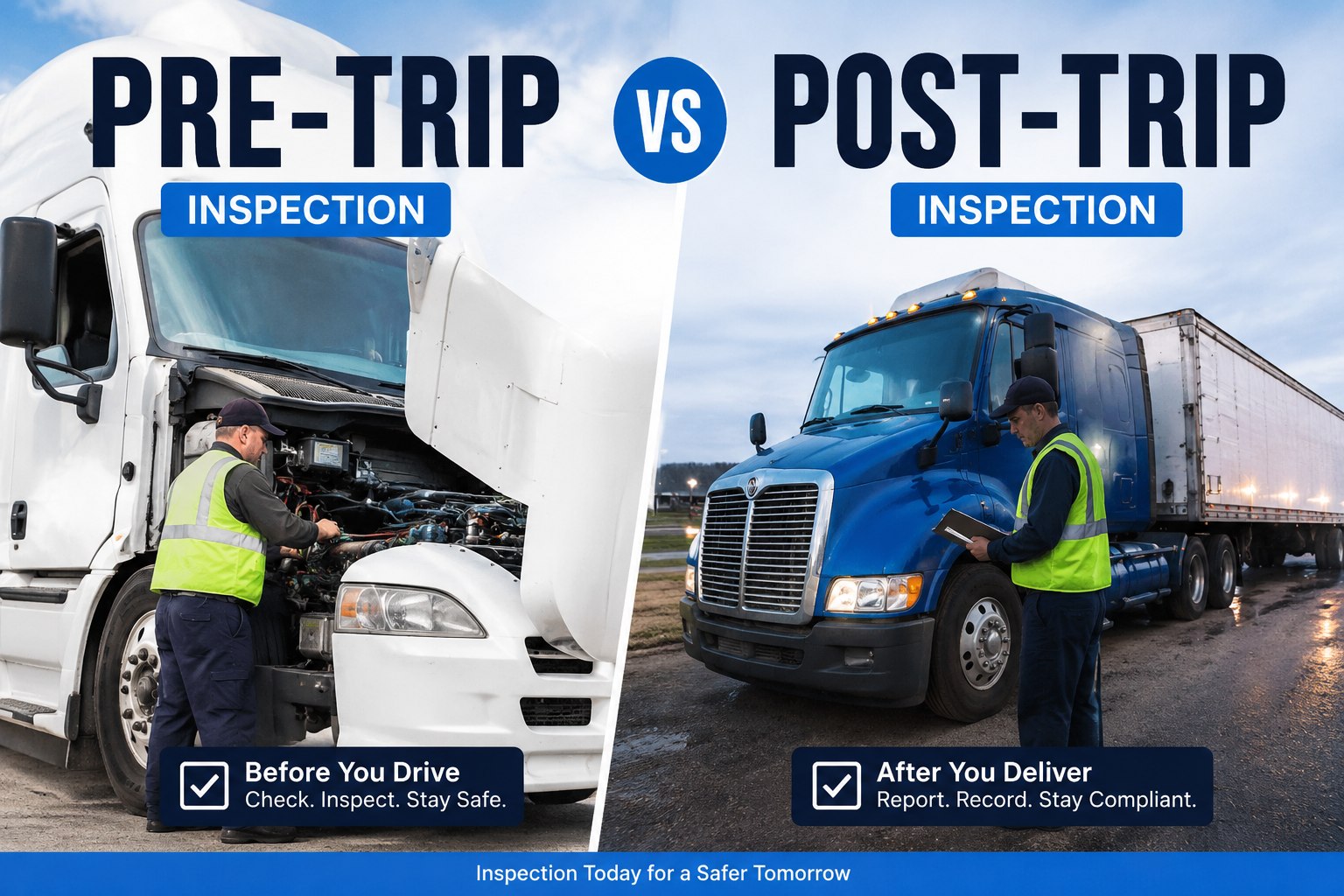
Pre trip vs post trip inspection is one of the most confused topics in CDL training — and one of the most consequential for FMCSA compliance. The pre-trip under 49 CFR §392.7 is a physical safety check before driving with no written report required. The post-trip DVIR under 49 CFR §396.11 is a written report at end of day for defects found. Same 11 components, different legal purposes. Book an HVI demo to digitize both.
Two inspections. Two regulations. Two very different legal exposures.
The pre-trip and post-trip cover the same 11 vehicle components — but the regulatory framework, documentation, and enforcement mechanisms are completely different.
The regulatory text — what each rule actually says
The confusion around pre-trip vs post-trip inspection starts with the fact that both regulations reference the same 11 vehicle components but impose completely different obligations on drivers and carriers. Reading the actual regulatory text removes the ambiguity.
"No commercial motor vehicle shall be driven unless the driver is satisfied that the following parts and accessories are in good working order — including service brakes, parking brake, steering, lighting, tires, horn, wipers, mirrors, coupling devices, wheels and rims, and emergency equipment."
The regulation requires the driver to be "satisfied" — a subjective safety standard. There is no federal requirement to document the pre-trip in writing. Enforcement happens through CDL road tests and roadside inspection findings, not through a written pre-trip report.
"Every motor carrier shall require its drivers to report, and every driver shall prepare a report in writing at the completion of each day's work on each vehicle operated. The report shall list any defect or deficiency discovered by or reported to the driver which would affect the safety of operation of the vehicle or result in its mechanical breakdown."
The regulation requires a written report of defects found — not a formal "post-trip inspection" as a distinct procedure. Since the 2014 rulemaking, property-carrying CMV drivers only file DVIRs when defects are found; passenger-carrying CMVs file every day regardless.
Both regulations were harmonized in the 2014 FMCSA rulemaking to reference the same 11 vehicle components. What changed is enforcement pathway: pre-trip failures show up as roadside violations; post-trip DVIR failures show up as DOT audit findings and CSA score deteriorations. Book an HVI demo to see both inspection workflows enforced digitally
The 5 most common pre-trip vs post-trip confusions
Fleet safety training routinely gets tripped up on the same five points of confusion between pre-trip and post-trip requirements. Every one shows up in audit findings and CSA violation patterns.
False. Under §392.7 the driver must be satisfied the vehicle is safe — but no written pre-trip form is federally required. The pre-trip is a physical inspection; the written report is the post-trip DVIR under §396.11. Confusion arises because many carriers require internal pre-trip paperwork as company policy, which is legal but not federal law.
Partially true. Under §396.11, property-carrying CMV drivers only file a DVIR when defects are found (since the 2014 rulemaking). Passenger-carrying CMV drivers file every day regardless. Most safety-conscious property carriers still require daily DVIRs including "no-defect" reports as company policy for audit-trail protection.
False. Both cover the same 11 minimum components under FMCSA's 2014 harmonization: service brakes (including trailer connections), parking brake, steering, lighting and reflectors, tires, horn, windshield wipers, rear-vision mirrors, coupling devices, wheels and rims, and emergency equipment. The scope is identical; the purpose differs.
Not exactly. FMCSA does not technically require a formal "post-trip inspection" as a separate procedure. What §396.11 requires is the DVIR — the written report of defects found. Most drivers do walk the vehicle at end of shift to identify defects, but the legal requirement is the written report, not the physical walkaround itself.
False. §396.13 requires the incoming driver to review the most recent DVIR and sign to acknowledge repairs before operating — this happens at the start of the next shift, not at the end of the previous one. It's part of the pre-trip workflow, closing the 3-signature accountability chain that began with the previous shift's post-trip DVIR.
Understanding the five confusions is what separates fleet safety programs that pass DOT audits from programs that get cited for the same violations year after year. Try HVI free to see pre-trip walkarounds and post-trip DVIRs run as separate but connected workflows.
The 24-hour compliance cycle — how pre-trip and post-trip work together
Pre-trip and post-trip inspections don't operate in isolation — they form a 24-hour compliance cycle that keeps unsafe vehicles from being dispatched. Understanding the cycle is what turns individual inspections into a fleet-wide compliance system.
Driver performs physical walkaround under §392.7. Reviews previous day's DVIR under §396.13 and signs to acknowledge any repairs. Physical inspection covers the 11 components. Duration: 15-30 min.
Driver operates the vehicle throughout the shift. Any defects observed during operation are noted mentally or in interim logs for capture on the post-trip DVIR. Roadside inspections during operation reference the earlier pre-trip.
Driver completes written DVIR under §396.11 documenting any defects found during the day. For property carriers no defects means no DVIR (but many file no-defect reports). Signs and submits to carrier for repair evaluation.
Carrier or mechanic reviews DVIR, performs required repairs, and certifies repair completion (or documents "repair not needed"). Signs the original DVIR before the vehicle can be dispatched again.
Incoming driver reviews the most recent DVIR under §396.13, confirms repairs were completed, and signs to acknowledge before operating. This closes the 3-signature chain and starts the next day's cycle.
Break any step in the cycle and the whole compliance framework breaks. This is why DOT audit findings tend to cluster: fleets that miss step 3 also miss step 4, and fleets that miss step 4 also miss step 5. Try HVI free to enforce all five cycle steps in sequence — the driver can't clock out until step 3 is complete, and the next driver can't dispatch until step 5 is done.
The 11 harmonized components — same list, two purposes
FMCSA's 2014 rulemaking harmonized the pre-trip inspection scope (§392.7) with the post-trip DVIR scope (§396.11) to cover the same 11 minimum vehicle components. Any defect affecting safe operation must be found during pre-trip or documented on post-trip — and often both.
The harmonized 11-component scope makes the driver's job easier and the auditor's job easier — but the different regulatory purposes create the compliance framework that keeps unsafe vehicles off the road. Book an HVI demo to see 11-component templates on your fleet
CSA scoring impact — how violations hit the fleet
Pre-trip and post-trip failures show up in different CSA BASIC scoring categories and drive different enforcement outcomes. Understanding the scoring impact is what drives investment in compliance systems.
- Defects visible during roadside inspection that a proper pre-trip should have caught
- Under Feb 2026 CSA overhaul: "Driver Observed" violations are now a distinct scoring category
- OOS tire violations carry severity weight of 2
- Civil penalties on serious findings up to $16,000+ per violation
- Cluster of violations triggers Compliance Review invitation
- Missing DVIRs on days defects were found
- Missing repair certifications on filed DVIRs
- Missing next-driver acknowledgment signatures under §396.13
- Civil penalties up to $1,270/day for missing reports, $12,700 for falsifying
- $19,277 penalty for operating an out-of-service vehicle
FMCSA audits DVIR records in 89% of compliance reviews and only 7% of motor carriers pass without a single DVIR violation. Pre-trip and post-trip enforcement together represent the most commonly cited compliance area in trucking. Book an HVI demo to see how digital pre-trip and post-trip workflows change the audit outcome
From a Safety Manager running 180 tractors and 540 trailers
Our drivers used to think pre-trip and post-trip were the same thing done twice a day. Nobody had ever explained that §392.7 and §396.11 were different regulations with different purposes. Our pre-trip compliance was high — drivers would walk the truck — but our DVIR paperwork was constantly incomplete because they didn't understand the "written report" was the legal requirement, not the walkaround.
When we digitized both workflows we forced the distinction: pre-trip walkaround with photo evidence at start of shift, separate DVIR submission at end of shift, and next-driver acknowledgment required before dispatch. Understanding of the two regulations went up along with the compliance rate. The confusion was structural — the paper form made pre-trip and post-trip look identical. Once we separated them digitally, the drivers actually understood what they were doing.
Frequently asked questions
What is the actual difference between a pre-trip and post-trip inspection?
The difference is regulatory framework, timing, documentation, and enforcement mechanism — not the physical scope of the inspection itself. Pre-trip inspection (49 CFR §392.7) is a physical safety check performed before driving. The regulation requires the driver to be "satisfied" the vehicle is in safe operating condition. No written report is federally required, though many carriers require internal pre-trip paperwork as company policy. Duration is typically 15-30 minutes. Enforcement happens through CDL road tests and roadside inspections. Post-trip DVIR (49 CFR §396.11) is a written report prepared at completion of each day's work documenting defects found during operation. Since the 2014 FMCSA rulemaking, property-carrying CMV drivers only file DVIRs when defects are found; passenger-carrying CMV drivers file every day regardless. Duration is typically 10-15 minutes for the report itself. Enforcement happens through DOT audits, CSA BASIC scoring, and civil penalties up to $1,270/day for missing reports. Both cover the same 11 vehicle components under FMCSA's 2014 harmonization: service brakes, parking brake, steering, lighting, tires, horn, wipers, mirrors, coupling devices, wheels and rims, emergency equipment. What matters legally is not which inspection is "better" — both are required — but understanding that they serve different regulatory purposes at different times of day and that failures show up in different enforcement pathways.
Is a pre-trip inspection required by federal law?
Yes. Under 49 CFR §392.7, no commercial motor vehicle may be driven unless the driver is satisfied that the parts and accessories listed are in good working order. The regulation makes the driver personally responsible for the pre-trip safety check. What §392.7 does NOT require is a written pre-trip report — the "satisfied" standard is met by the physical inspection itself, not by paperwork. Documentation happens on the post-trip DVIR under §396.11 (for defects found) or on the next driver's DVIR acknowledgment under §396.13 (confirming repairs to the prior day's DVIR items were completed). Many carriers require internal pre-trip forms as company policy because they help drivers remember every checkpoint and create an audit-trail defense in litigation — but this is voluntary carrier-level policy, not federal law. Digital inspection platforms typically run pre-trip as a walkaround with photo evidence on critical items, which serves the same audit-trail purpose without adding paperwork burden on the driver. Note that state law and specific carrier programs may layer additional pre-trip documentation requirements on top of the federal minimum, so drivers should verify their carrier's specific policy.
Do I need to file a DVIR every day even if there are no defects?
It depends on the vehicle class and carrier policy. Under 49 CFR §396.11 as amended by the 2014 FMCSA rulemaking, property-carrying CMV drivers are NOT required to submit a DVIR when no defects are found or reported during the day's work. Passenger-carrying CMV drivers must file a DVIR every day regardless of defect status. Most safety-conscious property carriers still require daily DVIRs — including "no-defect" reports — as company policy. The reasoning is practical: filing daily creates a positive audit-trail that demonstrates inspection diligence during DOT compliance reviews and defends the carrier in accident litigation where plaintiffs question whether inspections actually happened. The compliance cost is low (2-3 minutes per driver per day on a digital DVIR platform) and the litigation-defense value is high. FMCSA published a final rule on February 19, 2026 (effective March 23, 2026) explicitly authorizing electronic DVIRs — making the daily filing practical for fleets that previously found paper daily-DVIR requirements administratively burdensome. Under recent CSA scoring changes, "Driver Observed" violations are now a distinct scoring category that impacts safety ratings and insurance rates, giving further weight to daily DVIR discipline even where not federally required.
Does the pre-trip inspection include reviewing the previous DVIR?
Yes and no — it depends on how strictly you define "pre-trip inspection." The physical safety check under 49 CFR §392.7 is one requirement. Reviewing the previous DVIR under 49 CFR §396.13 is a separate but related requirement that also happens before driving. Under §396.13, the incoming driver must review the most recent DVIR and sign to acknowledge repair status before operating any vehicle covered by a prior DVIR. This creates the "3-signature chain" completing the accountability workflow that began with the previous driver's post-trip DVIR: signature 1 (Driver A completing post-trip), signature 2 (carrier or mechanic certifying repairs), signature 3 (Driver B acknowledging before operating). In practice these two obligations blend into a combined pre-trip workflow at the start of the driver's shift: review previous DVIR and sign under §396.13, then perform physical inspection under §392.7. Most digital inspection platforms consolidate them into a single pre-shift workflow. But legally they're separate obligations from separate regulations — and DOT auditors examine compliance with each one individually. Missing next-driver acknowledgment under §396.13 is one of the most commonly cited DVIR violations in compliance reviews.
Can pre-trip and post-trip inspections be done electronically?
Yes. Electronic inspection workflows have been permissible under 49 CFR 390.32 since 2018, and FMCSA published a final rule on February 19, 2026 (docket FMCSA-2025-0115, effective March 23, 2026) explicitly authorizing electronic DVIRs in §396.11 and §396.13. Under the final rule, digital signatures are legally equivalent to wet-ink for driver DVIRs, mechanic repair certifications, and next-driver acknowledgments. Electronic records may be stored digitally and produced during audits without paper. GPS timestamps and photo evidence supplement the audit trail. For pre-trip inspection, the physical walkaround itself is still a physical activity — but the documentation (photo evidence of critical items, checkpoint acknowledgment, signature capture) can be fully electronic on a driver's mobile device. Fleets moving from paper pre-trip and post-trip workflows to digital typically report compliance rate increases from 55-70% under paper to 95%+ within the first month, driven by workflow enforcement (can't skip mandatory fields), photo evidence attachment, GPS-timestamped signatures, automatic defect routing to maintenance, and instant audit retrieval. The February 2026 final rule is the regulatory tailwind formalizing what many carriers had already been practicing under the broader §390.32 authorization since 2018.
Two regulations. One driver app. Every signature enforced.
HVI's driver inspection module runs pre-trip walkarounds under §392.7 and post-trip DVIRs under §396.11 as separate connected workflows with the §396.13 next-driver acknowledgment enforced automatically. Photo evidence on critical items, GPS-timestamped signatures, defect routing to the maintenance shop, and full audit-trail retention for the FMCSA 3-month window and beyond. Live for your fleet in under two weeks. Typical compliance rate: 55-70% under paper → 95%+ within first month.
FMCSA-2025-0115 compliant · 3-signature chain enforced · CSA-safe audit exports · SOC 2 Type II