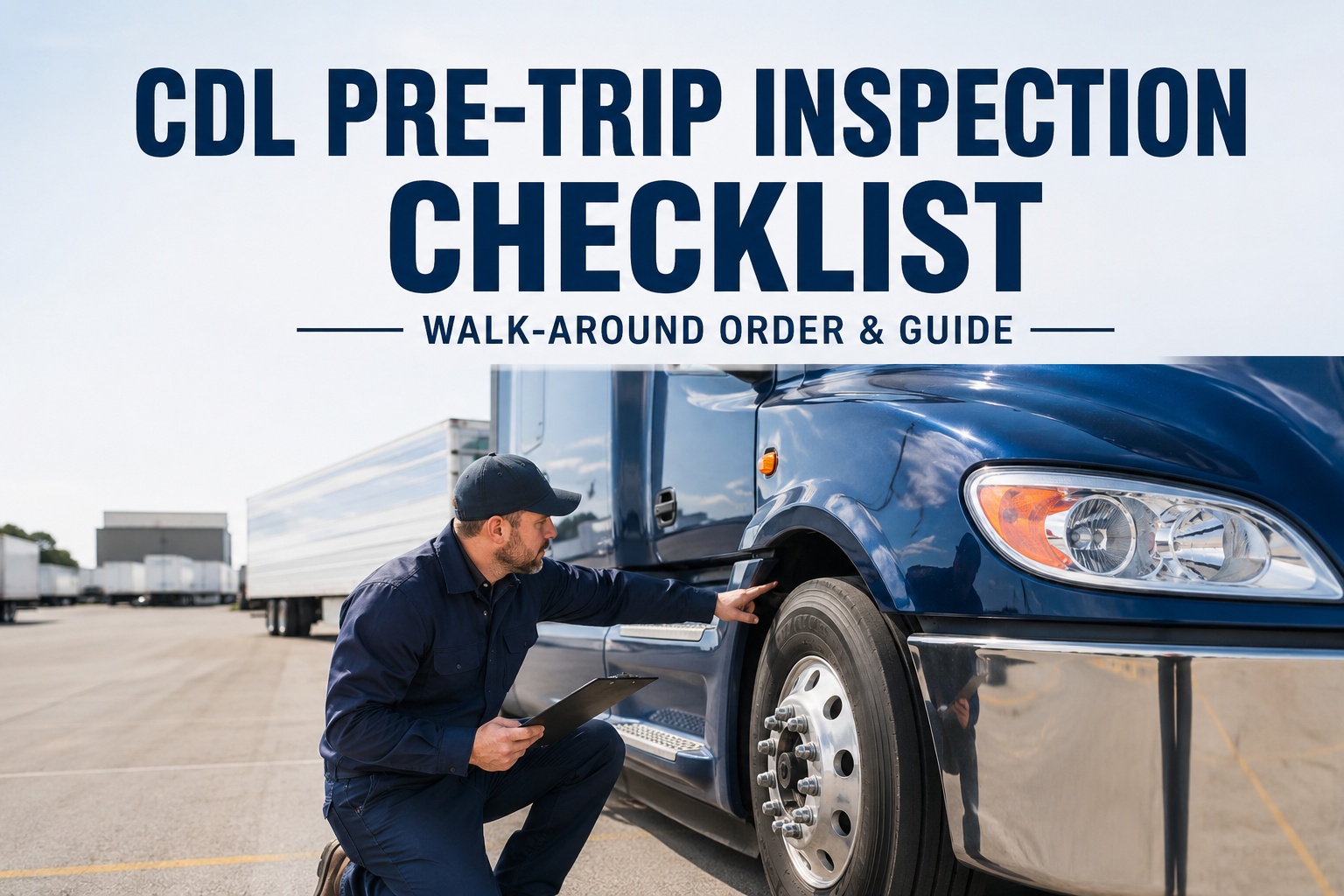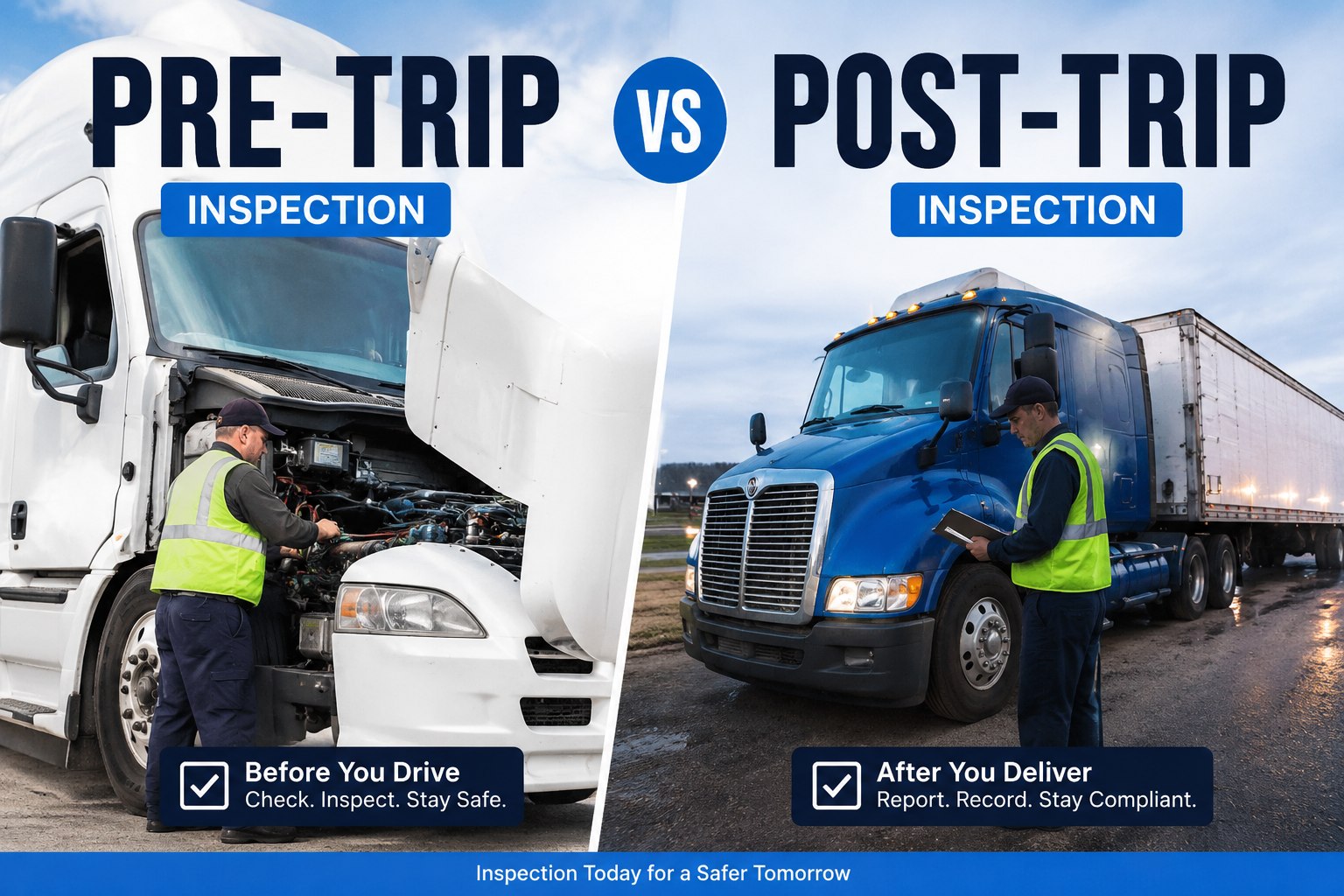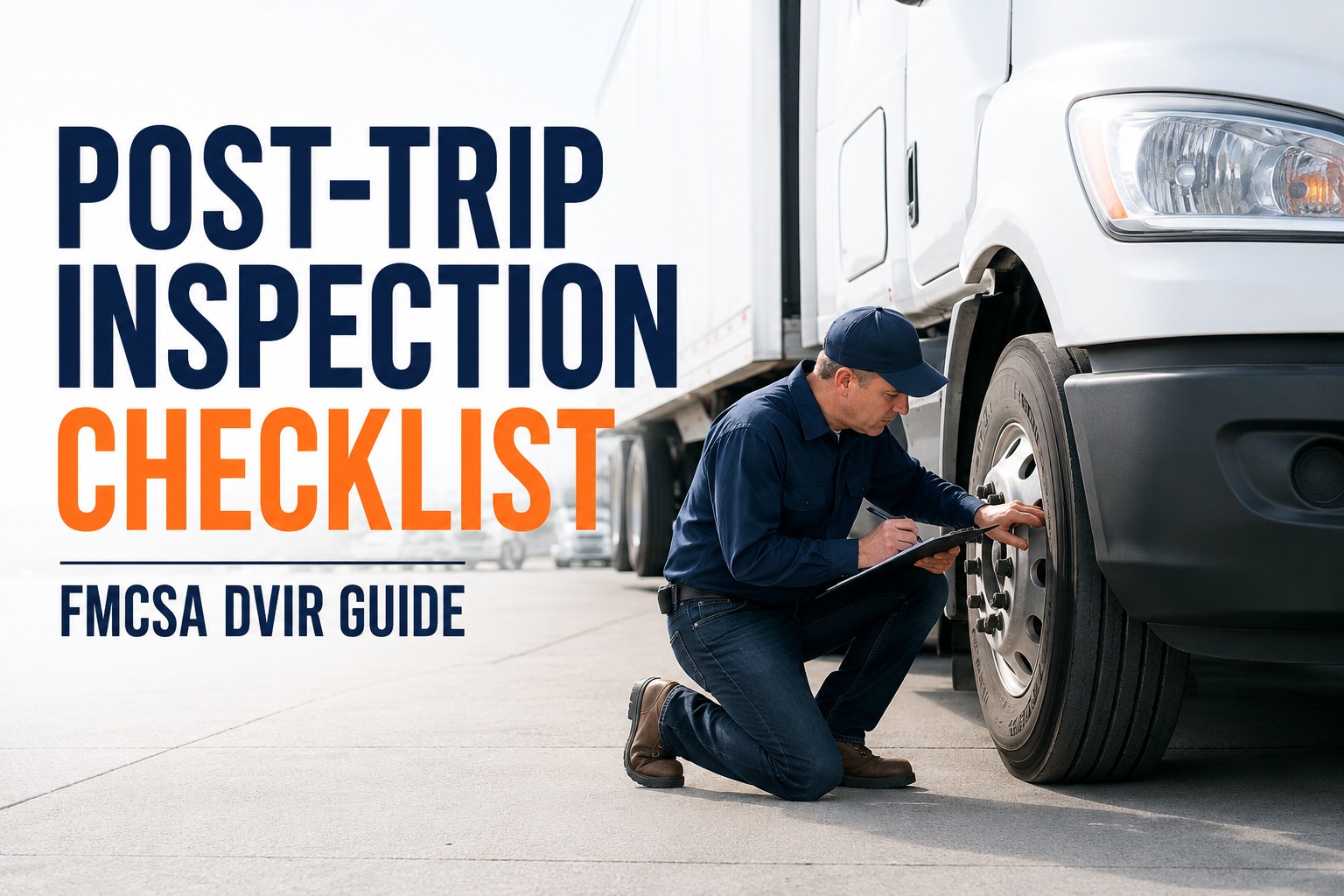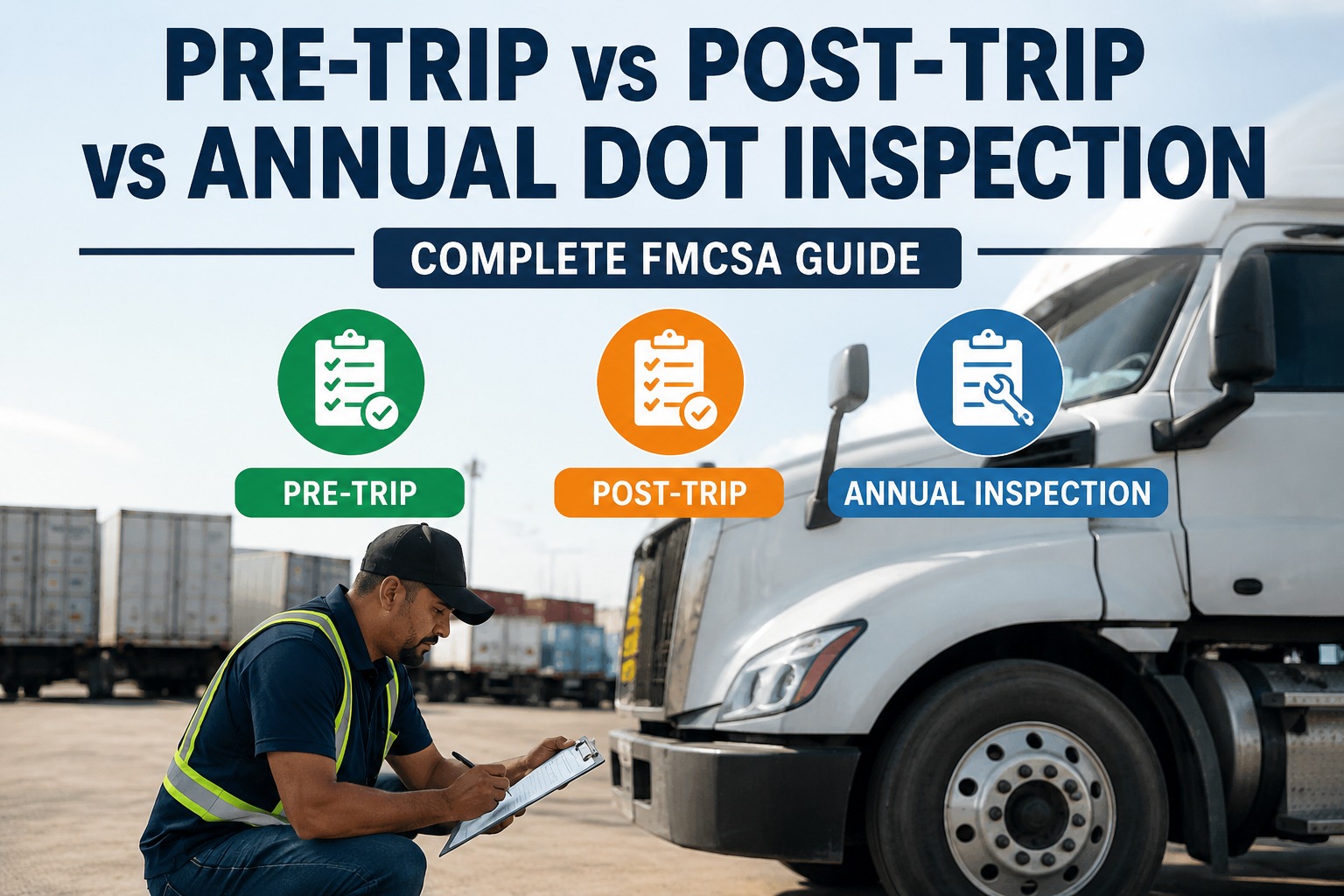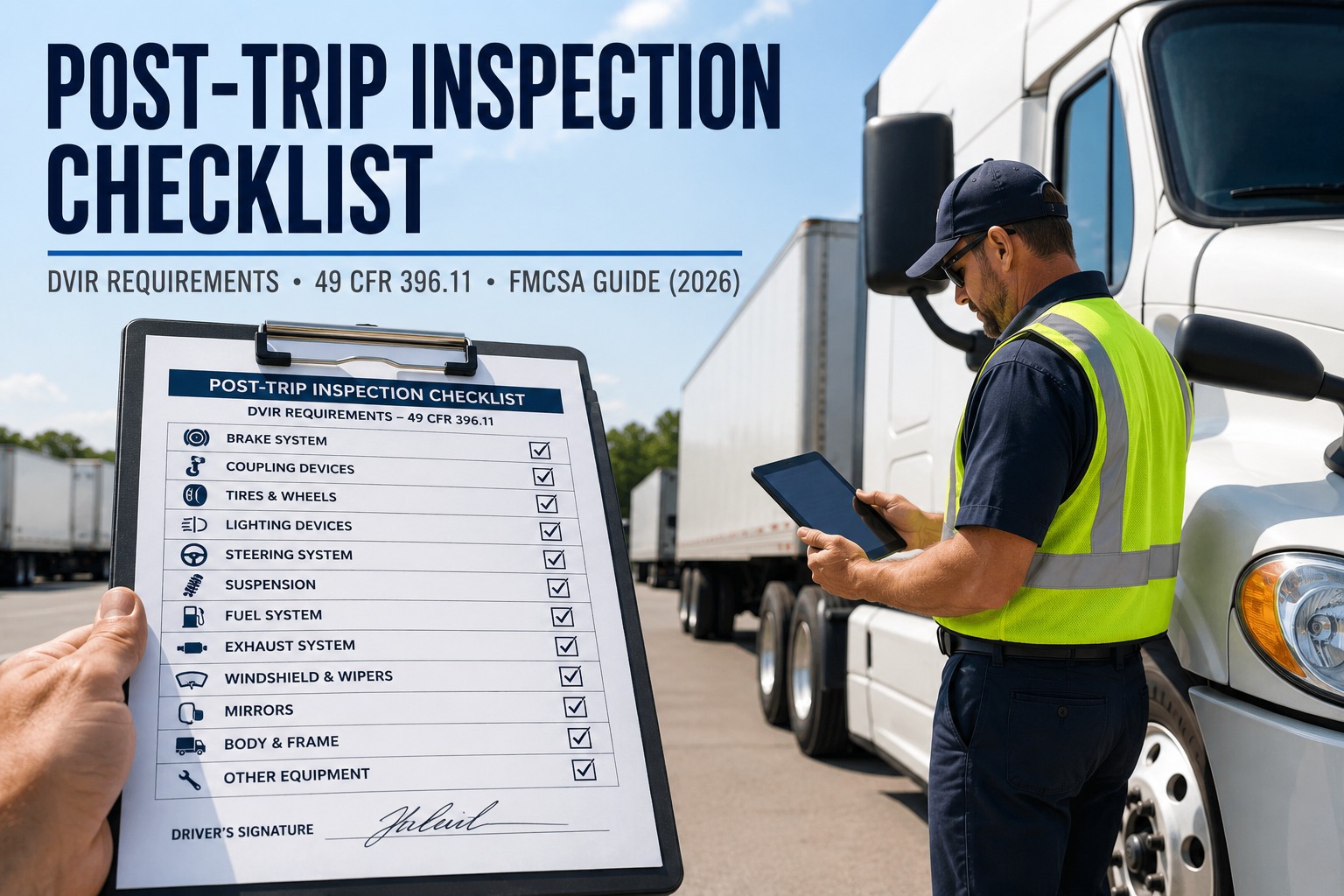
The end-of-shift walk-around is when a driver has the best chance to catch a defect that developed during the day — before it becomes tomorrow's roadside violation or the next driver's problem. This post-trip inspection checklist walks the physical sequence around a tractor-trailer in the order that produces the fewest missed defects: start at the cab, work the perimeter one direction, end at the paperwork. Under 49 CFR 396.11 the DVIR is what's legally required at end of shift; the walk-around is how you generate it accurately. Book a demo to see digital post-trip DVIRs.
The Post-Trip Walk-Around Path
Same route, every shift. Same order, every stop. That's what makes defects catchable instead of missable.
A post-trip walk-around at the end of a 10-hour shift is where discipline and fatigue collide. The truck made it home, the shift is over, the paperwork is waiting, and the temptation is to sign the DVIR quickly and hand it off. That's exactly what FMCSA auditors expect to find during a compliance review — and it's exactly what a fixed walk-around sequence prevents. The sequence below is what most driver training programs converge on: the same physical path in the same order every shift, so the routine becomes muscle memory instead of a decision.
Stop 1 — In the cab before you step downThe end-of-shift interior checks that catch cab-side defects
The walk-around starts inside the cab. This is where fatigue-driven shortcuts happen most easily — the temptation is to shut down and step out. Six checks before you leave the seat. Book a demo to see cab checks as tap-fields in HVI's driver app
Warning lights & dash indicators
Any dash indicator on that wasn't at start of shift — log it. Check engine, ABS, low air, DEF warning. A cleared light at the end of a shift is not "resolved" — it's information the next driver needs.
Air pressure & brake gauges
Air pressure should be at governor cut-out (typically 120–135 psi). Applied pressure loss when brake pedal held. Low air warning at correct threshold. Slack adjustment feels normal.
Mirrors, wipers, horn
Both electric horn and air horn functional. Wipers park correctly, no streaking issues noted. Mirrors adjusted correctly and not loose in mounts. All seemingly minor items that generate CSA citations if missing.
Seat belt, controls, gauges
Seat belt latches correctly (a Part 392.16 violation cost). All controls remained in-position through the shift. Fuel gauge, temperature, oil pressure — note anything trending unusual.
Park brake set + wheel chocks (if policy)
Park brake fully engaged, tractor and trailer both. Company policy may require wheel chocks at yard — verify per your fleet's SOP. Never depend on shore power to hold a parked unit.
Documents ready
Registration, IFTA sticker, medical card, hours-of-service records ready to hand over to the next driver or return to dispatch. Missing documents at start of tomorrow's shift = today's problem.
Stops 2–5 — the perimeter walk in one continuous directionCoupling → driver side → rear → passenger side, without backtracking
The perimeter walk moves one direction around the vehicle and doesn't backtrack. Backtracking is where "I already checked that" false confidence creeps in. Walk it as a loop.
Stop 6 — the paperwork stop that closes the loopWhere the walk-around becomes the DVIR under 49 CFR § 396.11
The final stop is documentation. The walk-around discovered defects; the DVIR records them for the carrier and creates the legal chain that goes to maintenance and eventually to the next driver. Start a free trial to see how each defect flows into a work-order.
List every defect specifically
"Left drive tire looks low" is not documentation. "Left drive outer tire, 82 psi cold, sidewall bulge 6 inches from valve stem" is. Specificity protects the driver and gives maintenance an actionable starting point.
Photo evidence where possible
Photo per defect with date/time/GPS metadata (automatic in a digital DVIR). Roadside photos of the exact defect are what turn contested findings into settled ones.
Sign the DVIR
Driver signs the DVIR certifying accuracy per § 396.11(a). Falsified DVIRs are federally actionable and carry disqualification consequences under Part 383.
Carrier repair or certification of no repair needed
Carrier certifies on the DVIR that defects were either repaired or that no repair was necessary before the vehicle is dispatched again. This is the second signature in the chain.
Next driver reviews and signs
The next driver reviews the previous DVIR under § 396.13 and signs acknowledging awareness of any defects or their repair. This is the third signature that closes the chain.
Records retained 3 months minimum
Motor carriers must retain DVIRs for at least 3 months per § 396.11. FMCSA reviews DVIR records during compliance audits to verify inspections actually happened, so "no defects" reports still get pulled.
From a driver trainer on why the sequence matters
I've trained drivers for 14 years and the single biggest walk-around mistake is the freestyle approach — "I know what I'm looking at, I'll just walk around." Two months later that driver misses a chafed hydraulic hose on the passenger side because they were tired and short-cut the walk. Next morning that hose lets go on the interstate.
What works: same route, same order, every shift. Cab in, coupling, driver side, rear, passenger side, back to cab. Six stops. Drivers who use the sequence catch defects at a rate that materially reduces roadside violations. Drivers who don't, eventually appear on the CSA report. The sequence is boring on purpose. Boring is what makes it work.
Frequently asked questions
What should you check during a post-trip inspection?
A post-trip inspection covers the same 11 component categories FMCSA requires in the pre-trip under 49 CFR § 392.7 — but the goal is different. The pre-trip verifies the vehicle is safe to operate; the post-trip identifies any defects that developed during the day's work so they can be documented on the DVIR under § 396.11 and repaired before the next dispatch. A structured walk-around covers: (1) cab interior — warning lights, gauges, air pressure, mirrors, wipers, horn, seat belt; (2) coupling — fifth wheel, kingpin, safety latch, air/electrical lines; (3) driver side — tires, wheels, lug nuts, mud flaps, marker lights, fuel tank, exhaust, drive-axle brakes; (4) rear — brake lights, turn signals, reverse lamps, license plate lamp, ICC bumper, cargo doors, conspicuity tape; (5) passenger side — mirror of driver side plus landing gear position; (6) documentation — DVIR completion with specific defect descriptions and driver signature per § 396.11(a).
What's the difference between a post-trip inspection and a pre-trip inspection?
Two different regulatory purposes even though the physical checks look similar. The pre-trip inspection under 49 CFR § 392.7 requires the driver to be satisfied 11 categories of parts and accessories are in good working order before operating the CMV — it's a fitness-to-drive check. The post-trip inspection is the mechanism that generates the DVIR under § 396.11 — a written report of any defects discovered during that day's work. FMCSA technically mandates the DVIR at end of shift, not a formal "post-trip inspection" — but the walk-around is how drivers actually find the defects that go into the DVIR. Additionally, under § 396.13, the driver must review the previous shift's DVIR before departure, so the post-trip DVIR becomes the pre-trip's starting reference. The chain is: previous post-trip DVIR → next driver's pre-trip → that shift's operation → that shift's post-trip DVIR.
Is a written post-trip DVIR always required?
No — not always for property-carrying CMVs. Since a 2014 FMCSA rulemaking, property-carrying CMV drivers are not required to submit a DVIR on days when no defects are discovered. Passenger-carrying CMVs, however, still require a DVIR at the end of every day regardless of whether defects were found. Regardless of the regulatory minimum, most compliance-focused fleets require a "no-defect" DVIR as company policy for every shift — not because federal law demands it but because it builds a positive compliance record. When FMCSA auditors pull DVIR records during a review, gaps in the record raise questions about whether inspections were actually happening; a consistent record of "no-defect" DVIRs answers that question before it's asked. And the walk-around itself is still expected under the driver's general fitness-to-drive obligation whether a DVIR gets filed or not.
Does HVI support digital post-trip inspection workflows?
Yes. HVI supports configurable digital fleet inspections and DVIRs including post-trip workflows — walk-around templates that guide drivers through each stop in a defined sequence, per-stop photo evidence, comments field for context, defect documentation with severity flags, automatic visibility to fleet and maintenance teams, and searchable inspection history at the driver and asset level. Templates can be tailored per vehicle class (tractor, trailer, dry van, flatbed, tanker) so each driver sees only the applicable items. Records are timestamped and can include GPS-stamped location. When a defect is flagged, a maintenance work order can be generated automatically and the next driver's pre-trip references the previous post-trip DVIR under the § 396.13 chain-of-custody requirement. FMCSA authorized eDVIRs explicitly in a March 2026 final rule; digital DVIRs remain fully compliant when they meet the content, signature, and retention requirements of §§ 396.11 and 396.13.
How long must post-trip DVIRs be retained?
Under 49 CFR § 396.11(b)(4), motor carriers must retain each DVIR (post-trip inspection report) and the certification of repairs for at least 3 months from the date the report was prepared. Some fleets retain longer as a best-practice buffer against audit windows, but 3 months is the federal minimum. During an FMCSA compliance review, auditors will typically request DVIR records for a sampling of drivers and dates to verify: (1) DVIRs are actually being filed when defects are found; (2) the carrier certification of repair or no-repair-needed is present; (3) the next-driver acknowledgement signature under § 396.13 is present; and (4) any defect flagged in a DVIR was addressed before the vehicle went back into service. Missing signatures in the DVIR chain are among the most-cited findings in DVIR-focused audits — the signatures matter as much as the content.
Make the post-trip a routine your fleet can actually audit
HVI supports guided digital post-trip inspections and DVIRs with per-stop photo evidence, defect documentation, severity flags, automatic maintenance work-order generation, and DVIR chain-of-custody records that satisfy 49 CFR §§ 396.11 and 396.13. The 6-stop walk-around, the DVIR, the maintenance handoff, the next-driver acknowledgement — all in one record.
No credit card · No hardware · Post-trip templates ready on day one