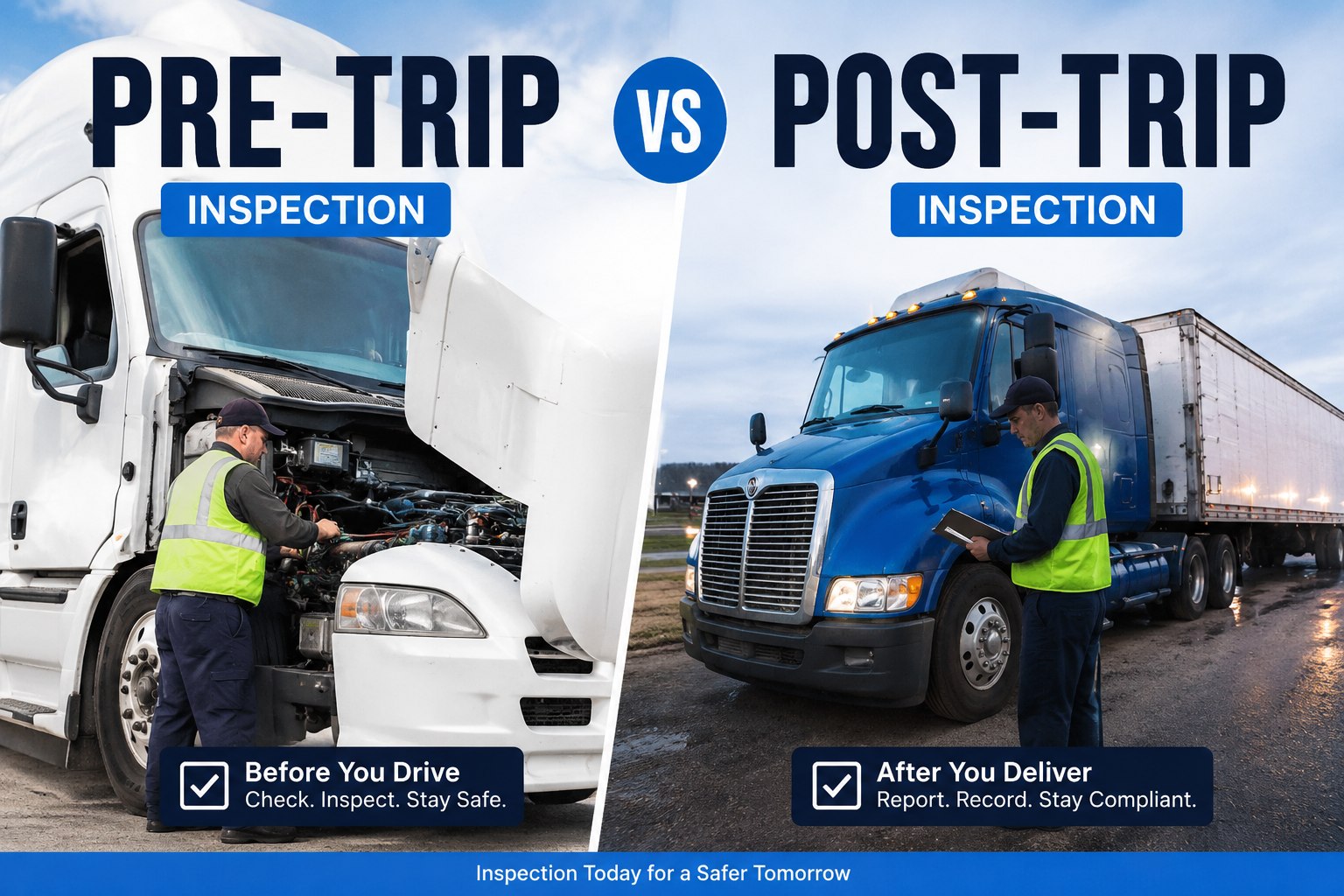
Pre-trip vs post-trip vs annual DOT inspection is one of the most-searched questions in commercial fleet compliance — and confusing the three is one of the fastest ways to fail an FMCSA audit. Each of the three inspections has a distinct FMCSA regulation behind it, a different frequency, a different qualified performer, a different focus, and a different documentation requirement. Combining or skipping any of them creates a compliance gap that CSA scoring picks up within one inspection cycle. This page walks all three side by side, what FMCSA requires for each, how they fit together across the daily and annual maintenance workflow, and the five recurring mistakes that put fleets out of compliance. Book a demo after you see the workflow end to end.
Pre-Trip vs Post-Trip vs Annual DOT Inspection
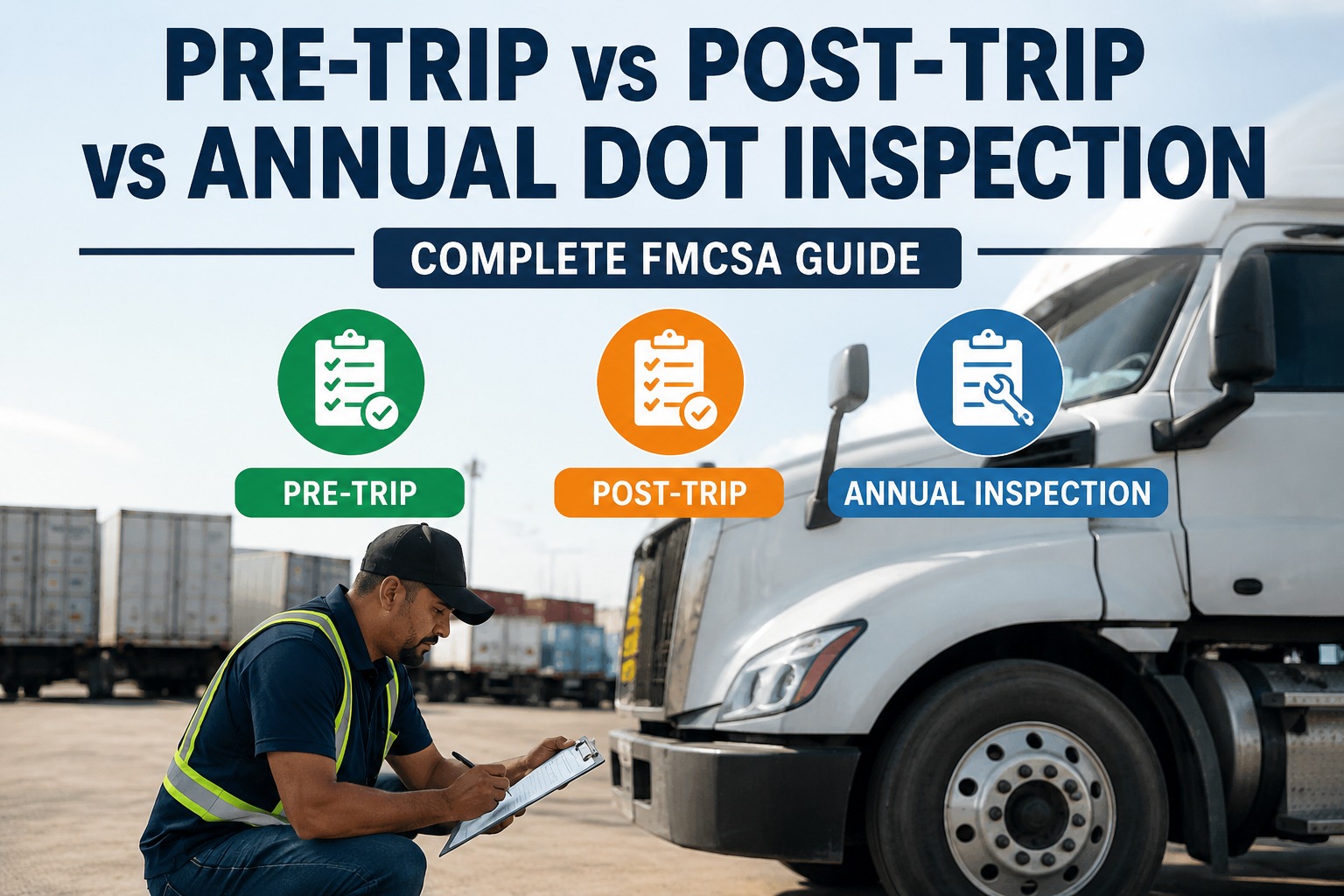
Three inspections, three regulations, three purposes. Miss any one and you have a compliance gap. Below is what each covers, when it's required, and who has to perform it.
Pre-Trip Inspection
Post-Trip Inspection (DVIR)
Annual DOT Inspection
Three different inspections, three different FMCSA regulations, three completely different purposes — and each one covers a specific safety gap the other two don't. Below is the deep dive on each: what the regulation actually says, what's checked, who performs it, and what documentation the audit will demand. Then how the three fit together, and the five mistakes that get fleets flagged.
Pre-trip inspection — the driver's legal duty before rolling
The pre-trip inspection is the driver's first line of defense against on-road failure — and 49 CFR §392.7, the FMCSA regulation that requires it, is one of the shortest in Title 49. The rule reads that the driver shall not operate a commercial motor vehicle unless satisfied that its parts and accessories are in good working order. That single sentence puts personal legal responsibility on the driver for every mile of the trip.
The regulation doesn't mandate a written record, but fleets that skip documentation lose the ability to defend the inspection during an audit. Modern digital pre-trip DVIR captures each item with timestamps and photos — converting a legal duty into an audit-ready record. Book a demo to see digital pre-trip DVIR enforced by workflow
Post-trip inspection — the DVIR that funnels defects to repair
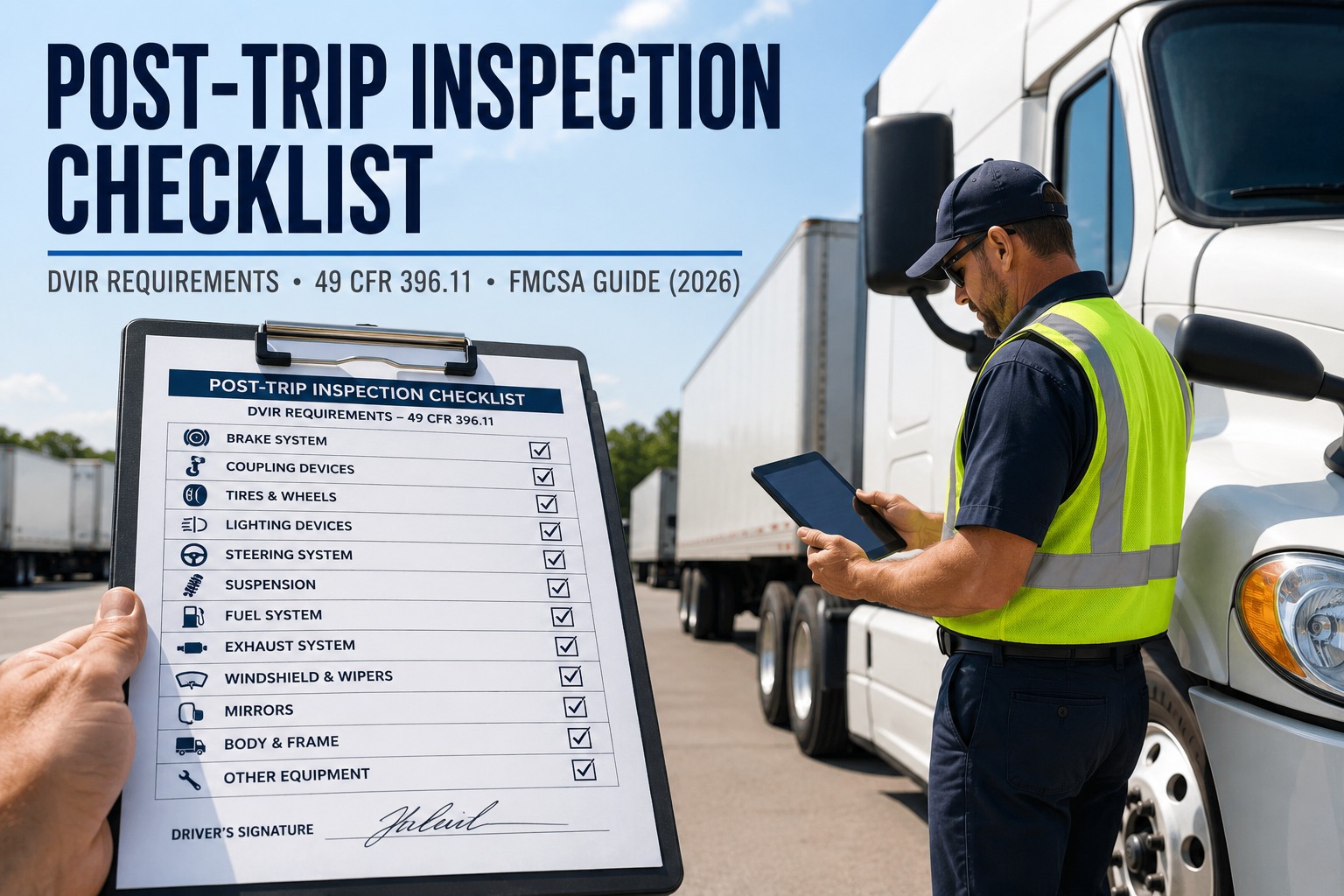
The post-trip inspection is the primary mechanism by which defects get reported into the maintenance queue — and it's the piece most fleets execute poorly. Under 49 CFR §396.11, the driver must prepare a written Driver Vehicle Inspection Report (DVIR) at the completion of each day's work if any defects or deficiencies were identified during the day. A 2015 rule update means a DVIR isn't strictly required if the driver has no defects to report, but many carriers still require them daily for the record.
The failure mode fleets keep hitting: driver logs "no defects" on paper because it's faster than describing them; defect never reaches the shop; the defect surfaces at a CVSA roadside as an OOS violation instead. Digital DVIR with mandatory photo verification and defect-to-work-order routing closes that gap. Start free and lock defect reporting into workflow
Annual DOT inspection — the comprehensive 12-month verification
The annual DOT inspection is the comprehensive mechanical check that anchors the year — required by 49 CFR §396.17 to be performed at least once every 12 months by a qualified inspector as defined in §396.19. Unlike pre-trip and post-trip, this one can't be completed by any driver: the inspector needs documented training and experience covering brake systems, coupling devices, and the full mechanical scope. Passing yields the DOT annual inspection sticker with month and year of expiration; failure means the vehicle is out of service until repaired and re-inspected.
- Brake system (all components)
- Coupling devices
- Exhaust system
- Fuel system
- Lighting devices & reflectors
- Safe loading conditions
- Steering mechanism
- Suspension
- Frame & body
- Tires, wheels & rims
- Windshield glazing & wipers
Fleets often mistake the annual DOT inspection for the CVSA Level V inspection — they're closely related but not identical. A Level V inspection typically satisfies the annual DOT requirement, but a passing annual inspection at a private shop doesn't automatically yield a CVSA decal. Book a demo to see annual inspection scheduling per truck automated
How pre-trip, post-trip, and annual DOT inspections work together
The three inspections aren't independent — they form a layered safety net. Pre-trip catches issues before they hit the road; post-trip funnels defects into the maintenance workflow; annual verifies the whole vehicle holistically once per year. Missing any layer creates a specific compliance gap.
Each layer catches what the others miss. Pre-trip catches immediate safety risks. Post-trip captures gradual defect accumulation over a shift. Annual catches long-term wear that daily walk-arounds don't reveal — frame corrosion, aged wiring, worn suspension bushings. Fleets that treat any one as optional pay for it eventually in either a CSA percentile hit or an OOS event on the road. Book a demo to see the three-layer workflow enforced per truck
5 common mistakes with the pre-trip, post-trip, and annual inspection cycle
Every fleet that's failed an FMCSA audit or been dinged on CSA scoring can trace the failure back to one of five recurring mistakes across the three-inspection cycle. All five are preventable.
Treating pre-trip as a 30-second glance
Driver walks to the truck, kicks a tire, checks that lights come on, and calls it a pre-trip. The 25 items §392.7 implicitly requires never get inspected, and the first CVSA Level II inspection finds two of them.
Marking "no defects" on post-trip to avoid paperwork
Driver notices a slow air leak during the day but marks the DVIR "no defects" to avoid delaying the next dispatch. Motor carrier never learns about the defect; it becomes an OOS violation at roadside.
Not verifying defects were repaired before next dispatch
DVIR logs a defect. Mechanic writes "repaired" on the work order. Truck goes back out. Nobody verified the actual repair. Same defect re-appears on next DVIR — audit flag.
Missing the annual DOT inspection deadline
Annual sticker expired last month. Truck kept rolling. First CVSA roadside inspection = immediate OOS. Under the 2026 CSA overhaul, this now counts 2x severity on the Vehicle Maintenance BASIC.
Paper records for all three inspections
Auditor requests 12 months of pre-trip, post-trip, and annual records across the fleet. Paper-based system produces partial records with missing signatures and unreadable copies. Partial equals non-compliant under FMCSA audit standards.
Every mistake above shows up in the same place: a failed FMCSA audit or an OOS violation that could have been caught days earlier. Digital inspection discipline across pre-trip, post-trip, and annual closes the gaps in one workflow. Book a demo to see the three-inspection workflow in production — or start free and get all three digitized this week .
From a fleet compliance manager on making the three inspections one workflow
We ran the three inspections as three separate paper systems for years. Pre-trip on a driver clipboard. Post-trip DVIR in a bin at dispatch. Annual inspection binder in the shop office. When FMCSA audited us in 2024, they asked for 12 months of records for eight specific trucks. It took three days to assemble what should have been a five-minute request.
Digital DVIR across all three inspections was the fix. Pre-trip, post-trip, and annual all flow into one truck record now, searchable in seconds, with photo verification on every safety-critical item. Audit-ready is a permanent state, not a fire drill.
Frequently asked questions
What's the difference between pre-trip and post-trip inspection?
Pre-trip and post-trip inspections are both performed by the driver on the same vehicle, but they serve different purposes and are governed by different FMCSA regulations. The pre-trip inspection, required under 49 CFR §392.7, happens before the driver operates the vehicle each day and verifies that the truck is in safe operating condition — brakes, tires, coupling, lights, mirrors, steering, and other safety-critical components. Duration is typically 15-30 minutes, and formal documentation isn't legally mandated (though most fleets require it for the record). The post-trip inspection, required under 49 CFR §396.11, happens at the end of the driver's shift and produces a written Driver Vehicle Inspection Report (DVIR) when any defects are found. The DVIR funnels defects into the maintenance workflow so the truck can be repaired before the next dispatch. Pre-trip protects that trip; post-trip protects tomorrow's trip.
Is pre-trip inspection required by FMCSA law?
Yes. 49 CFR §392.7 explicitly requires the driver of a commercial motor vehicle to be satisfied that specific parts and accessories are in good working order before operating the vehicle. Those parts include the service brakes (including trailer brake connections), parking brake, steering, lighting devices and reflectors, tires, horn, windshield wipers, rear vision mirrors, coupling devices, and emergency equipment. The regulation puts personal legal responsibility on the driver, not just the carrier. However, the rule doesn't specifically mandate a written pre-trip inspection report — that's a common source of confusion. Most fleets require a written pre-trip DVIR anyway because it's the only defensible evidence during an FMCSA audit that the inspection actually happened. Digital pre-trip DVIR with timestamps and photo verification is the current best practice.
Do I need a DVIR every day even with no defects?
Not strictly, under current FMCSA rules. A 2015 rule update to 49 CFR §396.11 removed the requirement for a written DVIR when no defects were identified during the day — the driver still has to inspect but doesn't have to submit a written report if everything was fine. However, many carriers still require a daily DVIR regardless of defects for two reasons. First, the record proves the inspection actually happened, which matters during audits and after crashes. Second, when the same vehicle is operated by multiple drivers in a day (team driving, relay operations), a DVIR is still required at the end of each driver's shift. Best practice for most fleets: require a daily DVIR from every driver, digital format, with photo verification on brakes/tires/lighting.
Who can perform the annual DOT inspection?
The annual DOT inspection required under 49 CFR §396.17 must be performed by a "qualified inspector" as defined in 49 CFR §396.19. A qualified inspector must have (1) understanding of the inspection criteria in Appendix A to Part 396, (2) sufficient knowledge and training to identify defects in brake systems, coupling devices, steering, suspension, tires, wheels, frame, and other components, and (3) either at least one year of training/experience as a mechanic or inspector in a fleet maintenance program, OR successful completion of a state-federal-approved commercial vehicle inspection training program. State DOT inspectors, CVSA-certified inspectors, and qualified mechanics at motor carriers or repair facilities all typically meet the definition. Drivers can perform pre-trip and post-trip inspections but generally cannot perform the annual DOT inspection unless they specifically hold qualified inspector credentials.
What happens if I miss my annual DOT inspection deadline?
Missing the annual DOT inspection deadline is one of the fastest ways to fail a roadside inspection. Under 49 CFR §396.17, the annual inspection must be completed at least once every 12 months, and the vehicle must display the current sticker showing the month and year of expiration. A missing or expired sticker is an immediate out-of-service (OOS) violation at any CVSA roadside inspection, meaning the truck is grounded on the shoulder until the annual inspection is completed and passed. Under the 2026 CSA overhaul, this violation now carries a severity weight of 2x, meaning it drives the carrier's Vehicle Maintenance BASIC percentile up sharply. Best practice: automated per-vehicle inspection expiration tracking with 60-day and 30-day alerts. Digital fleet management software surfaces expiring inspections before they lapse and blocks dispatch on any expired vehicle.
Run pre-trip, post-trip, and annual DOT inspections as one connected workflow
HVI enforces digital pre-trip and post-trip DVIR per shift with photo verification, routes every defect into a work order, tracks the annual DOT inspection cycle per vehicle with 60-day expiration alerts, and preserves the full audit trail. Live in under two weeks.
No credit card · No hardware · All three inspections digital day one