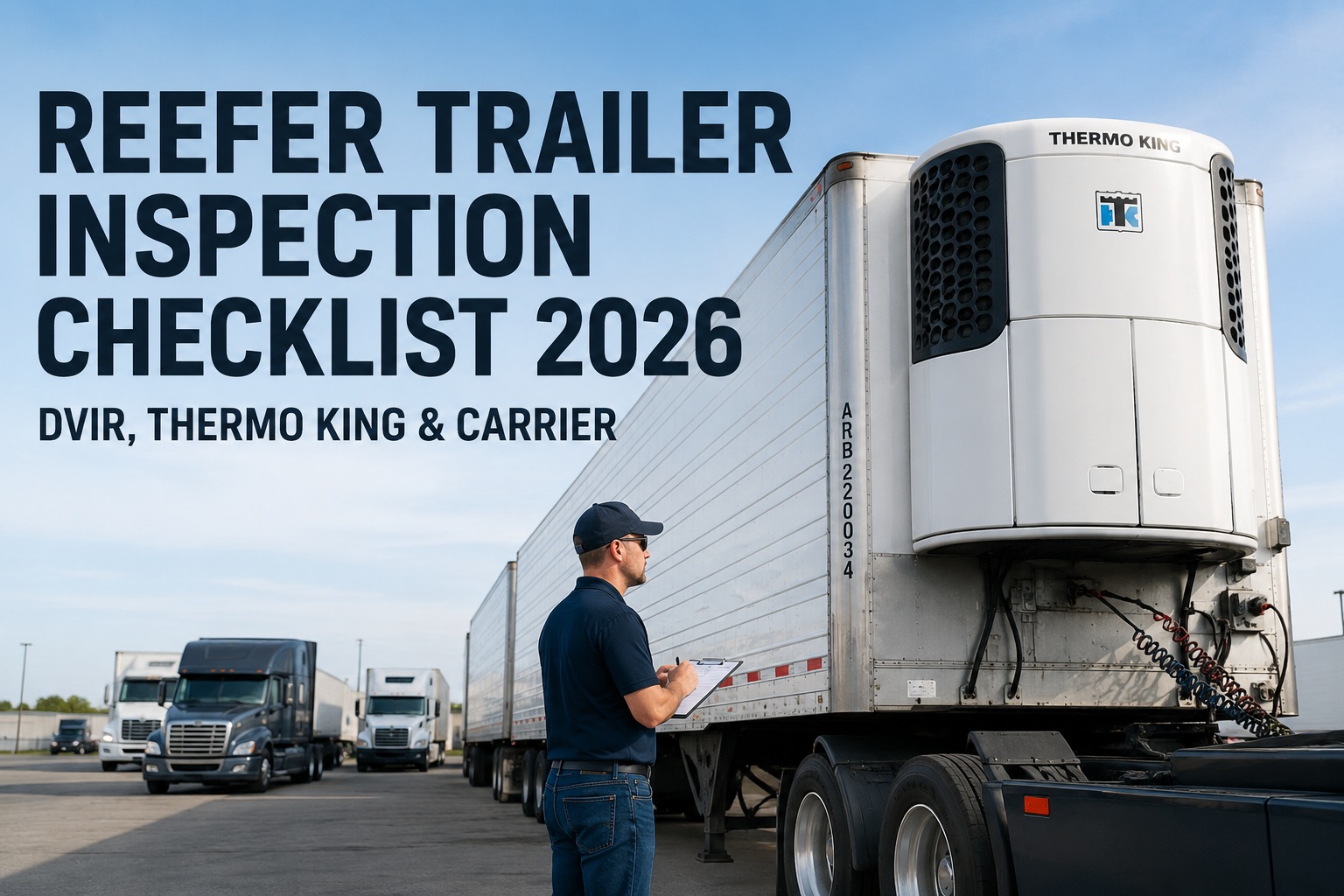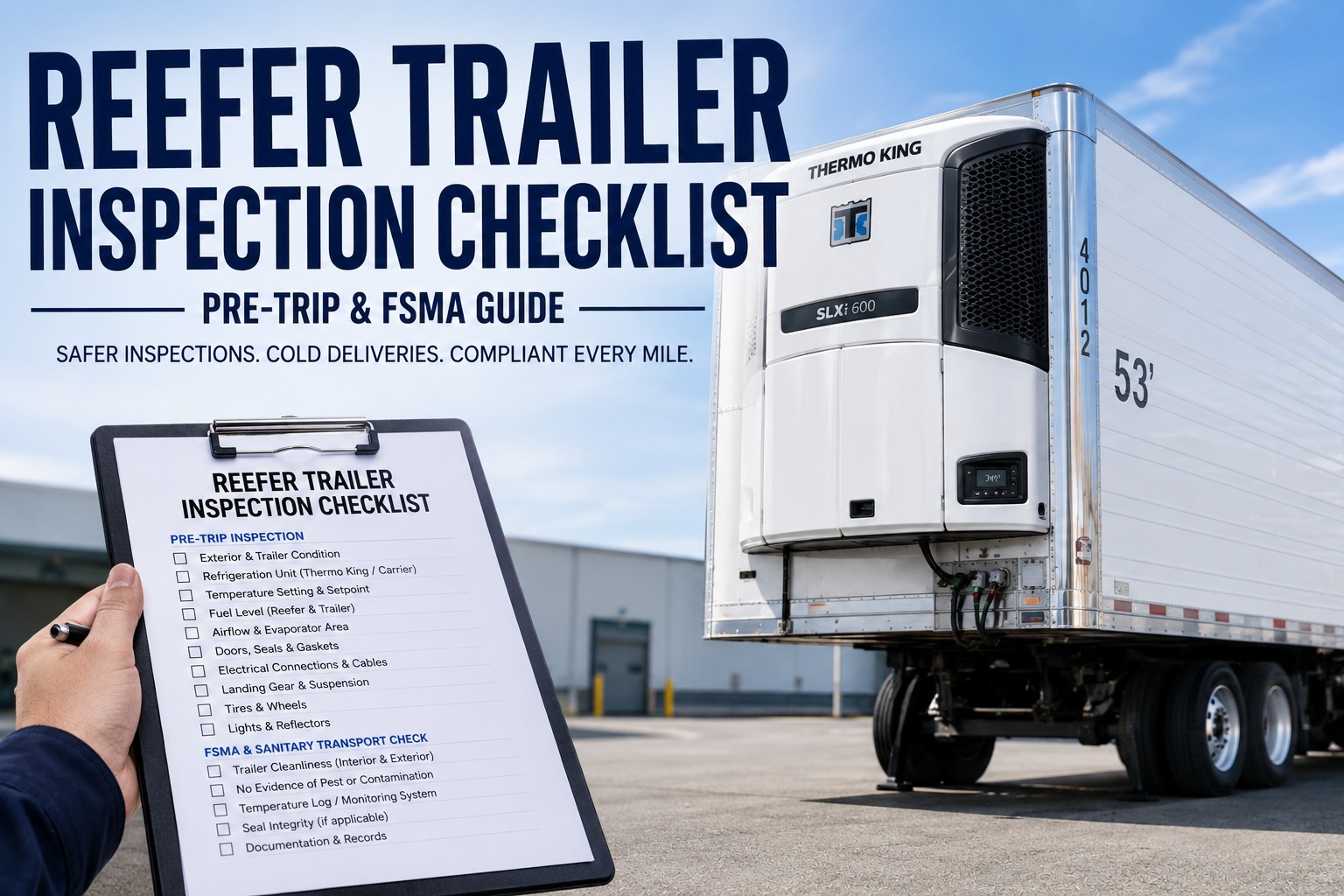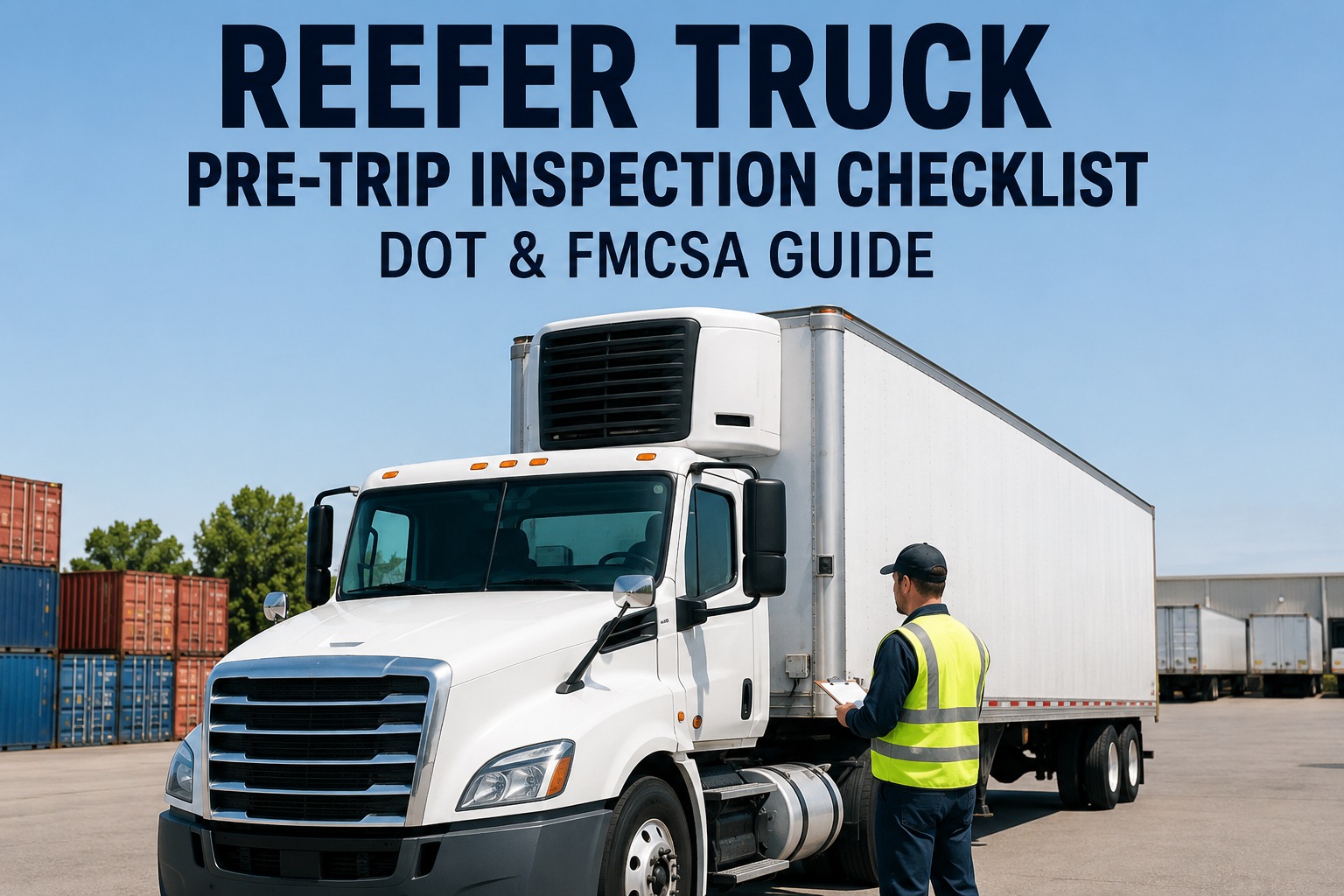
Reefer truck pre-trip inspection is the DOT-compliant checklist that stands between a signed BOL and a rejected load at the customer dock. A tractor-trailer walk-around under 49 CFR §392.7 covers brakes, tires, lights, and coupling — the standard 11 FMCSA-mandated components. A reefer adds three physical systems on top of that: an independent diesel engine mounted on the trailer nose, a sealed refrigeration cycle, and an airflow delivery path that has to reach the rear pallets. Any one of the three failing means 44,000 pounds of frozen or perishable cargo arrives warm, and the fleet eats the freight plus the load. This is the driver's compliance walkthrough for all three systems — the fifteen minutes that prevents the incident report. Book a demo to see a reefer-specific pre-trip template built into a mobile DVIR workflow.
The Reefer Truck Pre-Trip Inspection Checklist
A reefer isn't a dry van with a cooler bolted on. Three separate systems have to pass every shift. Here's the map, then each zone in detail.
Most cold-chain failures aren't catastrophic. They're small missed items — a slipping belt, a disconnected air chute, a set point that didn't get changed after the last cargo type. The reefer unit runs, the display looks fine, and the load in the back gradually warms. By the time an alarm triggers, the freight is already out of temperature spec. Structured pre-trip inspection is the only reliable prevention.
The 4 numbers that make the reefer pre-trip non-optional
Any single one of these justifies the fifteen-minute discipline before every dispatch. Together they explain why reefer inspection failures produce some of the highest per-load cost incidents in trucking.
- $50K+ Typical rejected-load cost on a 44,000 lb reefer — cargo + freight + penalty
- 3 systems Engine + refrigeration + airflow — each an independent failure point
- FSMA FDA Sanitary Transportation Rule requires temp records on food carriers
- 15 min Correct pre-trip duration — on top of standard DOT walk-around
The Food Safety Modernization Act's Sanitary Transportation of Human and Animal Food rule (21 CFR Part 1) makes temperature-record documentation a compliance requirement for anyone hauling food — not just a customer expectation. Missed pre-trip verifications become audit findings, not just internal quality gaps. Book a demo — see reefer temperature capture on a DVIR
Zone 1 — The reefer engine (front nose of trailer)
The reefer's own diesel engine runs the compressor. Independent from the tractor. Independent from shore power (unless plugged in). If it doesn't start, doesn't stay running, or runs but doesn't drive the refrigeration cycle, the trailer is a metal box. Check these five items every pre-trip.
Reefer engine checklist
4 min-
01
Fuel level Reefer fuel tank at least 3/4 full for the run. Tank is separate from tractor. Empty reefer = warm load. Some fleets require 100% fill before every dispatch to eliminate driver estimation error.
-
02
Engine oil level Check the reefer engine oil dipstick, not the tractor's. Low oil is the leading root cause of reefer engine failure at highway speeds and elevated ambient temperatures.
-
03
Coolant level and condition Coolant clear, at spec, no oil sheen. Reefer engines run hot under load; coolant loss cascades into overheat shutdown mid-route.
-
04
Drive belts Belt tension, no cracking, no glazing, no fraying. A slipping belt drives the compressor at reduced RPM — the unit runs, the load warms slowly. One of the most-missed failure signs.
-
05
Battery voltage & connections Battery voltage at spec. Critical on Cycle-Sentry mode — weak battery won't restart the engine after the sleep cycle, silently ending the cold chain overnight.
Zone 2 — The refrigeration cycle
The sealed system that actually produces cold: compressor, condenser, evaporator, expansion valve, refrigerant charge. Failures here don't produce alarms until the return-air sensor registers the temperature drift. Verify the system responds correctly before you close the doors.
Refrigeration cycle checklist
5 min-
01
Set point matches cargo profile Verify the temperature set point matches the BOL. 34-38°F for produce, 0 to -10°F for frozen. Wrong set point from the previous load is a top-3 cause of rejected shipments.
-
02
Return air temp (RAT) sensor reading The RAT sensor is what the unit references for cycle logic. Reading should be at or below set point after pre-cool. Sensor drift >2°F is a service-required item.
-
03
Refrigerant charge (no low-charge alarm) Any low-charge alarm code (Thermo King ALM 90 or Carrier alarms) means the sealed system has lost charge. The unit will still run — badly. Refuse dispatch until service.
-
04
Condenser coil clean and clear Debris in condenser coil kills heat rejection capacity. Physically inspect from the front. Bugs, plastic film, cardboard fragments are common blockers.
-
05
Evaporator coil no ice buildup Ice on the evaporator means defrost cycle isn't running correctly or the box has excess moisture load. Defrost heater or timer service required.
Zone 3 — The airflow path
The refrigeration cycle produces cold at the evaporator. Getting that cold to the rear pallets and back to the RAT sensor is a separate engineering system. This is where most reefer pre-trip inspections quietly fail — because these components aren't in the unit, they're in the box.
Airflow path checklist
4 min-
01
Air chute intact and attached The fabric air duct running along the ceiling from evaporator to rear. If disconnected, torn, or crushed by loading, cold air never reaches rear pallets. Walk to the back and look up before closing doors.
-
02
T-floor clear of obstruction Aluminum grooved floor allows return airflow under pallets. Debris, ice, or blocked drains kill the return path. Cold air can't leave the box, so it can't reach the RAT sensor.
-
03
Bulkhead condition The wall at the front separating the reefer unit from the cargo. Must be intact to force air through the chute. Damaged bulkhead = short-circuited airflow, cargo doesn't cool.
-
04
Door seals & gaskets Rear door and side door seals compressed evenly with no gaps. Warm air infiltration through poor seals is the #1 preventable cause of loads arriving out of temp.
-
05
Floor drains clear Two drains at the rear floor. Blocked drains cause standing water, ice buildup at drain, and airflow disruption. Push a finger through both — should be open to underside.
The airflow zone is where reefer pre-trips quietly fail because the components are in the trailer box, not the reefer unit's screen. A driver who verifies the display looks fine but doesn't physically walk to the back and look up at the air chute has missed the single most common preventable failure point. Start free and get mandatory air-chute photo capture built into every reefer DVIR
The pre-cool sequence — 4 steps in the right order
A reefer trailer can't be loaded warm. The pre-cool sequence brings the box to set point before cargo enters, protecting product from thermal shock and eliminating the temperature-recovery lag that produces borderline BOL temps. Same four steps every dispatch, in this order.
Program the target temperature into the reefer controller before starting. Verify continuous run vs. cycle-sentry mode matches cargo type.
Doors closed, unit running at set point. Empty trailer reaches temperature. Verify at RAT sensor and, ideally, spot-check front/middle/rear.
Load as quickly as possible. Close doors between pallets on long loads. Every minute doors are open, box gains temp faster than the unit can recover.
Verify RAT sensor is at set point before pulling out. Document the pre-departure temperature. This is your BOL-defense record for the shipper.
Departing with a box that hasn't recovered to set point means the load is arriving late-to-temp — and if the receiver rejects on infrared reading, the carrier eats the entire load. The pre-cool discipline is worth more than the 30 minutes it costs. Start free and log every pre-cool temperature automatically
Continuous Run vs Cycle-Sentry: which mode for which cargo
Reefer units operate in one of two modes. Getting the mode wrong for the cargo is a load-loss risk. Set the mode per BOL, not per driver preference or fuel budget.
Engine runs 24/7
- Frozen loads (-10°F to 0°F)
- Pharmaceuticals & vaccines
- Highly sensitive produce (berries, leafy greens)
- USDA / GDP-regulated cargo
Higher fuel consumption. Tighter temperature control ±1°F. No restart risk. Faster temperature recovery after door openings.
Engine cycles on/off
- Refrigerated produce (34-38°F)
- Beverages & dairy
- Non-critical fresh product
- Long distance where fuel matters
Lower fuel cost. Temperature swing ±3-4°F. Battery health critical — weak battery = failed restart = warm load overnight.
The most-missed check on Cycle-Sentry operation is the battery. A unit that starts fine in the yard can fail to restart at 3am when the ambient drops and the load in the alternator has been on standby. Always verify battery voltage under load on any Cycle-Sentry dispatch. Book a demo to see mode + cargo mapping enforced on every DVIR
From a driver who found the air chute at the wrong time
Three hours into a run from Omaha to Miami, alarm goes off. Return air's at 41°F on a 28°F frozen beef load. I pull off, open the rear, and there it is — air chute detached at the second bracket. Probably from the last unload. I thought I'd checked but I hadn't looked up at the ceiling near the back.
What changed for me was moving to the app. It literally requires a photo of the air chute from the rear before I can close the doors and mark the pre-trip complete. Feels silly the first time. Then you realize the reason the app requires it is because 3 out of 4 drivers were skipping it. That's the check that would have caught my Miami run.
Frequently asked questions
What does a reefer pre-trip inspection cover that a dry van doesn't?
A dry van pre-trip inspection covers the 11 FMCSA-mandated components under 49 CFR §392.7: brakes, steering, tires, lights, horn, wipers, mirrors, coupling, wheels, and emergency equipment. A reefer pre-trip covers all of that plus three additional physical systems specific to refrigerated transport: the reefer diesel engine (independent from the tractor engine — separate fuel, oil, coolant, belts, battery), the sealed refrigeration cycle (compressor, condenser, evaporator, refrigerant charge, RAT sensor), and the airflow delivery path (air chute, T-floor, bulkhead, door seals, drains). Any one of the three systems failing produces a warm load — the reefer unit can display a clean fault screen while the cargo at the rear pallets slowly heats. The complete reefer pre-trip typically takes an additional 15 minutes on top of the standard DOT walk-around, and it directly serves both FMCSA §396.11 documentation compliance and FDA Food Safety Modernization Act (FSMA) Sanitary Transportation Rule temperature-record requirements for food-grade loads.
What is the difference between Continuous Run and Cycle-Sentry modes?
Continuous Run keeps the reefer diesel engine running 24 hours a day at whatever RPM the temperature control requires — the engine never shuts off during the trip. Cycle-Sentry (Thermo King terminology; Carrier Transicold uses Start-Stop) cycles the engine on and off based on box temperature, running to bring temperature to set point then stopping until it drifts, then restarting. Continuous Run delivers tighter temperature control (±1°F typical), faster recovery after door openings, and eliminates the failure risk of a battery not being able to restart the engine after a shutdown cycle — critical for frozen loads (-10°F to 0°F), pharmaceuticals, vaccines, and highly sensitive produce like berries. Cycle-Sentry delivers meaningfully lower fuel consumption on long hauls but comes with wider temperature swing (±3-4°F) and battery-restart risk — best for less critical refrigerated cargo like beverages, dairy, and hardy produce (34-38°F range). The mode selection is a cargo-specific decision, not a driver preference or fuel-budget decision. Getting the mode wrong for the cargo is a load-loss exposure.
How long should you pre-cool a reefer trailer before loading?
The industry standard is 30 to 45 minutes of pre-cool at the target set point with all doors closed before loading begins. Loading into a warm trailer places excessive heat load on the refrigeration unit, extends the temperature recovery time, and puts cargo at risk of thermal shock — particularly for temperature-sensitive product. The pre-cool process: program the set point into the reefer controller, close all doors, run the unit continuously for 30-45 minutes, then verify the return-air-temperature (RAT) sensor is at or below set point before opening for loading. Best practice on high-value or FSMA-critical loads is to spot-check at the front, middle, and rear of the empty trailer with a handheld probe to confirm temperature uniformity, not just RAT sensor reading. On the loading side, minimize door-open time and, on long loads, close doors between pallets when possible. Every minute doors are open, box temperature rises faster than the unit can recover, and cumulative door time is the leading preventable cause of loads departing above set point.
Is a reefer pre-trip inspection required by DOT?
Yes, on both the standard DOT and reefer-specific dimensions. The standard driver pre-trip inspection under 49 CFR §392.7 applies to any commercial motor vehicle regardless of trailer type — the 11 minimum FMCSA components must be checked before every shift. The reefer-specific additions (engine, refrigeration cycle, airflow path) are required by two separate frameworks. First, the FDA Food Safety Modernization Act (FSMA) Sanitary Transportation of Human and Animal Food rule (21 CFR Part 1) requires food carriers to maintain temperature control equipment "in an appropriate manner" and to document temperature control during transport. Second, FMCSA §396.11 requires the driver to submit a DVIR at end of workday for any defects discovered — which includes reefer defects. Additionally, the annual DOT periodic inspection under §396.17 covers the trailer as a whole, and the annual inspection cannot certify a reefer trailer as safe for cargo transport if the refrigeration system is documented as non-functional. Carriers hauling pharmaceuticals must also comply with GDP (Good Distribution Practice) temperature control requirements enforced by USP <1079> guidance.
What are the most common causes of reefer load rejections?
Five preventable failures produce the majority of reefer load rejections at the receiver. First, disconnected or damaged air chute — the fabric duct running along the ceiling from evaporator to rear, easy to detach during loading and easy to miss at pre-trip. Cold air stops reaching rear pallets, and the RAT sensor at the front never signals the problem. Second, wrong set point from the previous load — reefer set to frozen for the last cargo, dispatched with a fresh produce load, product freezes or vice versa. Third, poor door seal condition — warm air infiltration through worn or damaged gaskets, especially problematic in humid or high-ambient-temperature routes. Fourth, insufficient pre-cool time — trailer loaded before the box reached set point, extending recovery time and producing borderline BOL temps that fail infrared checks at the receiver. Fifth, weak battery on Cycle-Sentry operation — unit shuts down for cycle logic overnight but doesn't restart, producing a slow warm-up that the RAT sensor eventually alarms too late. All five are catchable at a proper 15-minute pre-trip inspection with photo verification of the specific failure points.
Turn the reefer pre-trip into a 15-minute audit-ready record
HVI runs the full 3-zone reefer pre-trip as a guided mobile DVIR: reefer engine checks with photo capture, refrigeration cycle verification with RAT sensor documentation, airflow path validation with mandatory air-chute photo, and pre-cool temperature logging. FSMA-compliant temperature records auto-retained. Live on your fleet in under two weeks.
No credit card · No hardware · Reefer template ready day one