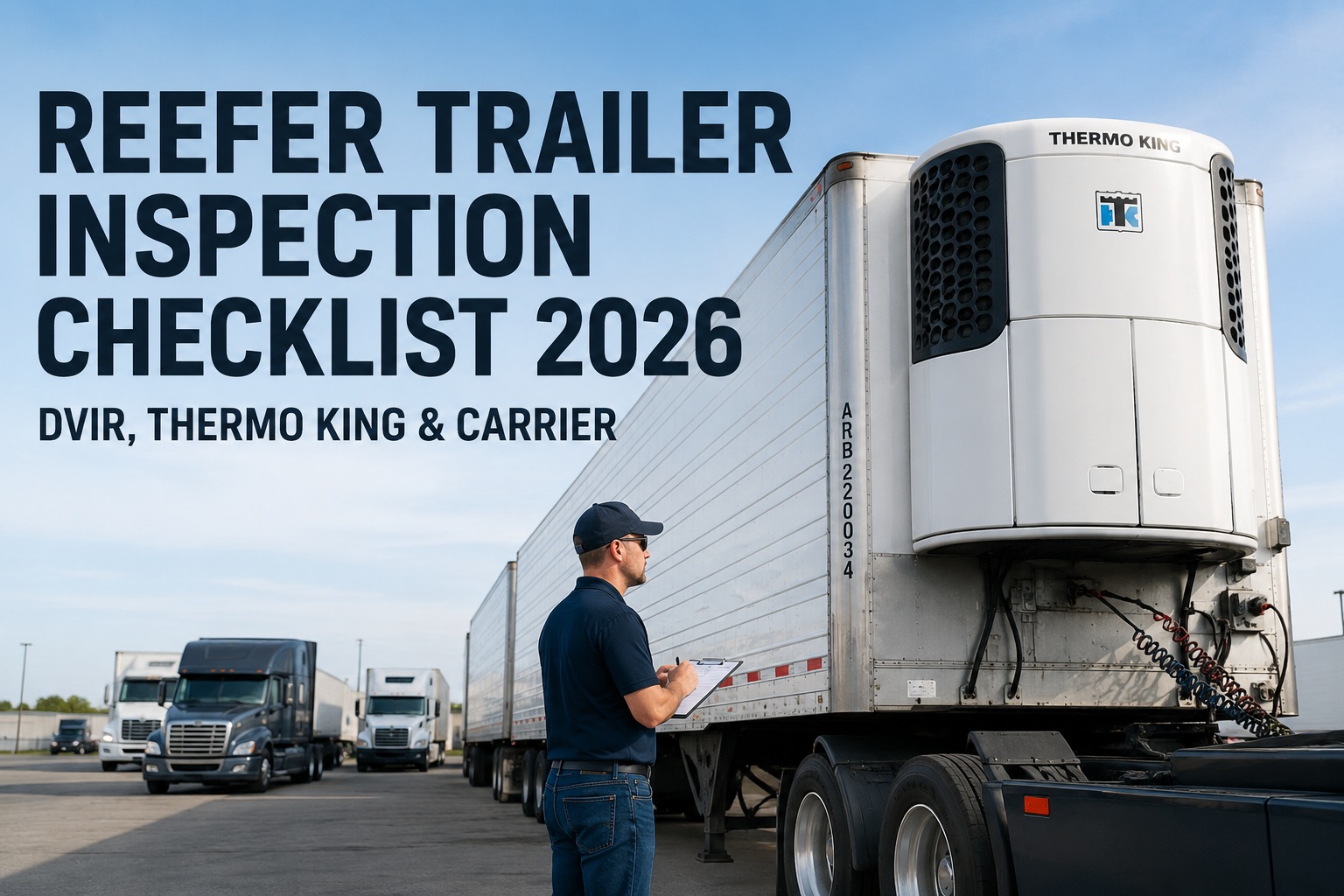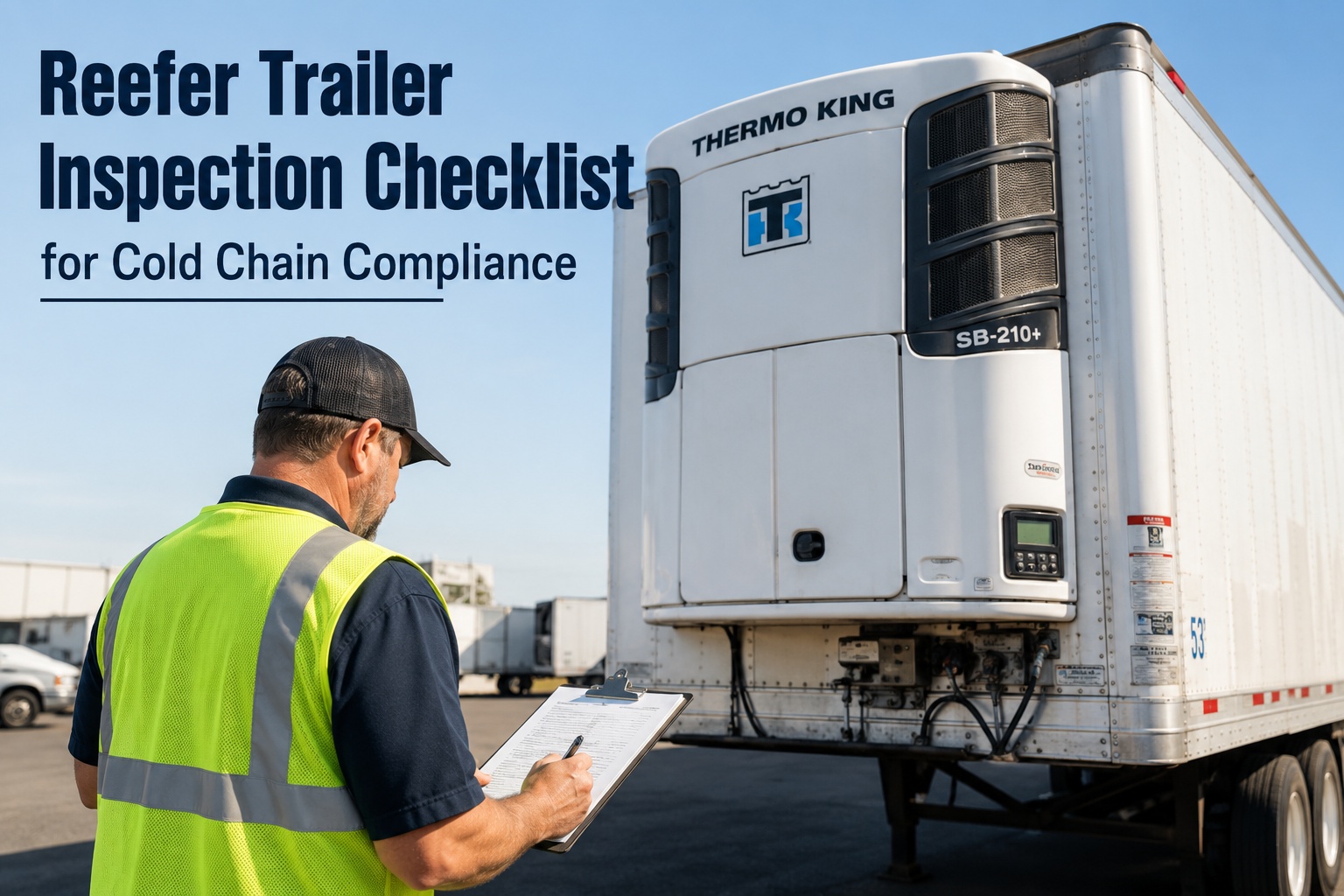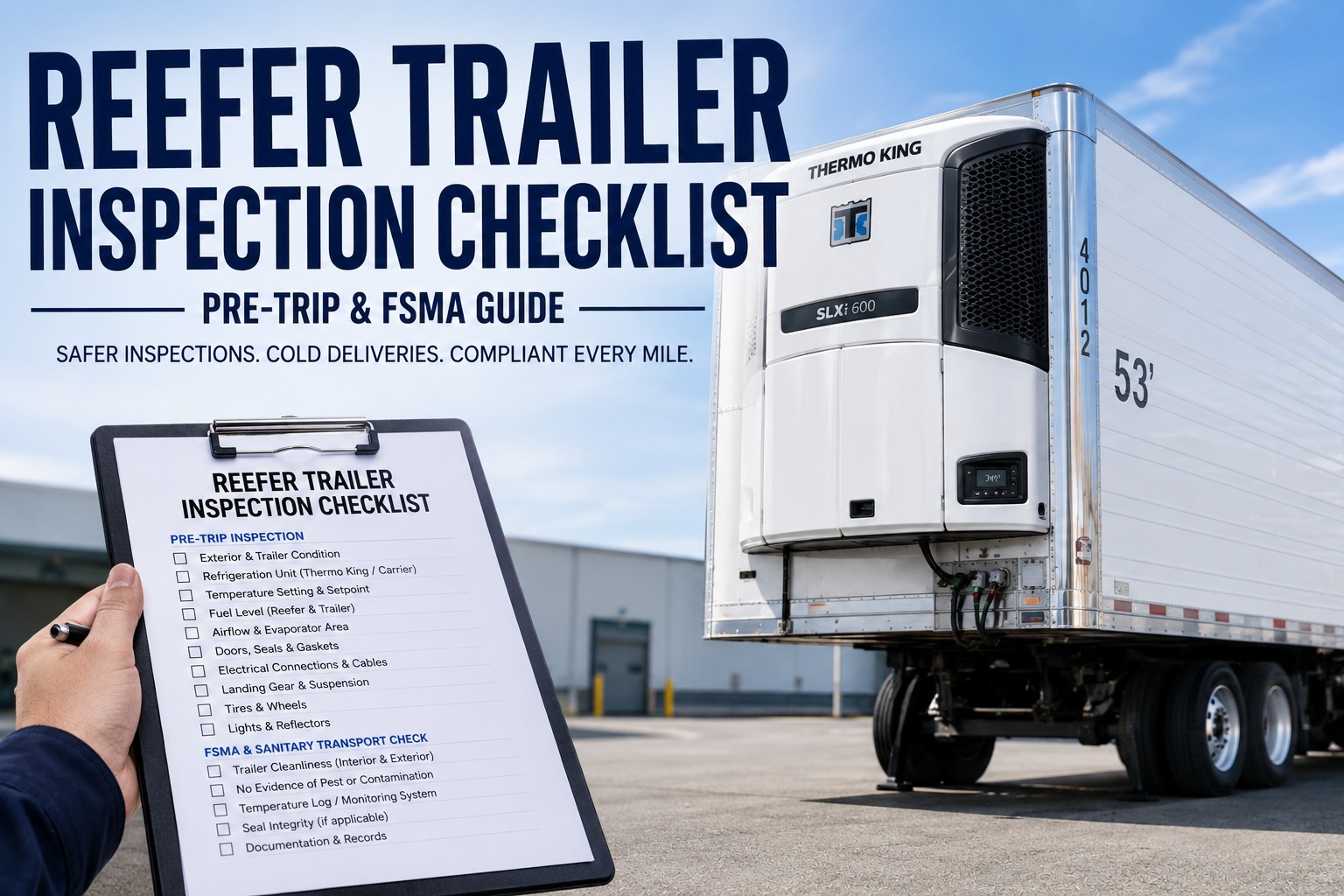
Reefer trailer inspection checklists are not a longer version of a dry van pre-trip — they're a different procedural sequence tied to FDA Food Safety Modernization Act (FSMA) Sanitary Transportation Rule requirements. Missing an item on a dry van produces an inconvenient delay; missing an item on a reefer trailer produces a rejected load, a spoilage claim, and potentially an FSMA violation. A reefer pre-trip runs across five stages starting 2-4 hours before the shipper's dock, ending with FSMA-ready documentation. Book an HVI demo to deploy the framework.
Five sequential stages. Two hours pre-cool. One documented pre-trip.
A compliant reefer pre-trip inspection is not one walkaround. It's a five-stage sequence that starts hours before the shipper's dock and ends with FSMA-ready records. Skip any stage and the load either gets rejected at pickup or fails at delivery.
Trailer set to load spec temperature before arriving at shipper. Frozen: -10 to 0°F. Fresh: 33-40°F. Shippers reject un-pre-cooled trailers.
Standard DOT DVIR items: tires, brakes, lights, ABS, air, coupling. FMCSA 49 CFR 396.11 baseline. Reefer walkaround adds fuel level check.
Thermo King or Carrier Transicold unit self-test. Setpoint verify. Fuel, coolant, oil, belts. Alarm history clear. Defrost cycle timing.
FSMA sanitary check: floors clean, drains clear, chutes intact, no residue, no odor. Door seal integrity. Bulkhead condition.
FSMA temperature record started. Pre-cool confirmation. Sensor calibration current. DVIR complete. 12-month records retention.
FDA's Food Safety Modernization Act (21 CFR Part 1) requires carriers to maintain temperature control procedures, monitoring records, and sanitary condition documentation for 12 months. Records must be retrievable within 24 hours of FDA inspection request. Paper-only reefer records increasingly fail modern FSMA audits.
Why reefer pre-trip differs from dry van — and why that matters
A dry van pre-trip is a vehicle inspection. A reefer pre-trip is a vehicle inspection PLUS a temperature-control system verification PLUS a food-safety sanitary check PLUS a compliance record creation. Same walkaround time budget, four times the failure surface. Generic Class 8 DVIRs miss the majority of what actually strands a reefer load.
The cost of missing items is disproportionate. A typical single-temperature reefer logs 1,800 operating hours annually — the equivalent of driving a car 100,000 miles every year in pure engine wear. A quarter-inch gap in a rear door seal on a 35°F load day forces the unit into continuous run, spikes fuel consumption 18-22%, and causes condensation damage. A temperature probe reading 3°F below actual means a load set to 38°F is actually traveling at 41°F — above the FDA safe transport threshold for fresh produce and many pharmaceutical loads.
Shippers routinely reject trailers that haven't reached load spec temperature before arrival. Pre-cool takes 2-4 hours depending on ambient and insulation — it must be planned into the route, not attempted at the dock.
Thermo King and Carrier Transicold units run independent diesel engines with separate fuel tanks, hour meters, and PM schedules. Reefer fuel is not tractor fuel. Reefer hours are not tractor hours. Missing this creates surprise breakdowns.
Cargo compartment cleanliness, drain integrity, and residue-free floors are FDA-inspectable items. A trailer that "passed" a dry van walkaround fails a sanitary transport audit if the compartment isn't documented clean.
Under FSMA, if it isn't documented it didn't happen. Temperature records, sanitation certifications, sensor calibration — retained 12 months, retrievable in 24 hours. Paper systems increasingly fail modern audits.
Book an HVI demo to see FSMA-aligned reefer templates against your fleet
Stage 1 — Pre-cool procedure (2-4 hours before shipper arrival)
Pre-cooling is the single item most-often missed on a reefer pre-trip because it happens hours before what most drivers think of as "the inspection." A trailer arriving at the shipper at ambient temperature will be turned away — loading warm product into a warm box produces immediate temperature abuse. Pre-cool sets the entire load's compliance chain.
Frozen loads require continuous engine operation to hold tight tolerance. Cycle-Sentry is inappropriate for frozen product. Start pre-cool early enough that trailer reaches setpoint plus 30 minutes stabilization before dock arrival.
Produce range varies by commodity: leafy greens 32-36°F, most vegetables 33-40°F, some tropical fruits 45-55°F. Confirm shipper spec before setpoint. Continuous Run for high-value; Cycle-Sentry acceptable for hardy commodities.
During pre-cool, verify: reefer fuel level minimum 3/4 tank; setpoint programmed correctly against load spec; setpoint reached and held for 30 minutes minimum; no active alarms on control panel; door seals intact. Start a free trial to deploy pre-cool verification workflows with automated setpoint capture.
Stage 2 — Chassis walkaround (standard DOT DVIR)
The chassis walkaround follows FMCSA 49 CFR 396.11 DVIR requirements identical to any Class 8 trailer — with one reefer-specific addition: reefer fuel tank level. Reefer fuel is drawn from a separate tank on the trailer (typically 50-100 gallons) and consumed independently of tractor fuel. Missing this check on a long haul produces a mid-route reefer engine shutdown that ruins the load.
- Tires: pressure, tread depth, sidewall damage
- Wheels and rims: lug indicators, no cracks
- Brakes: air pressure, slack adjusters, drums
- Lights: all functional including ABS indicator
- Coupling: kingpin, fifth wheel engagement
- Air lines and electrical connections
- Suspension: airbags, hangers, hardware
- Mud flaps, reflective tape, DOT decals
- Reefer fuel tank: minimum 3/4 tank for typical haul
- Fuel cap secure, no fuel leak signs at tank
- Reefer fuel line from tank to unit intact
- Trailer belly under-mounts secured (compressor, fuel)
- Insulation: no visible damage to sidewall panels
- Refrigeration return-air kickplate condition
- Temperature probe cable routing intact
- Data logger housing sealed, no water intrusion
The reefer fuel check catches the failure mode standard DVIRs consistently miss. Book an HVI demo to see reefer-fuel documentation captured on every pre-trip.
Stage 3 — Reefer unit inspection (Thermo King & Carrier Transicold)
The reefer unit is a self-contained diesel engine + refrigeration system + electronic controller mounted at the nose of the trailer. Modern Thermo King and Carrier Transicold units include self-test routines that run through pre-trip verification automatically — but the operator still validates results and inspects components the electronic self-test cannot see.
Both Thermo King and Carrier Transicold units offer a built-in pre-trip test accessible from the control panel. It cycles the engine, compressor, defrost, and refrigeration components while monitoring performance. Full test (engine off): 15-25 min. Running test (engine on): 5-10 min. Cannot run if unit is in sleep mode or has active alarms.
Verify setpoint programmed correctly for load. Confirm mode: Continuous Run for frozen/pharma or Cycle-Sentry for hardy loads. Cycle-Sentry depends on battery for restart — verify battery voltage 12.4V+ before selecting. Weak battery + Cycle-Sentry + overnight parking is the classic failure pattern.
Check engine oil, coolant, DEF (if equipped), and reefer fuel level. Inspect drive belts for glazing, cracking, or missing chunks. Verify air filter condition; a clogged air filter forces continuous run to reach setpoint. Radiator/condenser fins clear of debris.
Review alarm history on control panel. Any active alarm blocks pre-trip completion. Recent cleared alarms may indicate developing issue — note in DVIR. Check hour meter against PM schedule: 250 hours (high-utilization) or 500 hours (average). Reefer engines age by hours, not miles.
Verify defrost cycle timing configured correctly — too infrequent causes ice buildup; too frequent wastes fuel. Calibrate or verify temperature probes against a known reference. A 3°F probe drift means the trailer is 3°F warmer than the setpoint reads — potentially above FDA safe transport threshold without the operator ever knowing.
Stage 4 — Cargo compartment sanitary check (FSMA)
The FSMA Sanitary Transportation Rule requires the interior of the reefer trailer to be inspectably clean and free of contamination sources before food-grade loading. This is where dry van pre-trip habits fail most often — a "swept out" compartment is not the same as a "sanitary" compartment under FSMA.
- Floor: clean, no debris, residue, or spills
- Walls: no visible contamination or damage
- Ceiling: chutes intact, no missing sections
- Bulkhead: proper airflow, no blockage
- Return-air kickplate: clean, secure
- Floor drain grates: clear, no clogs
- Drain hoses: intact, not sealed shut
- Rear door seals: full contact, no gaps
- Side door seal (if equipped): intact
- Bulkhead-to-wall gaskets: sealed
- Wash-out ticket dated & retained
- Previous load documented (allergen check)
- No previous load residue or odor detected
- Sanitizer log entry if applicable
- Photo evidence of clean compartment
A quarter-inch gap in a rear door seal — often undetectable without close inspection — is a common invisible failure that spikes fuel 18-22%. Photo-verified digital DVIRs create the audit trail FDA and receivers expect.
Stage 5 — Documentation & FSMA records
Under FSMA, if it isn't documented it didn't happen. The pre-trip is only compliant if it produces records that satisfy FDA's 21 CFR Part 1 Sanitary Transportation Rule. Records must be retained 12 months and retrievable within 24 hours of an FDA inspection request.
Documented evidence trailer reached target setpoint before loading. Time, temperature, setpoint, driver ID. Data logger download attached or interval recording started at pre-cool completion.
Wash-out ticket or sanitation log entry. Previous load documented for allergen tracking. Photo of clean compartment if internal policy or receiver requires it.
Temperature probe calibration date within valid period. Calibration certificate retained 12 months minimum per FSMA even after sensor is removed from service.
Standard DVIR per 49 CFR 396.11 plus reefer-specific pre-trip stages 1-4. Signed by operator with timestamp. Any defects noted with corrective action or authorization.
Book an HVI demo to see FSMA record retention automated with 24-hour retrievability.
From a cold chain operations manager running 156 reefer trailers
We got hit with an FDA inspection request 18 months ago. Six-week temperature history on 40 trailers, sanitation records on 60 loads, sensor calibrations for the whole fleet — produced in 24 hours or fail the audit. We spent 96 hours in the office collating paper.
Deployed HVI with 5-stage pre-trip templates. Pre-cool verification, Thermo King unit self-test integration, sanitary checklist with photo evidence, FSMA records auto-retained. Second FDA inspection last quarter: full six-week history produced in 20 minutes. Zero findings. Rejected loads at receiver: down 71% because pre-trip catches door seals, probe drifts, and pre-cool misses before we roll.
Frequently asked questions
What temperature records does FSMA require for refrigerated transport?
The FDA Food Safety Modernization Act (FSMA) Sanitary Transportation of Human and Animal Food rule (21 CFR Part 1, Subpart O) requires carriers to document temperature control procedures and maintain records for 12 months. Required records include: written temperature control procedures for each type of food transported (with target ranges, corrective actions, and responsibilities); temperature monitoring device calibration records retained 12 months after use; temperature data recording throughout transit (data logger or continuous electronic capture at intervals appropriate to the load, typically 15 minutes); written agreements between shippers, carriers, and receivers defining temperature responsibilities; sanitary condition documentation for the vehicle interior; and any corrective actions taken on temperature excursions. All records must be retrievable and provided to the FDA within 24 hours of a written request during an inspection. Paper-only records increasingly fail modern FSMA audits because retrieval time exceeds the 24-hour window and manual transcription creates inspection findings. Digital DVIR platforms with automated FSMA record retention satisfy the retrievability requirement in seconds rather than the multi-day scramble a paper system produces. FSMA violations range from warning letters to injunctions, product seizures, and criminal prosecution in cases of gross negligence — the record-keeping requirement is not optional for any carrier transporting food-grade loads.
How long does it take to pre-cool a reefer trailer?
Pre-cool time varies with ambient temperature, target setpoint, and trailer insulation quality. Frozen loads (target -10 to 0°F) typically require 3-4 hours of pre-cool from ambient. Fresh product loads (target 33-40°F) typically require 2-3 hours. Both ranges assume moderate ambient (60-80°F). Extreme ambient adds time: a 100°F Southwest summer day may add 30-60 minutes; a 20°F Northern winter day reduces time for frozen loads but adds time for above-freezing setpoints. Modern Thermo King and Carrier Transicold units track pre-cool time and pull-down performance in the electronic controller. Data logger records show whether the trailer reached setpoint and held for the required stabilization window (typically 30 minutes minimum) before loading began. Best practice: start pre-cool timer with 30-minute stabilization buffer built in. If planned pre-cool is 3 hours, arrive at shipper 3.5 hours after starting. Shippers routinely reject trailers that arrive at ambient temperature or show insufficient pre-cool. Digital pre-trip templates that capture pre-cool start time, target setpoint, and stabilization confirmation produce the audit trail receivers and FDA inspectors expect.
What's the difference between Continuous Run and Cycle-Sentry mode?
Every Thermo King and Carrier Transicold unit offers two operating modes, and choosing correctly per load is one of the most impactful decisions in reefer operations. Continuous Run keeps the diesel engine running 24/7 to hold tight temperature tolerances. Required for frozen loads, pharmaceutical loads, and any commodity with narrow temperature specification. Fuel consumption is highest, but temperature control is precise. Cycle-Sentry (Thermo King term; Carrier calls its version Auto Start-Stop) monitors box temperature and starts/stops the engine automatically as needed. Fuel consumption drops significantly — often 30-50% versus Continuous Run — but temperature variation increases and the mode depends on battery strength for engine restart. A weak battery can cause the unit to stall overnight and fail to restart, silently letting the box drift out of temperature range. Appropriate for hardy commodities like packaged shelf-stable items or produce with wide tolerance. Never appropriate for frozen product, pharmaceuticals, or high-value produce with tight temperature specification. Cycle-Sentry requires more attention to battery condition; Continuous Run requires more attention to engine hours and PM cadence. Getting mode selection wrong on a high-value load produces the exact temperature excursion that generates a receiver rejection and FSMA finding.
Why check reefer fuel separately from tractor fuel?
The reefer refrigeration unit runs a completely separate diesel engine from the tractor, drawing fuel from an independent tank mounted on the trailer belly (typically 50-100 gallons capacity). Reefer fuel consumption is independent of tractor fuel — a reefer running Continuous Run mode consumes fuel whether the truck is driving, parked at a dock, or sitting overnight at a truck stop. Missing this on a pre-trip creates a classic mid-route failure pattern: driver leaves with full tractor fuel, doesn't check reefer fuel, reefer runs out mid-haul, engine shuts down, trailer temperature drifts, load fails. Best practice: reefer fuel at minimum 3/4 tank for any haul over 8 hours; fuel level checked and documented at every pre-trip; refueling opportunities mapped for hauls over 24 hours. Modern telematics platforms surface reefer fuel level alongside tractor fuel, but the pre-trip visual check remains the definitive verification because tank sensors can fail without alerting. Reefer fuel is also often at a different tax treatment (off-road diesel in some jurisdictions) with its own record-keeping requirements. A separate reefer fuel receipt system is standard practice for FSMA-compliant operations and IFTA reporting.
Can a digital DVIR replace paper reefer inspection records for FSMA?
Yes — and digital DVIR is now the operational standard for reefer fleets serious about FSMA compliance. Paper reefer inspection records have three structural limitations that digital platforms eliminate. First, paper records fail the FDA 24-hour retrieval requirement. A written FDA inspection request demands full temperature history, sanitation records, calibration certificates, and DVIR history within 24 hours. Paper systems typically require multi-day file cabinet searches; digital platforms produce full records in seconds. Second, paper records produce no photo evidence. A written signature confirming "compartment clean" is signature-based and unverifiable in a claims dispute. Digital DVIRs capture photo evidence with timestamps, GPS location, and driver ID. Third, paper records break the temperature-chain-of-custody. A driver's handwritten temperature reading on a clipboard is increasingly treated as insufficient evidence during FSMA audits. Continuous electronic records with timestamps, no gaps, and no manual gap-filling are what modern FSMA audits expect. Digital DVIR platforms designed for reefer fleets integrate with Thermo King and Carrier Transicold telematics APIs for automated temperature capture, retain records for the FSMA-required 12 months, and produce inspection-ready compliance history in seconds. Fleets transitioning from paper to digital report FDA inspection completion time drops from days to hours and rejected load rates drop 30-50% because pre-trip catches developing issues before dispatch.
From paper compliance chase to FDA-audit-ready in 20 minutes.
HVI ships with pre-built FSMA-aligned reefer inspection templates covering all 5 pre-trip stages. Pre-cool verification with time and temperature stamps. Thermo King and Carrier Transicold unit self-test integration. Sanitary compartment checklist with photo evidence. FSMA records auto-retained 12 months and retrievable in seconds. Live for your fleet in 5-7 days.
FSMA 21 CFR Part 1 aligned · FMCSA 49 CFR 396.11 compliant · Photo evidence · SOC 2 Type II