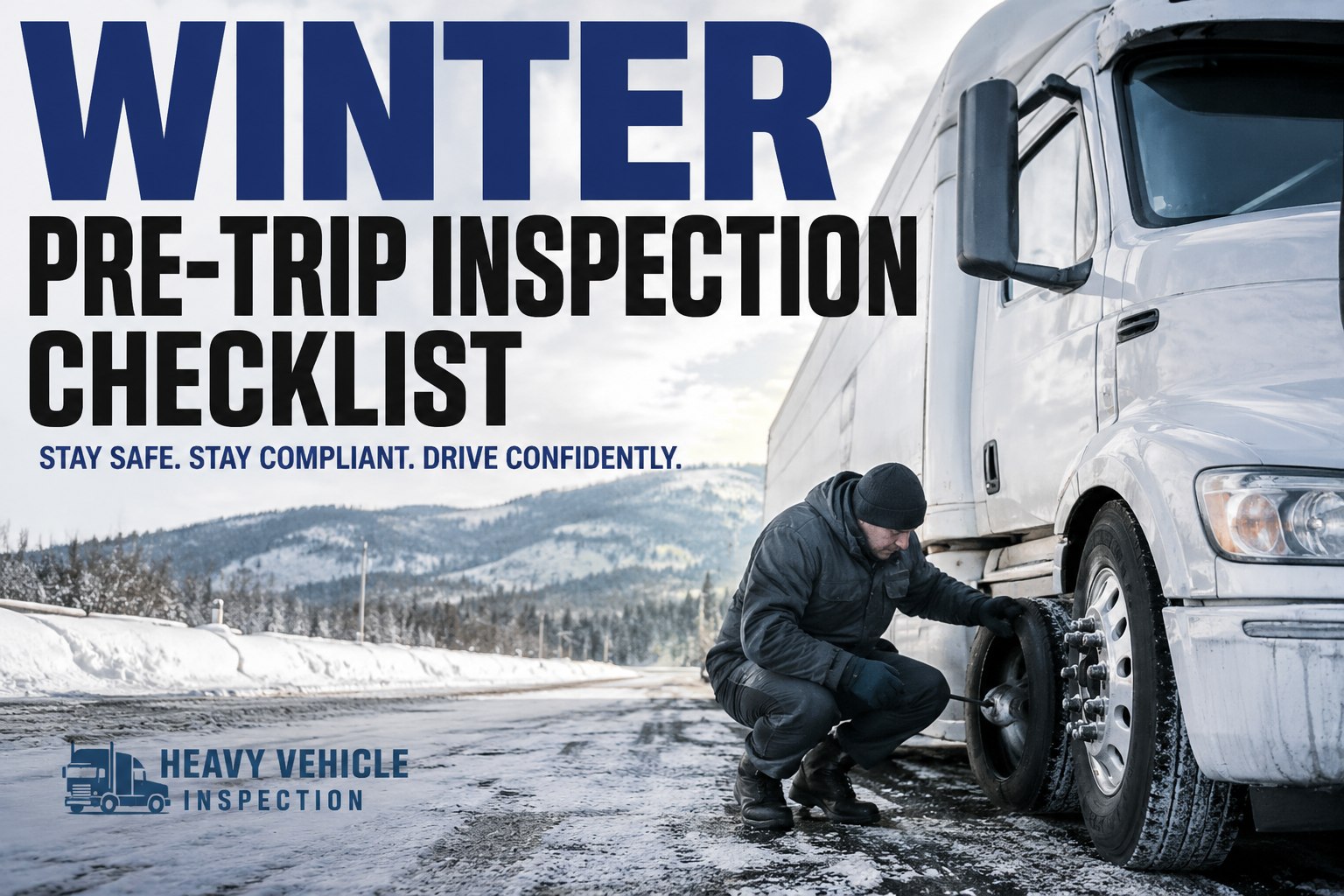
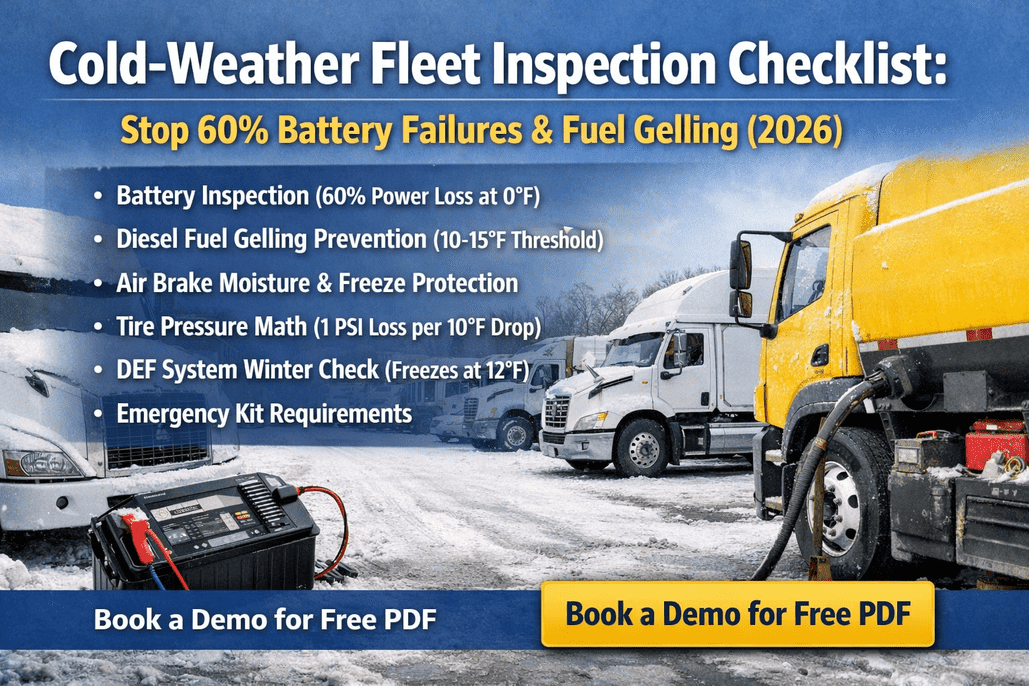
A winter pre-trip inspection checklist adds seven cold-weather-specific checks on top of the standard §392.7 walkaround. Water freezes at 32°F, DEF crystallizes at 12°F, #2 diesel gels around 10-15°F, and engine cold-starts get risky below -20°F. Each temperature threshold triggers different pre-trip failure modes a summer checklist doesn't catch. Skip the winter overlay,and one breakdown covers a season of prevention costs. Book an HVI demo for winter pre-trip templates.
Six temperature thresholds. Six different pre-trip failure modes.
The colder it gets, the more the truck fails in specific, predictable ways. Winter pre-trip inspection is about knowing which threshold you're operating at and what fails at that threshold.
Condensation in wet tank begins to freeze. Diesel cloud point starts. Windshield washer fluid must be winter-rated. Pre-trip: drain air tanks completely, confirm winter washer fluid.
Marginal batteries fail to start engines. Air brake seal elasticity drops. Tire pressure drops 1 PSI per 10°F. Pre-trip: verify battery condition and voltage, check tire pressure with digital gauge.
Diesel Exhaust Fluid freezes at 12°F due to 32.5% urea content. Modern trucks have DEF tank heaters but pre-trip must confirm they're functional. Diesel cloud haze visible.
Paraffin wax crystallizes and clogs fuel filters. Winter-blended fuel required (or #1 diesel or anti-gel additive). Pre-trip: verify fuel is winter-blended, spare fuel filter on board.
15W-40 conventional oil is too viscous to protect at start. 5W-40 synthetic required or block heater mandatory. Rubber seals lose elasticity. Pre-trip: confirm block heater plugged in during shutdown, oil rating correct.
Air brake system moisture freeze-up common even with drained tanks. Requires alcohol-injection air dryer, #1 diesel, block heater plus fuel tank warmer. Pre-trip: full 15-minute cold-weather protocol.
Why the winter pre-trip is different from the summer walkaround
Under 49 CFR §392.7 the driver must be satisfied the vehicle is in safe operating condition — the standard doesn't change with the seasons. What changes is the physics of the vehicle. Four cold-weather realities make certain failure modes far more likely in winter than in mild weather.
Diesel truck air brake systems accumulate water from condensation. In summer, water sits harmlessly in the wet tank. In winter, water freezes and can block air lines, jam valves, or cause brake lockup mid-route. The pre-trip air tank drain is the single most important winter-specific check.
A battery rated 800 CCA at 0°F delivers only 65-75% of its cranking capacity at that temperature, and 40-50% at -20°F. Batteries that started every day in September fail to start in December. Pre-trip voltage check catches this before dispatch.
Diesel Exhaust Fluid crystallizes at 12°F. Standard #2 diesel gels around 10-15°F. Both problems block flow and shut down the engine. Winter-blended fuel and functional DEF tank heaters are non-negotiable when temperatures drop into the teens.
Tire pressure drops approximately 1 PSI per 10°F drop from summer highs. A tire aired to 105 PSI in August reads 90-95 PSI in January — that's under-inflation territory, accelerated wear, and increased blowout risk. Winter pre-trip requires pressure verification with a digital gauge on every tire.
Every one of the four realities compounds when regional winter driving brings snow, ice, and wind chill. The winter pre-trip is where the fleet's ability to keep operating through the season is determined. Winter breakdown costs run 3-5x normal roadside assistance rates once cold weather compounds the failure. Book an HVI demo to see winter-configured pre-trip templates with temperature-triggered checkpoints
The 8 winter-specific system checks (beyond the standard pre-trip)
Below is the winter overlay — the 8 system checks that layer on top of the standard 11-component §392.7 pre-trip. Each system has cold-weather-specific failure modes and pre-trip verification steps.
- Drain all air tanks fully (wet tank first, then service tanks) — check for water discharge
- Verify air dryer alcohol reservoir if equipped (extreme cold operations)
- Check air compressor governor cut-in / cut-out cycle
- Test parking brake application & release under load
- Inspect air lines for frozen kinks, ice buildup, or brittleness
- Verify DEF tank heater function on startup (indicator light or ECM confirmation)
- Check DEF fluid level; top off before extended cold-weather trips
- Inspect DEF injector heater harness for damage
- Confirm DEF quality (API-licensed source; no additives added)
- Check SCR system fault codes on dashboard before departure
- Voltage check with digital multimeter (target 12.6V+ resting, 13.5-14.5V running)
- Inspect battery terminals for corrosion; clean and grease if needed
- Verify battery hold-downs are tight (vibration compounds cold damage)
- Check alternator belt tension & condition (belts stiffen in cold)
- Confirm block heater connection during previous shutdown
- Verify tire pressure on every tire with digital gauge (accounts for 1 PSI/10°F drop)
- Inspect tread depth — 4/32″ front, 2/32″ drive/trailer minimum
- Check for irregular wear, cuts, or exposed cord (freeze-thaw accelerates damage)
- Verify chains are on board and in serviceable condition (per route requirements)
- Confirm chain law compliance for planned route (CA, CO, OR, WA vary by elevation)
- Verify winter-blended fuel or #1 diesel for expected temperatures
- Confirm anti-gel additive dosed per manufacturer if using untreated #2
- Check fuel filter housing for water separator drain (drain if temperature dropping)
- Inspect fuel lines for kinks, cracks, or ice on external surfaces
- Carry spare fuel filter for cold-weather emergency replacement
- Verify antifreeze concentration rated for lowest expected temperature (test strip or refractometer)
- Inspect coolant hoses for stiffness, cracks, or bulging
- Confirm coolant level at expansion tank — top up with pre-mixed if needed
- Check for coolant leaks around water pump, radiator, and hoses
- Verify radiator shutters (if equipped) operate correctly for cold-weather warmup
- Verify cab heater function — must provide adequate heat for driver comfort
- Confirm defroster clears windshield and side windows within 5 minutes
- Check windshield wiper blades — winter blades recommended below 20°F
- Verify washer fluid is winter-rated (-25°F minimum, -40°F for extreme regions)
- Test mirror heaters if equipped — essential for visibility in snow conditions
- Verify §393.95 emergency equipment (triangles, fire extinguisher, spare fuses)
- Confirm cold-weather kit on board (blanket, boots, gloves, high-visibility jacket)
- Water, non-perishable food for 24-hour stranding scenario
- Sand or ice-melt for traction (in addition to chains)
- Charged phone, backup battery pack, working flashlight
Together the 8 systems form the winter overlay — 40-50 additional checkpoints on top of the standard pre-trip framework. Total winter pre-trip duration typically 25-40 minutes vs 15-30 minutes in mild weather. Try HVI free to configure winter overlay templates that auto-activate when regional temperatures drop below threshold.
The 4 most common winter breakdown scenarios
Aggregated across roadside assistance data, fleet incident reports, and TMC winter guidance, four breakdown scenarios account for the majority of unplanned winter downtime. Every one is preventable with a proper winter pre-trip.
Overnight moisture in air tanks freezes; driver builds air pressure at startup but brakes won't release, or brakes apply and won't release mid-route. Cost: $500-$1,500 for road service plus 4-8 hours downtime. Prevention: Daily wet tank drain plus alcohol-injection air dryer in extreme cold operations.
DEF tank heater failure allows DEF to crystallize; SCR system faults; engine enters derate mode within a few miles of startup. Cost: $800-$2,000 for tow and reset plus dispatch disruption. Prevention: Verify DEF heater function at every winter pre-trip; confirm heater harness integrity.
Untreated #2 diesel gels in fuel line or filter; engine dies and won't restart until warmed. Cost: $600-$1,500 for fuel filter replacement and additive treatment, plus load delay penalties. Prevention: Winter-blended fuel confirmed before dispatch; anti-gel additive dosed proactively.
Battery survives fall temperatures but fails at first hard freeze; truck won't crank. Cost: $200-$400 for jump-start or battery replacement, plus 2-6 hours dispatch delay. Prevention: Voltage check at every winter pre-trip; replace batteries showing degradation before December.
Every scenario is a winter pre-trip finding that got missed. A 25-minute winter walkaround prevents thousands of dollars in road service, dispatch disruption, and driver dead-time. The math is unambiguous. Book an HVI demo to model winter breakdown prevention economics for your fleet Or start a free trial and configure winter templates before the first hard freeze.
From a Fleet Safety Manager running 210 tractors through prairie winters
We operate 210 tractors across Minnesota, North Dakota, and Manitoba. December through February we see -30°F to -40°F windchills consistently. Our old summer pre-trip form worked fine 8 months a year and killed us 4 months a year. Drivers weren't skipping inspections — they were doing the same 11-component walkaround in a snowstorm as they did in July, and the winter-specific stuff just wasn't on the form.
We added a temperature-triggered winter overlay to our digital pre-trip last October. When forecast highs go below 32°F, the app auto-adds the 40-checkpoint winter overlay. When highs go below 0°F, it adds the extreme-cold protocol. Winter breakdowns dropped 54% in year one and we cut roadside assistance spend by $180,000 on 210 trucks. Winter pre-trip isn't a longer walkaround — it's a different one. The digital overlay made that structural.
Frequently asked questions
What's included in a proper winter pre-trip inspection?
A proper winter pre-trip inspection includes the standard 11-component §392.7 walkaround (service brakes, parking brake, steering, lighting, tires, horn, wipers, mirrors, coupling devices, wheels and rims, emergency equipment) PLUS an 8-system winter overlay adding 40-50 cold-weather-specific checkpoints. The 8 winter systems are: Air Brake System (drain all tanks, verify air dryer alcohol reservoir, test parking brake, inspect air lines for ice or brittleness), DEF & SCR System (verify DEF tank heater function, check DEF fluid level, inspect DEF injector heater harness, confirm DEF quality, check SCR fault codes), Battery & Electrical (voltage check with digital multimeter, terminal corrosion inspection, alternator belt tension, block heater connection confirmation), Tires & Traction (digital gauge pressure check accounting for 1 PSI/10°F drop, tread depth verification, chain readiness for route requirements), Fuel System (winter-blended fuel or #1 diesel verification, anti-gel additive confirmation, water separator drain, spare filter on board), Cooling & Coolant (antifreeze concentration test, hose stiffness inspection, coolant level, radiator shutter function), Cab Environment (heater and defroster function, winter wiper blades, winter-rated washer fluid, mirror heater test), and Winter Emergency Kit (§393.95 items plus blanket, food, water, sand/ice-melt, backup phone charger). Total time: 25-40 minutes vs 15-30 minutes for a mild-weather pre-trip.
At what temperature does diesel fuel gel?
Standard #2 diesel fuel has multiple relevant temperature thresholds. Cloud point (first visible sign of trouble): 14-32°F depending on fuel batch. At the cloud point, paraffin wax crystals begin forming and give the fuel a cloudy or hazy appearance. Cold Filter Plugging Point (CFPP): typically 10-20°F for untreated #2 diesel. At CFPP, wax crystals begin plugging fuel filters. Pour point (fuel stops flowing): 10-15°F for standard #2 diesel. Below the pour point, fuel won't pump through fuel lines. Winter-blended fuel (typically a #1/#2 diesel blend with additives) is functional to approximately -25°F. Pure #1 diesel resists gelling down to -40°F but produces less energy per gallon and reduces fuel economy. Anti-gel additives improve cold-flow properties on untreated #2 by 10-15°F when dosed proactively. For pre-trip inspection: below 20°F ambient temperature, verify the fuel is winter-blended or that anti-gel additive has been dosed at the correct ratio for the expected temperature. Carry a spare fuel filter for emergency roadside replacement. Never allow the fuel level to fall below ½ tank in extreme cold; low fuel level allows condensation and creates water-in-fuel issues that compound gelling problems.
Can DEF freeze — and what happens if it does?
Yes. Diesel Exhaust Fluid (DEF) freezes at 12°F (-11°C) due to its 32.5% urea content. This is a physical property of the fluid and cannot be modified with additives — adding anti-gel or antifreeze compounds destroys DEF quality and disables the SCR system. Modern Tier 4 trucks are engineered with DEF tank heaters and DEF line heaters that thaw the fluid on startup and maintain it above freezing during operation. The regulatory tolerance is generous: the truck is permitted to operate for approximately 20 minutes on frozen DEF as the heater thaws the fluid, then normal SCR operation resumes. If the DEF heater is non-functional, the SCR system faults, the truck enters derate mode (typically 55 mph maximum or reduced power), and eventually shuts down until repaired. Pre-trip winter checks require verifying DEF heater function (indicator light on startup or ECM confirmation), inspecting the DEF injector heater wiring harness for damage, and confirming DEF fluid quality. Never add antifreeze, alcohol, or anti-gel additives to a DEF tank — these compromise the SCR chemistry and typically require complete DEF system flush and fluid replacement, which can cost $1,500-$3,500. Store spare DEF containers indoors or in heated compartments to prevent them from freezing before use.
How do I prevent air brake freeze-up in winter?
Air brake freeze-up is caused by water condensation in the compressed air system, and prevention is a multi-step process starting at the daily pre-trip. Step 1: Drain all air tanks completely at the end of every shift, starting with the wet tank (the closest tank to the compressor) and working through each service tank. Water discharges as visible liquid; if you hear water in a tank, drain until only air comes out. Step 2: Verify the air dryer is functioning correctly. Modern trucks have a desiccant air dryer that removes moisture before it enters the tanks. Check for the purge cycle at each compressor cut-out (audible pop or hiss). Step 3: For extreme cold operations (regularly below 0°F), install and maintain an alcohol-injection air dryer or automatic alcohol evaporator. These inject methanol into the compressed air stream to lower the freeze point of any residual moisture. Step 4: Never operate a truck showing signs of an air system problem in winter — a small leak becomes a frozen locked brake within hours. Step 5: If brakes freeze while parked, warm the truck in a heated bay and drain water once thawed. Never operate a truck with frozen air brakes; the risk of stuck-applied or stuck-released brake failure mid-route is a genuine safety emergency. Pre-trip should include running the parking brake application/release cycle multiple times to verify function under load in cold conditions.
Are chains required by law in winter — and how do I check compliance?
Chain requirements vary by state and specific route. California, Colorado, Oregon, Washington, and several other Western states have "chain law" requirements that trigger on specific highways above specific elevations during posted conditions. Under California VC §605, commercial vehicles must carry chains when traveling any highway where chain-up conditions could reasonably be encountered. Chain law violations carry fines from $150 to $500 per violation depending on the state, with the truck being placed out-of-service if operating on posted chain-required roads without chains. FMCSA doesn't publish a federal chain requirement, so state law governs. Pre-trip chain compliance checks: (1) Verify chains are on board — count the required number for your rig configuration (typically 4-8 chains for a tractor-trailer depending on state and axle configuration). (2) Inspect chains for serviceable condition — no missing links, no cross-chain damage, all binders functional. (3) Confirm chain law status for your planned route via 511 or state DOT alerts; several states have real-time chain-required updates. (4) Verify you have the correct chain style for your route — some states require true chains (not cables or alternative traction devices) on commercial vehicles. (5) Ensure chain installation tools are on board (mat or gloves for putting chains on, tension tool for tightening). Digital pre-trip apps can integrate weather and chain-law feeds so the winter overlay auto-activates chain-verification checkpoints when the planned route includes chain-required territory.
Every truck. Every winter check. Every temperature threshold.
HVI's driver inspection module ships with a temperature-triggered winter overlay adding 40-50 cold-weather-specific checkpoints to the standard pre-trip when regional temperatures cross configurable thresholds. Air tank drain confirmation, DEF heater verification, chain compliance, battery voltage, winter-blend fuel — all captured with photo evidence, GPS-timestamped signatures, and audit-trail retention. Deploy before the first hard freeze; typical winter breakdown reduction 40-60% in year one.
Chain-law feed integration · DEF heater alerts · Weather-triggered overlays · CSA-safe audit exports
.png)