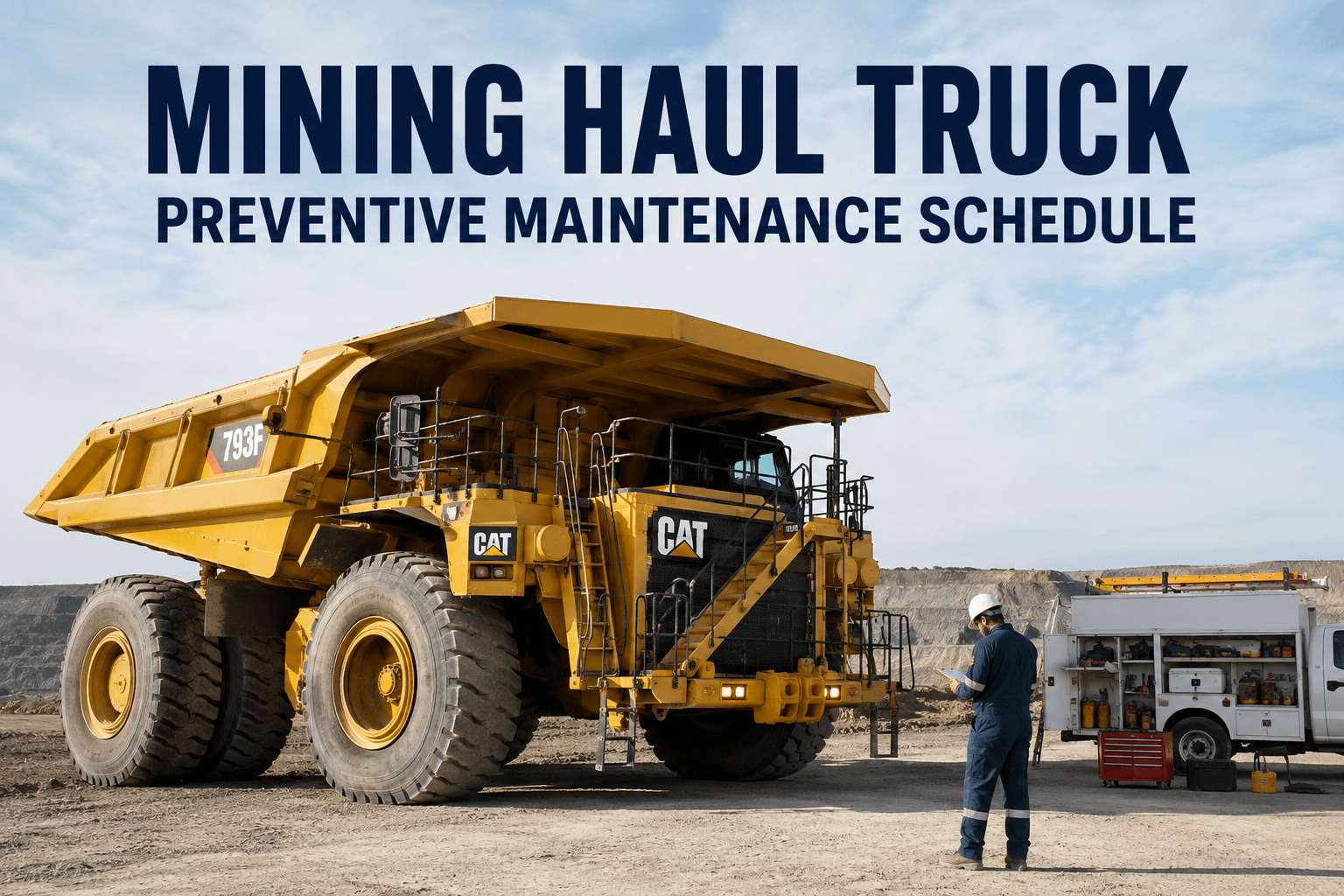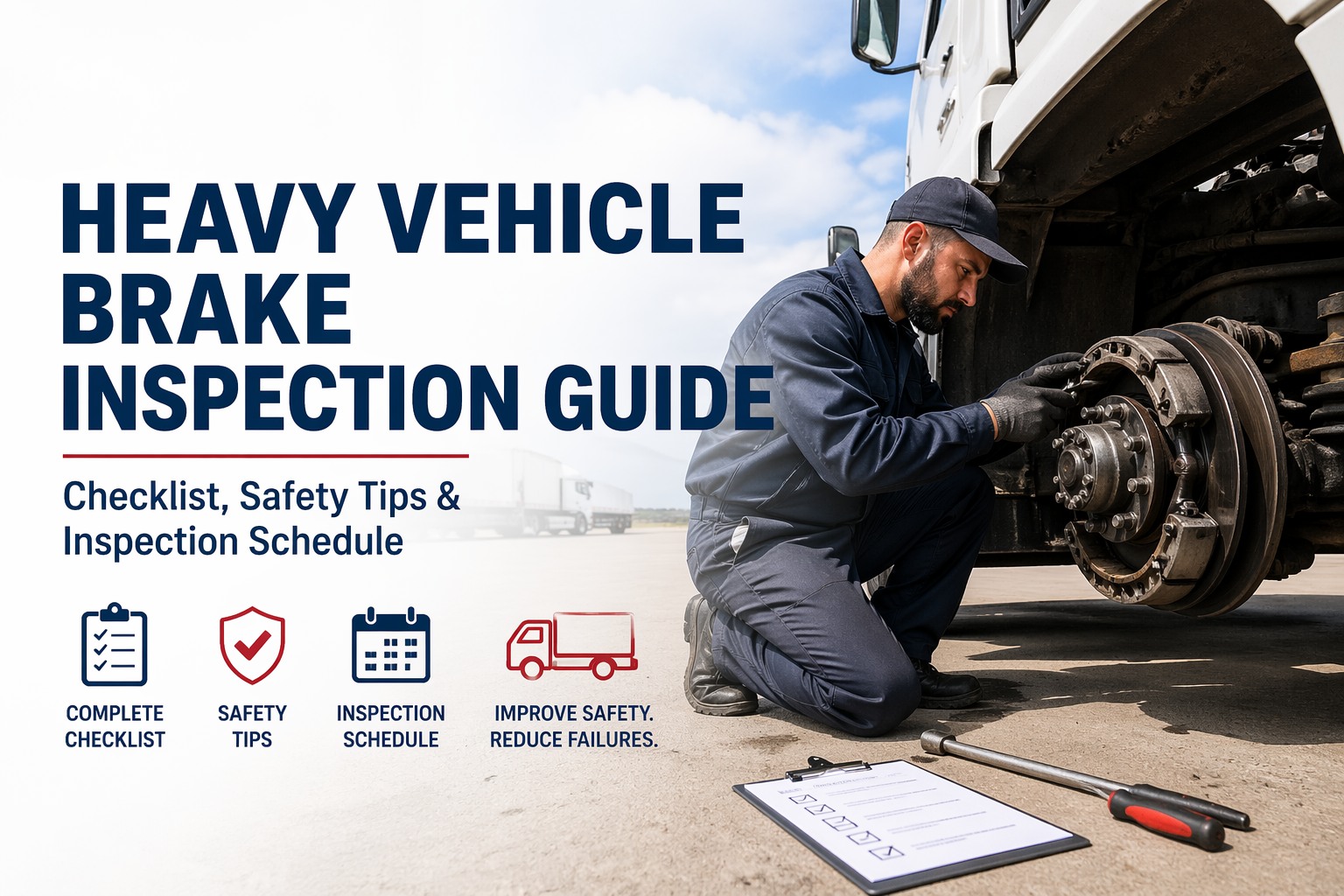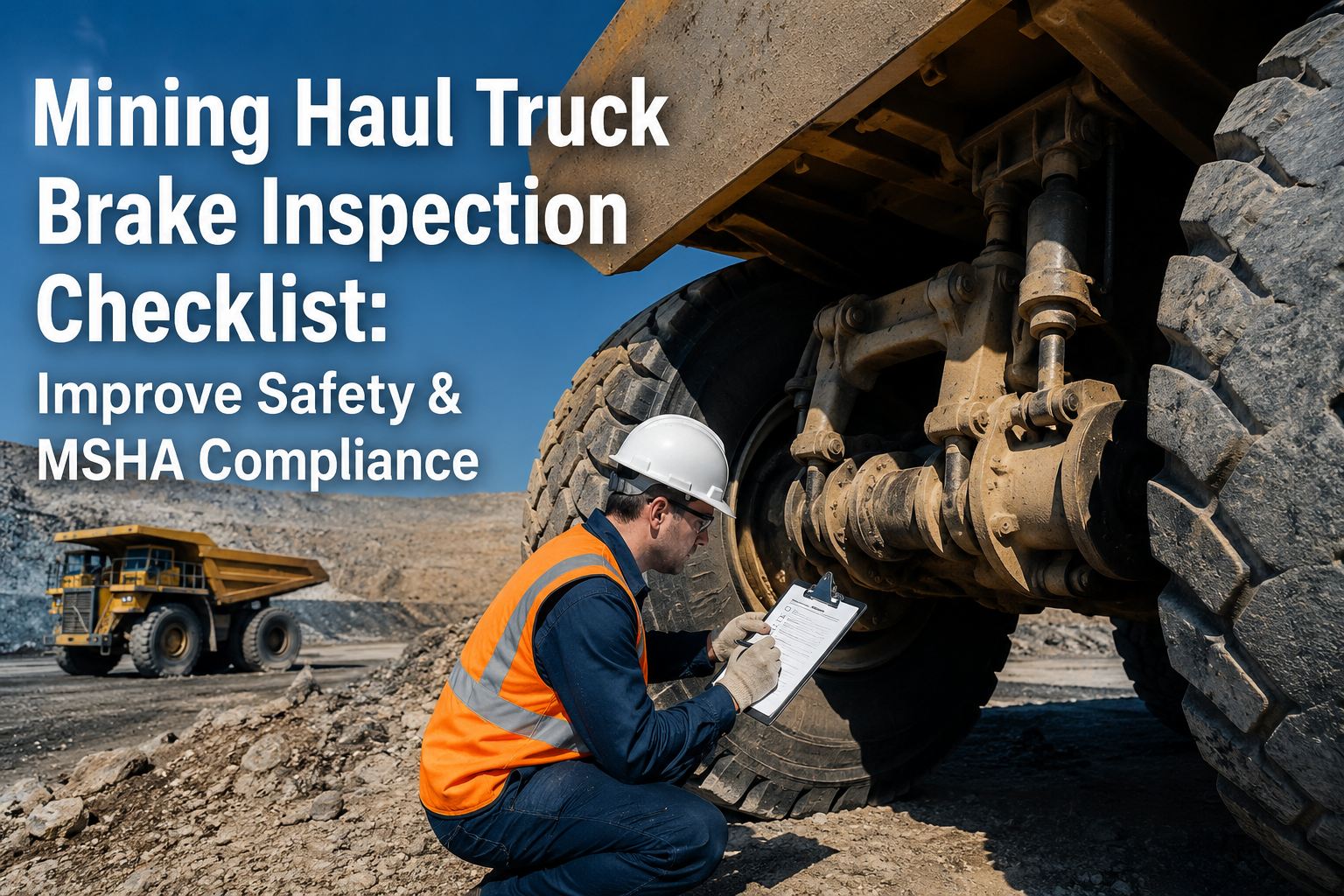
A loaded mining haul truck is the heaviest vehicle most people will ever stand near — a Cat 793 or Komatsu 980E carries 250 to 400 tons of payload down grades that run 8 to 10% for thousands of feet. The only thing standing between that mass and a catastrophe is the brake system, and it's not one system but four working together: service brakes to stop, a retarder to control speed on the descent, a parking brake to hold on grade, and a secondary or emergency brake as the last line of defense. When any one of them is degraded, the failure mode isn't a fender-bender — it's a runaway truck, which is why brake-related problems account for roughly 30% of haul truck incidents. That's also why MSHA wrote a brake standard specifically for this equipment, 30 CFR 56.14101, requiring service brakes capable of stopping and holding the loaded truck on the steepest grade it travels and a parking brake that holds it there — and why self-propelled mobile equipment must be inspected before every shift, with any safety defect tagged out until repaired. This guide is your mining haul truck brake inspection checklist: the four braking systems, the MSHA rules behind them, the daily pre-shift brake check, the retarder and downhill-descent discipline, and how heat and wear are caught before they cascade. book a 30-minute walkthrough to see it set up for your fleet.
Four braking systems, 400 tons, a 10% grade. The pre-shift brake check is the whole margin of safety.
HVI runs the haul truck brake inspection from a phone or tablet — service, retarder, parking, and secondary systems, oil-cooled disc condition, hydraulics, and the grade-hold check — to MSHA 30 CFR 56.14101, flags any defect, tags an unsafe truck out of service, and keeps the audit-ready record, fully offline in the pit.
Why haul truck brakes carry the highest stakes
On an ultra-class truck, a brake defect isn't a downtime problem — it's a life-safety one, and the cost of getting it wrong runs in both lives and dollars.
A runaway is the failure mode
Picture the worst case: a fully loaded truck on a long pit ramp loses the ability to control its speed. Service brakes alone can't hold hundreds of tons on a sustained grade — they overheat and fade — which is why the retarder does the continuous work of the descent. If the retarder fails and the operator falls back on service brakes that then fade, the truck accelerates with nothing left to stop it. That's the chain a brake inspection breaks. Each of the four systems exists to cover a different failure, and the pre-shift check confirms all of them are ready before the truck takes its first loaded trip down the grade.
The four braking systems
A haul truck's brakes are an integrated set, each with a distinct job. Understanding what each does is knowing why each is checked.
Service brakes
Oil-cooled, multi-disc brakes on front and rear axles are the primary system that stops the truck. They must be able to stop and hold the loaded truck on the steepest grade it travels, and they're checked for response and any unusual sound or air loss.
Retarder / dynamic brake
The retarder controls speed on a descent without using the service brakes, so they don't overheat and fade. Often with automatic retarder control, it's the system that does the continuous work downhill — its function must be confirmed every shift.
Parking brake
Often spring-applied and integrated with the gear selector, the parking brake must hold the loaded truck stationary on the maximum grade it operates on — an explicit MSHA requirement, and a key pre-shift verification.
Secondary / emergency brake
A spring-applied, pressure-release emergency system is the last line of defense, engaging automatically if system pressure is lost. Its readiness and warning indicators are confirmed so the backup is there if a primary system fails.
No single system is the whole answer — service brakes stop, the retarder controls the descent, the parking brake holds, and the secondary catches a failure. sign up free and check all four systems on every pre-shift, or book a demo to see haul-truck brake templates.
What MSHA 30 CFR 56.14101 requires
The federal brake standard sets two performance bars and a test method. Knowing them is the foundation of a compliant brake program.
Service brakes hold on grade
Self-propelled mobile equipment must have service brakes capable of stopping and holding the equipment with its typical load on the maximum grade it travels. This is the core performance requirement the daily check supports.
Parking brake holds the load
If equipped, the parking brake must hold the equipment with its typical load on the maximum grade it operates on. Verifying the park brake holds on grade is a direct pre-shift compliance check.
The service-brake performance test
When an inspector has cause, a test runs at 10–20 mph with a typical load, measuring stopping distance against Table M-1. Retarders may be used, but parking and emergency brakes may not be actuated during the test.
Pre-shift & tag-out
Under 30 CFR 56.14100, the truck is inspected before each shift; brake defects affecting safety must be reported and the truck tagged out and removed from service until repaired.
Brakes are consistently among MSHA's most-cited standards, and the consequences of a citation escalate fast — from civil penalties to unwarrantable-failure findings and pattern-of-violation status. Mining trucks are typically designed to the SAE J1473 standard, stopping a loaded truck from 30 mph on an 8–10% downgrade within 350 feet, which is why the grade-hold and stopping performance matter so much. HVI structures the brake check around these exact requirements. book a demo to see MSHA-aligned brake inspections.
The daily brake inspection checklist
This is the pre-shift brake walk-around and function check, before the truck takes its first load. Each item is a pass-or-pull decision.
A full ultra-class pre-shift runs 25–40 minutes across all systems, and the brakes are the section where a missed defect is least survivable. sign up free and run the brake check on a phone, photo-verified and offline in the pit.
The retarder & the downhill descent
The most dangerous moment in a haul cycle is a loaded descent, and the retarder is the system that manages it. This is where brake discipline matters most.
The retarder does the work
On a sustained downgrade, the retarder — not the service brakes — controls speed, because friction brakes would overheat and fade under continuous use. A failed or weak retarder forces the service brakes into a job they can't sustain.
Match grade, weight & speed
A combination of grade and load that exceeds retarder capacity is dangerous. Operators check the manual for the truck's grade-speed limits, and on grades over 10% extra caution is required — the pre-shift confirms the retarder is fully functional first.
Watch the brake temperature
Rising brake-oil temperature on a descent is the early warning of fade. Monitoring brake temp gauges and the cooling system, and catching abnormal heat on the pre-shift, prevents the overheating that ends in a runaway.
no runaway. The entire braking architecture of a haul truck is built around one principle: never ask the service brakes to do, by friction alone, what the retarder is designed to do continuously. A pre-shift that confirms the retarder engages, the cooling oil flows, and the brake temperatures read normal is what keeps a loaded descent controlled. Confirm the retarder before the grade, every shift — it's the difference between a routine haul and a catastrophe. HVI makes the retarder and brake-cooling check a required step.
Heat, wear & the cascade
Brakes degrade gradually, and the warning signs show up on the pre-shift before they become failures. Catching them early is the whole point of the daily check.
Heat is the enemy
Excess heat degrades oil-cooled brake performance and the cooling system that protects it. Abnormal brake temperatures, low cooling-oil level, or a fouled cooler are early signs that the system's heat margin is shrinking.
Disc & oil wear
Multi-disc brakes wear over thousands of hours, and contaminated or degraded brake oil accelerates it. Trending oil condition and brake response over time catches a fading system before it fails on a grade.
Catch it on the pre-shift
A soft pedal, a slow retarder, a creeping temperature, a small leak — logged today, these are the gradual warnings a brake system gives. Trended per truck, they predict the failure and drive a planned repair.
Every brake failure on a loaded descent was preceded by warning signs a disciplined pre-shift would have caught and logged. sign up free and trend brake condition per truck to catch fade before it happens.
Paper checklists vs. HVI
Both technically record a brake check. Only one verifies all four systems and the grade-hold, tags an unsafe truck out of service, trends brake condition, and keeps the MSHA record.
Paper / reactive
- "Brakes OK" with no system-by-system detail
- Parking-brake grade-hold never verified
- Retarder & secondary brake assumed, not checked
- Rising brake temperatures noticed too late
- Defects on paper, truck runs the grade anyway
- No MSHA brake record when an inspector asks
With HVI software
- All four brake systems checked, photo-verified
- Grade-hold & §56.14101 items built in
- Retarder & secondary confirmed every shift
- Brake temp & condition trended per truck
- A brake defect tags the truck out of service
- One-click MSHA audit export, works offline
of incidents — preventable at the pre-shift. Brake problems drive roughly 30% of haul truck incidents, and on an ultra-class truck a brake failure on a loaded descent is among the most catastrophic events on a mine. A pre-shift that verifies all four braking systems, confirms the grade-hold MSHA requires, and trends heat and wear before they cascade is the single highest-value safety check on the machine. HVI makes that check required, documented, and impossible to skip — even offline in the pit.
Frequently asked questions
What should a mining haul truck brake inspection include?
A haul truck brake inspection checks all four braking systems before each shift. The service brakes — typically oil-cooled multi-disc brakes on front and rear axles — are tested at slow speed for a firm, even stop with no unusual sound, grab, or pull, and must be able to stop and hold the loaded truck on the steepest grade it travels. The parking brake is verified to hold the truck stationary on its maximum operating grade, which is an explicit MSHA requirement. The retarder, or dynamic brake, is confirmed to engage and control speed on a descent. The secondary or emergency brake — usually spring-applied and pressure-released — is checked for readiness and its automatic apply on pressure loss. Beyond the four systems, the inspection covers brake and hydraulic fluid levels and leaks, the cooling-oil system, air and hydraulic pressure building and holding, the low-pressure warning, and the brake-temperature, pressure, and retarder-status gauges. Any brake defect affecting safety means the truck is tagged out until repaired. HVI's inspection and maintenance software provides a haul-truck brake template covering all of this. sign up free and run the full brake check.
What does MSHA 30 CFR 56.14101 require for brakes?
The standard sets two performance requirements and a test method. Under 56.14101(a)(1), self-propelled mobile equipment must have a service brake system capable of stopping and holding the equipment with its typical load on the maximum grade it travels. Under (a)(2), if the equipment has a parking brake, it must be able to hold the equipment with its typical load on the maximum grade it operates on. The standard also defines a service-brake performance test in subsection (b), conducted when an MSHA inspector has reasonable cause to believe the brakes don't meet the requirement: the truck is run at a constant speed between 10 and 20 mph with a typical load and its stopping distance is measured against Table M-1, using only the braking systems designed to stop it under normal conditions — auxiliary retarders are allowed, but parking and emergency brakes may not be actuated during the test. Mining trucks are generally designed to the SAE J1473 standard, stopping a loaded truck from 30 mph on an 8–10% downgrade within 350 feet. Brakes are among MSHA's most-cited standards. HVI's inspection and maintenance software builds these requirements into its brake templates. book a demo to see MSHA brake compliance.
Why is the retarder so important on a haul truck?
Because it's the system that controls a loaded truck's speed on a descent, and a haul truck's most dangerous moment is going down a long, steep grade with hundreds of tons of payload. Service brakes work by friction, and if they're used continuously to hold speed on a sustained downgrade they overheat and fade — losing effectiveness exactly when they're needed most. The retarder, or dynamic brake, does that continuous speed-control work instead, without generating the same heat in the friction brakes, so the service brakes stay cool and available for actual stops. If the retarder fails or is weak and the operator falls back on the service brakes, those brakes can fade and the truck can accelerate downhill with nothing left to stop it — a runaway. A combination of grade and load that exceeds the retarder's capacity is also dangerous, which is why operators check the manual for grade-speed limits and use extra caution on grades over 10%. Confirming the retarder works, and watching brake temperatures on the descent, is critical. HVI's inspection and maintenance software makes the retarder and brake-cooling check a required pre-shift item. sign up free and verify the retarder every shift.
How often must haul truck brakes be inspected?
Under MSHA 30 CFR Part 56/57, self-propelled mobile equipment including haul trucks must be inspected before being placed in operation each shift, and that pre-shift inspection includes the brakes. Any defects affecting safety must be reported, and equipment with a safety defect must be tagged out and removed from service until the repair is complete. So the baseline is a documented brake check every single shift, performed by the operator. Layered on top of the daily pre-shift, the brake system also receives deeper scheduled preventive maintenance — disc and oil condition, cooling system, and full function testing — fired on the truck's operating hours at the manufacturer's intervals. The daily check catches developing problems like a soft pedal, a slow retarder, or rising temperatures, while the scheduled PM addresses wear before it reaches a limit. Because brake failures cause roughly 30% of haul truck incidents and the consequences are catastrophic, both the daily discipline and the documentation matter. HVI's inspection and maintenance software runs the pre-shift brake check and fires hour-based brake PM automatically. book a demo to see brake PM scheduling.
How does HVI help with haul truck brake inspections?
HVI is an inspection and maintenance software platform built for mining fleets, including ultra-class haul trucks like the Cat 793 and 797F, Komatsu 980E, Liebherr T 284, and BelAZ 75710. Operators run the pre-shift brake inspection from a phone or tablet using a haul-truck-specific template that checks all four braking systems — service, retarder, parking, and secondary — plus the oil-cooled disc condition, brake and hydraulic fluids and cooling, system pressure, and the brake-temperature and retarder-status gauges, with mandatory photo capture on defects, and it works fully offline in the pit where there's no cell signal. The template includes the MSHA 30 CFR 56.14101 grade-hold checks, a brake defect tags the truck out of service per the tag-out requirement, and every defect auto-creates an assigned work order. The platform trends brake condition and temperature per truck to catch fade before it cascades, fires hour-based brake PM, and exports a one-click MSHA audit record. book a demo and we'll map the software onto your fleet on the call.
Verify all four braking systems before the first loaded descent — every shift, every truck.
HVI runs the haul truck brake inspection from a phone — service, retarder, parking, and secondary systems, oil-cooled disc condition, cooling, pressure, and the MSHA grade-hold checks — tags an unsafe truck out of service, auto-creates a work order from every defect, trends brake heat and wear per truck, and exports a one-click MSHA record, fully offline. Keep every loaded descent under control.
No credit card required · Live before your next shift · Four-system brake check + MSHA 56.14101 grade-hold + brake-temp trending + offline audit export in one platform