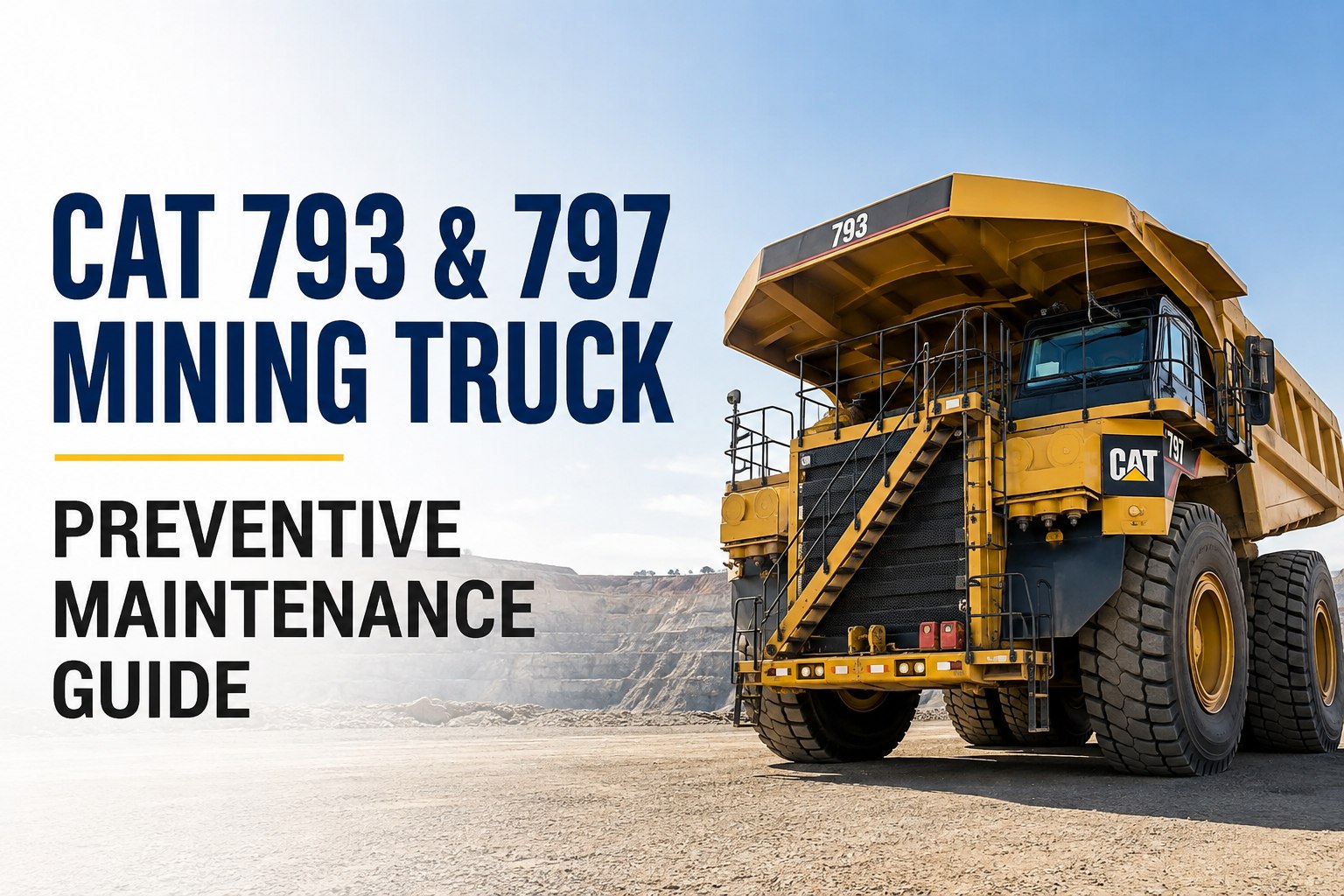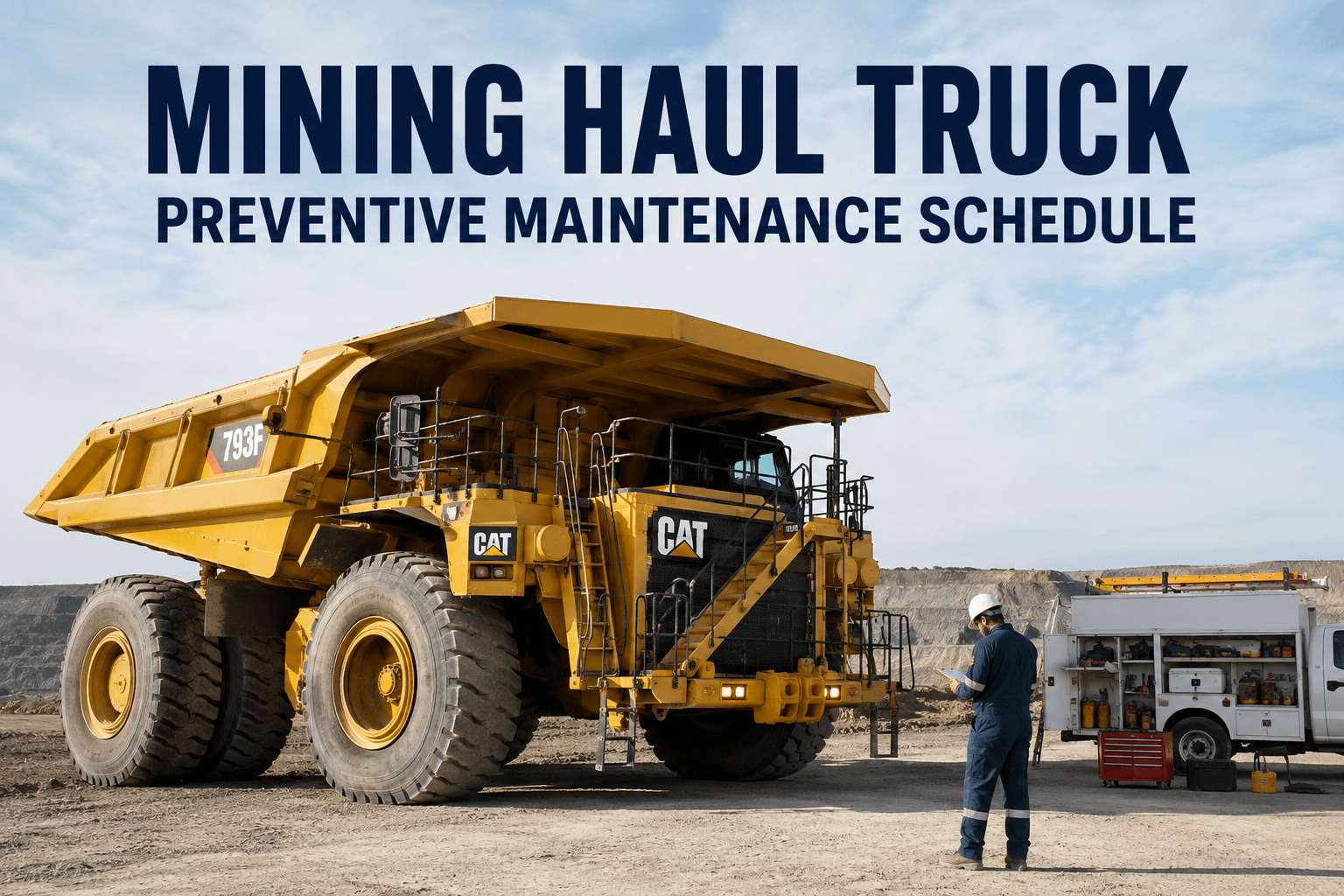
An ultra-class mining haul truck — a Cat 797 hauling 360 short tons, a Komatsu 930E at 290 tonnes — is a $5 to $8 million machine that earns its keep only when it's moving. And it moves a lot: mining equipment runs 5,000 to 7,000 hours a year, versus 1,500 to 2,500 for construction, which means a 250-hour service comes due every two to three weeks, not every two to three months. Mining conditions — dust, heat, vibration, and constant maximum load — accelerate wear 20 to 40%, so OEM intervals often need tightening, not just following. The stakes per hour are brutal: unplanned downtime on a single haul truck runs $5,000 to $20,000 an hour, an emergency repair costs about 4.8 times a planned one, and a final drive that fails unexpectedly is a $200,000 replacement. Get the preventive maintenance schedule right and a haul truck runs 100,000 to 150,000 hours before major repairs; get it wrong and performance drops 30 to 50%, pulling replacement forward by a year or two at $5 to $8 million a unit. This guide lays out the tiered PM schedule by service hours, TKPH-based tire management, the critical components that need tighter intervals, and how to keep a 24/7 fleet on schedule. HVI's mining fleet maintenance software fires every interval by real engine hours, integrates OEM telematics, and works offline in the pit. schedule a 30-minute walkthrough with our team to see it set up for your haul fleet.
A $5M truck running 6,000 hours a year. Downtime costs $20K an hour. The schedule isn't optional.
HVI fires every PM tier by real engine hours, integrates Cat MineStar and Komatsu KOMTRAX, tracks TKPH and tire health, and works offline in remote pits — so your ultra-class fleet stays on schedule and on production.
Why mining PM is a different game
Haul-truck maintenance isn't construction maintenance scaled up. The hours, conditions, and cost-per-hour change the math entirely — and explain why the schedule has to be relentless.
Because mining runs around the clock, there's no natural downtime window — PM has to be scheduled around shift changes and planned shutdowns, not "when the truck isn't in use." And because conditions accelerate wear 20–40%, the OEM interval is a starting point to tighten, not a ceiling.
The tiered PM schedule by service hours
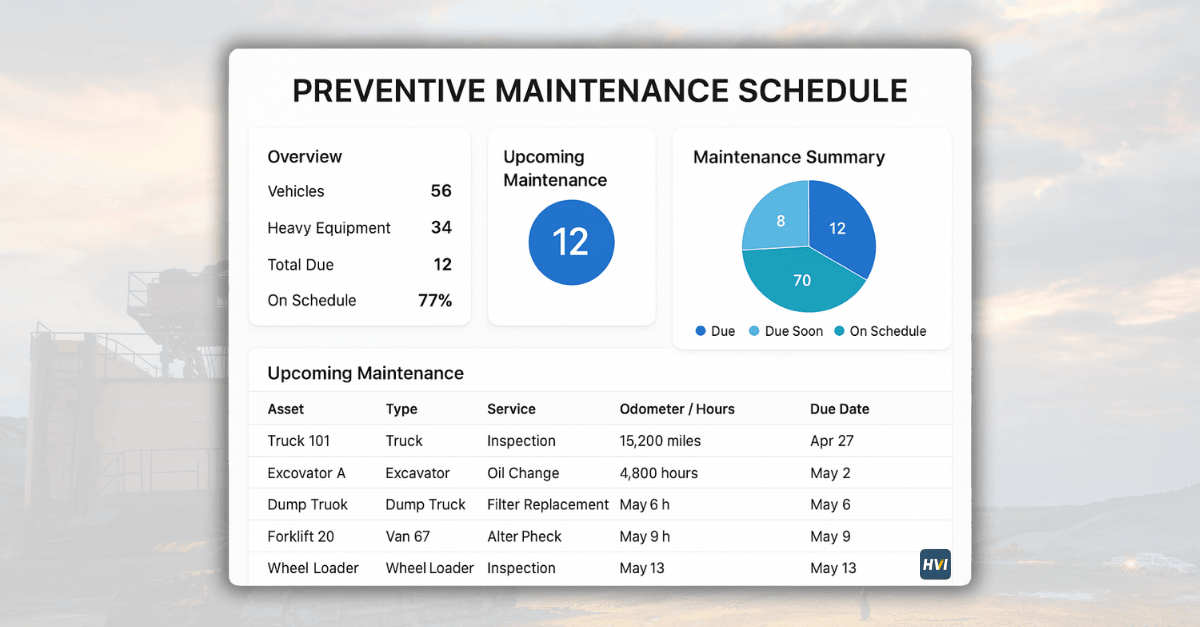
Ultra-class haul trucks follow a tiered, meter-based schedule. Each tier builds on the ones below it — and HVI fires every one automatically off real engine hours, adjusted for severe conditions.
Minor service & oil analysis
Engine oil and filters, lubrication, visual inspection, and oil sampling — oil analysis every 250 hours detects contamination and wear metals and extends engine life by around 30%. In mining, this comes due every 2–3 weeks.
Intermediate service
All 250-hour items plus deeper checks — hydraulic and brake systems, suspension struts, drivetrain inspection, and fluid sampling on major systems. Contamination control is critical: it causes 70–80% of hydraulic failures.
Major service
Comprehensive service of engine, electric-drive system, final drives, suspension, and structure, with full fluid changes and detailed component inspection against wear limits. The backbone of long-term reliability.
Powertrain rebuild
Full powertrain rebuild — engine, drive system, and final drives overhauled or replaced. Planned and budgeted from hour data, this is what carries a well-maintained truck to 100,000–150,000 hours of life.
A 250-hour service hitting every 2–3 weeks across a whole fleet is impossible to track on paper — miss one and you're into the 4.8× emergency-repair zone. sign up for a free HVI account and let every PM tier fire automatically off telematics engine hours, or schedule a live demo to see tiered scheduling adjusted for severe mining conditions.
TKPH & tire management: the biggest single cost
Tires are among the most expensive consumables on a haul truck, and heat is what kills them. Managing TKPH — tonne-kilometre-per-hour — keeps tires cool, alive, and productive.
Manage TKPH to control heat
TKPH measures the work a tire does — load times speed times distance. Keeping it within the tire's rating keeps the tire cooler, which prevents the truck from having to slow or stop and avoids premature, heat-driven tire loss.
Hold correct pressure
Keeping tire pressure in the correct range (roughly 110–130 psi on these machines) reduces failures by around 40% and improves fuel efficiency 5–10% — millions in savings across a large fleet, per Bridgestone and Michelin studies.
Monitor temperature
Extreme temperatures — above 50°C or below −30°C — drastically raise blowout risk. Thermal imaging and tire-pressure-monitoring systems are now standard on modern fleets to catch a hot tire before it fails.
A haul-truck tire program is inseparable from the PM schedule: pressure checks, TKPH tracking, and rotation belong on the same recurring cadence as oil and filters. In HVI, tire position, pressure, and condition are tracked per truck and flagged when they drift out of range.
Critical components that need tighter intervals
Not every system carries equal risk. These high-cost failure points justify shorter intervals, weekly sampling, and condition monitoring — because the replacement cost dwarfs the inspection cost.
Electric drive system
The AC drive and traction motors on a diesel-electric hauler — the most expensive single failure on the truck. Monitor continuously and inspect at every major service.
Final drives
A final-drive failure is a $200,000 replacement and major downtime. Oil sampling and wear-metal trending catch it before it strands the truck in the pit.
Hydraulic pumps & system
Contamination causes 70–80% of hydraulic failures, and one failure means 12–24 hours down and ~$500K in lost production. Clean fluid and sampling are everything.
Engine turbochargers
A turbo failure is costly and often preceded by detectable signs. Thermography and oil analysis flag it up to 30 days before failure — ample time to plan the repair.
Combining interval-based PM with condition monitoring — oil analysis, vibration, thermography — cuts unplanned downtime by as much as 75% versus intervals alone. sign up free and pair tiered PM with condition data on every critical component.
Spreadsheet PM vs. HVI mining fleet
Both run a PM schedule. Only one fires every tier off live engine hours, integrates OEM telematics, and works offline in the pit where it actually matters.
Spreadsheet / reactive
- 250-hr services missed as they hit every 2–3 weeks
- Hours logged by hand from each truck, error-prone
- Emergency repairs at 4.8× the planned cost
- Tire pressure & TKPH tracked separately, if at all
- A $200K final drive fails with no warning
- No record for MSHA pre-shift compliance
With HVI software
- Every tier fires automatically off telematics engine hours
- Cat MineStar & Komatsu KOMTRAX integrated for live hours
- Intervals auto-tightened for severe mining conditions
- Tire pressure, TKPH & position tracked per truck
- Oil-sampling & condition data flag failures early
- MSHA pre-shift checks logged, working fully offline
downtime reduction — one 215-unit mining operation cut unplanned downtime 42% and saved $3.2M a year on a $910K investment, a 352% ROI with a 3.4-month payback. Tiered PM by the hour, TKPH-managed tires, condition monitoring on critical components. HVI keeps every ultra-class truck on schedule and on production.
Frequently asked questions
What are the PM intervals for a mining haul truck?
Ultra-class haul trucks follow a tiered, meter-based schedule: a minor service every 250–500 engine hours (engine oil and filters, lubrication, inspection, and oil sampling), an intermediate service that adds deeper hydraulic, brake, suspension, and drivetrain checks, a major service every 1,000–2,000 hours covering engine, electric drive, and final drives with full fluid changes, and a full powertrain rebuild every 10,000–15,000 hours. The critical thing to understand is intensity: mining equipment runs 5,000–7,000 hours a year, so a 250-hour service comes due every two to three weeks rather than every few months. And because mining conditions accelerate wear 20–40%, OEM intervals often need tightening. HVI fires each tier automatically off real engine hours pulled from telematics, with severe-condition adjustments built in.
What is TKPH and why does it matter for haul truck tires?
TKPH stands for tonne-kilometre-per-hour — a measure of the work a tire performs, calculated from load, speed, and distance. It matters because heat is what destroys haul-truck tires, and TKPH is essentially a heat budget: operating within the tire's TKPH rating keeps the tire cool enough to survive, while exceeding it builds heat that leads to premature tire loss or, in extreme cases, blowouts. Managing TKPH lets a truck keep working without having to slow down or stop to let tires cool. Combined with correct tire pressure (around 110–130 psi, which cuts failures ~40%) and temperature monitoring via thermal imaging, TKPH management protects one of the most expensive consumables on the machine. HVI tracks TKPH, pressure, and tire condition per truck on the same cadence as the rest of the PM schedule.
How much does haul truck downtime cost?
Unplanned downtime on a single mining haul truck runs $5,000 to $20,000 per hour, driven by lost production rather than just the repair itself. The repair cost compounds the problem: an emergency repair costs about 4.8 times a planned one, and critical components are expensive — a final drive is roughly $200,000 to replace, a hydraulic-system failure means 12–24 hours down and around $500,000 in lost production, and the electric drive system can exceed $500,000. Over the machine's life, the gap is even larger: a well-maintained haul truck runs 100,000–150,000 hours before major repairs, while poor maintenance can drop performance 30–50% and pull replacement forward by a year or two at $5–8 million per unit. That economics is why preventive maintenance always wins. HVI is built to keep those trucks on schedule.
Why do mining trucks need tighter intervals than the OEM manual says?
Because mining is a far more severe duty cycle than the conditions OEM intervals are often baselined against. Constant maximum payload, abrasive dust, high heat, continuous vibration, and around-the-clock operation accelerate component wear by 20–40%. On top of that, mining equipment runs 5,000–7,000 hours a year — two to three times a construction machine — so the calendar time between services compresses dramatically. The result is that following the OEM interval to the letter can leave components under-served in real mining conditions. The best practice is to treat the OEM schedule as a starting point and tighten intervals based on actual operating conditions and, ideally, condition-monitoring data like oil analysis and vibration. HVI lets you apply site-specific adjustments to every interval and combines meter-based PM with condition data.
How does HVI help manage a mining haul truck fleet?
HVI runs the full mining PM program in one platform built for the pit. It fires tiered PM (250/500/1,000/2,000 hours) automatically off real engine hours, integrating with Cat MineStar, Komatsu KOMTRAX, and other OEM telematics so hours update without manual entry, and it applies site-specific adjustments for severe conditions. Operators run MSHA pre-shift inspections from a phone or tablet — with mandatory photo capture on defects — that works fully offline in remote pit locations and syncs when back in range. Defects auto-create work orders, oil-sampling and condition data flag critical components like final drives and hydraulics before failure, and tire pressure, TKPH, and position are tracked per truck. Everything is logged for compliance and exportable, and cost is tracked per machine. One 215-unit operation cut downtime 42% and saved $3.2M a year. schedule a demo and we will set it up around your specific haul fleet and mine site on the call.
Keep every ultra-class truck on schedule and on production.
HVI fires tiered PM by real engine hours, integrates OEM telematics, tracks TKPH and tire health, monitors your highest-cost components, and runs MSHA pre-shift checks offline in the pit. Stop paying 4.8× for emergency repairs and $20K an hour for downtime you could have planned around. Sign up free and protect a fleet of multi-million-dollar machines.
No credit card required · Live in under two weeks · Tiered PM + telematics + TKPH tire tracking + offline MSHA inspections in one platform