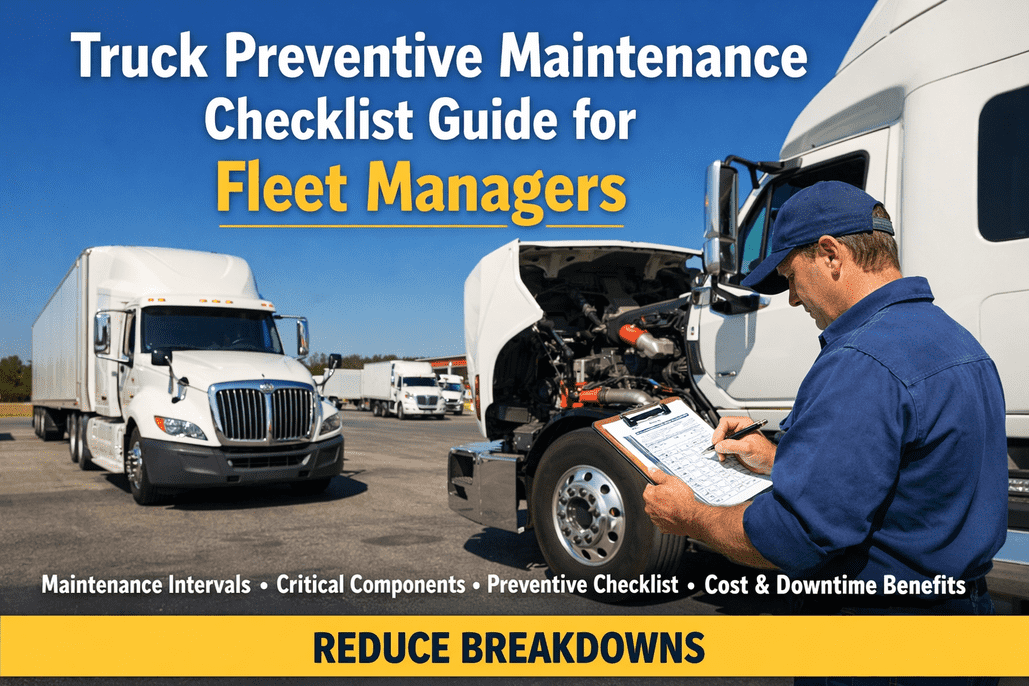
Your preventive maintenance schedule is the single most consequential document your fleet produces — and odds are nobody actually designed it. Most are inherited: a previous manager's spreadsheet, an OEM default, a "we've always done 15,000 miles" habit no one questions. That's the problem. A preventive maintenance schedule for commercial trucks isn't one interval; it's a tiered structure, a decision about what triggers each service, and adjustments for how each truck actually works. Get those three right and breakdowns become rare events instead of weekly fires. Book a demo to build a schedule designed around your fleet.
Preventive Maintenance Schedule for Commercial Trucks
Intervals by system, the duty-cycle factors that compress them, and what belongs at each service level. The schedule is a design decision — most fleets skip the design.
- One mileage interval for the whole fleet
- Nobody defined what each service includes
- Idle-heavy trucks quietly under-serviced
- Annual inspection is a scramble
- Tiered services, each defined item by item
- Trigger matched to how each truck runs
- Intervals compressed for severe duty
- Compliance on its own tracked clock
There is no single "correct" PM interval, and any chart that hands you one number is selling simplicity you can't actually use. The right schedule is built from three decisions made deliberately: the tier structure (what services exist and what each one contains), the interval basis (what clock triggers them — miles, engine hours, or calendar), and the duty-cycle adjustment (how much to compress those intervals for the way a given truck is worked). Skip any one of those and the schedule silently fails somewhere: a light service that's really a heavy one, an idle-heavy truck servicing far too late, or a compliance deadline that ambushes you. Let's build each decision properly.
Decision one: the tiered structure
The industry standard is a nested set of service levels — commonly A, B, C, and sometimes D — where each higher tier includes everything below it plus deeper work. The step most fleets skip is actually defining what each tier contains. Here's the ladder, with typical (not universal) intervals that vary by OEM, class, and duty.
Oil and filter change, chassis lubrication, fluid top-offs, and a structured safety inspection — lights, tires, belts, hoses, battery, and a visual brake check. This is where small issues get caught early, before they become roadside failures.
Everything in PM-A, plus the step that defines it: measurement. Brake lining thickness, pushrod stroke against the adjustment limit, air and fuel filter service, driveline, steering and suspension, wheel-bearing and cooling checks. This is where wear gets quantified, not just eyeballed.
Everything above, plus transmission and differential service, deeper cooling-system work, alignment, frame and structural review, and scheduled wear-component replacement. This tier commonly coincides with the annual DOT inspection window.
Major component rebuilds and seasonal work — the deepest tier, reserved for high-mileage structural and mechanical renewal. Not every fleet formalizes a D tier, but high-utilization operations benefit from defining one.
The intervals above are starting points, not gospel — OEMs differ (some set PM-A near 12,500 miles, others near 20,000), and class and duty shift everything. What matters more than the exact number is that each tier's contents are written down, so a PM-B is always the same PM-B regardless of which tech performs it. Book a demo to configure tiered PM templates per vehicle
Decision two: what clock triggers the service
This is the decision that most quietly wrecks a schedule. A mileage-only trigger seems obvious — but it systematically under-services any truck that spends its time idling or running short trips, because those hours of wear never show up on the odometer. Match the trigger to the work.
Over-the-road trucks that accumulate steady highway miles wear in proportion to distance. Mileage triggers fit them well.
Trucks that idle heavily or run low average speeds accumulate engine wear the odometer never sees. Engine-hour triggers — often in the 400–600 hour range — capture it.
Seasonal or low-mileage units may not hit a mileage or hour trigger for months, letting fluids and seals degrade. A calendar trigger ensures they're still serviced.
If your fleet mixes highway tractors, vocational trucks, and occasional-use units under one mileage number, some of them are being serviced wrong right now — you just can't see which until something fails. Start free on HVI to set mileage, engine-hour, and calendar triggers per unit.
Decision three: the severe-duty compression
Baseline intervals assume moderate, over-the-road use. Push a truck harder than that and those intervals are too long — wear accumulates faster than the schedule expects. Severe-duty operation typically compresses intervals by roughly 15–30%. These are the factors that turn a standard schedule into a severe-duty one.
Off-road, construction, and unpaved sites load air and oil filters far faster, shortening their usable interval.
Idle hours produce engine wear with zero odometer miles — the single biggest reason to add an engine-hour trigger.
Frequent starts and short runs keep the engine from reaching optimal temperature and hammer brakes and drivelines.
Consistently high gross weights stress engines, brakes, cooling, and suspension well beyond baseline assumptions.
Extreme heat or deep cold stresses fluids, batteries, and cold-start protection, often warranting tighter intervals.
Sustained grades and heavy braking accelerate wear on brakes, cooling systems, and drivetrains.
The honest way to set the compression isn't a guess — it's your own data. Oil analysis, brake-wear trends, and inspection findings on your trucks tell you exactly how much to tighten, per unit and per route. Start from the 15–30% guideline, then let your records refine it. Book a demo to tune intervals from your fleet's real wear data
What belongs at each level
Here's the tier structure as a reference — what each service adds on top of the one before it. Treat it as a template to adapt to your OEM guidance and duty cycle, not a fixed prescription.
| Service area | PM-A | PM-B | PM-C |
|---|---|---|---|
| Oil, filters, lubrication | Yes | Yes | Yes |
| Structured safety inspection | Yes | Yes | Yes |
| Brake lining & pushrod measurement | Visual | Measured | Measured |
| Air / fuel filters, driveline | — | Yes | Yes |
| Steering, suspension, wheel bearings | — | Yes | Yes |
| Transmission & differential service | — | — | Yes |
| Cooling system, alignment, frame | — | — | Yes |
| Typical interval | ~10–15k mi | ~25–30k mi | ~50–60k mi |
The single most valuable thing this table does is force the definition PM-A "visual brake check" versus PM-B "measured brake lining and pushrod stroke" is the difference between spotting a problem and quantifying it. Writing that distinction down is what makes the schedule real. Start free to turn this structure into per-vehicle templates.
The compliance clock runs separately
One overlay sits on top of the whole PM structure and runs on its own schedule: the annual inspection. It's easy to fold it into your thinking incorrectly, so keep it distinct.
Under federal rules, each commercial vehicle requires a periodic (annual) inspection on a 12-month cycle, independent of where it happens to fall in your mileage-based PM tiers. Many fleets time it to coincide with a PM-C so the truck is already in the shop — a smart efficiency — but the deadline is calendar-driven and doesn't move just because the mileage service isn't due. Maintenance records generally must be retained and available, commonly for at least 12 months. Confirm current federal and state requirements, since specifics can change.
Treating the annual inspection as "part of PM-C" is fine as scheduling strategy — but dangerous as a mental model, because a truck that isn't near its PM-C mileage still hits its annual deadline on time. Track the compliance clock separately and align the service to it, not the other way around. Book a demo to keep the annual-inspection clock visible per vehicle
The detail that makes it achievable: parts staging
A perfectly designed schedule still fails if the filters aren't on the shelf when the truck rolls in. The last piece of a real PM program is staging the parts each service needs, so a scheduled PM doesn't stall waiting on a backordered component.
A known PM calendar tells you which filters, fluids, and wear items you'll consume and roughly when — turning parts ordering from reactive to planned.
Kit the parts for each upcoming PM ahead of time, so the truck's shop time is spent on work, not waiting on a counter.
Recording parts consumed against each service keeps inventory accurate and feeds the next forecast — the schedule and the stockroom stay in sync.
This is the unglamorous discipline that separates a schedule that looks good on paper from one that actually runs on time. When the schedule drives the parts and the parts are ready for the schedule, PM stops being a bottleneck. Book a demo to connect your PM schedule with the parts each service needs
From a maintenance manager who redesigned his schedule
We ran everything on one number — 15,000 miles, whole fleet, for years. It felt disciplined. Then we actually looked at the data and realized our yard trucks and our vocational units were getting wrecked. They barely put miles on, so on paper they were "fine," but they idled all day and ran short cycles. We were servicing them a third as often as they actually needed.
Switching to whichever-comes-first — miles, hours, or calendar per truck — was the fix, but the bigger change was just defining what each service level actually meant. Turns out three of our techs each had a slightly different idea of what a "B service" included. Once it was written down and the schedule enforced it, our unplanned breakdowns dropped hard. The schedule was always the most important document we had. We'd just never treated it like one.
Design it, don't inherit it
A preventive maintenance schedule for commercial trucks isn't a number you copy — it's three decisions you make on purpose. Here's the whole design in one frame.
A/B/C(/D) services that build on each other — with each level's contents actually written down, so a B service is always a B service.
Mileage, engine hours, or calendar — whichever comes first, per unit — so idle-heavy and low-use trucks stop being under-served.
Tighten intervals ~15–30% for dust, idling, short trips, heavy loads, and extremes — then refine from your own wear data.
Layer the annual-inspection clock on top, stage the parts each service needs, and the schedule stops being a document you inherited and becomes a system you control. That's the whole difference between a fleet that fights breakdowns and one that quietly prevents them.
Frequently asked questions
What is a tiered PM schedule (PM-A, PM-B, PM-C)?
A tiered preventive maintenance schedule uses nested service levels — commonly PM-A, PM-B, PM-C, and sometimes PM-D — where each higher tier includes everything in the levels below it plus deeper work. PM-A is the light, frequent service, typically around every 10,000 to 15,000 miles, covering oil and filter changes, chassis lubrication, fluid top-offs, and a structured safety inspection of lights, tires, belts, hoses, battery, and a visual brake check. PM-B, typically around every 25,000 to 30,000 miles, adds measurement — brake lining thickness, pushrod stroke against the adjustment limit, air and fuel filter service, driveline, steering, suspension, wheel-bearing, and cooling checks. PM-C, often around every 50,000 to 60,000 miles or annually, is the major service adding transmission and differential service, deeper cooling-system work, alignment, frame review, and scheduled wear-component replacement, and frequently coincides with the annual DOT inspection window. PM-D, around every 100,000 miles or more, covers major overhaul work. Exact intervals vary by manufacturer, class, and duty cycle, so these figures are starting points. The most important part of a tiered schedule is not the interval numbers but defining exactly what each tier contains, so a given service is performed consistently regardless of which technician does it.
Should PM intervals be based on mileage or engine hours?
It depends on how the truck is used, and the strongest schedules use whichever trigger comes first per vehicle. Mileage-based intervals suit over-the-road highway trucks that accumulate steady miles, because their wear is roughly proportional to distance. Engine-hour-based intervals — often in the range of 400 to 600 hours — are better for trucks that idle heavily or run at low average speeds, such as vocational and severe-duty vehicles, because those trucks accumulate significant engine wear that never appears on the odometer. Calendar-based intervals matter for low-utilization or seasonal assets that might not reach a mileage or engine-hour threshold for months, during which fluids and seals still degrade. The key insight is that a mileage-only trigger systematically under-services idle-heavy vehicles, because idle time produces engine wear with zero corresponding miles. For this reason, the most robust approach is to trigger service on mileage, engine hours, or calendar — whichever threshold is reached first — configured individually per vehicle. A single interval applied across a mixed fleet inevitably over-services light-duty highway trucks while under-serving the hardest-working vehicles.
How much should severe duty shorten PM intervals?
Severe-duty operation typically compresses preventive maintenance intervals by roughly 15 to 30 percent compared to baseline over-the-road assumptions, though the exact adjustment should ultimately come from your own operational data rather than a fixed percentage. The factors that define severe duty and warrant tighter intervals include: heavy dust and debris exposure from off-road, construction, or unpaved-site operation, which loads air and oil filters much faster; extended idling, which produces engine wear with no corresponding odometer miles; short-trip and stop-and-go operation, which prevents the engine from reaching optimal temperature and increases stress on brakes and drivelines; consistently heavy loading at high gross weights; temperature extremes of heat or cold that stress fluids, batteries, and cold-start systems; and mountainous terrain with sustained grades and heavy braking. A truck subject to one or more of these is wearing faster than a standard interval assumes. Best practice is to start from the general 15 to 30 percent compression guideline, then refine the actual interval for each vehicle using oil analysis, brake-wear trends, and inspection findings from your own fleet, since two trucks in nominally similar service can wear quite differently.
Does the annual DOT inspection follow the PM schedule?
No — the annual DOT inspection runs on its own calendar-based clock, independent of the mileage-based PM tier schedule. Under federal requirements, each commercial motor vehicle requires a periodic (annual) inspection on a roughly 12-month cycle regardless of how many miles it has accumulated or where it falls in the PM tier structure. Many fleets time the annual inspection to coincide with a PM-C major service, since the truck is already in the shop, and that's a sensible efficiency. However, the annual inspection deadline is calendar-driven and does not move simply because a mileage-based service isn't due — a low-mileage truck still reaches its annual deadline on schedule. Treating the annual inspection as merely part of PM-C is fine as a scheduling convenience but risky as a mental model, because it can cause a low-utilization vehicle's compliance deadline to be missed. In addition, maintenance and inspection records generally must be retained and available, commonly for at least 12 months. The safe practice is to track the compliance clock separately per vehicle and align service to it, and to confirm current federal and state requirements, since specifics can change.
How can software help manage a PM schedule?
Once a preventive maintenance schedule involves tiered services, per-vehicle triggers on multiple clocks, and duty-cycle adjustments, it becomes very difficult to manage reliably on a spreadsheet, and a single missed service can lead to a breakdown. A dedicated maintenance platform like Heavy Vehicle Inspection (HVI) is designed to hold that complexity consistently. It lets a fleet set PM intervals by mileage, engine hours, or calendar for each individual unit, so idle-heavy and low-use vehicles are serviced on the right basis. It supports tiered, configurable templates so each service level is defined once and applied uniformly, and it handles nested services — when a vehicle reaches its PM-C threshold, the work order can automatically include every PM-A and PM-B item, so the truck receives full service in a single shop visit rather than several. It turns every defect found during inspection into a tracked work order so nothing falls through, and keeps the maintenance history organized and retrievable. Fleets running structured preventive maintenance on HVI have reported around a 25 percent reduction in maintenance costs, reflecting that consistent scheduled service is substantially cheaper than the unplanned breakdowns it prevents. The core value is consistency — holding the same schedule across every truck and every technician.
Build your PM schedule in HVI
HVI is built for exactly this: tiered configurable PM templates, intervals set by mileage, engine hours, or calendar per unit, nested services where a PM-C pulls in every lower-tier item automatically, and every defect found turning into a tracked work order. Fleets running structured PM on HVI have reported around a 25% reduction in maintenance costs. Design the schedule once, and let HVI hold it consistent across every truck and every tech.
Tiered PM templates · Mileage / engine-hour / calendar triggers · Defect-to-work-order tracking