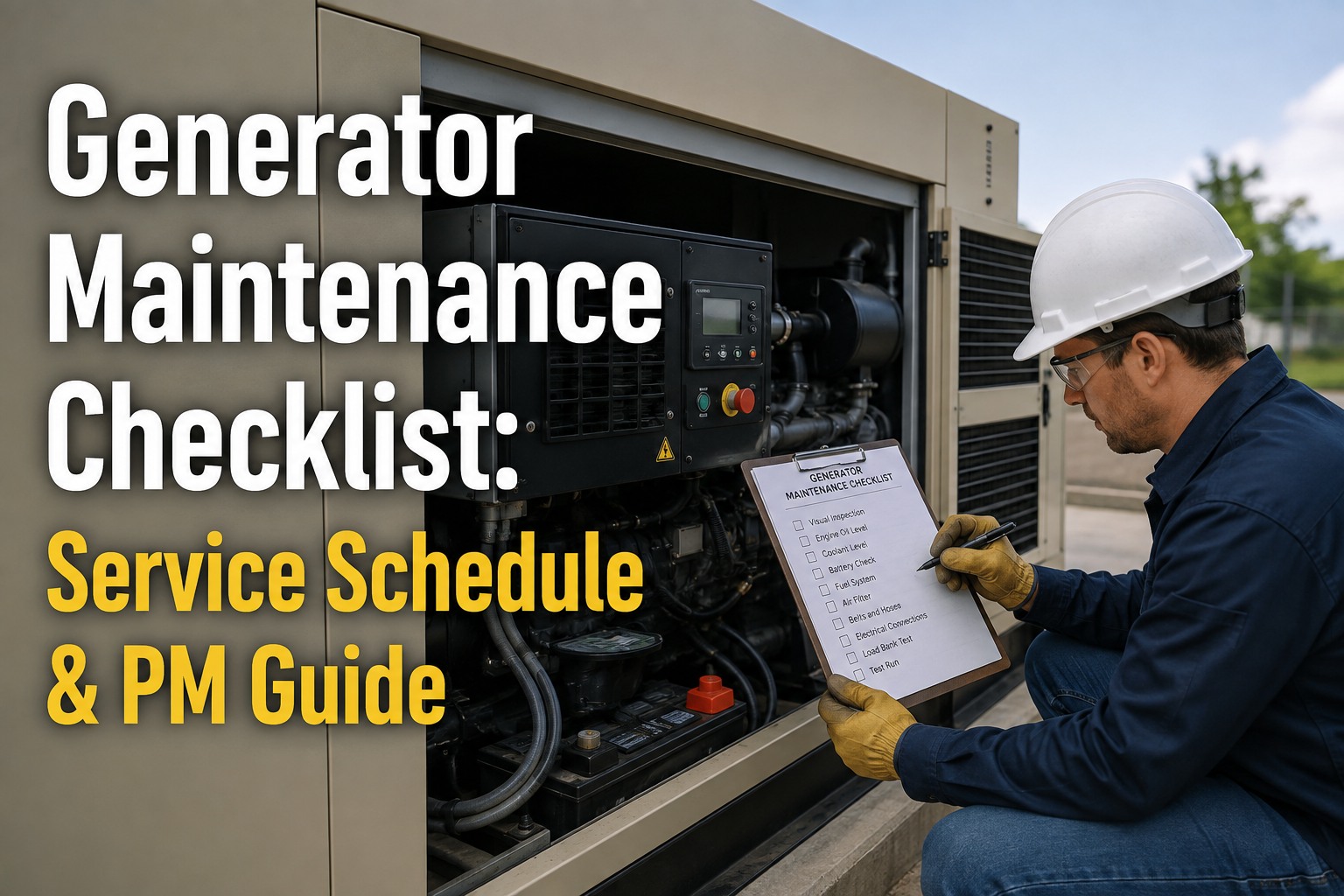
A standby generator that starts on Monday isn't a generator that will carry the building on Thursday. Starting proves the starter and fuel line worked. It doesn't prove the set can hold 400 kW under a Level 1 load for four hours — and every year during NFPA 110 audits, that gap becomes visible to the AHJ. This generator maintenance checklist covers the six readiness indicators every set needs green, on the cadence NFPA 110 requires — book a demo to manage generator PM & testing in HVI.
"Started Fine" Is Not the Same as "Ready to Carry Load"
A genset is only as ready as its weakest indicator. If one of these is red or missing a date, the set has drifted from compliance regardless of how it sounds on exercise day.
Weekly inspection
NFPA 110 §8.4.1 · Visual walk of lubrication, exhaust, battery, electrical, cooling, fuel
Monthly load test
30 min minimum, ≥30% nameplate kW or manufacturer's exhaust-temp target
Battery condition
§8.3.7 · #1 cause of failure to start · Replace VRLA at 3 yr, flooded at 5 yr
Fuel quality
Stored diesel degrades · water & microbial growth risk · polish when out-of-spec
ATS operation
§8.4.6 · Monthly transfer test · 10-second criterion for Level 1
Annual load bank
50% / 30 min + 75% / 1 hr per 2025 edition · AHJ deficiency if lapsed
One overdue indicator does not mean the generator can't start. It means the compliance evidence has lapsed — which is what the AHJ scores at audit, and what an insurer looks at after a failed transfer.
The rest of this page walks the weekly / monthly / quarterly / annual cadence NFPA 110 requires, the failure modes each test catches, and the tracking discipline that keeps every set on every schedule at once. Book a 30-minute demo to see per-genset PM and test-record tracking built in.
The four-cadence NFPA 110 maintenance schedule
NFPA 110 — the Standard for Emergency and Standby Power Systems — doesn't merely suggest maintenance. It requires it, in specific intervals, with documentation available to the AHJ during inspections. Gaps are among the most frequently cited deficiencies. The framework breaks into four cadences.
EPSS visual inspection — 15 min
- Coolant level, oil level, hoses and belts for wear or leaks
- Fuel level, fuel filter appearance, day-tank status
- Battery condition, terminal cleanliness, electrolyte (flooded)
- Coolant heater operation, block temperature warm to touch
- Control panel — no active alarms, hour meter and start-count logged
- Enclosure, air intakes, exhaust outlet clear of debris and rodents
Load test & ATS exercise — 30 min minimum
- Exercise diesel set 30+ min at ≥30% nameplate kW OR at min exhaust temp
- Operate the automatic transfer switch through the full cycle
- Log voltage, frequency, coolant & exhaust temps, oil pressure
- Verify 10-second transfer criterion for Level 1 systems
- Any unsatisfactory condition documented with corrective action
- Healthcare: 12 tests/year at 20–40 day intervals per NFPA 99
Systems verification — 60 min
- Battery capacity test & individual cell voltage (flooded)
- Fuel sample — water content, microbial growth, ISO cleanliness
- Cooling system pressure test & inhibitor concentration
- Governor and voltage regulator functional check
- Safety shutdowns bench-tested (overspeed, low oil, high temp)
- Review month's start-count and runtime against schedule
Load bank & comprehensive PM
- Annual load bank (if monthly < 30%): 50% for 30 min + 75% for 1 hr (2025 edition)
- Every 36 months (Level 1): 4-hour continuous test at rated load
- Full engine service: oil, filters, coolant, air filter, hoses
- Fuel polishing if sample analysis flagged degradation
- Battery replacement per age (VRLA 3 yr, flooded 5 yr)
- Insulation resistance test on alternator windings
Numbers above reference the NFPA 110 2025 edition. Older editions used a different annual load bank protocol (25% / 50% / 75% across 2 hours). Which edition applies is set by the Authority Having Jurisdiction — verify with the AHJ before signing a test plan, because the wrong protocol run in good faith still counts as a non-compliant test. Beyond NFPA 110 itself, healthcare facilities operate under additional NFPA 99 and Joint Commission EC.02.05.07 requirements that layer on top; commercial buildings under local fire and life-safety codes may have their own overlays; and OEM manuals from Caterpillar, Cummins, Kohler, Detroit Diesel, and other manufacturers publish model-specific intervals that can be more stringent than the standard baseline. The rule NFPA 110 §8.3 embeds explicitly: EPSS must be maintained in accordance with the standard and the manufacturer's recommendations, whichever is more stringent. Book a demo to see HVI hold per-genset calendar + runtime PM and NFPA 110 test evidence together.
Why "monthly load test" is the wrong shorthand
The monthly exercise is not a "just run it 30 minutes" checkbox. NFPA 110 §8.4.2 specifies loading conditions because a diesel engine run at light load for extended periods develops wet stacking — unburned fuel and soot accumulating in the exhaust, cylinders, and turbocharger. Left uncorrected, wet stacking degrades performance, fouls injectors, and can permanently damage the aftertreatment system.
| Load level during exercise | NFPA 110 status | Wet-stacking risk | What it actually proves |
|---|---|---|---|
| < 30% nameplate | Non-compliant — requires annual load bank as backstop | High | Engine starts, some components warm — but not that unit can carry rated load |
| 30% nameplate | NFPA 110 minimum for compliant monthly test | Managed | Combustion complete, cooling system engaged, ATS functional |
| OEM min exhaust temp | Alternate compliance path — sufficient exhaust temperature | Managed | Combustion reaching manufacturer target — same protective effect as 30% |
| 50% + nameplate | Compliant, comfortably above minimum | Low | Full-system exercise including alternator loading |
| 100% (load bank annual) | Compliant for annual test | None | Set can deliver rated output for required duration — the actual outage question |
The lesson embedded in these thresholds: a monthly exercise that never crosses 30% of nameplate is proving less than most facility teams assume. When building load can't hit 30% — common with oversized generators — NFPA 110 §8.4.2.4 requires an annual supplemental load bank to close the gap. Skipping it is the single most common NFPA 110 finding at Level 1 audits, and the correction plan that follows a citation always includes both scheduling the load bank going forward and documenting the historical gap in the facility's compliance record. The finding follows the facility through subsequent AHJ visits until closed properly. Book a demo to see HVI schedule the annual load bank as a recurring asset task with the correct 2025-edition protocol built into the test template.
The 5 failure modes generators actually die from
Genset failure at the moment of an outage almost never happens because the engine is worn out. It happens because one of these five systems was neglected long enough to matter.
Starting battery
Cause: Batteries age silently. A VRLA at 3+ years or flooded at 5+ years has degraded internal capacity even if float voltage looks normal.
Prevention: Weekly voltage check, quarterly capacity test, replace on age not on visible failure.
Fuel degradation & contamination
Cause: Diesel in long-term storage oxidizes and separates. Water accumulates from tank breathing. Microbial growth (diesel bug) plugs filters.
Prevention: Quarterly fuel sample, filter and polish when out-of-spec, keep tank at operating level.
Coolant heater failure
Cause: Coolant heater keeps the block warm so the set can start and load within seconds. A failed heater in cold ambient means a hard cold-start and possible failure to meet the 10-second transfer criterion.
Prevention: Weekly touch check — block should be warm; log heater current draw quarterly.
Wet stacking from chronic light-load exercise
Cause: Months of exercise below 30% nameplate accumulate unburned fuel and soot. Compression drops. Turbo fouls. Eventually the set can't reach rated output.
Prevention: Meet the 30% minimum monthly, or apply the annual load bank test with the 2025 edition protocol.
ATS transfer failure
Cause: The ATS is a mechanical + electronic device that ages independently of the engine. Contacts pit, coils weaken, logic boards drift. Level 1 systems must transfer in 10 seconds.
Prevention: Monthly ATS operation per NFPA 110 §8.4.6 — the transfer itself is the test, not just running the engine.
All five failures are catchable weeks-to-months before they become the reason the building goes dark. The maintenance program that catches them is the one that logs actual readings, not just check-marks tasks — because trends are only visible in the data. Start a free HVI trial to log per-test readings against each genset so trends show up before shutdowns do.
The item that trips more Level 1 facilities than any other
The generator that never sees load because building demand can't reach 30%
Standby generators are routinely sized above the load they actually see — a hospital building oversized for future expansion, a data center with efficient IT gear drawing well under nameplate, a commercial facility whose actual peak sits at 20% of the set's rated output. During the monthly NFPA 110 exercise, the building load simply cannot reach the 30% threshold the standard requires. NFPA 110 §8.4.2.4 addresses this explicitly: if the monthly test cannot achieve 30% (or the manufacturer's minimum exhaust-gas temperature), a supplemental load bank test is required annually — and under the 2025 edition, the protocol is 50% of nameplate for 30 minutes followed by 75% for 1 hour, total 1.5 hours. Level 1 systems additionally require a 4-hour continuous test at rated load at least once every 36 months. Facilities that treat the monthly building-load exercise as sufficient without adding the annual load bank are non-compliant by default, regardless of how faithfully the monthly test is being run. This is the specific gap AHJs cite most often in NFPA 110 audits. The fix is not more monthly testing; it's booking the annual load bank as a recurring scheduled item against the genset asset, with the test data captured and retained. Without it, the maintenance program is proving the generator starts — not that it can carry a Level 1 load through the outage.
A hospital facilities manager on the audit finding that changed everything
We had three 750 kW gensets serving a Level 1 hospital campus. Ran perfect monthly exercises for years. Auditor pulls the records during a Joint Commission survey, sees no supplemental load bank documentation, cites us. Building peak load never hit 30% of any set's nameplate — we'd been doing insufficient monthly tests plus zero annual load banks the whole time. Corrective action plan, 90 days to demonstrate compliance, the survey report went into our next renewal file.
Now every set has a monthly 30-min exercise logged with actual load percentage read from the panel, a scheduled annual load bank test with the 2025 edition protocol (50% for 30 min, 75% for 1 hour), a 4-hour Level 1 test on the 36-month calendar, and the entire test history attached to each unit. Two years since and we've cleared every follow-up survey without a repeat citation. The technical work didn't change — the documentation and scheduling did.
Frequently asked questions
How often should a standby generator be tested?
NFPA 110 — the Standard for Emergency and Standby Power Systems — sets the baseline schedule for most standby diesel generators, and the applicable edition is determined by the Authority Having Jurisdiction. Weekly: visual inspection of the EPSS covering lubrication, exhaust, battery, electrical, cooling, and fuel systems. Monthly: the generator is exercised for at least 30 minutes at 30% or more of nameplate kW rating, or at the manufacturer's minimum exhaust-gas temperature; the automatic transfer switch is operated through a full cycle. Quarterly: battery capacity test, fuel sample analysis, cooling and control-system verification. Annual: if the monthly building load cannot reach 30% of nameplate, a supplemental load bank test is required — under the 2025 edition, 50% of nameplate for 30 minutes followed by 75% for 1 hour, total 1.5 hours. Every 36 months for Level 1 systems: a 4-hour continuous test at rated load. Healthcare facilities under NFPA 99 and Joint Commission requirements typically perform 12 tests per year at 20–40 day intervals. Always verify the specific requirements for your facility's classification with the AHJ.
What is wet stacking and how do I prevent it?
Wet stacking is a diesel engine condition caused by prolonged operation at light load — typically below 30% of nameplate rating. At light load, the engine doesn't reach the combustion temperature needed to fully burn all the injected fuel. The unburned fuel and soot accumulate in the exhaust manifold, turbocharger, and cylinders, eventually reducing compression, fouling injectors, and degrading turbo performance. Left uncorrected, wet stacking can permanently damage the aftertreatment system and reduce the generator's ability to deliver rated output when it's actually needed. Prevention is straightforward and built into NFPA 110: exercise the generator at 30% or more of nameplate kW during the monthly test, or at the manufacturer's specified minimum exhaust-gas temperature. When building load can't reach 30%, add an annual load bank test to burn off any accumulated deposits and prove the set can still deliver rated output. The load bank test under the 2025 edition of NFPA 110 is 50% of nameplate for 30 minutes followed by 75% for 1 hour, a total of 1.5 hours. Skipping this is how a genset that "runs fine every month" quietly loses the ability to actually carry an outage load.
Why do generator batteries fail so often?
Starting battery failure is consistently the #1 cause of standby generator failure to start — it accounts for a majority of failed-start incidents across industry data. Several factors combine. First, batteries in standby service spend nearly all their time on float charge with rare deep discharge, which is a stressful duty cycle that ages internal plate structure differently than automotive service. Second, ambient temperature has an outsized effect: heat accelerates chemical degradation and cold reduces available cranking amps at exactly the moment a cold-start is needed. Third, float voltage set incorrectly on the charger can slowly overcharge or undercharge, both of which shorten life. Fourth, individual cell degradation in flooded batteries or module imbalance in VRLA strings can hide behind a normal-looking overall voltage reading. NFPA 110 §8.3.7 addresses this with specific weekly checks and periodic capacity testing. The practical rule most facilities use: replace VRLA batteries at 3 years of service age and flooded batteries at 5 years regardless of test results, and don't wait for a failed start to justify the replacement.
How long does stored diesel fuel last in a generator tank?
Untreated ultra-low-sulfur diesel begins to degrade within 6–12 months of storage and can be seriously compromised in 12–24 months depending on tank conditions, temperature swings, water intrusion, and microbial exposure. Three failure modes matter for standby generators. First, oxidation and thermal degradation produce gums and sediments that clog fuel filters and injectors. Second, water accumulates in the tank from breathing (air moving in and out with temperature) and settles at the bottom, providing the environment microbial growth needs. Third, microbial growth — often called "diesel bug" — produces sludge that plugs filters and corrodes tank walls. Management approach: keep the tank at operating level to minimize air space, use fuel biocide as needed, sample fuel quarterly for water content and microbial contamination, and polish the fuel (filter and treat in place) when analysis shows degradation. Standby generators serving critical loads often have polishing systems that circulate the fuel continuously. A generator that starts on clean fuel and fails halfway through an outage on contaminated fuel is a preventable and documented failure mode.
Do I need a load bank test if my generator runs monthly?
It depends on what load the generator actually sees during the monthly exercise. NFPA 110 §8.4.2.1 states that if the monthly test cannot be conducted at 30% or more of nameplate kW rating (or at the manufacturer's minimum exhaust-gas temperature), a supplemental annual load bank test is required. If the building load routinely hits 30% or more of nameplate during monthly exercises, the monthly test satisfies the requirement and no annual load bank is separately needed. If not, the load bank is mandatory. Under the 2025 edition of NFPA 110, the protocol when a load bank is required is 50% of nameplate for 30 continuous minutes followed by 75% of nameplate for 1 continuous hour, total 1.5 hours. Earlier editions used a three-step 25% / 50% / 75% protocol over 2 hours — which edition applies is set by your AHJ. Additionally, Level 1 systems (where failure could cause death or serious injury, including most hospital and life-safety applications) require a 4-hour continuous test at rated load at least once every 36 months regardless of monthly load percentage. Facilities with oversized generators — the most common architecture — almost always fall under the load bank requirement.
Every genset, every NFPA 110 interval, every audit — one clean record
HVI tracks each generator's weekly / monthly / quarterly / annual PM cadence, captures load-test readings with photos, logs battery age and fuel sample history, records ATS transfer times against the 10-second criterion, and produces the audit trail the AHJ actually inspects. When the Joint Commission surveyor or NFPA 110 auditor arrives, the entire compliance record for every unit is one click away. Live in under two weeks. No hardware. No credit card.
Trusted by facilities and industrial operations across North America · Ready on day one