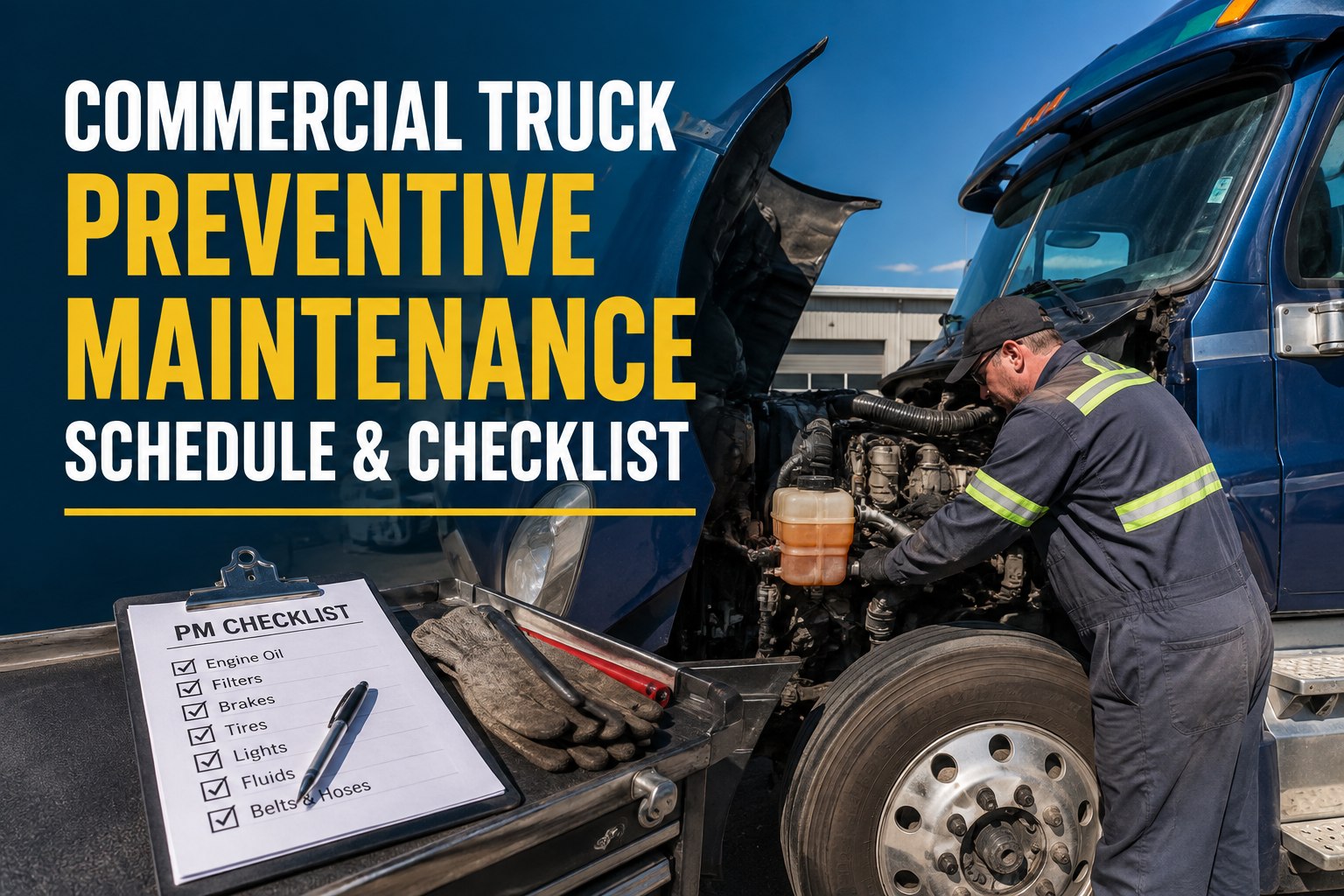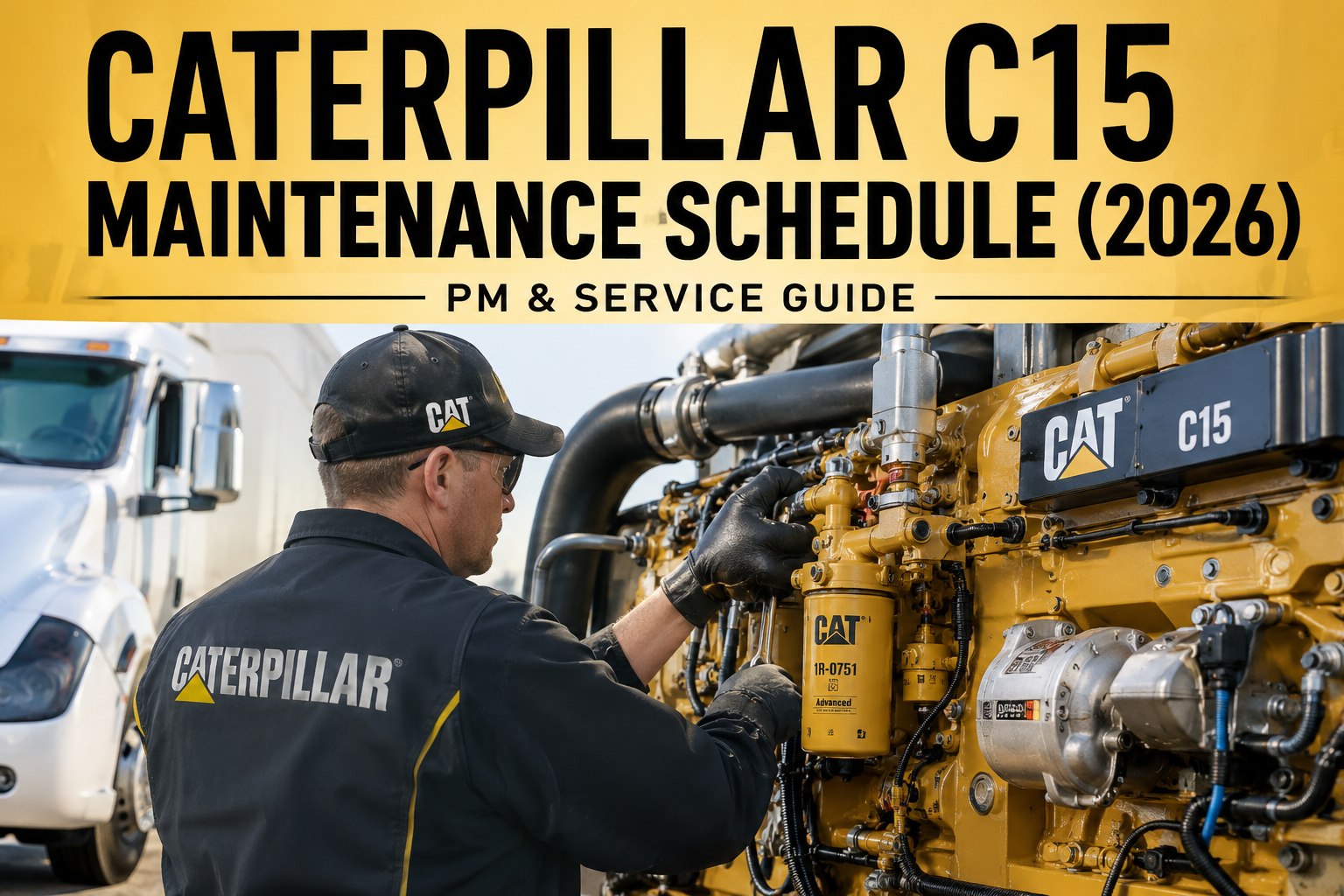
The Caterpillar C15 maintenance schedule is the reason so many of these 15.2L legends are still pulling loads at 1.2 million miles. Cat published intervals in hours, miles, and calendar days — and the fleets that hit all three consistently see 800,000+ miles before the first major overhaul. The intervals are different for Pre-ACERT (6NZ) and ACERT (MXS) variants, and severe-duty operations run tighter cycles. This guide covers every OEM interval. Book an HVI demo → to automate the whole schedule.
The maintenance schedule that gets a Cat C15 to 1.2 million miles.
Cat's own service data: consistent PM discipline is the difference between a 500,000-mile overhaul and a 1.2-million-mile legend. Here's the milestone journey every C15 hits — and what breaks the trucks that skip a checkpoint.
The complete Cat C15 maintenance interval matrix
Caterpillar publishes C15 intervals by fuel consumption, service hours, and calendar time — and the actual maintenance interval is whichever comes first. For high-idle vocational trucks the hour clock triggers before miles. For long-haul linehaul it's the miles that hit first. Both matter; missing either shortens engine life.
Two facts fleet mechanics know but Cat's manual doesn't emphasize: (1) the fuel filter setup is dual-stage — a 10-micron primary on the frame and a 2-micron secondary on the engine, and running both undersized will plug them before the next oil change, and (2) every experienced C15 shop treats S·O·S (Scheduled Oil Sampling) as non-negotiable, not optional. The oil analysis catches metal wear trends 30,000-50,000 miles before they become an overhaul. Book an HVI demo to see how meter-based PM auto-triggers hit hours, miles, and calendar limits without spreadsheet gymnastics.
The 500-hour discipline — where C15 legends are made
The Cat C15 became a million-mile engine because of one specific habit: fleets that hit the 500-hour oil-and-filter checkpoint like a metronome, paired with an S·O·S oil sample every drain, catch every developing problem before it becomes a failure. Here's the discipline broken into practical actions.
Fleets that follow this discipline consistently see 800,000-1,200,000 miles before major overhaul on both Pre-ACERT and ACERT variants. Fleets that skip S·O·S because "oil samples are for big fleets" typically see the first overhaul between 400,000 and 600,000 miles — and pay for damage the sampling would have caught. Try HVI free to log every S·O·S sample with the service record automatically.
ACERT-specific challenges — twin turbos, VVA, and the injector cup problem
The ACERT variant (2003-2010) added twin sequential turbos, Variable Valve Actuators (VVA), and higher injector pressures to meet emissions without a DPF or DEF system. Cleaner emissions came with three specific maintenance items that Pre-ACERT engines never dealt with. Book an HVI demo to see how ACERT-specific inspection templates handle VVA diagnostics and boost pressure verification automatically.
None of these are engine killers if caught early. All of them become expensive if the maintenance discipline slips. The C15's reputation for million-mile life depends entirely on the operator running the intervals — the engine itself is more than capable of the mileage. Book an HVI demo to see the C15 ACERT-specific inspection templates that catch these four issues in their early stages.
From a fleet mechanic running 18 Cat C15-powered day cabs
We inherited 18 Peterbilt 388s with C15 ACERT engines when we bought a regional carrier in 2022. Average odometer at acquisition: 640,000 miles. Previous owner ran oil changes at 50,000-mile intervals without S·O·S sampling. First month of ownership we lost two engines to injector cup failures — total repair bill $58,000.
Switched to HVI-managed PM: 500 hours or 40,000 miles whichever hits first, S·O·S every drain, coolant sample every 60,000 mi. Three years later: fleet averages 950,000 miles with zero engine failures. The oldest truck is at 1.14 million with original bottom end. The maintenance costs more up front but the engines pay for themselves twice over.
JGJames G.Shop Foreman · Regional flatbed carrier · 18 Peterbilt 388 w/ Cat C15 ACERT
Frequently asked questions
How often should Cat C15 oil be changed?
Caterpillar's published C15 oil change interval is 500 engine hours or approximately 40,000 miles for standard on-highway duty, whichever comes first, with a 12-month calendar backstop. Severe duty (high idle, heavy loads, extreme temperatures, dusty conditions) drops the interval to 250-300 hours. Use 15W-40 diesel oil meeting Cat ECF-1-a or ECF-3 specification — brands like Delo 400, Rotella T4, and Cat DEO all qualify. Every oil change should also include an S·O·S oil sample sent to a Cat dealer lab; the analysis catches metal wear trends 30,000-50,000 miles before they become failures. The oil filter (Cat 1R-1808 or equivalent) and both fuel filters change with every oil change.
What is the coolant change interval for a C15?
Depends on the coolant type. Cat DEAC (Diesel Engine Antifreeze/Coolant, traditional green): 3,000 hours or 200,000 miles or 24 months, plus SCA (Supplemental Coolant Additive) top-up every 250 hours or 15,000 miles. Cat ELC (Extended Life Coolant, red/pink): 12,000 hours or 600,000 miles or 6 years, with a one-time Extender addition at the halfway point (6,000 hours or 300,000 miles). ELC eliminates the SCA maintenance overhead but costs more up front. Freeze protection should be tested at every PM or at minimum twice per year. Never mix DEAC and ELC — a complete flush is required to switch types.
When should the valve lash be adjusted on a C15?
Caterpillar's standard C15 valve lash adjustment interval is 100,000 miles or 3,000 hours, whichever comes first. Severe-duty operations tighten to 60,000 miles. On ACERT engines (2003-2010) the same service includes injector timing verification and Variable Valve Actuator (VVA) checks. The valve lash service catches wear in rocker arms, valve guides, and valve seats before it becomes damage, and it's one of the few services where the shop's diagnostic skill matters as much as the calendar. Fleets running charter buses and day cabs often move the check to 60,000 miles regardless of duty rating because the labor cost is low compared to a burned valve.
What is the difference between C15 Pre-ACERT and ACERT maintenance?
Base intervals (oil, fuel filters, coolant, valve lash) are identical between variants. Where they diverge is in the ACERT-specific systems added in 2003 to meet emissions without a DPF or DEF. ACERT engines have sequential twin turbochargers with a wastegate and actuator that needs boost verification at every 100K-mile service. ACERT has Variable Valve Actuators (VVA) that adjust intake valve timing electronically — VVA solenoids fail when oil quality drops, making Cat-spec oil non-negotiable. ACERT injector pressures are higher, stressing the copper injector cups in the head; a failed cup lets coolant into the cylinder. Pre-ACERT (6NZ) engines are simpler, single-turbo, and are still considered the most bulletproof C15 variant — but ACERT engines with disciplined PM run just as long.
Can a Cat C15 really run 1 million miles?
Yes, and it's not unusual. Cat's own field data and years of trucker forums consistently show C15 engines running 800,000 to 1.2 million miles before the first major overhaul when properly maintained. Some individual engines have crossed 1.5 million miles on original bottom ends. The pattern in every million-mile C15 story is the same: consistent 500-hour oil and filter service, S·O·S oil sampling at every drain, coolant discipline (DEAC or ELC, matched to the flush schedule), and valve lash service at 100K miles or better. Engines that fail early almost universally trace back to skipped S·O·S sampling, extended oil drain intervals beyond the published limit, or off-spec oil. The engine itself is more than capable; the maintenance discipline is the variable.
Automatically schedule Cat C15 preventive maintenance across your fleet.
HVI ships with Cat C15-specific PM templates for both Pre-ACERT (6NZ) and ACERT (MXS) variants. Meter-based triggers hit hours or miles whichever comes first. Calendar overlays for coolant and SCA schedules. S·O·S sample logging with lab report attachment. Photo-verified service history that supports warranty claims and resale value. Live for your fleet in 5-7 days.
Cat C15 · Cummins X15 · Detroit DD15 · PACCAR MX · Volvo D13 templates ready · SOC 2 Type II