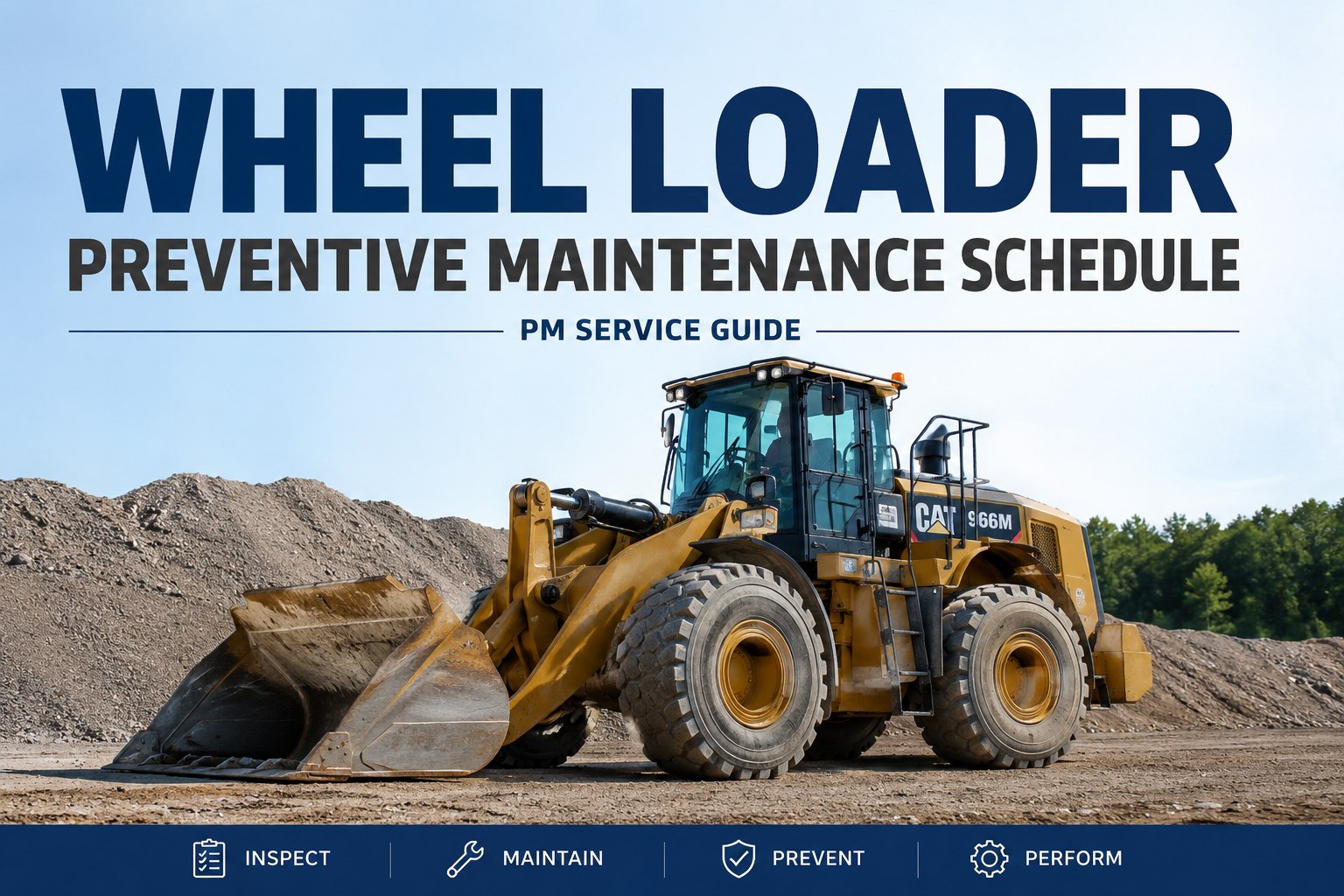
A wheel loader preventive maintenance schedule from the OEM manual is the baseline — but it assumes ideal operating conditions most fleets don't have. Quarry face-loading, high-cycle stockpile work, and abrasive material handling each accelerate wear at different rates and require duty-cycle-adjusted PM intervals. Get the base schedule right, calibrate for actual duty cycle, and component life extends 30-40%; ignore duty cycle and you meet the OEM schedule while accelerating failures. Book an HVI demo for duty-cycle-calibrated wheel loader PM.
Same wheel loader. Different site. Different schedule.
The OEM base interval is a starting point — not a finished schedule. Adjust for duty cycle severity and the real PM interval shifts by 25% to 50%.
Why the OEM base interval isn't the actual PM schedule
Every OEM publishes a base preventive maintenance schedule — Cat's PM1-PM4 tiers, Volvo's Care Track intervals, Deere's PowerTech schedules, Komatsu's KOMTRAX-linked service milestones. These base intervals assume a specific operating profile: moderate ambient temperature, moderate dust exposure, moderate hydraulic load, and predictable duty cycles. Most real fleets don't operate under those conditions.
OEM 500-hour air filter service assumes 6 mg/m³ particulate load. Quarry and stockpile operations routinely see 15-25 mg/m³ — requiring air filter service every 250 hours or less. Following the OEM schedule guarantees premature turbo failure.
Base 1000-hour hydraulic service assumes steady-state load. Quarry face-loading with rock impact creates pressure spikes that oxidize fluid faster. Real interval in severe duty is often 500 hours — matching the base schedule accelerates pump failure by 40%.
Base 500-hour engine oil service assumes normal duty. Load-and-carry with frequent tram cycles and heavy transient loads accelerates oil breakdown. S.O.S fluid analysis routinely calls for changes at 375-400 hours under medium-severe duty.
Larger interval services (1000h/2000h) assume ideal wear rates. Under severe duty the wear on final drives, hydraulic pumps, and torque converters compresses toward 500h/1000h effective intervals — the difference between a 15,000-hour machine and a 25,000-hour machine over lifecycle.
The difference between fleets that treat the OEM schedule as absolute and fleets that calibrate for duty cycle shows up in equipment life — 30-40% longer service life on the duty-calibrated fleets. Book an HVI demo to see duty-cycle-adjusted PM intervals on your wheel loader fleet
The 3 duty cycle profiles — and what defines each
Duty cycle is not subjective. Industry-standard classification uses three profiles defined by measurable operating characteristics. Every wheel loader in the fleet falls into one of the three — and PM intervals should track the profile, not the calendar.
Material yards, aggregate distribution, hopper feed operations. Predictable load-and-carry cycles on hard surfaces. Follow the OEM base schedule without modification.
Construction sites, waste transfer, truck loading, mixed materials. Some transient loads and shock. Reduce PM intervals to 75% of OEM base — air filter to 375h, engine oil to 375h, etc.
Quarry face-loading, mining, demolition, rock handling. Heavy shock loads, abrasive material, extreme dust. Cut PM intervals to 50% of OEM base — air filter to 250h, hydraulic oil to 500h.
The three-tier classification is what turns a static PM manual into a duty-aware maintenance program. Skip the classification and the fleet defaults to OEM base intervals regardless of what the wheel loader is actually doing. Try HVI free to configure duty-cycle-tagged wheel loader PM on your fleet.
PM1 — 250-hour service (Every 250 engine hours)
PM1 is the highest-frequency PM tier and the foundation of every wheel loader maintenance program. Under Cat's PM1-PM4 tier system this triggers at 250 engine hours; Volvo, Deere, and Komatsu use equivalent intervals with brand-specific terminology. Skipping PM1 to save 90 minutes of shop time is the most expensive false economy in wheel loader maintenance.
- Engine oil & filter change
- Fuel filter primary element check
- Air filter pre-cleaner service
- Hydraulic tank breather check
- Full loader arm pivot grease
- Bucket & linkage pivots
- Articulation joint grease
- Driveshaft U-joints (if equipped)
- Battery load test & terminals
- Cooling system visual & cleanout
- Tire pressure & sidewall
- Fault code review from ECM
PM2 — 500-hour service (Every 500 engine hours)
PM2 extends PM1 with expanded fluid changes and secondary filter services. Note the current-industry shift: Cat's Next-Gen 966 / 972 14C models (2024+) eliminated the PM2 interval entirely by engineering longer-life components and consolidating tasks into an extended PM3. On earlier-generation machines and other OEM platforms, PM2 remains an active service tier.
- Engine oil & filter (again)
- Fuel filter primary & secondary
- Air filter primary element replacement
- Hydraulic screen cleaning
- Transmission oil sample (S.O.S)
- Belt tension & wear check
- Radiator & oil cooler pressure wash
- DPF differential pressure check
- Alternator output test
- Wheel bearing repack (if scheduled)
- ROPS/FOPS mounting bolt torque
- Loader arm cracks & weld inspection
- Articulation lock function test
- Emergency lowering system check
Mixed fleets need to know which machines have PM2 in the schedule and which don't — the answer determines the tier structure the maintenance planner works from. Book an HVI demo to see generation-aware PM templates for Cat 966/972 across model years
PM3 — 1,000-hour service (Every 1,000 engine hours)
PM3 is the major hydraulic and drivetrain service and the tier where duty-cycle calibration matters most. Fleets running severe-duty quarry operations at OEM base schedules routinely see hydraulic pump failures 30-40% earlier than fleets adjusting PM3 to a 500-hour effective interval.
- Complete hydraulic oil change
- Hydraulic filter replacement (all)
- Hydraulic pressure test & verification
- Cylinder rod & seal inspection
- Kidney-loop filtration service
- Transmission oil & filter change
- Front & rear differential oil change
- Final drive planetary oil change
- Torque converter fluid check
- Driveshaft U-joint measurement
- DPF ash service (Tier 4 machines)
- DEF system inspection & filter
- Air filter secondary element
- Cooling system flush inspection
- Turbocharger boost check
PM3 is where most fleet maintenance programs succeed or fail on wheel loaders — the hydraulic, drivetrain, and aftertreatment scope is significant, and the duty-cycle calibration is where the real economic value is captured. Try HVI free to see PM3 auto-triggered at the calibrated interval for each machine's actual duty cycle.
PM4 — 2,000-hour service (Every 2,000 engine hours)
PM4 is the deep powertrain and cooling service that establishes the wheel loader for its next 2,000-hour operating cycle. This is where premium engine components (injectors, valve lash, coolant chemistry) get attention that determines whether the machine sees 15,000 or 25,000 lifetime hours.
- Valve lash adjustment
- Injector tip inspection & test
- Turbocharger inspection & test
- EGR cooler cleanout (Tier 4)
- Fuel injection pressure test
- Complete coolant flush & refill
- Thermostat replacement
- Water pump inspection
- Alternator & starter bench test
- Complete wiring harness inspection
- Frame & articulation weld inspection
- Tire tread & sidewall measurement
- Bucket & loader arm wear measurement
- Complete sensor calibration
- Comprehensive road test
OEM-specific service points — Cat, Volvo, Deere, Komatsu
The PM1-PM4 tier structure applies across all major wheel loader OEMs, but each brand has distinct terminology, service-point locations, and telematics integrations that maintenance planners need to know.
- PM1-PM4 tier terminology — Cat's official schedule at 250h/500h/1000h/2000h with Self-Service parts packages by tier
- Next-Gen 966/972 (14C, 2024+) — PM2 500h interval eliminated; base PM3 extended to 1000h
- S.O.S fluid analysis — Cat's oil analysis program identifies wear metals; sample at every PM2 in severe duty
- Product Link + VisionLink — Auto-syncs engine hours and generates PM alerts at 50 hours before due
- CareTrack telematics — Volvo's remote monitoring pushes PM reminders and fault codes to the fleet portal
- OptiShift transmission — Volvo's fuel-saving Reverse-by-Braking system requires calibration verification per PM3
- D13 engine service — Volvo D13 has specific injector service intervals distinct from other Tier 4 platforms
- Boom Suspension System — If equipped, requires accumulator pressure check per PM2 in severe duty
- JDLink Ultimate telematics — Deere's premium telematics tier syncs service intervals and pushes alerts to the dealer network
- PowerTech PSS engine — Deere PowerTech has proprietary S3 service intervals distinct from generic Tier 4 schedules
- Autolock differential — If equipped, requires differential oil sample at every PM2 for wear metal monitoring
- Modular hydraulic tank — Deere's tank design allows access without cab removal; verify service panel condition per PM3
- KOMTRAX telematics — Komatsu's telematics is included on nearly all machines and drives PM scheduling in the fleet portal
- Komatsu Care — OEM PM program included on new machines for first 3 years / 2,000 hours — verify Komatsu Care service log at every PM
- SAA6D140E engine — WA500's engine has specific coolant chemistry requirement; use only Komatsu-approved coolant
- Torque converter transmission — Torque converter fluid sample required at every PM3 under severe duty
The 5 duty-cycle-amplified failure modes
Every wheel loader failure mode has a base rate under ideal conditions and an amplified rate under severe duty. Aggregated across OEM warranty data and fleet post-mortems, five failure modes account for the majority of unplanned wheel loader downtime — and every one has an interval-compression fix.
Base rate: rare under light duty. Severe-duty rate: 3-5x higher under quarry face-loading due to pressure spike oxidation of hydraulic oil. Cost: $8,000-$18,000 pump replacement. Fix: Compress PM3 hydraulic service from 1000h to 500h in severe duty.
Base rate: rare with sealed intake systems. Severe-duty rate: 4-8x higher when air filter service is missed. Cost: $4,500-$12,000 turbo replacement. Fix: Compress air filter service to 250h in severe duty and monitor intake restriction gauge daily.
Base rate: 15,000-hour typical life. Severe-duty rate: 8,000-10,000-hour life if planetary oil service is deferred. Cost: $18,000-$35,000 per axle for planetary rebuild. Fix: Compress PM3 planetary oil change to 750h under severe duty.
Base rate: OEM-scheduled fluid gives 3000+ hour life. Severe-duty rate: fluid breakdown at 1,500-2,000 hours from thermal cycling. Cost: $12,000-$25,000 for torque converter overhaul. Fix: Torque converter fluid sample at every PM3, change at PM4 or when S.O.S calls for it.
Base rate: 20,000+ hour life. Severe-duty rate: crack initiation at 10,000-12,000 hours from cumulative shock loading. Cost: $25,000-$60,000 for loader arm assembly replacement. Fix: Weld inspection at every PM3 in severe duty; magnetic-particle testing at PM4.
Every failure mode on the list is preventable with duty-calibrated PM. The math is unforgiving: cutting PM intervals in half under severe duty costs 40-60% more in PM spend but reduces failure-related downtime by 70-80%. Book an HVI demo to model duty-calibrated PM economics for your fleet
From a Maintenance Supervisor running 22 wheel loaders across 3 quarry sites
We run 22 wheel loaders across 3 quarry operations in the Midwest — 8 Cat 966s, 6 Volvo L150Hs, 5 Deere 644Ks, and 3 Komatsu WA500s. For years we ran OEM base schedules across all three sites regardless of what the machines were doing. Our hydraulic pump failure rate at Site 3 (severe quarry face) was three times higher than at Sites 1 and 2 (light stockpile). We treated it as bad luck.
Once we duty-tagged each machine and adjusted PM3 hydraulic service from 1000h to 500h at Site 3, hydraulic failures dropped 62% in the first 6 months. Yes, our PM spend went up roughly 18% at that site. But we saved $340,000 in avoided hydraulic pump rebuilds in year one — net win of $260,000 on a fleet of 3 machines at that site alone. Duty cycle was the missing variable in our entire maintenance program. Nobody was hiding it — we just weren't looking.
Frequently asked questions
What are the four wheel loader PM intervals?
Cat's PM1-PM4 tier terminology is the industry standard applied across all major wheel loader OEMs. PM1 (250 engine hours): engine oil and filter change, fuel filter primary element check, air filter pre-cleaner service, hydraulic tank breather check, full grease service at loader arm pivots and articulation joints, battery load test, cooling system visual and cleanout, tire pressure and sidewall inspection, fault code review from ECM. 90-120 minutes. PM2 (500 engine hours): everything from PM1 plus engine oil and filter (again), fuel filter primary and secondary replacement, air filter primary element replacement, hydraulic screen cleaning, transmission oil sample for fluid analysis, belt tension and wear check, radiator and oil cooler pressure wash, DPF differential pressure check, alternator output test, ROPS/FOPS mounting bolt torque, loader arm cracks and weld inspection. 3-4 hours. Note: Cat's Next-Gen 966/972 (14C, 2024+) has eliminated PM2 by engineering longer-life components. PM3 (1,000 engine hours): everything from PM1-PM2 plus complete hydraulic oil change, hydraulic filter replacement, cylinder rod and seal inspection, transmission oil and filter change, front and rear differential oil change, final drive planetary oil change, torque converter fluid check, DPF ash service on Tier 4 machines, DEF filter service, turbocharger boost check. 6-8 hours. PM4 (2,000 engine hours): everything from PM1-PM3 plus valve lash adjustment, injector tip inspection and test, turbocharger inspection, EGR cooler cleanout, complete coolant flush and refill, thermostat replacement, alternator and starter bench test, complete sensor calibration, frame and articulation weld inspection with magnetic-particle testing under severe duty. 10-14 hours.
How does duty cycle change the wheel loader PM schedule?
Duty cycle severity directly compresses PM intervals from the OEM base schedule. Industry-standard classification uses three profiles. Light duty (stockpile loading, material yards, aggregate distribution): 60-70% engine load, low shock impact, minimal dust exposure. PM adjustment: 1.0× the OEM base schedule — follow the manual without modification. Medium duty (construction sites, waste transfer, truck loading, mixed materials): 70-80% engine load, moderate shock impact, some dust exposure. PM adjustment: 0.75× base — reduce all PM intervals by 25%. So PM1 becomes 200h (not 250h), PM2 becomes 375h (not 500h), PM3 becomes 750h (not 1000h), PM4 becomes 1500h (not 2000h). Severe duty (quarry face-loading, mining, demolition, rock handling): 80-100% engine load, heavy shock impact, extreme dust exposure. PM adjustment: 0.5× base — cut all PM intervals in half. PM1 at 125h, PM2 at 250h, PM3 at 500h, PM4 at 1000h. The compression happens because harsh duty cycles accelerate specific wear mechanisms: hydraulic oil oxidation from pressure spikes, air filter loading from dust concentration, engine oil degradation from thermal cycling, and component fatigue from cumulative shock loading. Following the OEM base schedule under severe duty guarantees premature failure of hydraulic pumps, turbochargers, and final drives — the exact components fleet managers most want to protect. Fleets moving from calendar-based PM to duty-cycle-calibrated PM consistently see 30-40% extension of equipment life at 15-20% increase in PM spend — a decisive net positive that also reduces unplanned downtime by 60-70%.
Did Cat eliminate the 500-hour service on the newest 966 and 972 wheel loaders?
Yes. Cat's Next-Generation 966 and 972 wheel loaders (14C model designation, 2024 and later production) eliminated the PM2 500-hour service interval and extended the base PM3 to 1,000 hours. The design change was enabled by longer-life engine oil, extended hydraulic fluid intervals, more capable air filtration, and consolidated task scheduling. Cat reports this reduces lifetime maintenance costs up to 20% on standard 966 / 972 models and up to 25% on the XE CVT variants (which combine the extended PM intervals with CVT transmission fuel efficiency gains up to 35%). Importantly, this change applies to base ideal-conditions operation. Fleets running Next-Gen 966/972 machines under severe-duty quarry conditions still need to compress the PM3 from the extended 1,000h base back toward 500-750h based on measured wear rates from S.O.S fluid analysis — the machine's engineering can extend intervals but cannot eliminate the underlying wear physics of quarry face-loading. Cat's Product Link and VisionLink telematics push the extended PM3 alerts at 50 hours before due, giving fleet managers advance notice to schedule downtime. Older-generation 966K, 966M, and pre-14C 966 machines retain the classic PM2 500-hour interval and follow the traditional PM1-PM4 tier structure. Mixed fleets need to know which generation each machine is when configuring PM templates.
Which wheel loader failures are most preventable with proper PM?
Five failure modes account for the majority of unplanned wheel loader downtime, and every one is decisively PM-preventable. Hydraulic pump failure from oil oxidation (base rate rare, severe-duty rate 3-5x higher) costs $8,000-$18,000 per replacement and is prevented by compressing PM3 hydraulic service from 1000h to 500h in severe duty. Turbocharger failure from dust ingest (base rate rare, severe-duty rate 4-8x higher) costs $4,500-$12,000 per replacement and is prevented by compressing air filter service to 250h in severe duty plus daily intake restriction gauge monitoring. Final drive planetary failure (base 15,000-hour life, severe-duty 8,000-10,000 hours) costs $18,000-$35,000 per axle for planetary rebuild and is prevented by compressing PM3 planetary oil change to 750h in severe duty. Torque converter fluid breakdown (base 3,000+ hour fluid life, severe-duty breakdown at 1,500-2,000 hours) costs $12,000-$25,000 for converter overhaul and is prevented by torque converter fluid sampling at every PM3 with change triggered by S.O.S fluid analysis rather than calendar. Loader arm structural cracking (base 20,000+ hour life, severe-duty crack initiation at 10,000-12,000 hours) costs $25,000-$60,000 for loader arm assembly replacement and is prevented by weld inspection at every PM3 in severe duty plus magnetic-particle testing at PM4. The economics of duty-calibrated PM are decisive: 15-20% increase in scheduled PM spend prevents 60-70% of unplanned downtime and typically returns 8-12x on the incremental investment in year one.
How do Volvo, Deere, and Komatsu PM schedules compare to Cat PM1-PM4?
All four major OEMs use the same 250h/500h/1000h/2000h base tier structure, but each brand has proprietary terminology, telematics integration, and OEM-specific service points that fleet managers need to know. Cat 966/972/980 uses PM1-PM4 terminology officially, supports Self-Service Option parts packages by tier, integrates with Product Link and VisionLink for auto-scheduling, and Next-Gen 14C models (2024+) have eliminated PM2 in favor of extended PM3. Volvo L150/L180/L220 uses CareTrack telematics for remote PM management, integrates OptiShift transmission calibration into PM3, has D13 engine-specific injector intervals distinct from generic Tier 4 platforms, and Boom Suspension System requires accumulator pressure check per PM2 in severe duty. John Deere 644K/744L/844L uses JDLink Ultimate telematics for premium-tier remote monitoring, PowerTech PSS engine has proprietary S3 service intervals different from generic schedules, Autolock differential requires oil sample at every PM2 for wear metal monitoring, and modular hydraulic tank access simplifies PM3 hydraulic service. Komatsu WA380/WA500/WA600 uses KOMTRAX telematics standard on nearly all machines with fleet portal integration, includes Komatsu Care OEM PM program on new machines for first 3 years or 2,000 hours (verify Komatsu Care service log at every PM), SAA6D140E engine on WA500 requires only Komatsu-approved coolant chemistry, and torque converter transmission requires fluid sample at every PM3 under severe duty. Fleets running mixed rosters benefit from digital PM platforms that ship with OEM-specific templates pre-configured for each brand plus duty-cycle calibration applied automatically based on the site the machine is deployed to.
Every wheel loader. Every PM tier. Calibrated to the actual duty cycle.
HVI's preventive maintenance module ships with pre-configured PM1-PM4 templates for Cat, Volvo, Deere, and Komatsu wheel loaders. Duty-cycle tags per site auto-adjust PM intervals from OEM base to calibrated schedule. Engine hours sync from Product Link, CareTrack, JDLink, and KOMTRAX. Work orders auto-generate at each calibrated milestone with the correct tasks for the tier. Live for your fleet in under two weeks — typical results include 30-40% extension of equipment life and 60-70% reduction in unplanned failure-related downtime.
Cat Next-Gen 14C aware · S.O.S fluid analysis integrated · Komatsu Care log-tracking · OEM-warranty-compliant