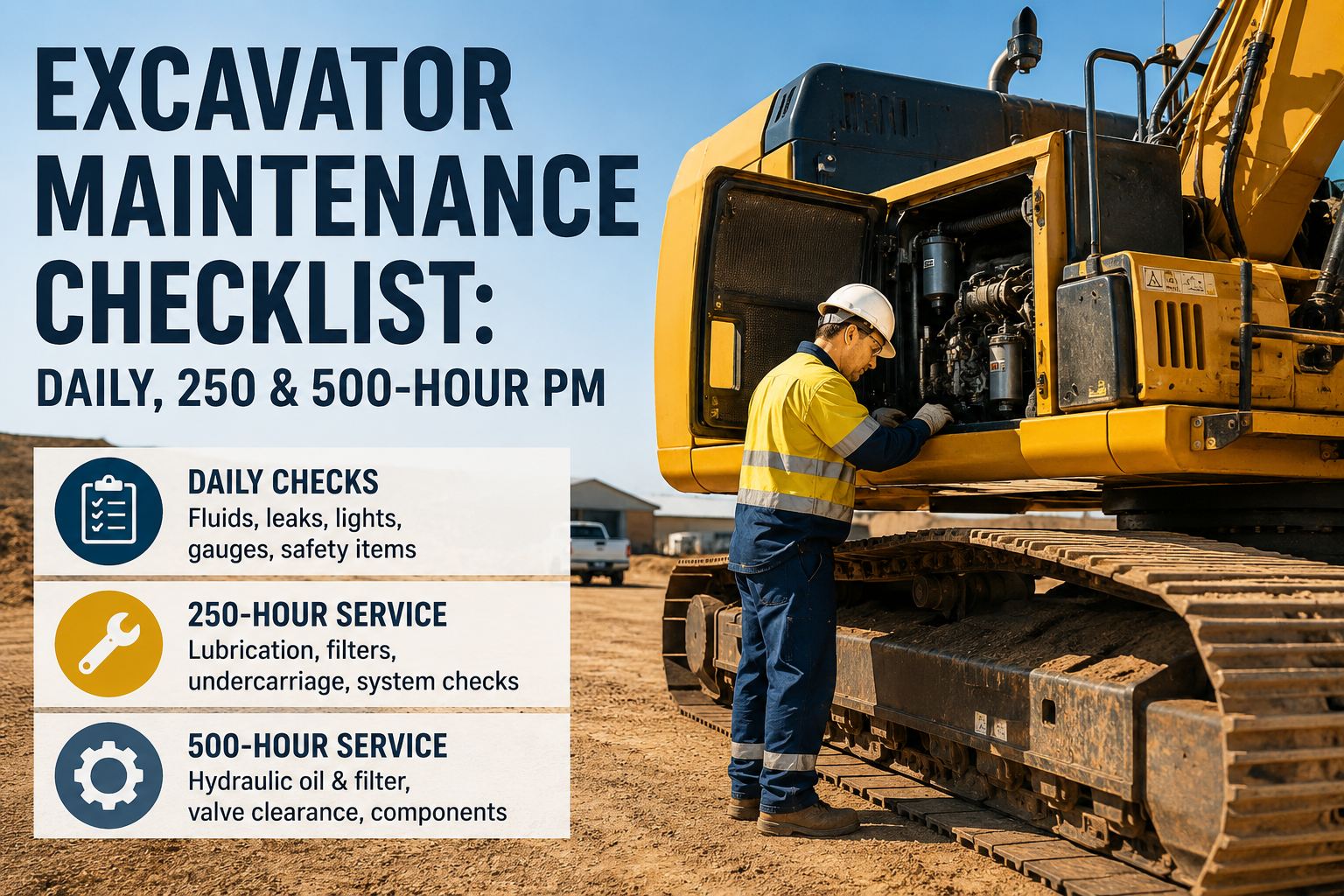
The 250 and 500-hour services are where most excavator maintenance actually happens. The 1,000- and 2,000-hour majors get attention, but the machine's day-to-day reliability — and the undercarriage that costs $30,000 to overhaul — is decided at the two smaller intervals every 4 to 12 weeks. Get the 250 disciplined and the 500 measured, and the majors become scheduled work. Miss them and the majors become emergencies. This excavator maintenance checklist covers the daily walkaround plus the split between 250 and 500 — book a demo to manage in HVI.
Every 500-Hour Service = 250-Hour + 6 Specific Additions
The 500 doesn't replace the 250. It compounds on it. Miss what's specific to the 500 and undercarriage wear, hydraulic contamination, and valve clearances all drift silently.
Minor service — 1.5 to 2.5 hrs
- Engine oil & filter change
- Fuel/water separator drain
- Air filter inspection (replace if indicated)
- Coolant level check
- Hydraulic oil level check
- Belts & hoses inspection
- Track tension check & adjust
- Grease every boom, arm, bucket pin
- Grease swing bearing & slew ring
- Battery & electrical connections
- Safety device test (horn, alarm, seatbelt)
- Structural inspection (boom, arm, teeth)
Intermediate service — 4 to 6 hrs
- Fuel filter replacement
- Outer air filter replacement
- Coolant concentration test (refractometer)
- Hydraulic return & pilot filter replacement
- Hydraulic oil lab sample
- Undercarriage wear measurement (track pad, link pitch, roller/idler)
- Valve clearance check
- Battery load test (CCA)
- A/C condenser clean & refrigerant test
- Fan belt tension adjustment
The 250 keeps oil clean and pins greased. The 500 measures undercarriage wear, samples the hydraulic fluid, and catches the drift before the 1,000-hour major. Two services, one compound schedule.
The rest of this page walks the daily 10-15 minute walkaround, why undercarriage measurement at 500 hours matters more than most operators realize, hydraulic contamination as the #1 preventable failure, and the tracking discipline that keeps a mixed excavator fleet in schedule. Book a 30-minute demo to see engine-hour PM combined with per-asset undercarriage measurement.
The daily walkaround — 10-15 minutes, engine cold, machine level
Daily inspection is required under OSHA 29 CFR 1926.602 and standards in equivalent jurisdictions across Canada, the UK, and Australia. Practically, it's the check that catches most developing failures at the least expensive stage. Do it cold: fluid readings are accurate, leaks are visible, and heat hasn't yet closed the gaps that would otherwise be obvious.
Levels & visible leaks
- Engine oil, coolant, hydraulic reservoir — operating range
- Fuel level, water separator drain
- Ground scan under machine for fresh drips
- DEF level on Tier 4 engines, no crystallization visible
Rods, hoses, cylinders
- Cylinder rods for scoring, damage, uneven wear
- Every hose along boom, arm for abrasion at pinch points
- Fittings and manifolds for wet spots or weeping
- Attachment pins & bushings for visible play
Tracks, rollers, sprockets
- Track debris removed, track pads for wear or damage
- Rollers, idlers, sprocket teeth for wear or missing hardware
- Track tension visual (measured at 250-hr service)
- Final drive area for oil leaks — symptom of seal failure
Controls, alarms, structure
- Horn, backup alarm, work & road lights operational
- Seat belt, ROPS/FOPS structure intact
- Startup fault codes on controller display cleared
- Full boom, arm, bucket & swing function test
Any defect gets photo-documented, not verbally reported at shift change. The photo is the compliance evidence, the trend-detection tool, and the difference between a competent-person inspection under OSHA and a hollow paper record that inspectors see through immediately. Book a demo to see HVI capture per-item pre-start observations with photos and defect flow to the shop.
Undercarriage measurement at 500 hours — where the biggest maintenance dollars live
The undercarriage on an excavator is a wear system. Tracks, chains, rollers, idlers, sprockets — every one of them loses material every operating hour. The rate is determined by ground conditions (abrasive rock vs soft soil), operator technique (aggressive turns vs smooth), and how faithfully the machine is greased. Overhauling an excavator undercarriage typically costs $15,000 to $30,000 or more depending on machine size and how far the wear was allowed to progress before intervention. Measuring at 500 hours turns that overhaul from a surprise expense into a planned budget line item.
| Undercarriage component | What to measure | Why it matters |
|---|---|---|
| Track pads (shoes) | Height (mm) at the grouser bar | Below wear limit = replace; trending shows remaining life to next service |
| Track chain link pitch | Distance between pin centers | Increased pitch = internal pin/bushing wear; drives sprocket wear if run past limit |
| Rollers (upper & lower) | Tread diameter & flange condition | Uneven roller wear indicates alignment issue or bearing failure |
| Idler wheel | Tread wear against OEM chart | Idler wear affects track alignment & tension; failure allows track de-track |
| Sprocket teeth | Tooth profile against wear-limit template | Worn sprocket accelerates chain wear; the two must be replaced together at limit |
| Track tension | Sag between rollers per OEM procedure | Wrong tension = accelerated wear on every component in the system |
Cat's Undercarriage Measurement System (UMS), Komatsu's KOWA program, Volvo's Care Track, and equivalent OEM systems all provide wear-limit charts specific to the machine. Third-party undercarriage specialists offer measurement services if the fleet doesn't have the tools in-house. What matters is that the measurements are logged against the individual machine, trended service to service, and used to predict replacement timing rather than reacting to a failure. The economic case is straightforward: a full undercarriage overhaul at $15,000–$30,000+ per machine, planned six months in advance from measurement trends, is dramatically cheaper than the same overhaul executed as an emergency after a component fails on-site — the emergency version adds recovery costs, unplanned downtime, and often collateral damage to adjacent components that were still serviceable before the failure event. Undercarriage measurement discipline at every 500-hour service is one of the highest-ROI items in the entire excavator maintenance program. Book a demo to see HVI log undercarriage measurements against each excavator with trend graphs per component.
Hydraulic contamination — the #1 preventable failure mode
Hydraulic systems on modern excavators run at pressures of 5,000–6,500 PSI with clearances measured in microns. Contamination — dirt, water, metal particles, oxidized fluid — wears the pump, damages the valves, and eventually seizes the components. The failure is expensive: pump replacement runs $8,000–$20,000 on mid-size to large excavators, and a contaminated system typically means flushing the entire circuit and replacing filters at every position, not just the pump itself.
Sample at every 500-hour service
Draw fluid from the operating hydraulic tank at the correct sampling port. Send to accredited lab for ISO cleanliness code, water content, metal spectroscopy, and viscosity. A $50 sample can flag pump wear months before failure.
Filter changes on schedule
Hydraulic return filter and pilot filter at every 500-hour service. Don't stretch intervals because "the filter looks OK" — visual inspection cannot detect particle loading below the media surface, and a bypassing filter looks identical to a new one.
Clean handling during hose & component replacement
Cap every open port when replacing a hose, cylinder, or component. Use lint-free rags, not shop towels. The 30 seconds a system is open is where 60% of contamination happens; procedural discipline at the shop is the fix.
Trend the sample results
One clean sample doesn't tell you much. Four samples over 2,000 hours trending upward on metal content or particle count tells you the pump is degrading. Logged results against the asset make the trend visible; a folder of paper reports doesn't.
The pattern separating fleets with rebuilt pumps every few thousand hours from fleets that run pumps to 15,000+ hours: sampling discipline, filter discipline, and cleanliness at every hose change. All three are cheap. All three fail silently when the maintenance program lacks the tracking to catch drift. And the economics compound: an $8,000–$20,000 pump replacement is only the beginning — a genuinely contaminated system typically means flushing the entire circuit, replacing every filter, and often replacing valves and cylinder seals that were damaged by the same particulate. A $50 sample every 500 hours is the least expensive insurance policy in heavy-equipment maintenance. Start a free HVI trial to load 250 and 500-hour excavator templates against your fleet with sample tracking built in.
Severe-duty conditions — when OEM intervals need compressing
Quarry, mining, and high-cycle operations often need 25–50% shorter intervals
OEM service intervals are set for typical duty cycles. Real-world operations vary widely, and several conditions require compressing intervals below the OEM baseline. Abrasive environments (quarry limestone dust, coal mining, sand and aggregate operations) accelerate air filter loading, hydraulic contamination through cylinder rod seals, and undercarriage wear — a Cat 336 in a limestone quarry may need air filter service every 100 hours instead of 250, and undercarriage measurement every 250 hours instead of 500. High ambient temperatures (desert construction, summer duty in hot climates) degrade oil viscosity faster, shorten hydraulic fluid life, and stress cooling systems — coolant sampling and cleaning becomes a monthly item rather than a quarterly one. Continuous digging or heavy loading (mass excavation, foundation work, tunneling) puts higher cyclic stress on hydraulic pumps, cylinders, and structural components, and typically justifies more frequent oil sampling and shorter fluid change intervals. High-cycle rock breaking with hammer attachments dramatically shortens hydraulic component life — some hydraulic hammer operations run 50% of standard intervals on hydraulic fluid and filters. The rule: the OEM service manual is the starting baseline, and the environment adjusts it downward. Consult the manual for the specific machine, then apply an honest assessment of the actual duty cycle before setting the schedule. Machines running "typical" service on a severe-duty site are quietly building toward a preventable failure that will cost 10–30 times more than the compressed maintenance schedule would have. The extra hours a shortened schedule adds each year are a rounding error next to a single unplanned pump or undercarriage failure.
Trend monitoring — the discipline that separates well-run fleets from average ones
Individual measurements catch the obvious failures. Trends catch the ones that would otherwise become surprises. Every 500-hour service produces four categories of data that only become useful when logged against the machine and reviewed over time.
Oil sample results
Hydraulic oil sample every 500 hours — ISO cleanliness code, water content, and metal spectroscopy (iron, copper, aluminum, silicon). Individual result is a snapshot. Four to six samples over 2,000-3,000 hours becomes a trend that predicts pump and cylinder condition months in advance of any performance symptom.
Undercarriage measurements
Track pad height, link pitch, roller and idler wear against the OEM chart. Logged per component per service, the trend shows the wear rate and predicts replacement dates. Cat UMS, Komatsu KOWA, and equivalent OEM systems all produce measurement data that only matters when tracked over time.
Recurring defect patterns
The same hydraulic hose failing every 800 hours on the same machine is a routing or protection issue, not bad luck. Recurring defect tracking across daily inspections and PM services reveals the root causes an isolated repair record hides. This is where digital records outperform paper: patterns are searchable, not buried.
Cost per operating hour
Total maintenance and parts spend per operating hour, trended per machine, exposes the units that are getting expensive to keep. It's the number that answers "rebuild or replace" and the number fleets often can't produce without a proper CMMS behind the PM program.
The pattern across every well-run heavy-equipment operation: measurements captured at every service, trended per asset, and reviewed before setting the next service's scope. Reactive fleets replace the pump when it fails; proactive fleets schedule the rebuild months earlier at a fraction of the cost, informed by the data the 500-hour service was already producing all along.
Beyond the 500 — how the majors compound on the pair
The 1,000 and 2,000-hour services are the majors, and they build on the 250 and 500-hour cadence rather than replacing it. Every 1,000-hour service performs all 500-hour items plus additions including hydraulic fluid change (or continued sampling if the analysis supports extended intervals), full coolant flush and replacement, final drive oil change, turbo inspection, undercarriage wear-limit comparison, and structural crack inspection. Every 2,000-hour service adds valve adjustment, comprehensive component evaluation, and full hose inspection with pressure testing. And every 4,000-hour service introduces hydraulic pump performance testing, cylinder rebuild evaluation, complete undercarriage measurement vs replacement limits, and pin-and-bushing measurement across the boom and arm.
What the majors depend on: the trend data the 250 and 500-hour services have been producing all along. A 4,000-hour major without four years of oil sample results and undercarriage measurements is essentially a guess — the technician sees only the current state, not the trajectory. Same major with the trend data: informed decisions about which components to rebuild proactively, which to replace, and which will run through to the next major service safely. The paper vs digital difference at the major service is what a maintenance program is really being tested on.
A quarry maintenance supervisor on the shift to measurement-based PM
We ran seven Komatsu PC300s in a granite quarry. Standard 500-hour service was being done on time on paper, but we were still averaging one major hydraulic pump replacement per year across the fleet — each one running $15,000 to $18,000 with parts and labor, plus a week of downtime per unit.
Two years ago we started actually taking the oil samples the 500-hour service calls for, sending them to a lab, and logging the ISO codes and metal content per machine over time. First set of results flagged two pumps trending on iron content. We scheduled preventive rebuilds during a planned shutdown — controlled cost, no unplanned downtime. Since then, four preventive pump rebuilds caught by sampling, zero unplanned pump failures. The undercarriage measurement discipline layered on top has helped us plan track and idler replacements 6-8 months ahead of the wear limit instead of scrambling when a component fails. Not glamorous work — but the maintenance line on the P&L moved measurably.
Frequently asked questions
What is included in an excavator 250-hour service?
A 250-hour excavator service is the minor scheduled service performed approximately monthly at full-time utilization. It typically takes 1.5 to 2.5 hours and includes: draining and replacing engine oil (viscosity per OEM, commonly 15W-40 for diesel excavators), replacing the engine oil filter, inspecting or replacing the outer air filter, draining the fuel/water separator, checking coolant level, checking hydraulic oil level, inspecting belts and hoses for wear or damage, checking and adjusting track tension per OEM procedure, greasing every boom, arm, and bucket pin, greasing the swing bearing and slew ring, checking battery and electrical connections, testing safety devices (horn, backup alarm, seatbelt), and inspecting structural components (boom, arm, bucket teeth, cutting edge). Cat, Komatsu, Volvo, John Deere, and Hitachi all publish 250-hour service specifications for their excavators with specific fluid capacities, filter part numbers, and grease grades. The 250-hour service is the foundation of the PM program — the 500-hour and 1,000-hour services carry all 250-hour tasks forward and add more comprehensive items on top.
What is added at an excavator 500-hour service?
A 500-hour excavator service (intermediate service) performs every 250-hour item plus six specific additions that catch wear and contamination the 250 doesn't reach. First: fuel filter replacement (250 only drains water; 500 replaces the filter element). Second: outer air filter replacement (250 inspects; 500 replaces regardless of appearance). Third: coolant concentration test with a refractometer to verify inhibitor levels and freeze protection. Fourth: hydraulic return filter and hydraulic pilot filter replacement — both critical for hydraulic system cleanliness. Fifth: hydraulic oil sample drawn and sent to accredited lab for ISO cleanliness code, water content, metal spectroscopy, and viscosity analysis. Sixth: undercarriage wear measurement using OEM procedure — track pad height, track link pitch, roller and idler wear, sprocket condition — recorded against the machine for trend analysis. Additional items: valve clearance check and adjustment if required, battery load test (CCA measurement), A/C condenser cleaning and refrigerant test, fan belt tension adjustment, clean and tighten all earth straps. Total time roughly 4 to 6 hours. Verify exact requirements against the specific machine's OEM service manual because 500-hour scope varies by manufacturer and model.
How do I measure excavator track tension?
Track tension is measured per the OEM's specific procedure because the correct value varies significantly by machine size, undercarriage type, and manufacturer. General procedure common to most tracked excavators: position the machine on level ground with the tracks off the ground on one side (typically by extending the boom, curling the bucket, and using it to lift one side of the machine off the ground — per OEM safe-lifting method), measure the sag or deflection between designated rollers or between the sprocket and idler at the point the OEM specifies, and compare against the OEM tolerance for that machine. Sag is typically expressed in millimeters and is measured from a straight-edge laid across the top of the track to the top of the track pad at the specified point. Wrong tension — too tight or too loose — accelerates wear on every undercarriage component in the system. Too tight increases pin and bushing wear, increases sprocket load, and can cause premature roller failure. Too loose allows track de-track under load and rapid wear at the sprocket teeth. Track tension is checked and adjusted at every 250-hour service. Measured values should be logged against the machine.
How often should hydraulic oil be sampled on an excavator?
Hydraulic oil sample analysis at every 500-hour service is the industry-standard baseline for excavators, and reducing to every 250 hours may be justified under severe-duty conditions (quarry work with hammer attachments, high ambient temperatures, dusty environments, continuous heavy loading). The sample is drawn from the operating hydraulic tank at the correct sampling port — not from the drain plug and not from a filter housing, both of which give unrepresentative results. Sample is sent to an accredited lab for ISO cleanliness code (particle count by size range), water content in ppm, metal spectroscopy (iron from bearings, copper from bushings, aluminum from pumps, silicon from external contamination), and viscosity. Individual sample results tell you the current state; the value comes from trending sample results over time. A single sample flagged with elevated iron may be a fluke; four samples showing iron trending upward over 2,000 hours is a pump-wear warning that gives time to schedule a preventive rebuild instead of waiting for failure. Sampling discipline is often the single highest-ROI item on an excavator maintenance program — a $50 sample can flag issues months before a $15,000 pump replacement becomes unavoidable.
Do quarry or mining operations need different excavator service intervals?
Yes. OEM service intervals are set for typical duty cycles, and several conditions common in quarry, mining, and heavy construction operations require compressing intervals below the OEM baseline — typically by 25 to 50 percent. Abrasive environments (limestone quarry dust, coal mining, sand and aggregate work) accelerate air filter loading, hydraulic contamination through cylinder rod seals, and undercarriage wear. Air filter service that OEM calls for every 250 hours may need to happen at 100 hours in these environments, and undercarriage measurement every 250 hours instead of 500. High ambient temperatures (desert construction, hot climate summer duty) degrade oil viscosity faster and shorten hydraulic fluid life. Continuous digging or heavy loading (mass excavation, foundation work, tunneling) puts higher cyclic stress on hydraulic pumps, cylinders, and structural components. High-cycle hydraulic hammer operations dramatically shorten hydraulic component life — some hammer operations run 50 percent of standard intervals on hydraulic fluid and filters. The rule: the OEM service manual is the starting baseline, and the actual duty cycle adjusts it downward. Consult the manual for the specific machine, honestly assess the operating environment, and set the schedule accordingly. Machines running "typical" service on a severe-duty site are quietly building toward a preventable failure.
Every excavator, every 250 & 500-hour interval, one clean asset history
HVI holds each excavator's engine hours, calendar intervals, 250 & 500-hour PM templates, hydraulic oil sample results, undercarriage wear measurements, structural inspection photos, and complete work-order history in one record. When the interval arrives, the template opens on the technician's phone. When a sample flags degradation, the trend graph shows how far it's moved. When the auditor asks for the file, it's one screen. Live in under two weeks. No hardware. No credit card.
Trusted by construction, quarry & industrial fleets across the USA, Canada, UK, & Australia · Ready on day one