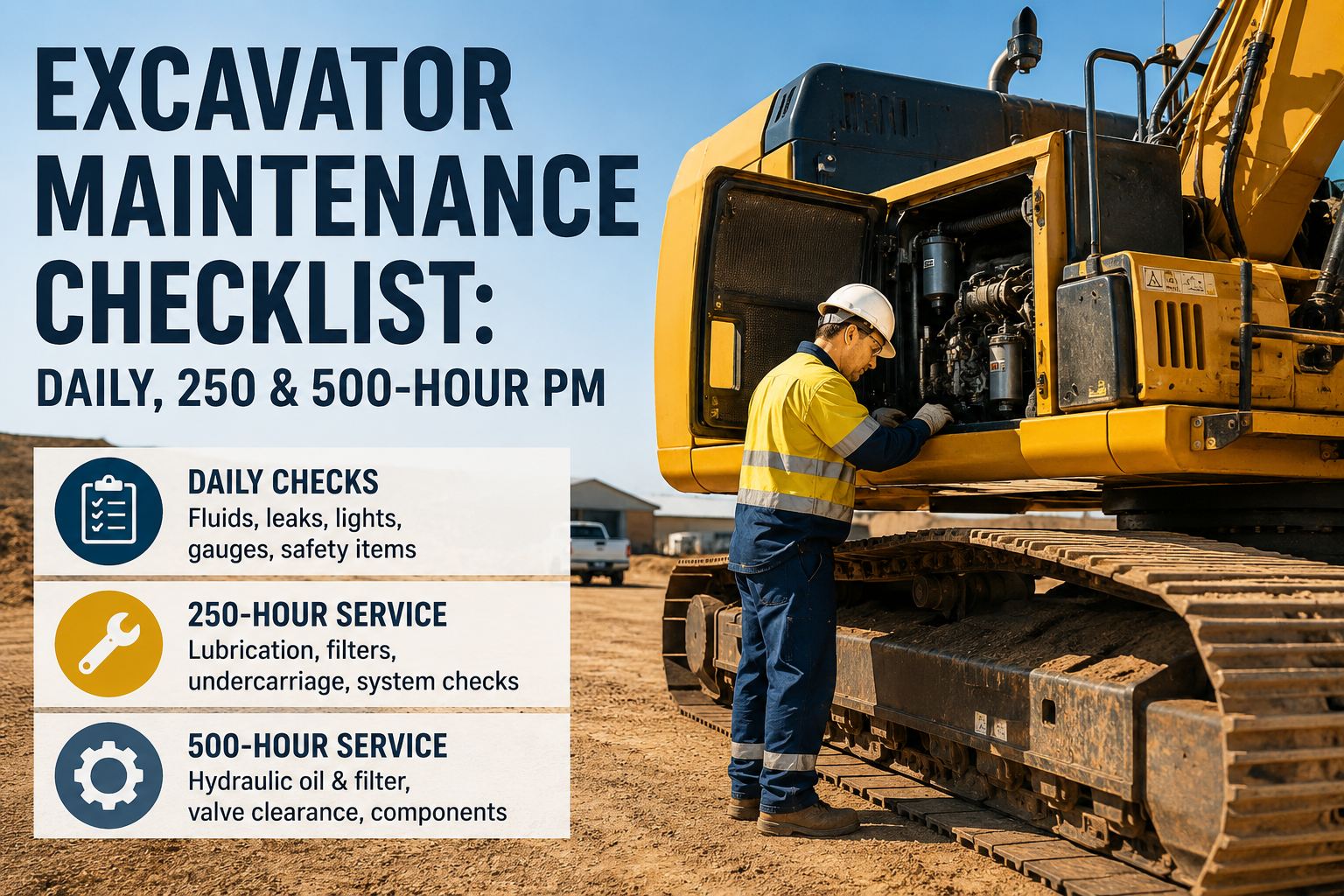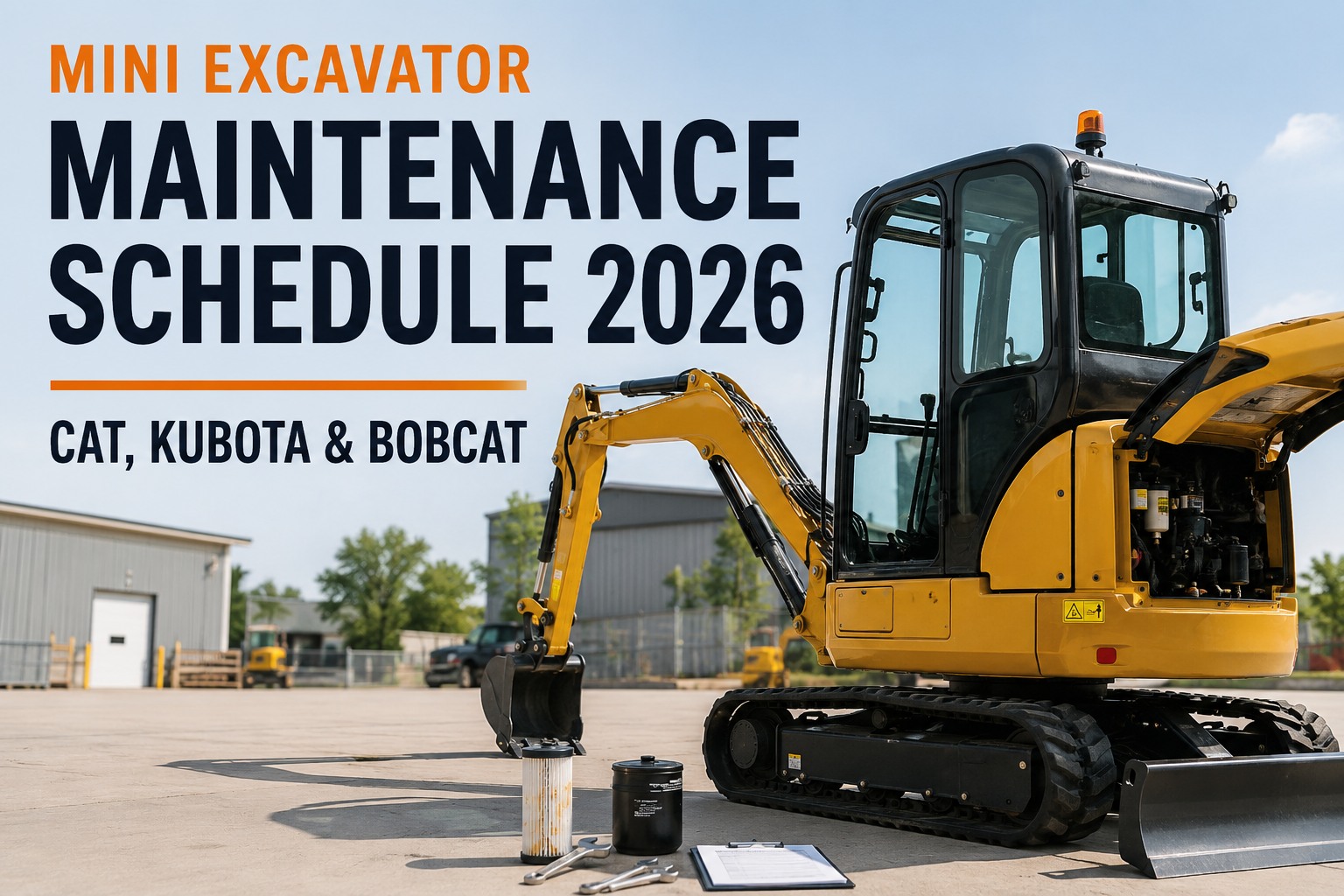
Your Kubota KX057 pump seized at 1,240 hours. The prior oil sample showed metal counts climbing — nobody flagged it. Now: $6,800 for a new pump, four days of downtime, and a rental to cover the job. That's the mini excavator maintenance schedule story most rental and contractor fleets don't tell — the one where a $180 filter change would have caught it. This guide walks the PM matrix, six inspection zones, and OEM-specific windows for Cat, Kubota, and Bobcat. Book a 15-min HVI demo.
Six Systems. One Machine. Every Hour Costs You If You Skip One.
Mini excavators earn every hour on the meter. Miss a filter, ignore a track measurement, or run past a hydraulic sample and the repair bill hits before the invoice does.
The Mini Excavator Is a 500-Hour Machine, Not a Calendar Machine
Every mini excavator PM interval Cat, Kubota, and Bobcat publish is in operating hours — not months, not miles. A rental machine in the middle of a busy season can rack up 200 hours in three weeks. A landscaper's owned unit might take eight months to hit the same number. Same machine, same wear, wildly different calendar. Track the hour meter religiously or the manual's numbers become meaningless. That single discipline separates fleets that hit expected component life from fleets that write off pumps and undercarriages at half their rated hours.
Rental fleets have the added complication of returned-machine unknowns. A unit comes back after a two-week rental and the operator won't volunteer that they were running in ankle-deep mud for four days. The condition doesn't show up on the invoice, but it shows up in the next hydraulic sample. Start a free HVI trial to see how return-condition capture protects the next 500 hours.
The Complete Mini Excavator PM Interval Matrix
Every service item mapped against the six hour milestones every OEM uses. Print this, hand it to techs, laminate it to the workshop wall. Adjust down 20-30% for severe conditions — more on that below.
| Service Item | 10 hr | 50 hr | 250 hr | 500 hr | 1,000 hr | 2,000 hr |
|---|---|---|---|---|---|---|
| Visual Walkaround | ✓ | ✓ | ✓ | ✓ | ✓ | ✓ |
| Fluid Level Check | ✓ | ✓ | ✓ | ✓ | ✓ | ✓ |
| Grease Pivot Points | ✓ | ✓ | ✓ | ✓ | ✓ | ✓ |
| Engine Oil & Filter | 1st only | ✓ | ✓ | ✓ | ✓ | |
| Fuel Filter & Water Sep | ✓ | ✓ | ✓ | ✓ | ||
| Hydraulic Filter | 1st only | ✓ | ✓ | ✓ | ||
| Air Filter (Primary) | Inspect | Replace | Replace | Replace | ||
| Undercarriage Measure | ✓ | ✓ | ✓ | |||
| Hydraulic Oil Sample | ✓ | ✓ | ✓ | |||
| Hydraulic Oil Change | ✓ | |||||
| Coolant Change | ✓ | |||||
| Swing Bearing Torque | ✓ | ✓ | ||||
| Diagnostic Scan | ✓ | ✓ | ✓ |
The 50-hour break-in service is non-negotiable. First engine oil, hydraulic filter, and fastener torque check at 50 hours. Miss it on a new or rebuilt machine and warranty coverage on internal component failures is compromised for the life of the unit. Every OEM audits this in a claim investigation.
The 6-Zone Inspection Walkthrough
A complete mini excavator inspection covers six distinct zones. Here's what to check in each — and why skipping any one of them shows up on the next repair bill.
Cat vs Kubota vs Bobcat: OEM-Specific Service Windows
The three brands that dominate the North American mini excavator market share a similar PM framework, but each has model-specific quirks and required fluids that fleet managers get wrong most often when a machine gets swapped between suppliers.
One PM Plan Doesn't Work Across Three OEMs
HVI's equipment maintenance library pre-loads Cat, Kubota, and Bobcat mini excavator intervals by model — auto-triggering hydraulic samples, undercarriage measurements, and swing bearing torque at the right hour meter reading. No spreadsheet, no missed 50-hour break-in, no warranty exposure.
The 5 Failures That Kill Mini Excavator Uptime
Every mini excavator that dies before its rated hours dies from one of these five causes. In field data across rental and contractor fleets, they account for close to 90% of unplanned downtime.
Condition Modifiers: Why the Manual Interval Isn't Your Interval
Every OEM interval assumes normal operating conditions. Rental and contractor fleets rarely operate normally. Four common conditions drive real-world intervals 20-30% shorter than the manual's number — and running the manual's number in the wrong conditions is how fleets grind through pumps.
The Rental Fleet Playbook: Different Machine, Same PM, Higher Stakes
Rental mini excavators face a different economics equation than owner-operated machines. Utilization drives revenue, but return-condition unknowns drive failure. Three disciplines matter more in rental than in contractor fleets.
How HVI Digitizes Mini Excavator Maintenance
Manual PM tracking on mini excavator fleets breaks down at scale because intervals are hour-based, model-specific, and condition-modified. HVI closes the gap in four places.
Frequently Asked Questions
What are the standard mini excavator maintenance intervals?
Every major OEM (Cat, Kubota, Bobcat, Hitachi, Komatsu) uses the same six hour-based service milestones for mini excavators: a 10-hour daily walkaround (visual inspection, fluid levels, grease points), a 50-hour first service (break-in oil and hydraulic filter), then 250-hour, 500-hour, 1,000-hour, and 2,000-hour progressive services. Engine oil and filter typically at every 250 hours. Hydraulic filter at 500. Full hydraulic oil change at 2,000. Coolant change at 2,000. Undercarriage measurement documented at every 500-hour service. Adjust down 20-30% for severe conditions (demolition dust, high ambient heat, extended idle, muddy ground). Track the hour meter religiously — calendar-based intervals miss the mark on rental fleets and busy contractor units.
What's the most common mini excavator failure?
Hydraulic system failures account for approximately 45% of excavator breakdowns, including hose failures, pump wear, and contaminated fluid. The primary cause is contaminated hydraulic fluid — water or dirt in the reservoir, missed filter changes, or use of the wrong fluid spec. Kubota mini excavators require SUPER UDT specifically and do not tolerate multi-function tractor fluids; substituting compromises pump warranty. The economic case for filter discipline is stark: a $30 hydraulic filter change on schedule prevents a $5,000+ pump replacement. Undercarriage failures are the second-most-common cause (roughly 22% of downtime), followed by DPF/aftertreatment issues (12%), cooling system overheating (10%), and swing bearing/structural failures (8%).
How often should I check track tension on a mini excavator?
Track tension should be visually checked at every pre-operation walkaround (every 10 operating hours) and measured against OEM spec weekly. Proper sag is typically 10-30mm at the mid-point between the front idler and the rear sprocket — check the specific machine's operator manual for the exact range. Symptoms of incorrect tension: tracks too loose sag noticeably between rollers and can derail; tracks too tight strain sprockets and drive motors, increase fuel consumption, and shorten track life dramatically. After operating in mud or heavy debris, clean the undercarriage before checking tension — packed material can mask the reading. Track tension is one of the single highest-leverage checks on the machine because getting it wrong destroys the most expensive component on the excavator.
What fluid does a mini excavator hydraulic system need?
Fluid specification is brand-specific and using the wrong fluid can void the pump warranty. Cat mini excavators require Cat HYDO Advanced 10 or Cat BIO HYDO (biodegradable option). Kubota requires Kubota SUPER UDT (Super Universal Dynamic Tractor Fluid) exclusively — do not substitute multi-function tractor oils, they are explicitly disallowed for Kubota excavator hydraulic systems. Bobcat requires Bobcat All-Season Hydraulic/Hydrostatic Fluid. When mixing brands is unavoidable (fleet servicing multiple OEMs), maintain separate labeled fluid stocks and never top up with the wrong brand. Hydraulic fluid contamination or wrong-spec fluid is the number-one cause of pump failure. Change the filter at 500 hours; sample the fluid at every 500-hour interval; full oil change at 2,000 hours.
Is the 50-hour first service really critical?
Yes, and skipping it is one of the most common ways fleet managers lose warranty coverage on internal engine and hydraulic components. The 50-hour break-in service catches manufacturing debris circulating in the engine oil and hydraulic system, tightens fasteners that seat during initial operation, and resets torque values on critical connections. Every major OEM specifies this service, and every OEM audits its completion during a warranty claim investigation on an early-life component failure. On a new machine or a rebuilt unit, the 50-hour service is not a maintenance recommendation — it's the condition for warranty coverage on the components most likely to fail during break-in. Document it with hour meter reading, technician signature, and photos of the removed filters. Digital DVIR workflows generate this record automatically; paper systems typically don't survive an OEM claim review.
Turn the Hour Meter Into Automated Uptime
Cat 305, Kubota KX057, Bobcat E50 — every model, every interval, every condition modifier auto-adjusted from real machine hours. Digital inspection templates for all six zones. Undercarriage wear tracking and cost-per-hour analytics built in. Live in under 30 minutes.