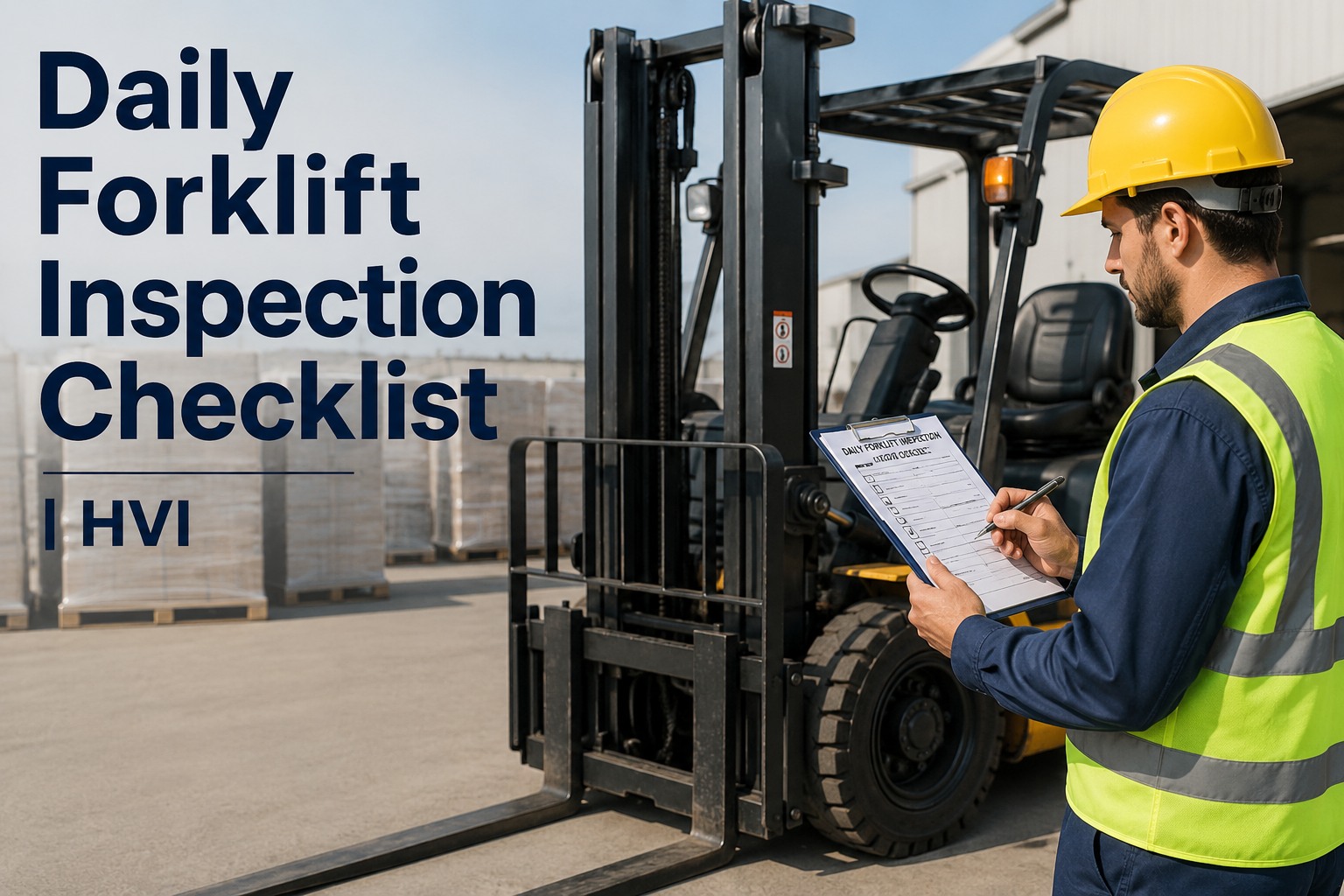
The reason a generic forklift inspection checklist misses things is that a single template can't cover an electric rider, a propane cushion-tire, and a diesel pneumatic-tire equally well. The battery cables that matter on Class I don't exist on Class V. The exhaust and coolant that decide Class V safety don't apply to Class II. What OSHA 29 CFR 1910.178(q)(7) actually requires is inspection before each shift — and getting that inspection right means using the checklist that matches the truck. This guide walks the daily forklift inspection checklist across all three power types side by side: what's universal, what changes, and what triggers immediate tag-out no matter which truck it is. OSHA fines run $16,550 per serious violation and $165,514 per willful, and forklift violations consistently rank in OSHA's top 10 most-cited standards. A five-to-ten-minute pre-shift check is what stands between operation and citation. Book a demo to see chemistry-specific inspection templates built in.
The Daily Forklift Inspection Checklist
Same OSHA rule, three different power types, three different inspections. Here's the walkthrough of what's universal, what changes, and what triggers tag-out — without missing anything the auditor will ask for.
- Battery pack & BMS
- Cables & connectors
- Charging port
- Tank mount & valve
- Hoses & regulator
- Leak test
- Engine oil & coolant
- Fuel system
- Exhaust & DPF
OSHA's rule is deliberately format-agnostic. 29 CFR 1910.178(q)(7) says the forklift shall be examined before being placed in service and shall not be placed in service if the examination shows any condition adversely affecting safety — but it never specifies which items to check. That flexibility is what makes power-type-appropriate checklists a competitive advantage. A truck inspected with the wrong template still gets checked; it just misses the items that matter most for that specific machine. Here's the framework.
The 4 numbers that shape the discipline
Any single one of these justifies the five-to-ten-minute pre-shift check. Together they explain why forklift violations sit permanently in OSHA's top 10 most-cited standards.
- 85 Forklift-related deaths per year in the United States — per BLS data
- 34,900 Serious forklift injuries annually — roughly 100 per day
- $165,514 Maximum OSHA penalty per willful violation — 2025 rate
- $15M+ Total 2024 forklift-related OSHA penalties — single year
Three of the top five most-common forklift violations are documentation failures — missing training records, missing refresher records, missing certifications. The other two are daily-inspection failures. Which means most citation risk closes with disciplined recordkeeping, not just better inspections. See audit-ready OSHA recordkeeping in a demo
The 5 checks that are universal — every truck, every shift
These items apply to Electric, LPG, and Diesel forklifts equally. They're the pre-shift walk that catches roughly 70% of tag-out-worthy defects across every power type. Do these first, then move to the power-type-specific items.
Forks, mast, and lift chains
Forks free of cracks, bends, and heel wear beyond 10%; no field-welded repairs. Mast rails, rollers, and pin connections examined for wear. Lift chains inspected for stretch, twist, missing pins, and adequate lubrication. Any deformation past OEM tolerance = tag-out.
Hydraulic system — leaks, cylinders, hoses
Ground beneath truck dry, no fluid pooling. Lift, tilt, and side-shift cylinders free of scoring, pitting, and weeping seals. Hoses checked for chafing, bulges, and cracked crimped ends. Lift and tilt smooth through full range with no drift.
Brakes — service and parking
Service brake test on level ground — forklift stops promptly, no pull to either side, no dragging. Parking brake tested on incline — truck holds without creep. Brake failure is the leading cause of pedestrian fatalities in powered-truck incidents; this check is non-negotiable.
Safety devices — horn, backup alarm, lights, seat belt
Horn audible at operator position and at a distance. Backup alarm functional under reverse. Working lights forward and reverse. Seat belt intact, buckle operates, retractor pulls smoothly. Overhead guard structurally intact with all bolts secured, no unauthorized modifications.
Tires and steering
Solid tires: check for chunking, flat spots, embedded debris. Pneumatic tires: proper inflation, tread condition, no sidewall damage. Steering response smooth from lock to lock, no dead zone or pull. Data plate legible and matches truck configuration.
Five items, five minutes. If any of them fails, the truck stays out. If all five pass, move to the power-type-specific checks below — these are where the checklists diverge. Start free and get the 5-check pre-shift template built in
Power-type-specific inspections — the 3-way comparison
Same OSHA rule, three different truck realities. Here is exactly what changes across Electric, LPG, and Diesel — the items that a generic checklist misses and an auditor still expects you to have covered.
The pattern that separates every high-performing warehouse from the average one is having a chemistry-specific template per class of truck — not one universal form. Universal forms produce universal-quality inspections. Book a demo — see power-type-specific templates in the app
The 5 defects that trigger immediate tag-out
Under 1910.178(p)(1), any defect adversely affecting safety requires the forklift to be immediately removed from service and tagged "DANGER — DO NOT OPERATE" until repair. These five are the tag-out triggers that show up most in incident investigations — the ones that must never be discretionary.
- Brake failure or draggingLeading cause of pedestrian fatalities in powered-truck incidents. Zero exceptions.
- Steering malfunction or dead zoneLoss of directional control with a raised load is not survivable in a populated aisle.
- Hydraulic leak or lift driftLifted load drifting down uncontrolled; fluid injection injury risk from pressurized leaks.
- Non-functional horn, alarm, or lightsFederally required warning devices. Pedestrian awareness depends on them.
- Damaged overhead guard, seat belt, or ROPSThe systems that protect the operator in a tipover or falling-load incident.
Digital inspection platforms enforce this structurally — flagging any of the five automatically tags the truck out and prevents further operation until a signed repair certification clears it. That workflow, run consistently, is what keeps the fatality number from being higher than 85. Start free and get tag-out enforcement built in
The 3 records OSHA actually checks on a forklift audit
When an OSHA officer arrives, three records get requested by name — every time. These are the documents where most citations originate. Not driving practice, not maintenance quality; recordkeeping.
Operator certification record
The single most-cited record in forklift audits. Four required fields: operator name, date of training, date of evaluation, name of person conducting the training and evaluation. Missing any one field turns a compliant operator into a citation. Kept for the duration of employment plus reasonable audit-tail.
3-year re-evaluation record
Every certified operator must be re-evaluated at least once every 3 years. The evaluation date is a required field on the certification record. Miss it and the operator silently expires from compliant to cited. Timely re-evaluation also cuts accident rates by up to 30%.
Daily inspection log
OSHA doesn't specify a format, and technically doesn't require the log itself to be written — but the inspection is required, and without a log there is no proof it happened. Best practice is 3-year retention. Digital timestamps and photos beat a paper checkmark in every audit.
Three records, one system. When they live in the same platform as the inspection itself, the audit that used to take a day of file-cabinet digging becomes a five-minute PDF export. See audit-ready 1910.178 recordkeeping
From a warehouse safety manager running a mixed fleet
We ran the same paper checklist across 22 forklifts — 14 electric, 5 propane, 3 diesel. Same form for all of them. In hindsight, obvious problem: our electric trucks had cable checks the form didn't prompt, our propane trucks had leak tests nobody remembered, and the diesel form skipped exhaust and coolant.
What changed for us was moving to power-type templates on mobile. Every operator gets the checklist matched to their specific truck. The propane checklist prompts a soap test on the coupling. The electric prompts a photo of the battery cables. Six months in, we've had zero repeat defects on the same truck — because the record now shows exactly what got checked, and by whom, on which specific machine.
Frequently asked questions
What does OSHA require for daily forklift inspections?
Under 29 CFR 1910.178(q)(7), powered industrial trucks — the OSHA term that covers all forklift types including electric, LPG (propane), diesel, and gasoline — must be examined before being placed in service, and shall not be placed in service if the examination shows any condition adversely affecting safety. Trucks used on a round-the-clock basis must be examined after each shift. OSHA does not prescribe a specific checklist format; the requirement is that the examination happen and that defective equipment be removed from service. However, using a standardized checklist (paper or digital) is the most reliable way to ensure nothing gets missed and to provide documentation of compliance. Best practice is to use a power-type-specific template because the items that matter most differ across electric, LPG, and diesel trucks — a battery cable check on Class I doesn't apply to Class V, and an exhaust check on Class V doesn't apply to Class I. The inspection typically takes 5 to 10 minutes for a trained operator and should cover forks, mast, chains, hydraulics, brakes, steering, safety devices, tires, and the power-source-specific items.
What are the differences between inspecting electric, LPG, and diesel forklifts?
The universal items — forks, mast, chains, hydraulics, brakes, steering, safety devices, and tires — apply to all three types equally and account for roughly 70% of a pre-shift inspection. What changes is the power-source-specific section. Electric forklifts (Class I, II, III) require battery pack inspection, cable and connector checks, charging port cleanliness, and either electrolyte level (lead-acid) or Battery Management System indicator (lithium-ion). Charging area ventilation and eyewash station location are also part of the inspection scope for lead-acid trucks because of hydrogen off-gassing and acid handling risks. LPG (propane) forklifts (Class IV cushion tire, Class V pneumatic tire) require tank mount and valve inspection, hose condition, regulator seating, and a soap test for leaks around the coupling and connections. Enclosed operation requires functional CO monitoring per site policy. Diesel forklifts (Class V, VII) require engine oil and coolant levels, fuel system integrity, battery terminals, alternator belt condition, and exhaust routing without fractures. Diesel operation indoors is generally prohibited unless the engine meets EPA Tier 4 emissions and the area is properly ventilated.
When must a forklift be tagged out of service?
Under 29 CFR 1910.178(p)(1), any powered industrial truck found to be in need of repair, defective, or in any way unsafe must be taken out of service until it has been restored to safe operating condition. In practice, five categories of defect trigger immediate tag-out regardless of power type: brake failure or dragging (the leading cause of pedestrian fatalities in powered-truck incidents), steering malfunction or dead zone (loss of directional control with a raised load), hydraulic leak or uncommanded lift drift (falling load risk plus fluid injection injury from pressurized leaks), non-functional horn, backup alarm, or required lights (federally mandated pedestrian warning devices), and damaged overhead guard, seat belt, or rollover protection structure (the systems that protect the operator in an incident). Tag-out means the truck is physically tagged "DANGER — DO NOT OPERATE," the ignition or start controls are secured against use, and the defect and repair status are documented. The truck must not return to service until repair is completed and certified by a qualified person, and the record shows the sign-off. Digital inspection platforms enforce this structurally by blocking the truck from an operational state until repair certification is captured.
What records do I need to keep for forklift inspections?
Three records show up in every OSHA forklift audit and account for the majority of citations. First, the operator certification record under 29 CFR 1910.178(l)(6), which is the single most-cited forklift record. Required fields are operator name, date of training, date of evaluation, and name of the person conducting the training and evaluation. Missing any one field turns a compliant operator into a citation. Second, the 3-year re-evaluation record under 1910.178(l)(4)(iii). Every certified operator must be re-evaluated at least once every three years; the evaluation date is a required field on the certification. Miss the date and the operator's status silently expires. Third, the daily inspection log under 1910.178(q)(7). OSHA doesn't prescribe a format and technically doesn't require the log itself to be written — but the inspection is required, and without a log there is no proof it happened. Best practice is 3-year retention of daily inspection records. Digital timestamps and photos beat a paper checkmark in every audit context, and California (Cal/OSHA) states enforce stricter recordkeeping than federal minimums.
Can I use the same inspection checklist for all my forklifts?
You can, but you shouldn't — and most facilities running mixed fleets don't. OSHA's rule is deliberately format-agnostic, which means a single generic checklist technically satisfies 1910.178(q)(7) as long as the underlying inspection happens. The practical problem is that a generic checklist misses items an auditor still expects covered. If your electric checklist prompts an exhaust check, operators check nothing (there is no exhaust) and the missing prompt hides the cable and connector items that actually matter for that truck. If your diesel checklist doesn't prompt fuel filter, coolant level, and exhaust routing, those items get skipped even though they are the specific defects most likely to hit a Class V machine. Best practice on any facility with more than one power type is a template per class of truck — Class I electric rider, Class IV cushion-tire LPG, Class V pneumatic tire, and so on. Digital inspection platforms make this trivial because the correct template loads based on the truck's asset record; paper systems make it hard because each operator has to grab the right form for the right truck every shift, and the wrong form gets used constantly.
Run 1910.178 inspections that match the truck — every shift
HVI provides forklift inspection templates matched to each OSHA class of powered industrial truck, with chemistry-specific paths for Li-ion vs. lead-acid on electric trucks, LPG leak-test prompts on propane, and diesel-specific fluid and exhaust checks. Every inspection captures the audit-required fields, every defect routes to a work order, and the three OSHA-checked records live in one platform for instant audit retrieval.
No credit card · No hardware · Class I–VII templates ready