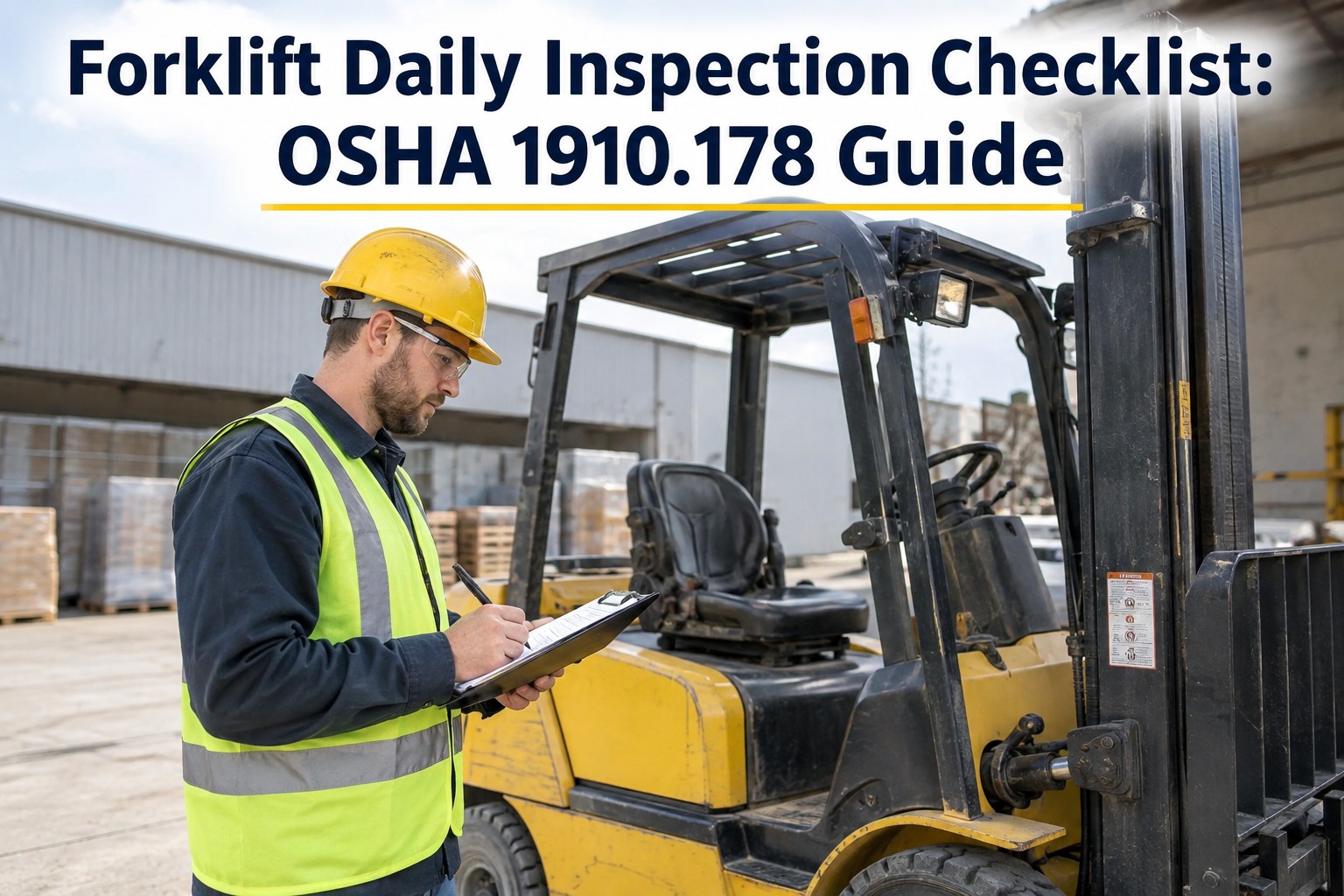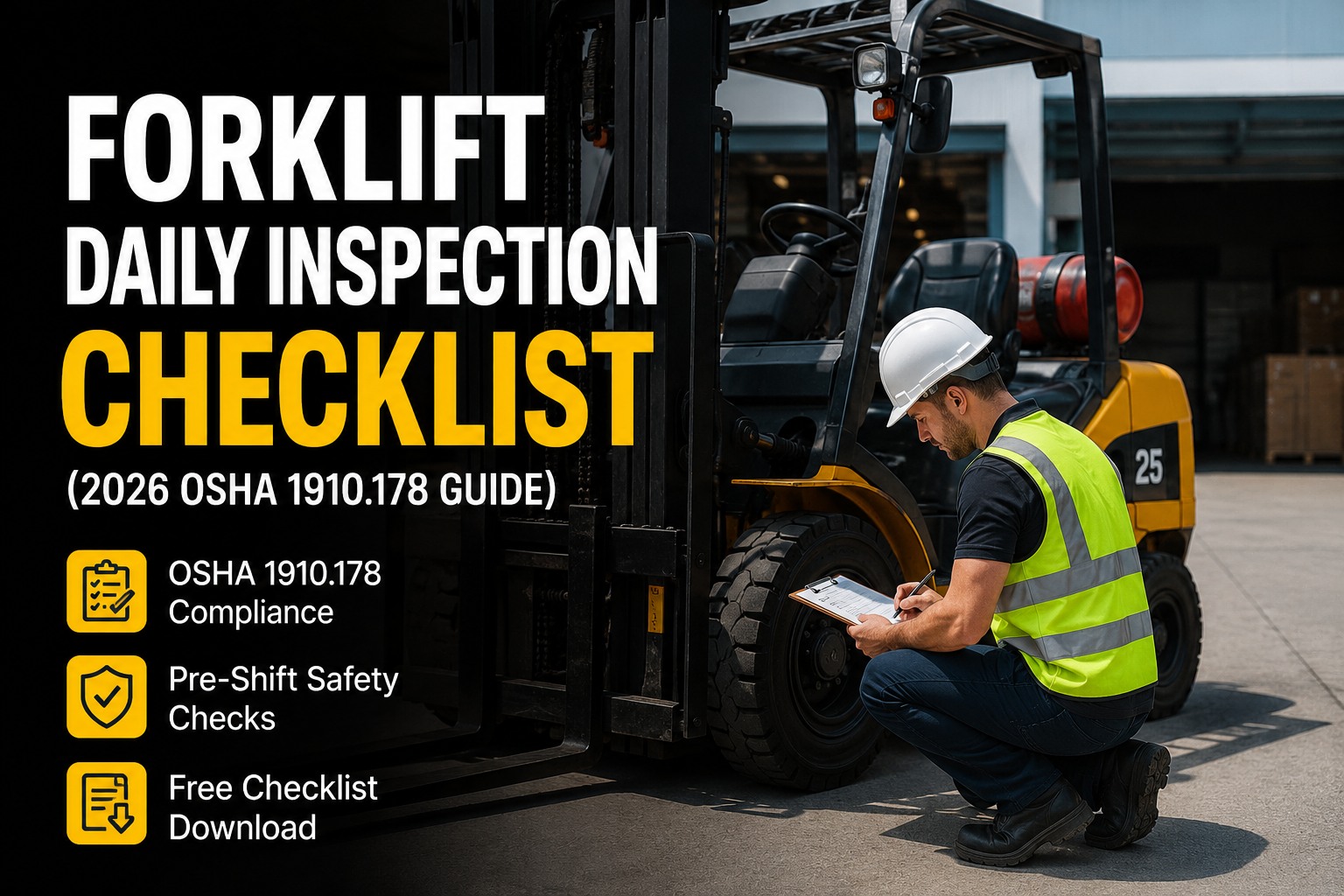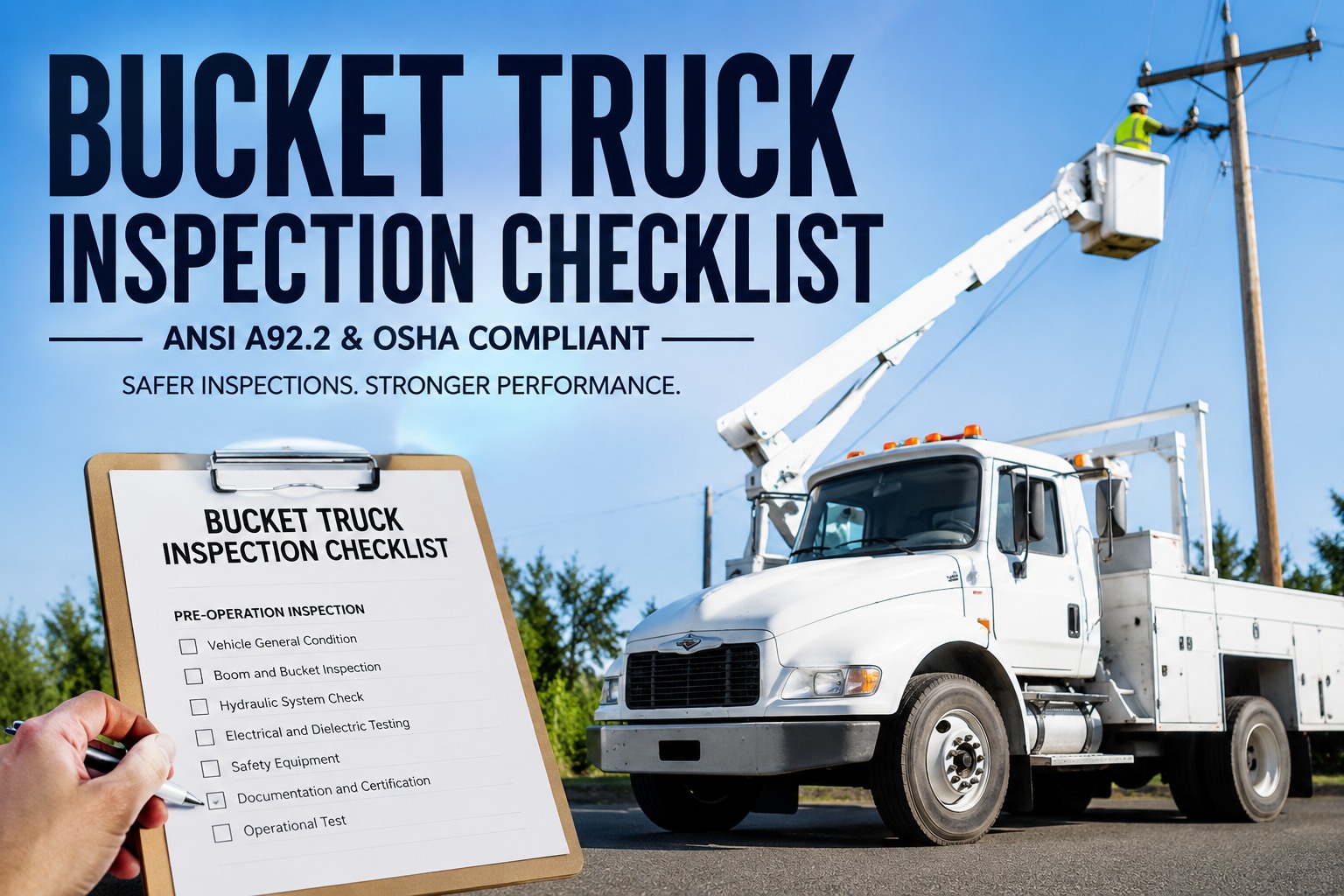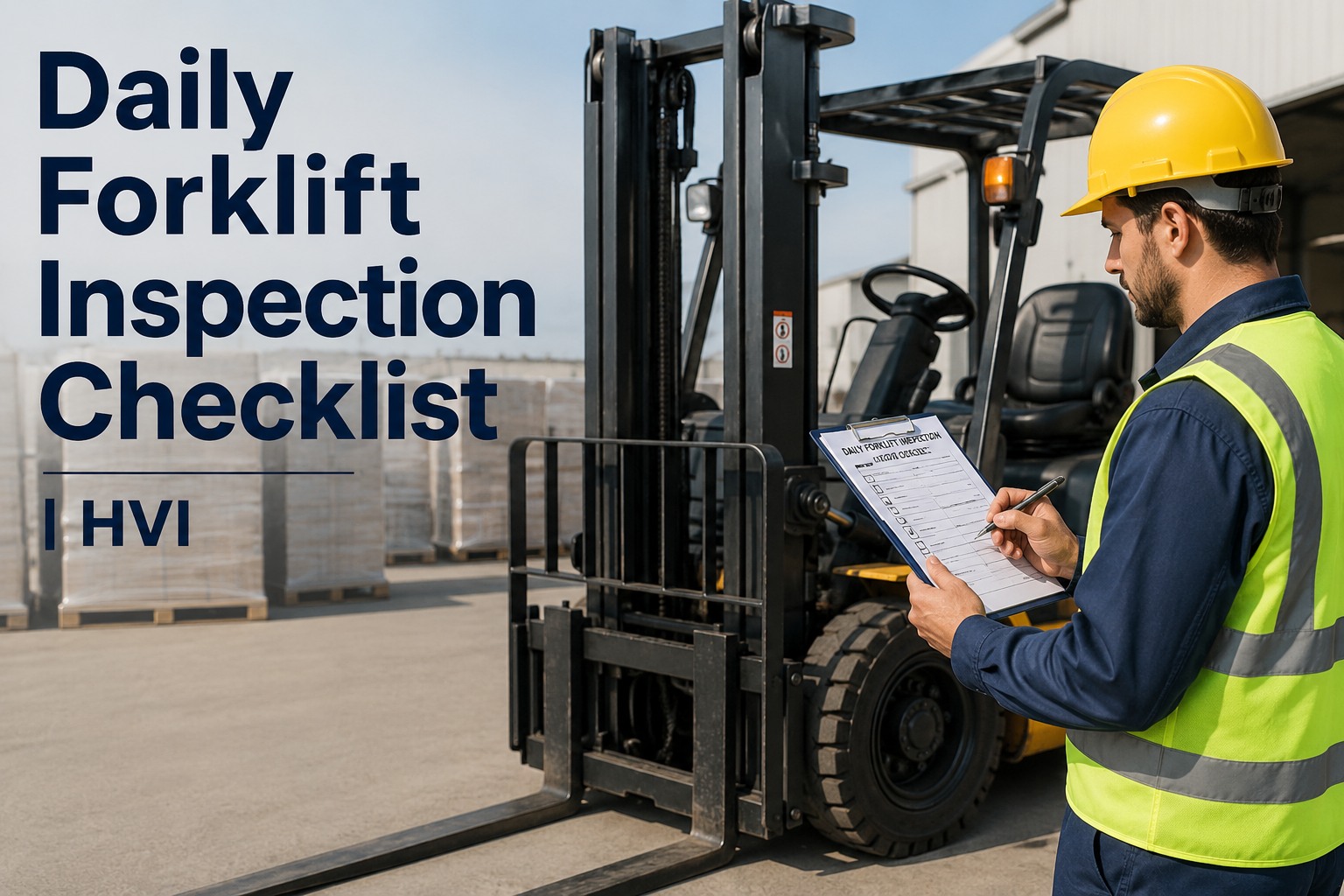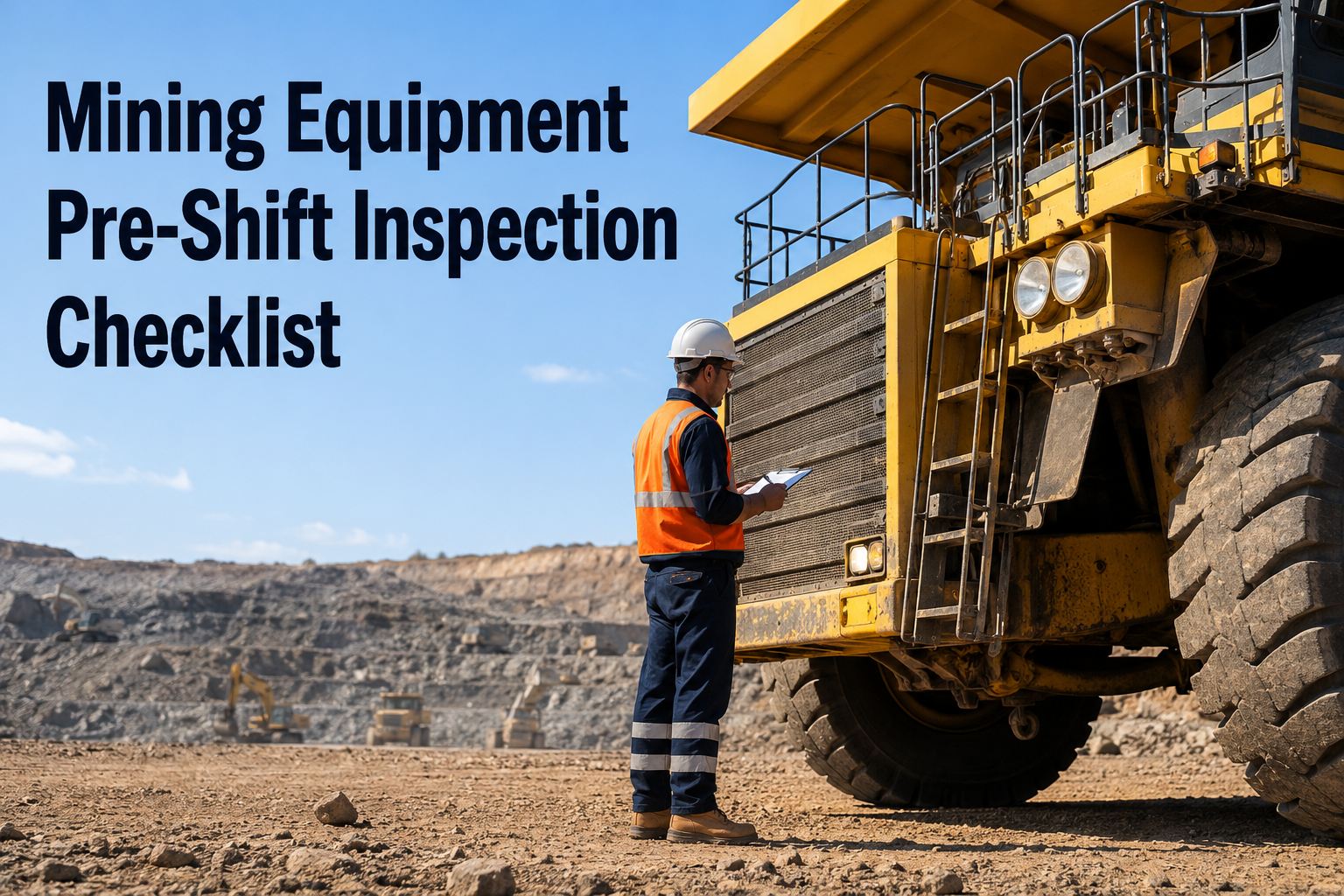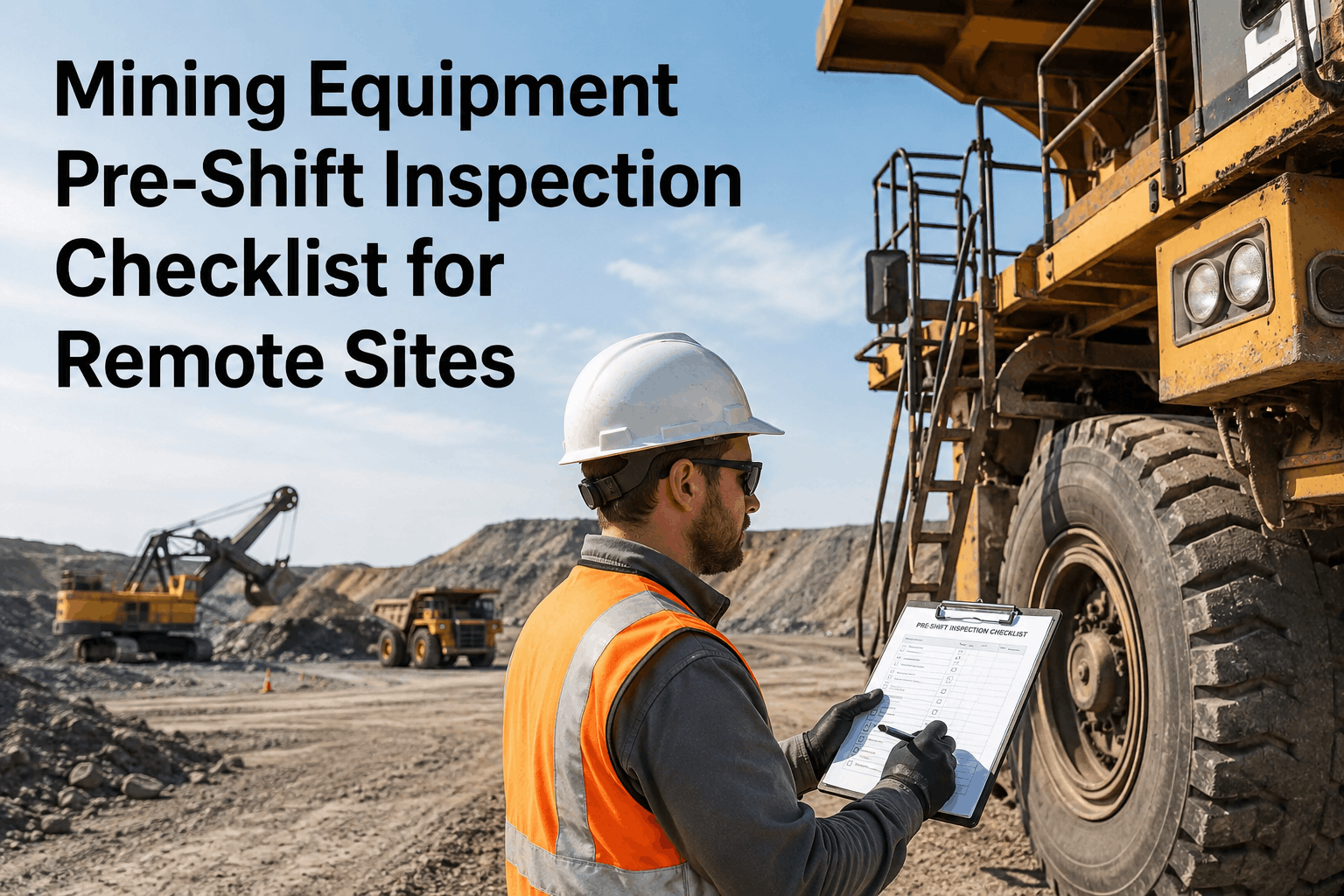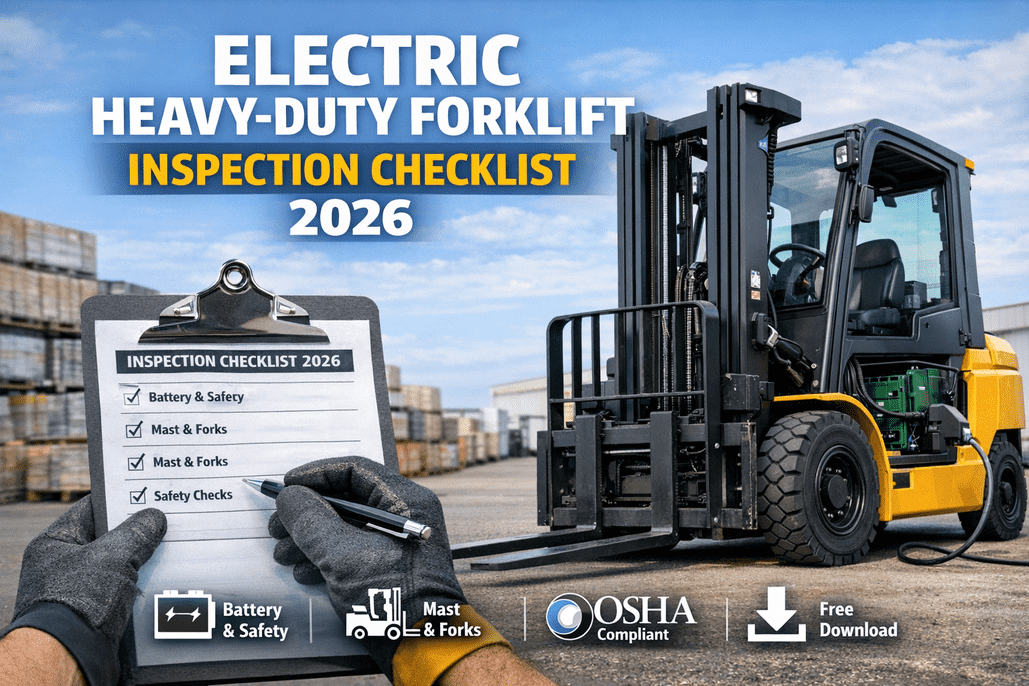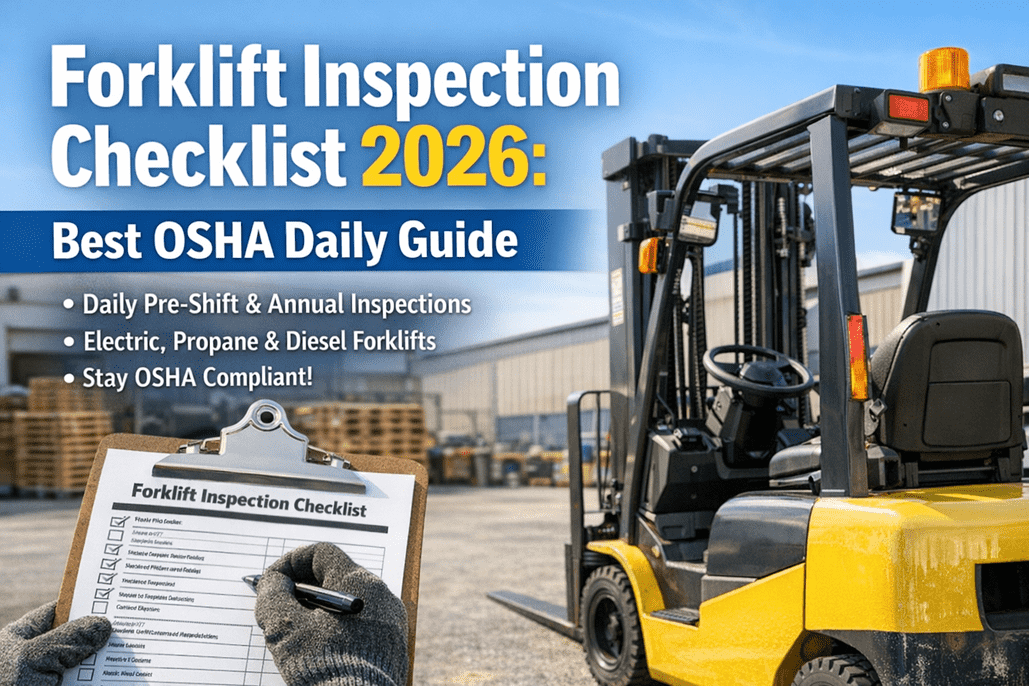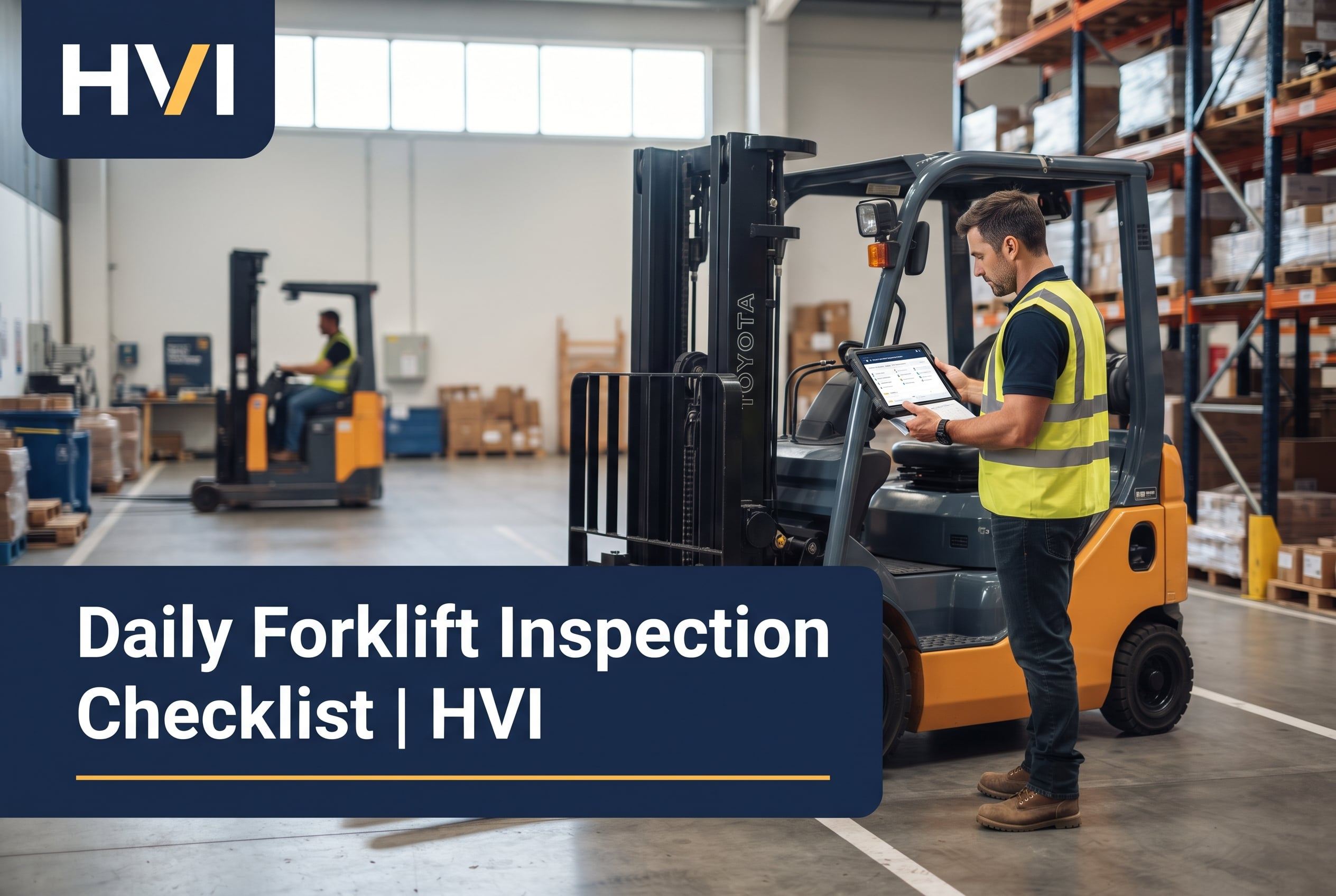
A forklift that skidded on a patch of hydraulic leak, a mast that dropped because a hose let go under load, a tip-over on a dock plate from a brake nobody tested — these aren't freak accidents. They're the predictable result of a lift truck that went to work without a real pre-shift check. OSHA requires a forklift inspection before every shift for a reason, and skipping it is one of the most-cited violations in the country. This forklift inspection checklist walks the OSHA daily pre-shift routine exactly as an operator should: the key-off walk-around, then the key-on operational test, system by system. Book a 30-minute walkthrough to see it run on a tablet at shift start.
The OSHA Forklift Inspection Checklist
Every system a daily pre-shift forklift inspection must cover under OSHA 1910.178 — the key-off walk-around and the key-on operational test — with the conditions that pull a lift truck out of service.
Unit 07 · Electric Sit-Down PIT
- Frequency
- Before each shift
- Two parts
- Key-off + key-on
- If it fails
- Tag out of service
- Operator
- Certified & signed
Documented before the first lift
-
Daily
inspection required before each shift under OSHA 1910.178(q)(7)
29 CFR 1910.178(q)(7) -
Top 10
powered industrial truck rules are among OSHA's most-cited standards
OSHA citation data -
~85
fatal forklift accidents reported in U.S. workplaces each year
industry safety data -
~34,900
serious forklift-related injuries reported annually
industry safety data
What OSHA actually requires
The rule is short and strict. Under OSHA 29 CFR 1910.178(q)(7), a forklift must be examined before it's placed in service and at least daily — or after each shift if the truck runs around the clock. If the examination shows any condition that adversely affects safety, the truck can't go to work. Any powered industrial truck not in safe operating condition has to be removed from service and tagged out until an authorized person repairs it. On top of the inspection itself, only trained and certified operators may run the equipment, certification renews every three years, and the data plate showing rated capacity has to be legible — a missing or faded plate is its own violation. It isn't a suggestion; it's a citation-level obligation carrying serious penalties. See how HVI enforces the daily check at shift start
-
1 · Key-off walk-around
A visual check with the truck off — forks, tires, hydraulics, leaks, battery or fuel, data plate.
-
2 · Key-on operational test
Engine running — brakes, steering, horn, lights, mast lift and tilt, and all safety devices.
The two-phase inspection, system by system
The daily check has two parts: a key-off walk-around and a key-on operational test. Switch between them below — each system carries its own out-of-service conditions, and the ones in amber are where most forklift incidents begin.
Before the key turns, walk the truck — this is where you catch the leaks, cracks, and worn parts a running check never surfaces.
Forks, mast & hydraulics
1910.178(e)- Forks free of cracks, bends, or worn heels; both blades even, locking pins seated
- Mast rails, rollers, and chains not cracked, worn, or kinked; chains evenly tensioned
- Hydraulic hoses free of cracks, abrasion, or bulging; no leaks at fittings
- Hydraulic fluid at level, not milky or foamy (water contamination)
- Carriage, backrest, and load guard secure and undamaged
- Data plate present and legible — rated capacity, weight, attachment limits
Out of service if: a cracked or bent fork, a leaking or bulging hydraulic hose, worn or damaged mast chains, or a missing/illegible data plate. A hose failure with a load raised is a leading cause of forklift fatality.
Tires, wheels & power source
1910.178(p)(4)- Tires free of large cuts, chunking, or flat spots; correct inflation on pneumatic tires
- Wheel fasteners present and tight; no debris wrapped in the axles
- No fuel, oil, coolant, or hydraulic leaks under the truck
- Electric: battery secure, connector and cables undamaged, electrolyte at level, no corrosion
- Propane/LPG: tank secure and in date, fittings and hose leak-free, pressure-relief clear
- Engine oil and coolant at level on internal-combustion trucks
Out of service if: a fuel-system leak of any kind, a damaged battery or LP tank, worn drive tires, or a leak that could cause skidding. No truck may run with a fuel-system leak until it's corrected.
Now start the truck and test everything that only works when it's running — the systems that stop a tip-over or a pedestrian strike.
Brakes & steering
1910.178(q)(7)- Service brake pedal firm and consistent — not spongy or hitting the floor
- Truck decelerates evenly and doesn't pull to one side when braking
- Parking brake holds the truck on a flat surface and on its rated grade
- Steering responsive with no excessive free play, pulling, or hydraulic noise
- No unusual noises or vibrations through the controls
Out of service if: a low or spongy brake pedal, a brake that pulls, a parking brake that creeps, or steering with excessive free play. Brake and tire failure is the primary contributor to tip-over, the leading cause of operator death.
Warning devices & controls
1910.178- Horn audible above ambient noise from at least 10 feet
- Headlights, brake lights, and strobe/blue safety light all function
- Back-up alarm sounds when reversing
- Seat belt latches and retracts; operator presence system works
- Gauges, hour meter, and warning lamps read normally
Out of service if: a non-functioning horn, an inoperative light or back-up alarm, or a failed operator-presence system. Disabled warning devices are cited in a large share of pedestrian-fatality investigations.
Mast & load functions
ANSI/ITSDF B56.1- Forks raise and lower smoothly through the full range with no load
- Mast tilts forward and back without jerking, drift, or hesitation
- Side-shift and attachments operate correctly if equipped
- No drift — raised forks hold position without creeping down
- Lift and tilt controls return to neutral and hold
Out of service if: the forks drift down under their own weight, the mast hesitates or jerks, or a control won't return to neutral — all signs of hydraulic failure that can drop a load.
Every one of these is a pass/fail an operator can run in a few minutes — and a defect on any one is grounds to tag the truck out. Book a demo to see the inspection gated on a device
Checks that change by forklift type
OSHA recognizes two broad classes of powered industrial truck, and each adds its own items on top of the shared checklist. Match the extra checks to what you're running.
Electric (battery)
- Battery secured, connector and cables undamaged
- Electrolyte at proper level; no corrosion on terminals
- Charging done in a ventilated area (hydrogen gas risk)
- Hood latch secure; no exposed or frayed wiring
- Battery discharge indicator in normal range
Internal combustion (gas / LPG / diesel)
- LP tank secure, in date, mounted at the correct angle
- Fuel fittings and hoses leak-free; relief valve clear
- Engine oil, coolant, and fuel at proper levels
- No exhaust leaks; no sparks or flames from the exhaust
- Water muffler filled where equipped
Whatever the power source, the rule is the same: any leak, damage, or defect means the truck comes out of service until it's fixed and re-checked. Load the right checklist for each truck type
Where a skipped check turns into an incident
Each system on the checklist maps to a real failure mode. This is why the pre-shift inspection is non-negotiable — the walk-around is the last line before these become recordable incidents.
-
Hydraulics
Hose bursts under load
Sudden mast drop — a leading cause of forklift fatality.
-
Brakes & tires
Can't stop or holds poorly
Tip-over on ramps and dock plates — the top operator-death cause.
-
Horn, lights, alarm
Pedestrian never warned
Struck-by collision — cited in a large share of pedestrian deaths.
-
Fuel / battery
Leak or damaged cell
Fire, skidding, or hydrogen-gas exposure during charging.
Catch any one of these on the walk-around and it's a work order. Miss it, and it's an OSHA recordable. That gap is the entire case for a documented daily inspection. Book a demo to see defects auto-route to maintenance
Expert view
Priya D.
Warehouse EHS Manager
Distribution center
40 lift trucks
On paper, every forklift got inspected every shift. Then an auditor asked to see last Tuesday's checks and half of them were blank or backfilled. The inspections were happening in name only — a signature on a clipboard, no real look at the truck.
Going digital fixed the honesty problem. The operator can't start the shift until the check is done on the tablet, a spongy brake gets photographed and flagged on the spot, and the truck won't clear until maintenance signs off. Our near-misses dropped and I can pull any inspection in seconds when OSHA asks.
— Priya D., Warehouse EHS Manager, distribution center
Paper forklist form vs. HVI digital checklist
The inspection is the same either way. What changes is whether it actually happened, whether defects reach maintenance, and whether you can prove it when OSHA arrives.
Paper forklift form
- A checkmark with no proof the truck was actually looked at
- Easy to backfill a whole week of blank forms
- No photo of the leak or cracked fork that was found
- Defect handoff to maintenance relies on a note
- Forms lost before an OSHA inspector asks for them
HVI digital checklist
- Timestamped, signed check the operator must finish before lifting
- Pass/fail gates that block a skipped or backfilled inspection
- Mandatory photos on any flagged defect
- Defects auto-route to a work order and tag the truck out
- Any inspection produced in seconds for an OSHA audit
Documented daily inspections are also your proof of due diligence if an incident ever does happen — and far easier to defend when they're timestamped and photo-backed. Sign up free and digitize your forklift checks
Frequently asked questions
How often does OSHA require forklift inspections?
OSHA 29 CFR 1910.178(q)(7) requires that a forklift be examined before it's placed in service and at least daily. Where trucks are used on a round-the-clock basis, they must be examined after each shift. In practice this means a documented pre-shift inspection before the first lift of every shift. If the examination shows any condition that adversely affects the safety of the vehicle, the forklift can't be placed in service, and any powered industrial truck not in safe operating condition must be removed from service until an authorized person repairs it. Only trained and certified operators should perform the inspection and operate the equipment.
What does an OSHA forklift inspection checklist cover?
A complete daily inspection has two phases. The key-off walk-around covers forks, mast, chains, and hydraulics; tires and wheels; leaks; the battery or fuel system; and the data plate. The key-on operational test, with the engine running, covers service and parking brakes, steering, horn, lights, back-up alarm, seat belt and operator-presence system, gauges, and the lift, lower, and tilt functions of the mast. The checklist aligns with OSHA 1910.178 and the ANSI/ITSDF B56.1 industry standard. Electric trucks add battery and electrolyte checks, while internal-combustion and propane trucks add fuel, LP-tank, and exhaust checks.
Who is allowed to inspect a forklift?
Under OSHA 1910.178(l), only operators who have been trained and evaluated may operate a powered industrial truck, and that training must include vehicle inspection and maintenance procedures. So the daily pre-shift inspection is performed by a trained, certified operator. Operator certification must be renewed at least every three years, and also after any accident, near-miss, observed unsafe operation, or assignment to a different type of truck. Repairs, however, are different: any powered industrial truck found not in safe operating condition must be removed from service, and all repairs must be made by authorized, qualified personnel, not by the operator.
What happens if a forklift fails inspection?
If any safety-related defect is found, the forklift must be removed from service immediately and tagged out — typically with a "DANGER – DO NOT OPERATE" tag — until repairs are completed by authorized personnel. It cannot be returned to service until the defect is corrected and the truck is re-checked. Common out-of-service conditions include a spongy or failing brake, a leaking or bulging hydraulic hose, a cracked or bent fork, worn drive tires, a fuel-system leak, a non-functioning horn or light, or forks that drift down under load. Operating a forklift with a known safety defect is a citation-level violation and puts operators and pedestrians at serious risk.
Do forklift inspection records need to be documented?
Yes. OSHA expects written or digital records of daily inspection results, any defects found, and the corrective actions taken. Documented inspections are essential proof of compliance during an OSHA inspection and can help reduce liability if an accident occurs. The record should identify the specific truck by asset or unit number, be completed and signed by the operator before the first lift of the shift, and capture any defects and how they were resolved. Digital inspection records make this far easier to maintain and retrieve — a timestamped, photo-backed history for every truck can be produced in seconds rather than dug out of a filing cabinet.
Put the full OSHA forklift inspection on every phone
HVI runs the complete daily pre-shift inspection as a guided pass/fail routine — the key-off walk-around and key-on test, mandatory photos on defects, automatic work orders and out-of-service tagging, and signed, timestamped records producible in seconds for any OSHA audit. Stop letting a skipped check turn a good truck into an incident.
No credit card · No hardware · Live on your floor in under two weeks