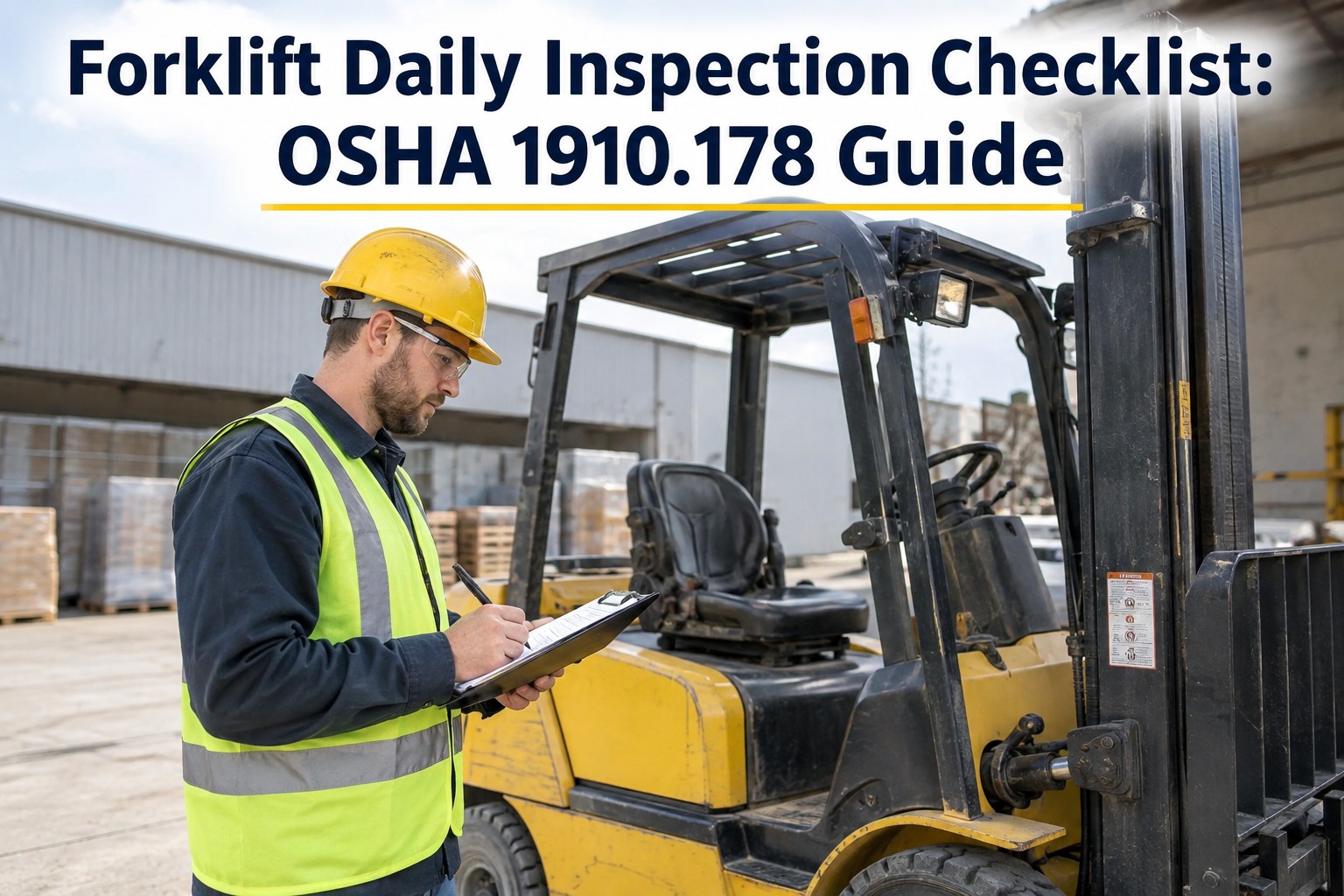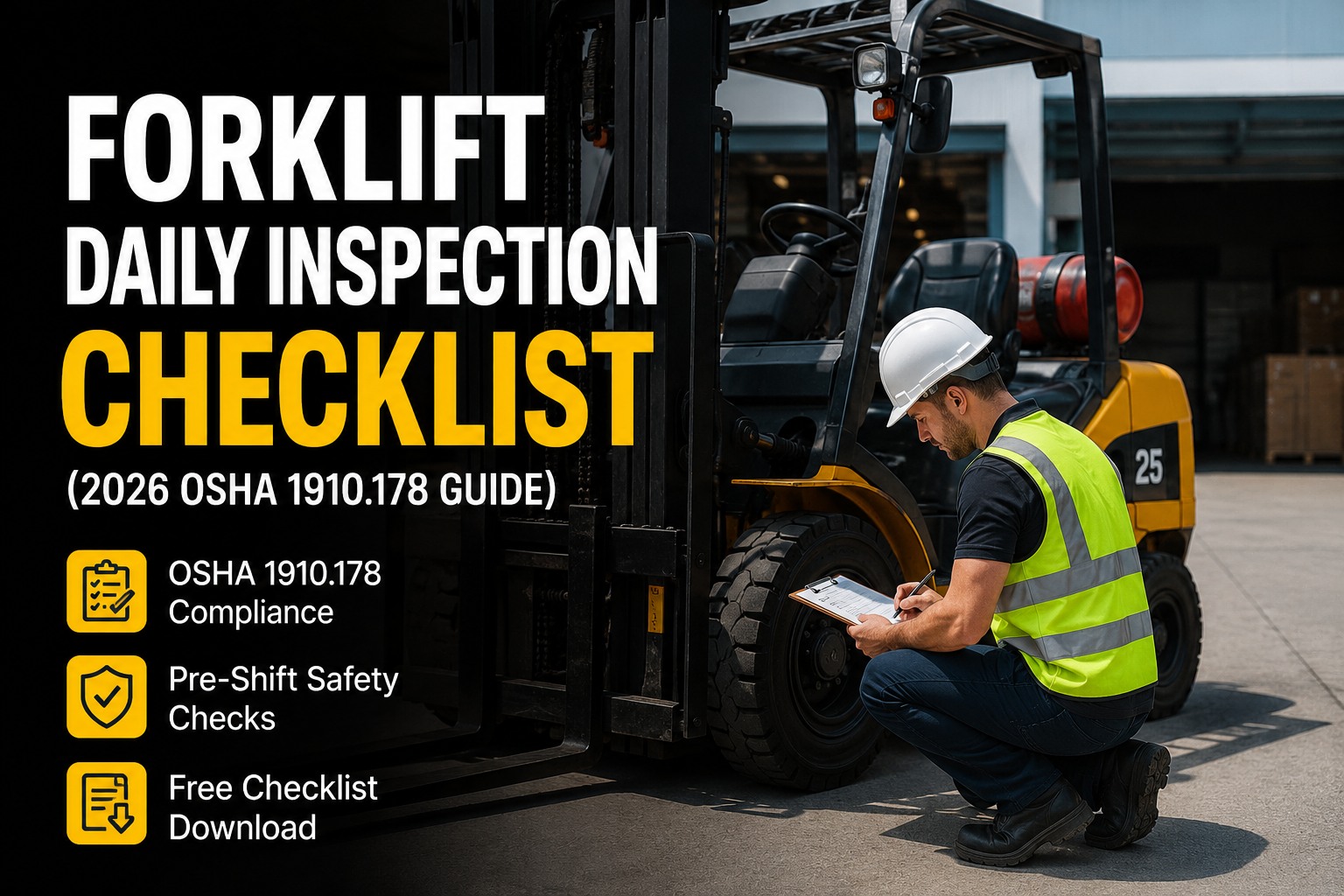
OSHA 1910.178(q)(7) says it in four sentences: examine every forklift before it goes to work, at least daily, after each shift on round-the-clock operations, and remove any unsafe truck from service immediately. Forklift accidents cause roughly 85 deaths and 34,900 serious injuries every year in the U.S., and powered industrial truck violations consistently rank in OSHA's top 10 most-cited standards. A pre-shift inspection takes 5 to 10 minutes. Skipping it costs fines up to $161,323 per willful violation. This is the complete forklift daily inspection checklist for 2026. Book a demo to digitize your forklift inspections.
Forklift Daily Inspection Checklist: OSHA 1910.178 Compliance in 5–10 Minutes
Three power types. One federal requirement. Know what to check on yours.
Every forklift inspection follows the same structure regardless of power type: engine-off walkaround first, power-system-specific checks second, operational test third. The checklist below covers all three phases with the power-type variations called out. Use the version that matches your fleet.
What OSHA 1910.178 Actually Requiresthe four sentences that drive the entire program
The regulation itself is 29 CFR 1910.178(q)(7): forklifts must be examined before being placed in service, at least daily. Round-the-clock operations require examination after each shift. Any condition adversely affecting safety means the truck is removed from service until corrected. Defects must be immediately reported. Federal OSHA doesn't explicitly require written inspection records — but virtually every safety attorney, insurance underwriter, and state OSHA plan recommends documented inspections because without records, you can't prove the inspection happened. Book a demo to see how HVI creates timestamped, signed inspection records automatically
Phase 1: Engine-Off Walkaroundbefore you turn the key — all power types
Start with the forklift off and the parking brake set. Walk a full circle around the truck, looking for anything that's different from yesterday. This phase catches the defects that are invisible once the engine is running.
Phase 2: Power-Type-Specific Checkselectric, propane, and diesel variations
Check battery charge level and electrolyte levels (flooded lead-acid). Inspect cables and connectors for corrosion, fraying, and loose terminals. Verify the battery restraint is secure — an unsecured battery can shift during braking or on ramps. Check for acid leaks or swelling. Inspect the charging connector for damage. Confirm the battery disconnect switch functions.
Check tank mounting bracket and retaining strap — the tank must be secure and not able to shift. Inspect the tank valve, hose, and fittings for leaks (use soapy water or a gas detector, never an open flame). Verify the tank is not past its recertification date (stamped on the collar). Check fuel gauge. Confirm adequate ventilation if operating indoors. Book a demo — HVI supports propane-specific inspection templates
Check engine oil level, coolant level, and fuel level. Inspect belts and hoses for cracks, fraying, and proper tension. Check the air filter indicator. Inspect the exhaust system for leaks and damage — OSHA 1910.178(q)(8) prohibits exhaust that emits hazardous sparks or flames. Verify the radiator cap is secure and no coolant leaks are present.
Phase 3: Operational Testengine on, controls verified, before entering the work area
With the engine or motor running and the forklift in an open area, test every control and safety device before moving into the work zone. This is where hidden defects — soft brakes, sluggish hydraulics, intermittent horn — reveal themselves.
Immediate Tag-Out Defectsconditions that require removing the forklift from service
OSHA 1910.178(q)(7) is explicit: a forklift found to be in unsafe condition must not be placed in service. These defects require immediate tag-out — no exceptions, no "run it until the end of the shift."
Service or parking brake fails to hold. Spongy pedal. Pulling to one side. Any brake deficiency is an immediate tag-out.
Visible leak from any cylinder or hose. Forks drift down under load. Mast tilts without operator input. Loss of load control.
Any visible crack at the heel or shank. Bent beyond manufacturer tolerance. Unequal tip height exceeding 3% of fork length.
Excessive play, binding, or no response. Steering that requires abnormal effort. Any steering defect creates an immediate tip-over and crush risk. Start free — tag-out triggers auto work orders in HVI
Paper vs. digital: why clipboard checklists fail
Completed from memory — operators check every box without walking around the forklift
Illegible or lost — handwritten forms degrade, get wet, or disappear before filing
No photos — no proof that the operator actually inspected anything
No timestamps — no evidence the inspection happened before the shift started
No follow-up — defects written on paper get filed, not fixed
Sequential walk-through — operators follow the physical inspection order on screen
Photo-required steps — camera capture at forks, mast, tires, and data plate proves the walkaround
Auto-timestamped + GPS — every inspection is signed, located, and time-verified
Defects auto-generate work orders — flagged items go directly to maintenance, not a filing cabinet
Instant retrieval — pull any inspection in seconds during an OSHA audit Book a demo
From a warehouse operations manager running 22 forklifts
We had an OSHA visit after a near-miss incident. The inspector asked for our last 90 days of forklift inspection records. We had a filing cabinet full of paper checklists — half of them illegible, a third missing entirely, and every single one checked "OK" on every line. The inspector noted that identical handwriting and timing patterns suggested operators were filling them out at the end of the shift, not the beginning.
Since moving to digital inspections with required photos, our completion rate went from about 60% to 98%. But the real change was that operators started actually finding defects — because walking the forklift with a phone forces the walkaround that the paper checklist never did. We caught a cracked fork heel on week two that would have been a catastrophic load drop.
Frequently asked questions
How often must forklifts be inspected under OSHA?
OSHA 29 CFR 1910.178(q)(7) requires that powered industrial trucks be examined before being placed in service, at least daily. When forklifts are used on a round-the-clock basis, they must be examined after each shift. The examination must occur before the forklift enters the work area, and any condition adversely affecting safety requires the truck to be removed from service until corrected. While federal OSHA does not explicitly require written inspection records, documenting every inspection is strongly recommended by safety professionals and insurance underwriters because without records, you cannot prove the inspection occurred during an OSHA investigation or audit.
What should be included in a forklift daily inspection?
A complete forklift daily inspection covers three phases. Phase 1 (engine off) includes forks (cracks, bends, unequal height), mast and lift chains (stretch, damage, lubrication), tires and wheels (cuts, wear, inflation, lug nuts), overhead guard (integrity and mounting), hydraulic system (fluid level and leaks), and data plate (present and legible per OSHA 1910.178(e)). Phase 2 covers power-type-specific items: battery, cables, and connectors for electric forklifts; propane tank, valve, hose, and fittings for LPG units; and oil, coolant, belts, air filter, and exhaust for diesel or gas units. Phase 3 (engine on) tests service and parking brakes, steering, lift and tilt controls, horn, lights, backup alarm, seatbelt, and all dashboard gauges and warning indicators.
What are the OSHA penalties for forklift inspection violations?
OSHA penalties for forklift violations can be substantial. Serious violations carry fines of up to $16,131 per violation. Willful or repeated violations can reach $161,323 per violation. In 2024, forklift-related OSHA citations totaled over $15 million in penalties across the United States. Powered industrial truck violations consistently rank among OSHA's top 10 most-cited standards. Common citation categories include failure to conduct daily inspections (1910.178(q)(7)), inadequate operator training (1910.178(l)), operating equipment in unsafe condition (1910.178(q)(1)), and failure to maintain equipment in safe operating condition. Each forklift found without a documented inspection can generate a separate citation.
When should a forklift be immediately removed from service?
A forklift must be immediately removed from service and tagged out when any of the following conditions are found during inspection: brake failure (service or parking brake does not hold properly), hydraulic leak or drift (forks drift down under load or mast tilts without input), cracked or bent forks (visible cracks at the heel or shank, tips differing in height by more than 3% of fork length), steering failure (excessive play, binding, or no response), damaged overhead guard (bent, cracked, or loose mounting), fluid leaks creating a fire or slip hazard, non-functional horn or warning devices, or any condition that could cause the forklift to tip, drop a load, or injure the operator or nearby workers. The forklift must not return to service until all defects are corrected by qualified maintenance personnel.
Can I digitize forklift inspections with a CMMS or inspection app?
Yes, and digital inspections solve the two biggest problems with paper forklift checklists: operators completing forms from memory without walking around the truck, and defects being documented but never reaching maintenance. A platform like HVI (Heavy Vehicle Inspection) lets you build separate inspection templates for electric, propane, and diesel forklifts, require photo capture at critical inspection points (forks, mast, data plate), enforce sequential completion so operators must follow the physical walkaround order, auto-generate work orders from flagged defects so nothing gets filed and forgotten, and store every inspection with timestamp, GPS, and digital signature for instant retrieval during OSHA audits. Digital inspections typically increase completion rates from 50 to 60% (common with paper) to over 95%, while also increasing the number of real defects caught before they cause incidents.
Every forklift, every shift: 5-minute inspection, permanent digital record
Build per-power-type inspection templates. Require photos. Flag defects. Auto-generate work orders. Store every inspection with timestamp, GPS, and signature. Pull any record in seconds for OSHA. Works on any phone or tablet. Live in under a week.
No credit card · No hardware · Works with any forklift brand or model