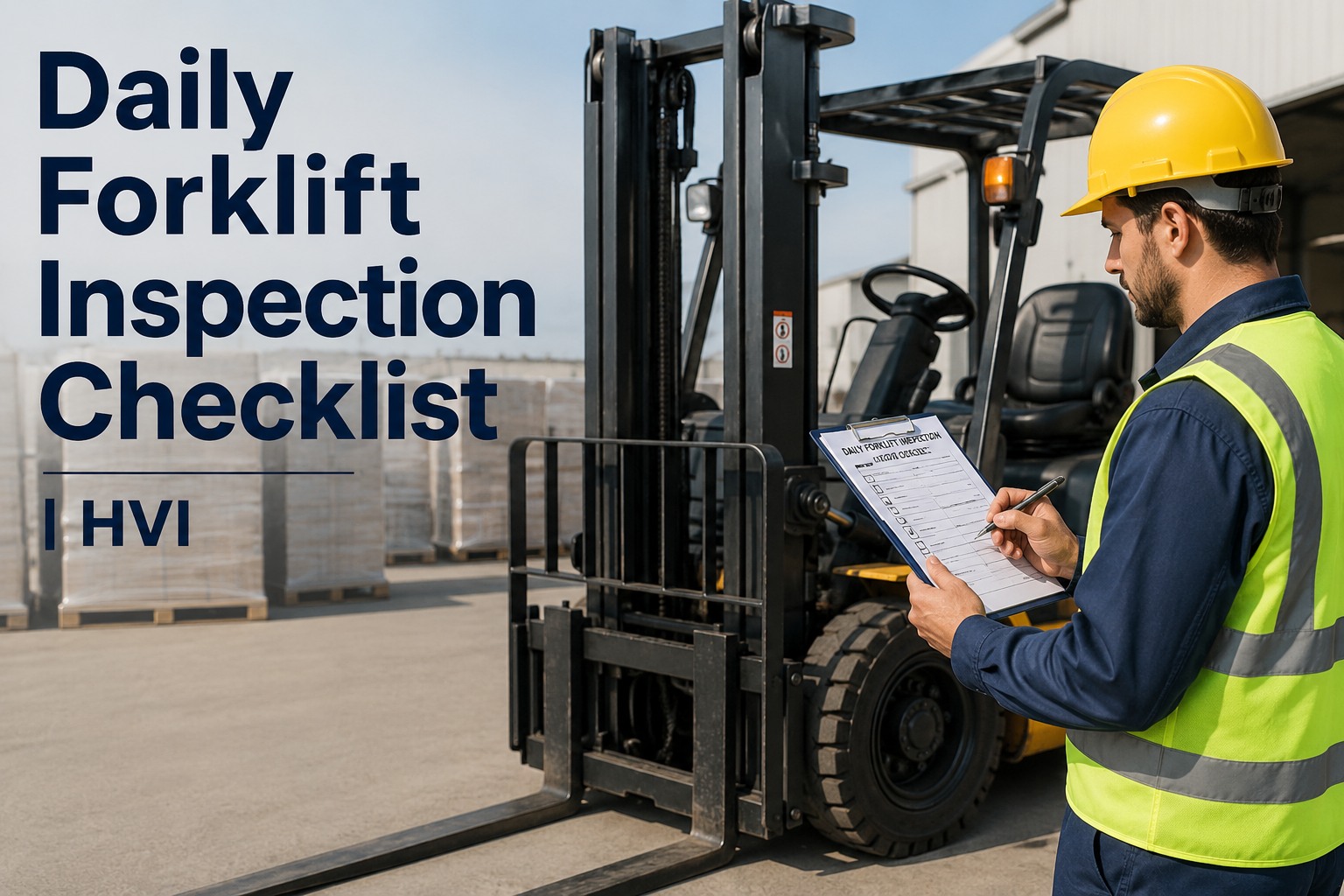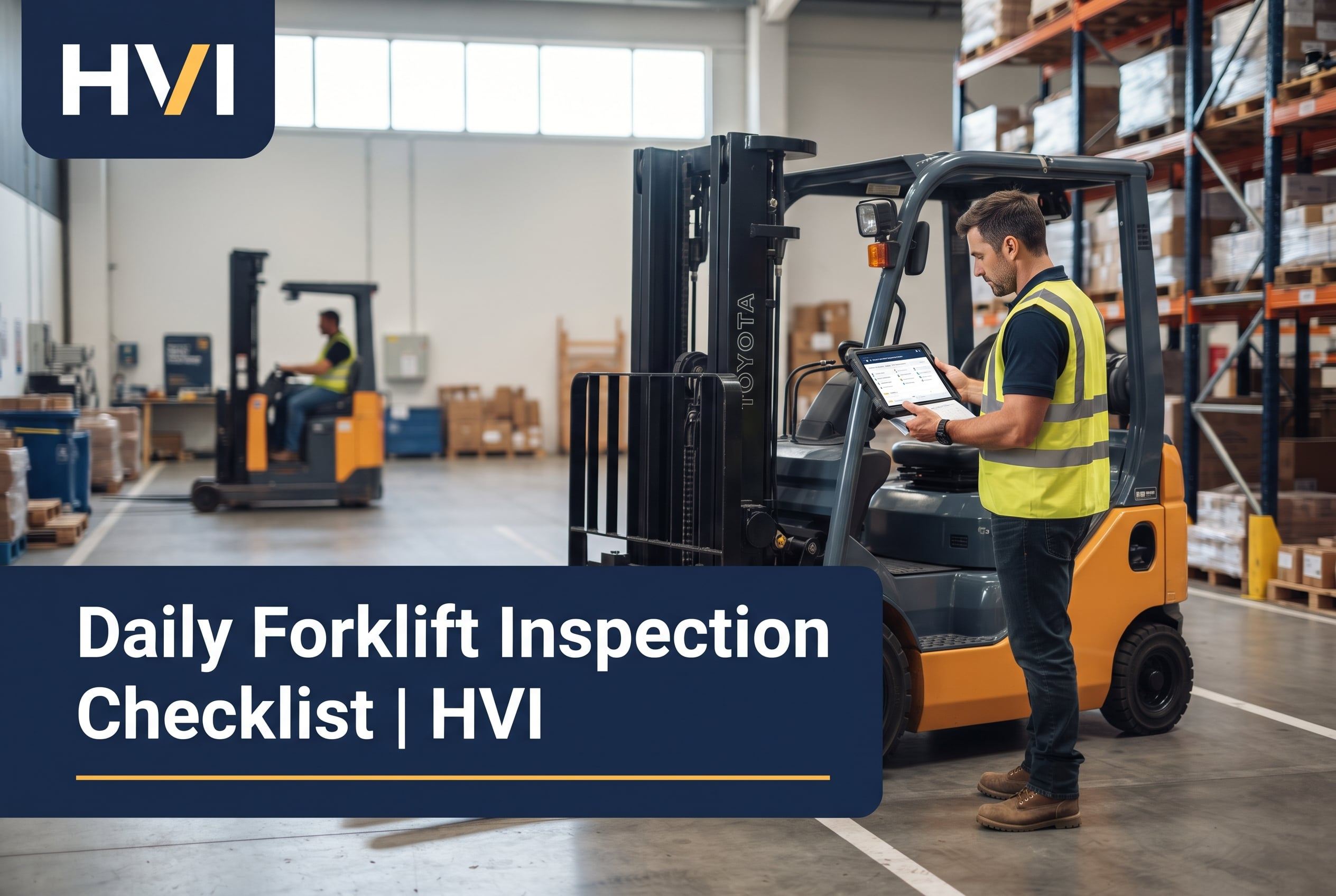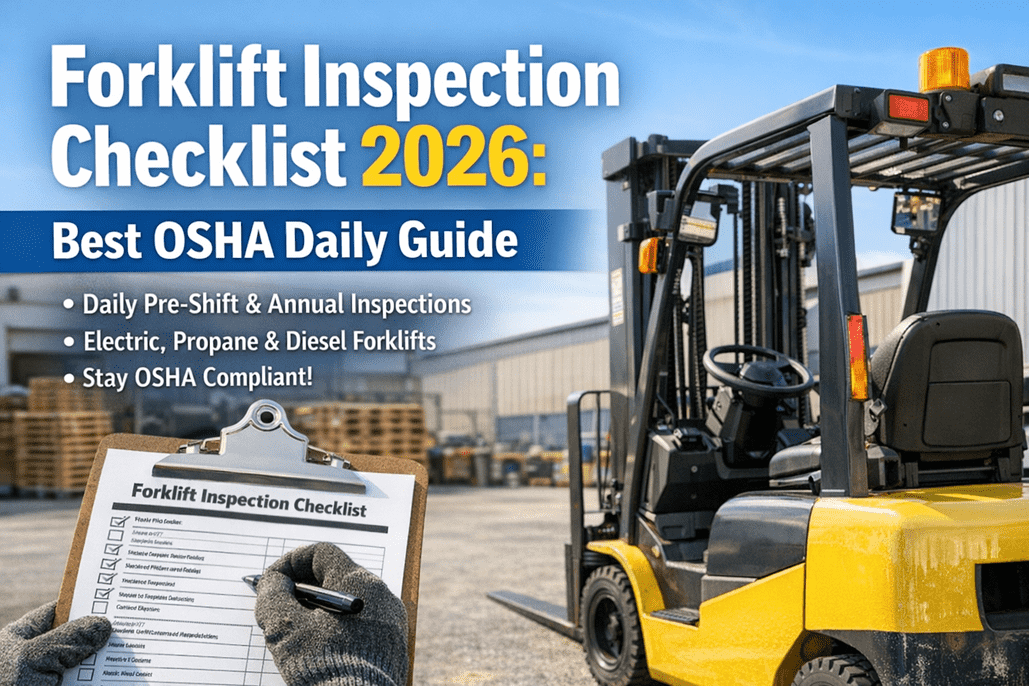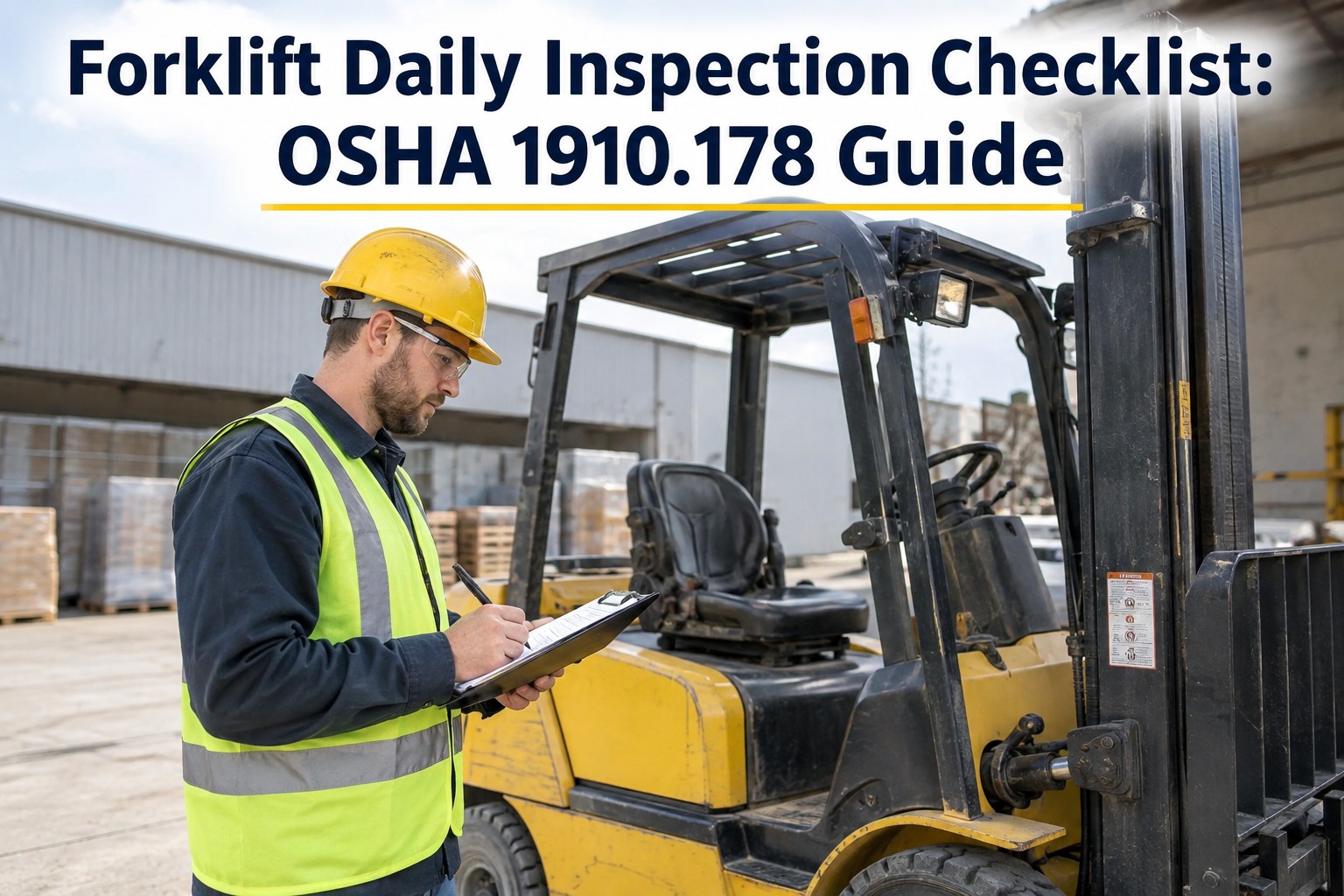
A forklift with a dead horn, a soft brake pedal, or a cracked lift chain doesn't announce itself — until an operator is mid-turn with a raised load and someone's walking behind it. That's the exact scenario OSHA 1910.178 exists to prevent, and it's why a forklift daily inspection checklist isn't paperwork; it's the last check before a two-ton machine goes to work around people. This guide covers what OSHA actually requires, a practical pre-shift checklist, and what to do after you find a defect. Book a demo to see forklift inspections and defect tracking run in HVI.
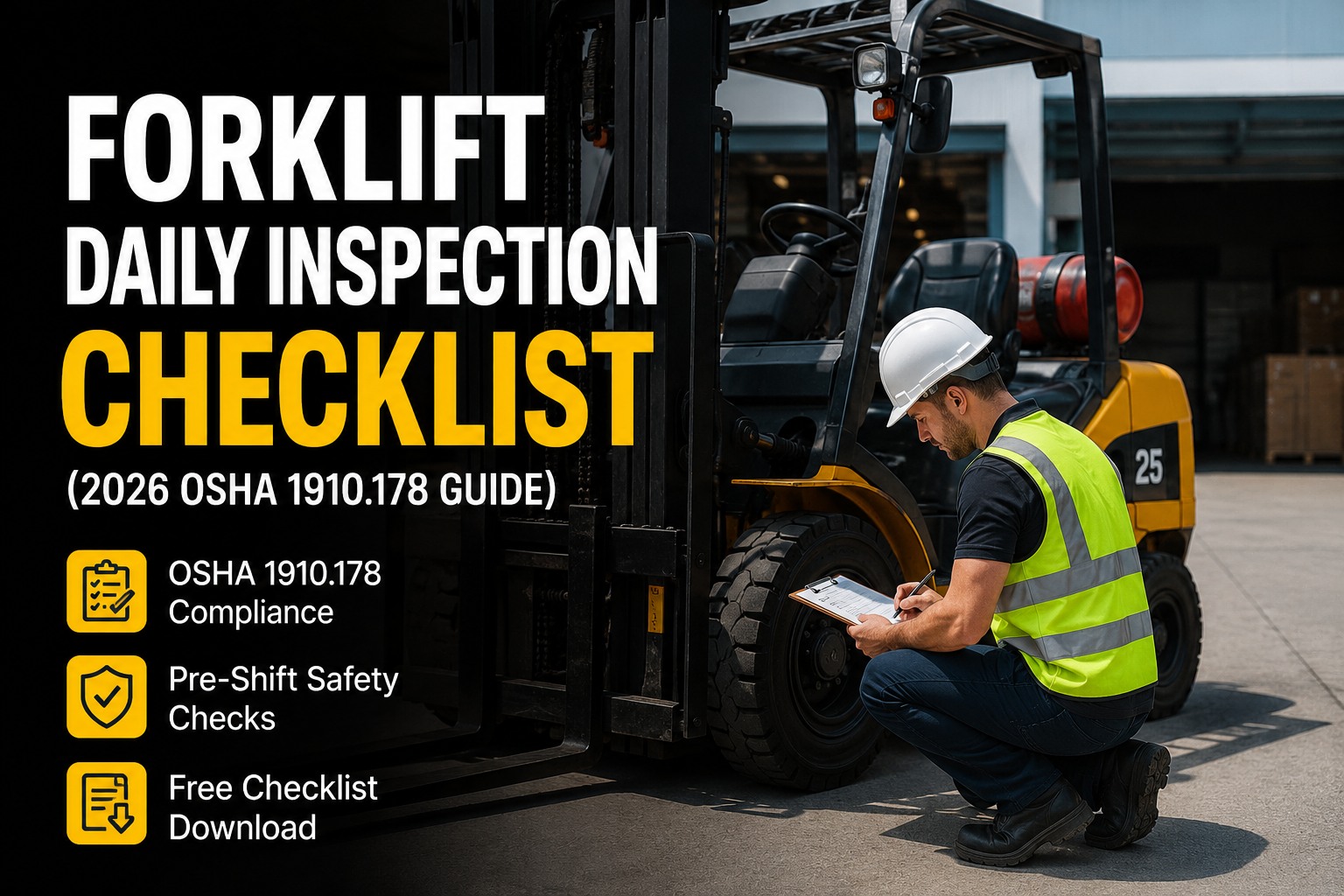
Forklift Daily Inspection Checklist & OSHA 1910.178
Powered industrial trucks must be examined before each use. Here's the OSHA requirement, a usable checklist, and the defect-to-correction workflow that actually keeps unsafe trucks parked.
Educational overview of OSHA 1910.178 — not OSHA compliance advice or certification. Verify specifics against the current standard for your operation.
OSHA's powered industrial truck standard, 29 CFR 1910.178, is one of the agency's most-cited standards year after year, and the reasons are consistent: missing or inadequate inspections, untrained operators, and unsafe trucks left in service. The good news is that the inspection requirement itself is simple to meet once you understand exactly what it says — and what it doesn't. Let's separate the actual rule from the common misconceptions, then turn it into a checklist and a workflow you can run every shift.
What OSHA 1910.178 actually requires
The core inspection rule lives in 1910.178(q)(7), and it's short. Getting it exactly right matters, because a lot of well-meaning safety content adds requirements OSHA never wrote.
Trucks must be examined before being placed in service and at least daily. Where trucks run round-the-clock, they're examined after each shift.
A truck must not be placed in service if the examination shows any condition adversely affecting the safety of the vehicle. Defects, when found, must be immediately reported and corrected.
OSHA doesn't require a particular checklist, but the employer is responsible for ensuring trucks are properly inspected — a checklist is simply the reliable way to do that.
Under 1910.178(q)(1), a truck not in safe condition is removed from service and repairs are made only by authorized personnel — the operator finds and reports, and doesn't improvise a fix.
That's the whole inspection backbone: check before use, don't run it if it's unsafe, report and fix defects, and leave repairs to authorized people. Notice what's not in the standard — a mandated form, a required signature format, or a universal retention rule for the daily check. Those are good practices, and often site policy, but it's worth distinguishing the actual regulation from recommended habits so your program is built on what the law says. Book a demo to run a compliant examination on every truck, every shift
The pre-start (engine-off) visual checks
A daily forklift inspection has two halves: what you check with the truck off, and what you verify with it running. Start with the walk-around, engine off. These are the common items — adjust for your specific truck type, attachments, and fuel source, since not every item applies to every machine.
The point of the engine-off pass is to catch the structural and fluid issues that a running-truck check can hide — a hairline fork crack, a weeping cylinder, a stretched chain. Any one of these is a "condition adversely affecting safety," which under the standard means the truck doesn't go into service until it's corrected. Start free on HVI to build a pre-start checklist matched to each truck class in your fleet.
The operational (engine-on) checks
With the pre-start pass done and no defects, start the truck and verify everything that only reveals itself in operation. Again, tailor the list to the equipment — an electric reach truck, an LPG sit-down, and a rough-terrain forklift won't share every control.
If every operational check passes, the truck is cleared for the shift. If any check fails, the truck stops right there — and what happens next is the part that actually determines whether your program works. Book a demo to guide operators through both inspection passes on a phone or tablet
The defect-to-correction workflow
This is what separates a real inspection program from a signature drill. Finding a defect is step one; the standard's requirement to report, remove from service, and correct is what actually protects people. Here's the full loop.
The operator spots a condition affecting safety during the pre-start or operational check.
An unsafe truck doesn't operate. It's tagged/flagged and taken out of service, not "run gently until it's fixed."
The finding is reported immediately and documented: which truck, what was found, who found it, when.
Authorized personnel repair the defect. The operator's role is find-and-report, not improvise a fix.
The repair is confirmed and the truck is restored to safe condition before it goes back to work — with the resolution documented.
The weak link in most operations is between steps 2 and 4: a defect gets noticed but the truck keeps running because removing it from service is inconvenient, or the report is a verbal "hey, the horn's out" that never reaches maintenance. A workflow that flags the truck's status and routes the defect to a tracked corrective action closes that gap — the truck can't quietly go back to work, and nobody has to remember to follow up. Book a demo to see safety-status blocking and corrective-action tracking together
Training & evaluation: the other half of 1910.178
Inspection keeps the truck safe; training keeps the operator safe. The two most-cited parts of 1910.178 are inspection and operator training, so a complete program has to cover both — and the training rule is widely misstated, so it's worth getting right.
Formal instruction plus practical training, tied to the specific truck type and workplace — no one operates until competent.
A qualified evaluator watches the operator run the actual truck in the actual work area and confirms safe operation.
Document the operator name, training date, evaluation date, and the evaluator's name — the record OSHA asks for first.
Each operator's performance is evaluated at least once every three years — an evaluation, not automatic full re-training on a calendar.
That last point is where a lot of content gets the law wrong. OSHA doesn't require blanket re-training every three years; it requires a performance evaluation at least that often, plus refresher training when specific triggers occur — an operator seen operating unsafely, an accident or near-miss, a failed evaluation, assignment to a different truck type, or a workplace change affecting safe operation. Building your program around the real triggers, not a calendar myth, keeps it both compliant and sane. Start free to keep operator certifications and evaluation dates alongside your inspection records.
From an EHS manager who tightened the loop
Our forklift inspections were a clipboard on each truck. Operators ticked the boxes, the sheets piled up, and honestly nobody looked at them until something went wrong. We had a reach truck with an intermittent brake issue get "inspected" fine three days running because ticking a box is easier than stopping production.
What changed things wasn't a better checklist — it was making a failed item actually flag the truck and open a corrective action nobody could ignore. Now an unsafe truck shows up red, it can't just keep working, and I can pull the full inspection and repair history on any unit in seconds when an auditor asks. The inspection finally connects to something.
The checklist is the start; the workflow is the control
A forklift daily inspection checklist matters because OSHA 1910.178 requires powered industrial trucks to be examined before being placed in service and at least daily — after each shift where trucks run round-the-clock — and prohibits operating any truck with a condition that adversely affects safety. A good pre-start visual pass and operational check, adapted to your specific truck types, attachments, and fuel sources, is how you meet that duty in practice. But the checklist is only the front half. The requirement to immediately report and correct defects, remove unsafe trucks from service, and have repairs done by authorized personnel is what actually protects the people working around these machines.
That's why the real control is the workflow, not the form: identify the defect, stop the truck, report and record it, correct it through authorized personnel, verify, and return to service with a documented history. And it sits alongside the other load-bearing half of 1910.178 — operator training, workplace evaluation, written certification, and a performance evaluation at least every three years. HVI is built to run exactly this: configurable forklift inspection templates by truck type, defect capture with safety-status blocking, corrective-action tracking, and searchable inspection and training records you can retrieve in seconds. HVI is an inspection and maintenance workflow platform, not an OSHA certification or a substitute for compliance advice — always verify current requirements against the OSHA standard and official guidance for your operation. Book a demo to digitize forklift inspections in HVI.
Frequently asked questions
How often does OSHA require forklift inspections?
Under OSHA 29 CFR 1910.178(q)(7), powered industrial trucks must be examined before being placed in service and at least daily. Where trucks are used on a round-the-clock basis across multiple shifts, they must be examined after each shift rather than just once a day. The standard also states that a truck must not be placed in service if the examination reveals any condition that adversely affects the safety of the vehicle, and that defects, when found, must be immediately reported and corrected. In practice this means the inspection happens at the start of each shift or work period, before the truck carries its first load, so that an unsafe condition is caught before the equipment operates around people. It's worth noting what the standard does not specify: OSHA does not mandate a particular checklist form, a required signature format, or a universal retention period for the daily examination itself. Those are common and sensible practices, and are often required by site policy, but they are recommended documentation practices rather than the literal text of the inspection requirement. The employer does, however, bear responsibility for ensuring trucks are properly inspected, which is why a consistent checklist is the practical way to demonstrate the examination was actually performed.
What should a forklift daily inspection checklist include?
A daily forklift inspection generally has two parts: an engine-off visual walk-around and an engine-on operational check. The pre-start visual pass commonly covers tires and wheels (wear, damage, pressure, missing lug nuts), fluid levels and any leaks under the truck, the forks (cracks, bends, heel wear, secure locking pins), the mast and lift chains (wear, kinks, uneven tension, bent rails), hydraulic hoses and cylinders (chafing, cracking, leaks), the overhead guard and load backrest, the capacity/data plate and warning decals, and the seat and restraint system where the truck is so equipped. The operational check, performed with the truck running, commonly covers the service and parking brakes, steering response, smooth lift and lower, tilt and any attachments, the horn and backup or motion alarms, and lights and gauges. Importantly, these items are a strong starting point, not a universal list: the specific things to inspect vary by truck type, installed attachments, fuel source such as electric or LPG or diesel, operating environment, and the manufacturer's requirements. An electric reach truck, an internal-combustion sit-down, and a rough-terrain forklift will not share every item. The right approach is to adapt the checklist to each truck configuration rather than applying one generic form to every powered industrial truck.
What should happen when a forklift defect is found?
The defect-handling requirement is where OSHA 1910.178 has real teeth, and it's the heart of an effective program. When an inspection reveals a condition that adversely affects safety, the truck must not be placed in or kept in service. Under 1910.178(q)(1), any powered industrial truck that is not in safe operating condition must be removed from service, and all repairs must be made by authorized personnel. So the correct sequence is: identify the defect during the inspection; stop and remove the truck from service rather than running it in a limited way; immediately report and document the finding, capturing which truck, what condition was found, who found it, and when; have the defect corrected by authorized personnel, since the operator's role is to find and report rather than to improvise a repair on a safety-critical component; and then verify the repair and restore the truck to safe operating condition before it returns to work, with the resolution documented. The most common failure point is the gap between finding a defect and actually removing the truck from service, where production pressure tempts a team to keep running a marginal truck. A workflow that flags an unsafe truck's status and routes the defect to a tracked corrective action closes that gap so an unsafe truck cannot quietly stay in service.
Does OSHA require forklift operators to be retrained every three years?
This is one of the most commonly misstated points in forklift compliance. OSHA does not require blanket re-training of every operator every three years. What 1910.178(l) actually requires is that an evaluation of each operator's performance be conducted at least once every three years — an evaluation, which is an assessment of whether the operator still operates the truck safely, not automatic full re-training on a fixed calendar. Separately, the standard requires refresher training when specific triggers occur: the operator is observed operating the truck unsafely, is involved in an accident or a near-miss, receives an evaluation showing they are not operating safely, is assigned to operate a different type of truck, or a condition in the workplace changes in a way that could affect safe operation. So the three-year item is a recurring evaluation, while refresher training is event-driven. On top of that, before an operator ever runs a truck, the employer must provide formal and practical training, evaluate the operator in the actual workplace on the actual truck type, and certify in writing, recording the operator's name, the training date, the evaluation date, and the evaluator's name. Building a program around the real evaluation-and-trigger structure, rather than a generic three-year retraining myth, is what keeps it both compliant and workable.
Can forklift inspections be done digitally instead of on paper?
Yes. OSHA 1910.178 requires that trucks be properly examined but does not mandate that the examination be recorded on paper or on any specific form, so a digital inspection fully satisfies the requirement as long as the examination genuinely happens and unsafe trucks are kept out of service. In fact, moving from paper to a configurable digital workflow addresses most of the weaknesses of clipboard inspections. A digital system can present a checklist tailored to each truck type and its attachments, require that an inspection actually be completed before a truck is used, capture the finding with a photo, and — critically — flag a truck's safety status so a failed unit cannot simply continue operating. It can route a defect straight to a tracked corrective action so the report doesn't die as a verbal comment, and it keeps a searchable history so you can instantly show which truck was inspected, when, by whom, what was found, and how each defect was resolved. That retrievable history is exactly what an OSHA compliance officer tends to ask for. A platform like HVI provides configurable forklift inspection templates, defect management with safety-status blocking, corrective-action tracking, and searchable records, while operating as an inspection and maintenance workflow tool rather than a substitute for OSHA compliance advice or certification.
Digitize forklift inspections and defect management in HVI
HVI runs the full loop: configurable forklift inspection templates by truck type, guided pre-start and operational checks, defect capture with safety-status blocking so unsafe trucks can't stay in service, corrective-action tracking, and searchable inspection and training records ready for any audit. An inspection-and-maintenance workflow platform, not a compliance-advice substitute. Mobile-first for the warehouse floor, live in under two weeks.
No credit card · Configurable forklift templates · Defect & safety-status tracking on day one