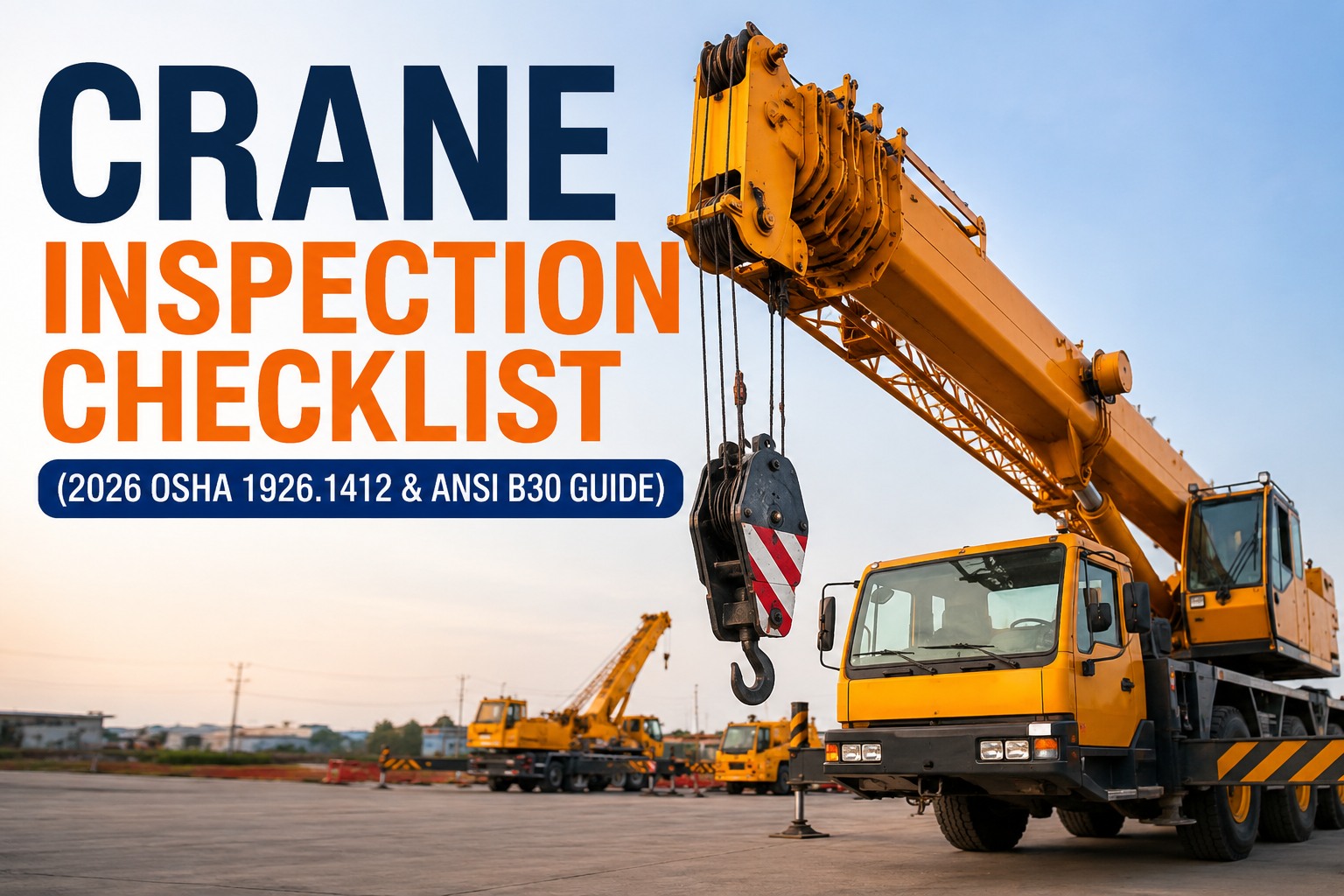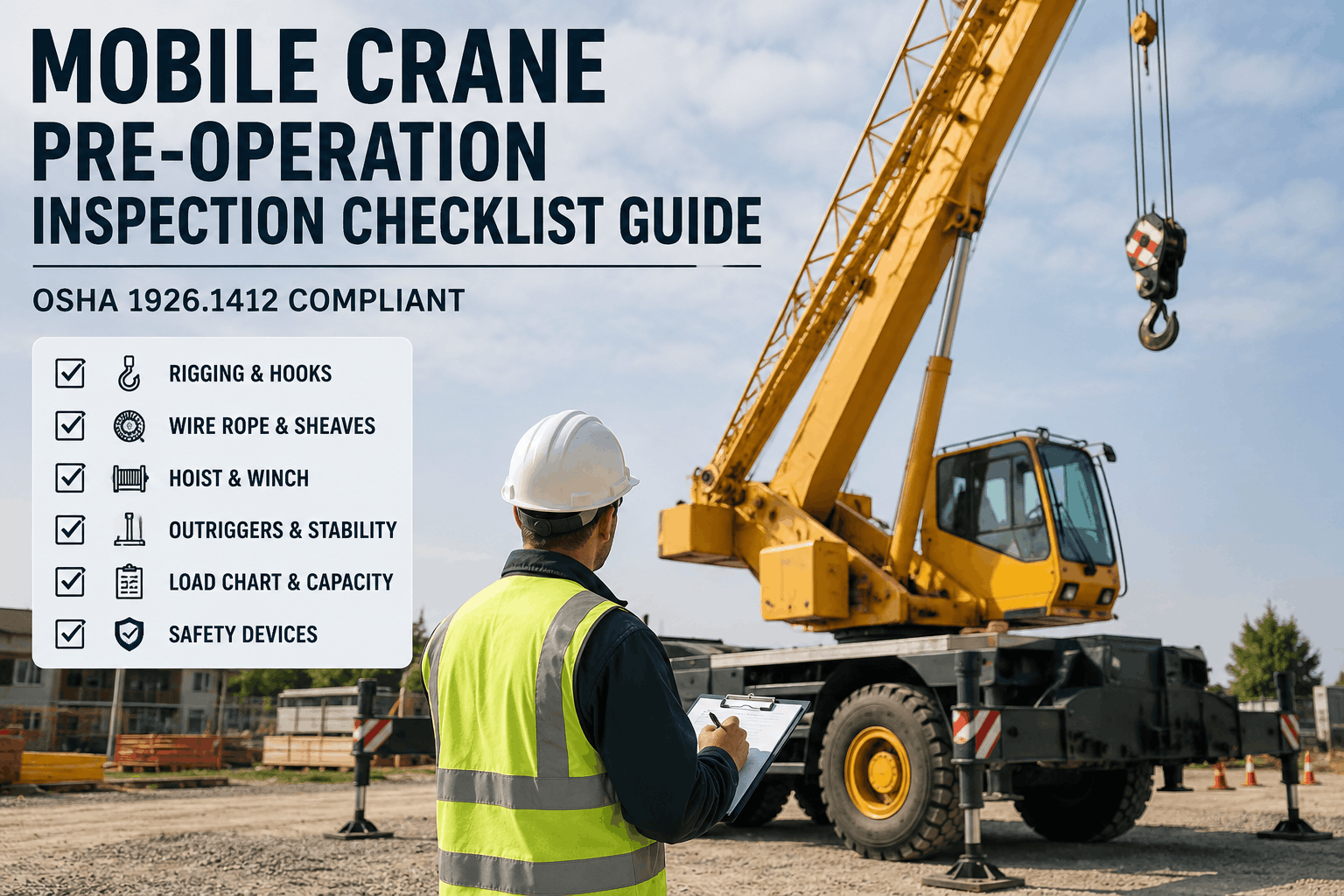
A crane inspection checklist without knowing which OSHA standard governs the crane is the setup for the most common compliance failure OSHA cites: applying general-industry criteria to a construction crane, or vice versa. Construction mobile cranes fall under 29 CFR 1926.1412 with a shift/monthly/annual tier structure. General-industry overhead cranes fall under 29 CFR 1910.179 with frequent/periodic terminology. Wire rope has its own standard, 1926.1413, with three-category removal criteria — book a demo to digitize crane inspections in HVI.
Which Standard Governs Your Crane?
Applying the wrong standard's inspection tiers is the most common compliance gap OSHA identifies. Start here.
OSHA 29 CFR 1926.1412
OSHA 29 CFR 1910.179 & 1910.180
OSHA 29 CFR 1926.1413
Most sites operate under more than one regime. A construction site with a permanent overhead crane in the yard shop needs both frameworks documented, per crane, per interval.
The rest of this page walks the shift/monthly/annual tier scope under 1926.1412, the wire-rope removal criteria that account for 27% of crane fatalities, the hook and rigging inspection points, and the qualified-vs-competent-person distinction that determines who can sign what. Book a 30-minute demo to see multi-tier crane inspection templates in HVI.
Shift, monthly, annual — the three-tier construction-crane cadence
Construction cranes under OSHA Subpart CC (1926.1412) require three parallel inspection tiers. Each tier has its own scope, its own qualified person, and its own documentation. Fold them together and one lapses silently — and the tier most commonly missing in audit is the monthly, not the shift or the annual.
Before each shift — 15 to 60 min
- Control mechanisms, brakes for excessive wear or leaks
- Hydraulic system for proper fluid level and leaks
- Hooks, latches for cracks, deformation, opening beyond spec
- Wire rope visual for apparent deficiencies (no untwisting)
- Safety devices & operator aids functional
- Signed by: competent person · Docs: recommended
In-depth — documented
- All shift items in more depth
- Rope inspection with attention to end connections
- Structural inspection (visible fatigue, cracks, distortion)
- Hydraulic hoses at wear points, cylinder rod condition
- Load-moment indicator & anti-two-block calibration
- Signed by: competent person · Docs: MANDATORY, retained
Comprehensive — qualified person
- Full structure: welds, pins, sheaves, drums, boom
- Hydraulics: load-hold test, hose age, filter status
- Wire rope full length including normally hidden sections
- All safety devices bench-tested
- Electrical continuity, insulation resistance where applicable
- Signed by: qualified person · Docs: MANDATORY, retained per 1926.1412(f)(7)
After specific triggers
- Post-assembly: after every erection, before use
- Post-repair: after any repair to load-bearing component
- Post-alteration: after modification affecting capacity or safety
- Post-overload: if load exceeds rated capacity, before next lift
- Post-incident: after any impact, collision, or unusual event
- Load test may be required per manufacturer or ASME B30
Every defect gets photo-documented, not verbally reported to the operator between shifts. The photo is the evidence the annual inspector will look at when preparing the yearly report, and the audit trail OSHA follows when investigating an incident. A missing shift-inspection photo record is often the first thing a CSHO asks for after an incident, and its absence turns the investigation adversarial fast. Book a demo to see how HVI captures shift observations with photos and defect flow to the shop.
Wire rope removal criteria — 27% of crane fatalities start here
Wire rope is the single component on a crane that directly suspends every load, and unlike most crane failures, wire rope failure offers no second chance. OSHA 1926.1413 organises the removal criteria into two categories: Category I conditions that must be evaluated by a competent person, and Category II thresholds that force immediate removal from service. Every threshold is measurable, not subjective.
| Defect | Threshold | Category | Action |
|---|---|---|---|
| Broken wires — mobile crane | 6 randomly distributed in one lay (ASME B30.5) | Cat II | Remove from service |
| Broken wires — overhead crane | 12 randomly distributed in one lay (ASME B30.2) | Cat II | Remove from service |
| Diameter reduction | > 5% from nominal diameter | Cat II | Remove from service |
| Kinking, birdcaging, crushing, core protrusion | Any occurrence — no threshold | Cat II | Remove immediately |
| Valley breaks | > 2 in one lay | Cat II | Remove from service |
| Severe corrosion | Per competent person evaluation | Cat II | Remove from service |
| Electric arc / heat damage | Any evidence | Cat II | Remove immediately |
| End connection wear / corrosion | Per manufacturer criteria | Cat I / II | Evaluate → may require removal |
Two operational rules that follow from the criteria: first, splicing wire rope is prohibited — a rope with a localized defect may be severed and the undamaged portion continued in use, but never spliced back together; second, when the rope is shortened, the drum must retain a minimum of two wraps of wire when the load or boom is at its lowest position. Rope lubricants that hinder inspection are prohibited. When a rope is removed from service under 1926.1413, the equipment or the specific hoist must be tagged out per 1926.1417(f)(1) until the rope is repaired or replaced. The tagged-out state is a hard stop, not a suggestion — and the tag itself must remain in place until the rope replacement is completed and verified by a competent person. Book a demo to see HVI apply the correct removal criteria per crane type.
Hook & rigging inspection — the second most cited category
After wire rope, hooks and rigging are the crane components with the highest citation frequency at OSHA inspection. The failure mode is direct: a hook that opens beyond spec releases the load; a rigging component that fails drops it. Every criterion below is measurable — visual "looks OK" is not an inspection under OSHA or ASME B30.
Cracks & deformation
Hook body inspected for cracks, gouges, nicks, or visible deformation. Magnetic particle or dye penetrant testing at annual per ASME B30. Any crack = immediate removal.
Throat opening
Measured against manufacturer spec. Typical threshold: 15% increase in throat opening from original = remove. Comparison against a new-hook reference measurement is the operational baseline.
Twist
Hook twist beyond 10 degrees from unloaded plane = remove from service. Twisted hooks indicate side-loading history and structural fatigue, and cannot be safely rehabilitated.
Latch & retention
Safety latch functional, closes fully, no missing hardware. Rigging shackles, slings, hooks each inspected before every lift per ASME B30.9 (slings) and B30.10 (hooks).
Rigging inspection is a separate discipline governed by its own ASME B30.9 (slings), B30.10 (hooks), and B30.26 (rigging hardware) standards. On a construction site, rigging inspection is performed by the qualified rigger before every lift and documented per site policy. OSHA 1926.251 covers rigging equipment for material handling. Chronic rigging issues almost always trace back to storage discipline — slings dragged across concrete, hooks stored on the ground, shackles thrown in a bin — not to overload events. A rigging storage cabinet with dedicated hooks and slings hung up rather than piled on a bench is one of the highest-ROI shop-organisation changes a lifting operation can make, and it shows up immediately in reduced defect rates at pre-lift inspection. Digital pre-lift inspection with photo-documented rigging status per lift produces the audit trail OSHA looks for after any incident, and turns the daily rigger check into an operational data point rather than a compliance box. Start a free HVI trial to load per-rigging-asset inspection templates against your fleet with photo evidence and defect flow.
Competent, qualified, designated — the three roles OSHA won't let you mix up
Different terms, different definitions, different scope of signing authority
OSHA and ASME use three distinct terms for the person authorised to inspect or evaluate crane equipment, and mixing them up creates compliance gaps that the CSHO will catch. A competent person under OSHA 29 CFR 1926.1401 is someone capable of identifying existing and predictable hazards in the surroundings or working conditions unsafe to employees, and is authorised to take prompt corrective measures to eliminate them. This is the person who performs shift and monthly inspections under 1926.1412. A qualified person is someone who by possession of a recognized degree, certificate, or professional standing, or who by extensive knowledge, training, and experience, has successfully demonstrated the ability to solve or resolve problems relating to the subject matter, the work, or the project. Qualified persons perform annual/comprehensive inspections under 1926.1412(f), and they perform inspections that require deeper technical evaluation than a competent person is qualified to make. A designated person under some ASME B30 standards is a person selected or assigned by the employer as being competent to perform specific duties, and is a narrower category than either of the above. Practical consequence: an inspector qualified to sign a monthly inspection is not automatically qualified to sign the annual, and a rigger designated to inspect slings is not automatically qualified to inspect the entire crane. The written inspection record must identify the inspector by name and demonstrate that person's qualification for that tier of inspection. Getting this wrong is one of the most consistent OSHA citations across crane operations, and the fix is administrative — document the qualification against the person against the tier, and only route the inspection to someone properly qualified for that tier.
A lifting supervisor on the audit that pulled every inspection record
We operate 8 mobile cranes and 3 overhead cranes across two industrial sites. OSHA came in after a near-miss on the yard — a rigging shackle failed at load, thankfully with no injury. Compliance officer pulled every inspection record for every crane going back 12 months. We produced them, but three findings hit us: monthly inspections on two cranes were signed by an operator without documented competent-person status; four wire rope inspections lacked the broken-wire counts required under 1926.1413; and the overhead crane records used the construction-crane framework (1926.1412) instead of general-industry 1910.179 — wrong standard entirely.
Full corrective plan: person qualification documented against every crane and tier; per-crane inspection templates that apply the right standard automatically; wire rope inspections require broken-wire counts and diameter measurements before submission. That was 14 months ago. OSHA came back last quarter for a follow-up, pulled the file for the same crane that had the finding — clean record for the intervening 12 months. Cost of the software over the year was less than the fine on one of the original three findings.
Frequently asked questions
What does OSHA require for crane inspection frequency?
Construction cranes under OSHA Subpart CC (29 CFR 1926.1412) require three inspection tiers. Shift inspection: performed by a competent person before or during each shift the crane is used — visual and functional check of operating mechanisms, hooks, wire rope, hydraulics, brakes, controls, and safety devices. Documentation is not federally required but strongly recommended as evidence of due diligence. Monthly inspection: performed by a competent person, more in-depth than the shift inspection, mandatorily documented and signed. This is the tier most commonly missing in OSHA audits. Annual/comprehensive inspection: performed by a qualified person, full teardown-level evaluation covering structure, welds, pins, sheaves, drums, hydraulics, controls, and safety devices, documented per 1926.1412(f)(7). Additional inspection is required after assembly, repair, alteration, overload, or any incident that could have affected the crane's safety. General-industry overhead cranes fall under 1910.179 with a "frequent" and "periodic" tier structure. Wire rope has its own separate standard, 1926.1413, applying to all cranes under Subpart CC. Verify current OSHA requirements and the manufacturer's specific instructions for the crane.
When must a crane wire rope be removed from service?
OSHA 1926.1413 and ASME B30 standards define specific removal criteria for crane wire rope. Broken wires: 6 randomly distributed broken wires in one rope lay on a mobile crane (per ASME B30.5), or 12 randomly distributed broken wires in one rope lay on an overhead crane (per ASME B30.2). Diameter reduction: rope diameter reduced by more than 5% from nominal — Category II removal under 1926.1413. Structural distortion: kinking, birdcaging, crushing, unstranding, or steel core protrusion between outer strands — any occurrence, no threshold, immediate removal. Valley breaks: more than 2 in one rope lay. Severe corrosion: per competent person evaluation. Electric arc or heat damage from any source: any evidence, immediate removal. Improperly applied or corroded end connections: evaluate per manufacturer criteria. When a rope is removed from service, the equipment or the specific hoist must be tagged out per 1926.1417(f)(1) until the rope is repaired or replaced. Splicing wire rope is prohibited — a localized defect may be corrected by severing the rope in two and continuing to use the undamaged portion, but splicing back together is not permitted. Approximately 27% of crane fatalities trace to load drops from rigging and cable failure, which is why the criteria are numeric and strictly enforced.
What is the difference between a competent person and a qualified person?
OSHA and ASME use three distinct terms for the person authorised to inspect crane equipment, and they are not interchangeable. A competent person under OSHA 29 CFR 1926.1401 is someone capable of identifying existing and predictable hazards in the surroundings or working conditions that are unsanitary, hazardous, or dangerous to employees, and who has authorisation to take prompt corrective measures to eliminate them. Competent persons perform shift and monthly inspections under 1926.1412(d) and 1926.1412(e). A qualified person is someone who by possession of a recognized degree, certificate, or professional standing, or who by extensive knowledge, training, and experience, has successfully demonstrated the ability to solve or resolve problems relating to the subject matter, the work, or the project. Qualified persons perform annual/comprehensive inspections under 1926.1412(f). A designated person under some ASME B30 standards is a person selected or assigned by the employer as being competent to perform specific duties — a narrower category. Practical consequence: an inspector qualified to sign a monthly inspection is not automatically qualified to sign the annual. The written inspection record must identify the inspector by name and demonstrate the person's qualification for that tier.
What should be on a crane hook inspection checklist?
Crane hook inspection covers four measurable criteria under ASME B30.10 and OSHA-applicable standards. Cracks and deformation: hook body inspected for cracks, gouges, nicks, or visible deformation. Magnetic particle or dye penetrant testing is performed at annual inspection intervals per ASME B30. Any crack requires immediate removal from service. Throat opening: measured against manufacturer specification. Typical threshold: 15% increase in throat opening from the original dimension requires removal, though the exact percentage varies by hook type and manufacturer. Comparison against a new-hook reference measurement is the operational baseline; a manufacturer's data plate or new-hook template is the standard reference. Twist: hook twisted more than 10 degrees from the unloaded plane requires removal. Twisted hooks indicate side-loading history and structural fatigue and cannot be safely rehabilitated. Safety latch and retention: latch functional, closes fully, no missing hardware or wear that prevents proper closure. Rigging shackles, slings, and hooks are separately inspected before every lift per ASME B30.9, B30.10, and B30.26. The rigging inspection is performed by the qualified rigger before each lift and documented per site policy. OSHA 1926.251 covers rigging equipment for material handling on construction sites.
Do crane inspections need to be documented?
Documentation requirements vary by inspection tier under OSHA 1926.1412. Shift inspections: documentation is not federally required, but is strongly recommended as evidence of due diligence in the event of an OSHA inspection or incident investigation. Most sites document shift inspections as a matter of policy, and the digital pre-shift walkaround with operator sign-off is standard practice on well-run operations. Monthly inspections: mandatory documentation under 1926.1412(e)(3). The record must be signed and dated by the competent person performing the inspection and retained. Annual/comprehensive inspections: mandatory documentation under 1926.1412(f)(7). The record must include crane serial number, inspection date, findings, corrective actions taken or required, and inspector name and qualification. All documents produced under 1926.1413 (wire rope) must be available during the applicable document retention period to all persons who conduct inspections under that section. Practical rule: document everything, sign everything, retain everything for at least the duration required by the applicable standard (typically the life of the crane for annual records, and per site policy for shift and monthly). Digital records with photo evidence per checkpoint are the operational standard most auditors now expect to see.
Every crane, every OSHA tier, every wire rope measurement — on one dashboard
HVI holds each crane's shift, monthly, and annual inspection cadence per asset, applies the correct standard-specific criteria (1926.1412 vs 1910.179 vs 1926.1413), fires 90/60/30-day alerts before each interval, captures broken-wire counts and diameter measurements against ASME thresholds, tracks defects into work orders, retains inspection certificates per OSHA retention requirements, and produces the audit-ready record OSHA actually inspects. Live in under two weeks. No hardware. No credit card.
Trusted by construction, industrial & utility fleets across USA, Canada, UK & Australia · Ready on day one