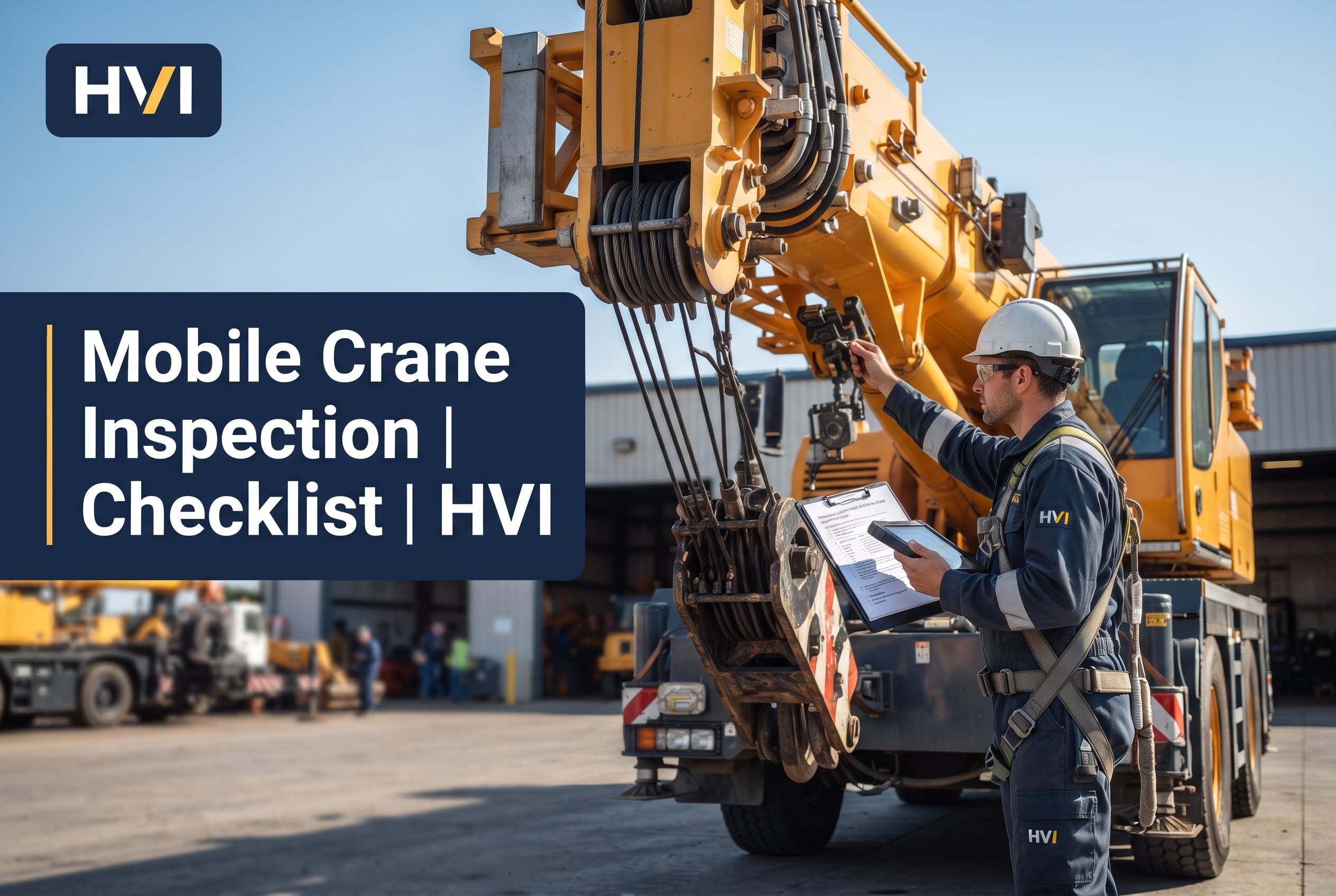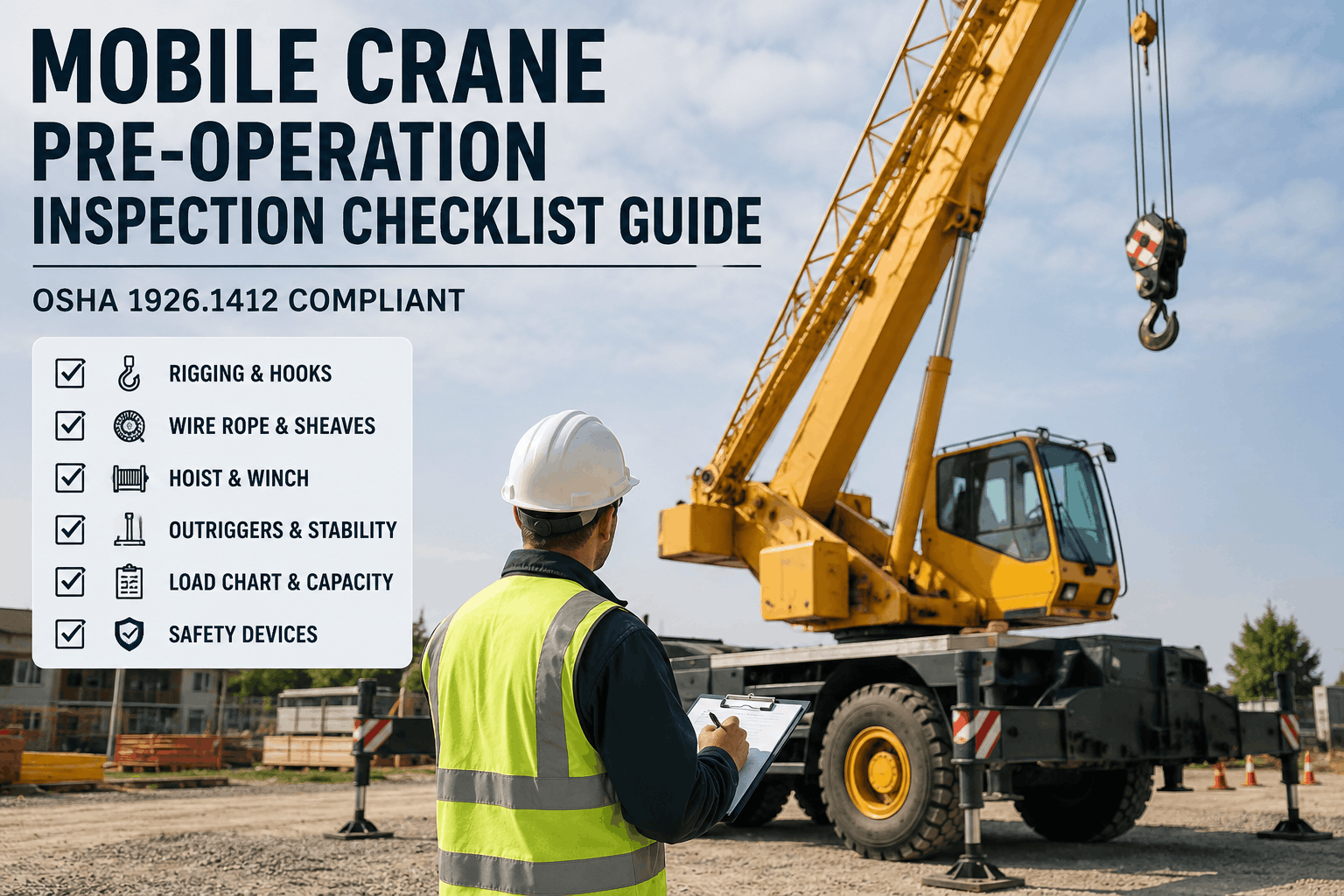
An average of 44 crane-related fatalities occur annually in the United States. Over 90% are caused by human error — and the single most common OSHA crane citation is a failed or missing inspection under 1926.1412. A willful violation now carries a penalty exceeding $165,000, and causing a worker's death through willful negligence can mean criminal prosecution with up to six months in prison. This is the complete crane inspection checklist for 2026, structured around OSHA's three-tier system. Book a demo to digitize every tier in one platform.
Crane Inspection Checklist: The 3-Tier System That Keeps Loads Off Workers
Each tier goes deeper. Each needs a different signer. Miss one and the next OSHA visit decides your future.
Tier 1: Shift Inspectionthe go/no-go check before the crane lifts anything — 1926.1412(d)
A competent person — typically the crane operator — performs a visual inspection before each shift the crane is used. If any item adversely affects safe operation, the crane does not work until corrected. This is a quick but critical pass across eight systems.
Tier 2: Monthly Inspectioneverything in Tier 1, plus deeper checks, fully documented — 1926.1412(e)
The monthly inspection covers the same systems in greater depth, with mandatory documentation: items checked, results, inspector's name and signature, date. Records retained for at least three months. Here's what the monthly adds beyond the shift check.
Tier 3: Annual Comprehensivequalified person required — NDT, load test, disassembly — 1926.1412(f)
The annual inspection is the deepest evaluation in the system. It requires a qualified person — someone with a recognized degree, certificate (NCCCO Crane Inspector), or extensive professional experience. This inspection may involve disassembly, non-destructive testing, and load testing. Records are retained at least 12 months; CMAA Specification 78 recommends lifetime retention.
Magnetic particle, ultrasonic, or dye penetrant testing of critical welds and structural connections. Required when the qualified person determines it's warranted. Catches internal fatigue cracks invisible to visual inspection.
Per manufacturer specifications or ASME B30. Verifies the crane handles rated capacity with appropriate safety margin. Typically required after major repair, modification, or structural concern. Book a demo — track annual inspection history per crane in HVI
Full inspection per 1926.1413: broken wire count per rope lay, diameter reduction, kinking, crushing, birdcaging, corrosion, heat damage, core protrusion. Qualified person determines replacement need.
Full calibration check of anti-two-block, load moment indicator, boom angle indicator, all limit switches and operational aids. Devices must respond within manufacturer tolerances under test load.
By Crane Typewhat changes for mobile, overhead, and tower cranes
Mobile Crane (OSHA 1926.1412 + ANSI B30.5)
Outrigger/stabilizer condition and deployment verification at every setup. Ground bearing capacity assessment. Boom condition including telescoping sections. Travel lock engagement when relocating under load. Load chart verification for current boom length, angle, and radius. Counterweight confirmation. Swing lock and house lock function. LMI calibration for current configuration. In Canada and Australia, mobile crane inspections follow CSA Z150 and AS 2550 respectively, with similar tiered requirements.
Overhead / Gantry Crane (OSHA 1910.179 + ANSI B30.2)
Runway rail alignment and condition. Bridge and trolley travel limit switches. Hoist limit switches (upper and lower). Pendant control condition and function. Collector shoes or festoon cable system. Bridge and trolley wheel condition. End stops and bumpers. Runway beam deflection. General industry cranes under 1910.179 use "frequent" (daily to monthly) and "periodic" (1 to 12 months) inspection tiers rather than the construction shift/monthly/annual system.
Tower Crane (OSHA 1926.1412 + ANSI B30.3)
Mast bolt torque and alignment. Slewing ring and bearing condition. Jib and counter-jib connections. Trolley and trolley rail. Climbing frame and collar (for climbing cranes). Foundation bolt torque and grout condition. Anti-collision system function (multi-crane sites). Weathervaning capability when out of service. Tower cranes are subject to additional local building code requirements in most U.S. jurisdictions. Start free — build tower-crane-specific inspection templates in HVI
Wire Rope: Its Own StandardOSHA 1926.1413 removal criteria — separate from the crane inspection
Wire rope has its own OSHA standard (1926.1413) with specific inspection schedules and removal criteria. A rope that passes a visual shift check can still be past its removal threshold based on broken wire count, diameter loss, or internal deterioration.
Removal triggers: Broken wires meeting count criteria per rope lay · Diameter reduction exceeding limits · Kinking, crushing, or birdcaging · Core protrusion · Evidence of heat damage · Severe corrosion affecting strength · Any condition a qualified person determines warrants replacement
From a safety manager running 14 cranes across 6 construction sites
We had an OSHA inspection after a tower crane incident on a neighboring site. The inspector asked for shift, monthly, and annual records on all 14 cranes across our 6 projects. Paper system: annuals filed by crane number, monthlies in a binder at each site, shift inspections on clipboards in the cabs — half rained on, a third incomplete, two cranes with no monthly records for 60 days.
Since moving to digital, every crane has a complete record chain in one system, retrievable by serial number in 15 seconds. The last OSHA visit took 20 minutes for records instead of three hours. But the real win was catching a hook throat opening at 12% on a monthly that shift checks hadn't flagged — before it hit the 15% replacement threshold. Book a demo
Frequently asked questions
How often must cranes be inspected under OSHA?
OSHA 29 CFR 1926.1412 requires construction cranes to be inspected at three tiers. A shift inspection by a competent person must occur before each shift the crane is used. A monthly inspection must be documented, signed, dated, and retained for at least three months. An annual comprehensive inspection by a qualified person must occur at least every 12 months, may include non-destructive testing and load testing, and records must be retained for 12 months. General industry overhead and gantry cranes under 1910.179 follow a similar two-tier system with frequent (daily to monthly) and periodic (1 to 12 months) inspections. Cranes must also be inspected after any event that could affect safe operation, including repairs, modifications, and incidents.
Who can perform crane inspections under OSHA?
OSHA defines two qualification levels. A competent person (1926.32(f)) can identify existing and predictable hazards and has the authority to take corrective action. This is sufficient for shift and monthly inspections, and the crane operator typically qualifies. A qualified person (1926.32(m)) has a recognized degree, certificate, or professional standing, or can demonstrate through extensive knowledge and experience the ability to evaluate equipment. This higher bar is required for annual comprehensive inspections. NCCCO Crane Inspector certification is the most widely recognized credential satisfying the qualified person requirement. Employers must keep documentation of each inspector's credentials and scope of qualification.
What crane inspection records must be kept and for how long?
Shift inspections under 1926.1412(d) do not require written documentation unless a deficiency is found. Monthly inspections under 1926.1412(e) must include items checked, results, inspector name and signature, and date, with records retained for at least three months. Annual inspections under 1926.1412(f) require the same documentation elements and must be retained for at least 12 months. CMAA Specification 78 (2025 revision) recommends retaining annual inspection and load test records for the entire service life of the crane. Incomplete records missing any required element are treated as missing records during OSHA audits. Each missing record can generate a separate citation.
What are the penalties for crane inspection violations?
As of 2025, the maximum OSHA penalty for a serious crane violation is $16,550. A willful or repeated violation carries a maximum of $165,514 per violation, with a minimum of $11,823. These amounts are adjusted annually for inflation. OSHA commonly issues multiple citations per crane incident, so the total penalty for a single event can reach six figures. When a willful violation causes a worker's death, criminal prosecution is possible with up to six months in prison and a $10,000 fine for a first conviction, doubling to one year and $20,000 for a second conviction. Crane inspection violations are the single most cited crane-related OSHA finding, accounting for more citations than the next two categories combined.
Can I digitize crane inspections for OSHA compliance?
Yes. A platform like HVI (Heavy Vehicle Inspection) lets you build separate templates for shift, monthly, and annual inspections per crane type (mobile, overhead, tower), require photo capture at critical points (hooks, wire rope, structural connections), track inspector qualifications and certification dates, auto-retain records for OSHA-required durations (3 months for monthly, 12 months for annual), auto-generate lockout work orders from flagged defects, and retrieve any inspection by crane serial number in seconds during an OSHA audit. Digital inspections solve the three biggest paper-system problems: records scattered across multiple sites, incomplete documentation treated as missing during audits, and defects documented but never reaching maintenance.
44 fatalities a year. 90% human error. The inspection is the last line.
Build per-crane templates for every tier. Require photos. Track credentials. Auto-retain records. Auto-lock defective equipment. Pull any record in seconds. Works on any phone, at any site, for any crane type. Live in under a week.
No credit card · No hardware · OSHA-ready from day one